
1.2.36 Zeichen und Weisungen der Polizeibeamten
👮 Wie regelt die Polizei den Verkehr, was bedeuten ihre Zeichen – und warum geht das, was der Polizist sagt, immer vor? Das schauen wir uns hier an.
🧠 Was gilt zuerst?
1. Polizeibeamte
Gehen allem anderen vor
2. Ampeln
Gehen Verkehrszeichen vor
3. Verkehrszeichen
Gehen den Grundregeln vor
4. Rechts vor links
Die Grundregel
🚦 Die Zeichen des Polizeibeamten
Brust oder Rücken zu Ihnen
Sehen Sie die Vorder- oder Rückseite des Beamten, heißt das: Halt. Sie warten.
Seitlich zu Ihnen
Sehen Sie den Beamten von der Seite, dürfen Sie vorsichtig weiterfahren.
Arm hochgehoben
Das heißt: Achtung, gleich wechselt die Freigabe. Sie halten an und bereiten sich auf die Weiterfahrt vor. Wer schon in der Kreuzung ist, muss sie räumen.
🚓 „BITTE FOLGEN“ auf dem Streifenwagen
📢 Was das bedeutet
- Die Polizei will Sie anhalten.
- Sie müssen dem Polizeifahrzeug folgen – das gilt auch, wenn Ihnen jemand aus dem Fahrzeug vor Ihnen die „Polizeikelle“ zeigt.
- Sie dürfen das Polizeifahrzeug nicht überholen.
- Hält das Polizeifahrzeug an, halten Sie auch an.
⚠ Für wen gilt das?
„BITTE FOLGEN“ gilt nur für das Fahrzeug direkt hinter dem Streifenwagen – also für Sie, wenn er vor Ihnen eingeschert ist.
⚠ Typische Situationen an der Kreuzung
🚗 Rechts abbiegen
Steht der Beamte seitlich zu Ihnen, dürfen Sie fahren und vorsichtig rechts abbiegen.
↩ Links abbiegen
Fahren Sie vorsichtig in die Kreuzung ein und achten Sie auf die nächsten Zeichen des Polizeibeamten.
🚦 Und die Ampel?
Regelt ein Polizist den Verkehr, gelten seine Zeichen – nicht die Ampel und nicht die Vorfahrtschilder.
👀 Trotzdem aufpassen
Auch wenn die Polizei den Verkehr regelt: Achten Sie weiter auf Fußgänger, Radfahrer und andere Fahrzeuge.
📚 Zum Merken
| Haltung des Polizisten | Bedeutung | Was Sie tun |
|---|---|---|
| Brust oder Rücken zu Ihnen | Halt | Anhalten und warten |
| Seitlich zu Ihnen | Freie Fahrt | Vorsichtig fahren |
| Arm hochgehoben | Achtung, Wechsel | Warten, Kreuzung räumen |
🎯 Tipps für die Prüfung
- Polizist geht vor Ampel und Schild
- Brust oder Rücken = Halt
- Seite = Fahren
- „BITTE FOLGEN“ müssen Sie befolgen
- Nach der Ampel statt nach dem Polizisten fahren
- „BITTE FOLGEN“ nicht beachten
- Zu schnell über die Kreuzung fahren
- Fußgänger übersehen
Übungsfragen (11)
-
Frage 1 von 11
Ein Polizeibeamter regelt auf einer Kreuzung den Verkehr, obwohl die Ampeln in Betrieb sind. Was gilt?
1.2.36-0014 Punkte -
Frage 2 von 11
Welche Bedeutung haben Weisungen von Polizeibeamten?
1.2.36-0034 PunkteErklärung
The driver must always follow the signs and instructions of police officers. Other arrangements and rules, such as traffic lights or traffic signs, are put last. However, the road user must not neglect due diligence.
-
Frage 3 von 11
Welches Verhalten ist richtig?
1.2.36-0044 Punkte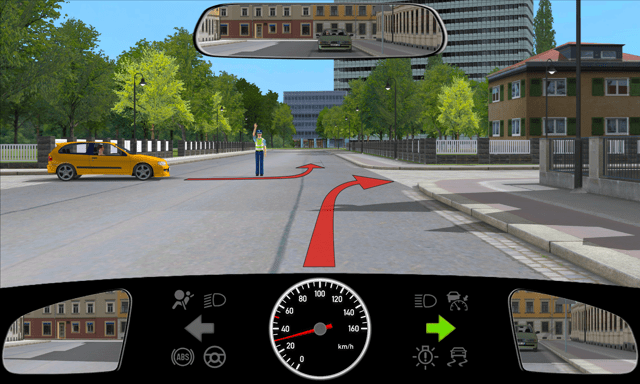
Erklärung
The police officer gives the traffic instructions by his body position and with specific arm movements. A raised arm means: The drivers waiting at the intersection are not allowed to continue driving, previously locked drivers should prepare for the onward journey. For this, the policeman spreads his arms from the body or puts them on the body, depending on the instructions. If the police officer stands with his chest to the driver, the driver must stop. If the police officer stands sideways and the driver sees his profile, the driver may continue driving at a moderate speed.
-
Frage 4 von 11
Im Rückspiegel sehen Sie auf dem Dach eines unmittelbar hinter Ihnen fahrenden Streifenwagens in roter Leuchtschrift „STOP POLIZEI“. Für wen gilt dies?
1.2.36-0073 PunkteErklärung
Since the request is displayed to the front and you are directly front of the police car, the request is addressed to you. You are required by law to follow the instructions from police officers.
-
Frage 5 von 11
Ein Polizeifahrzeug überholt Sie und schert unmittelbar vor Ihnen ein. Auf dem Dach erscheint in roter Leuchtschrift „BITTE FOLGEN“. Wie müssen Sie sich verhalten?
1.2.36-0113 PunkteErklärung
The signal "PLEASE FOLLOW" always applies to the driver directly behind the police car. So, you have to follow the instructions of the police, drive after the officers and stop behind the police car as soon as it stops.
-
Frage 6 von 11
Ein Polizeifahrzeug überholt Sie und schert unmittelbar vor Ihnen ein. Auf dem Dach erscheint in roter Leuchtschrift „BITTE FOLGEN“. Für wen gilt dies?
1.2.36-0123 PunkteErklärung
The signal "PLEASE FOLLOW" on a police car applies to the vehicle immediately behind the police, in this case for you. The police may stop you for traffic control. Follow the police vehicle and stop when it stops.
-
Frage 7 von 11
Aus einem unmittelbar vor Ihnen fahrenden Fahrzeug wird Ihnen mit der „Polizeikelle“ Zeichen gegeben. Was bedeutet dies?
1.2.36-0133 PunkteErklärung
Basically, the driver who drives directly behind the police car has to follow the signal given by the police. If this is recognizable, the police signaling disc may also apply to drivers in front. You must not overtake the police car and you have to follow it.
-
Frage 8 von 11
Wie verhalten Sie sich jetzt richtig?
1.2.36-0144 Punkte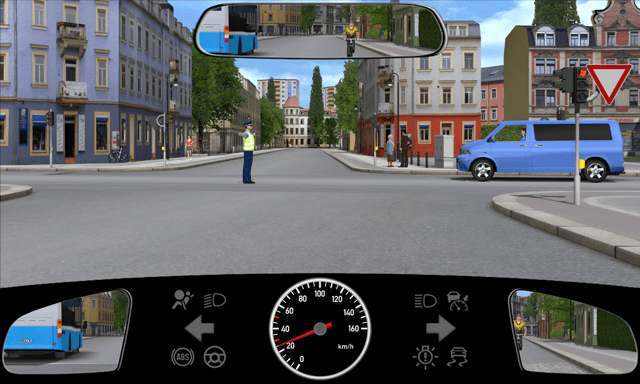
Erklärung
The police officer is hierarchically first in the right-of-way. Basic rule "right before left", traffic signs and light signals have no effect at this moment. Nevertheless, be attentive because other road users could still behave incorrectly.
-
Frage 9 von 11
Wer darf zuerst fahren?
1.2.36-0154 Punkte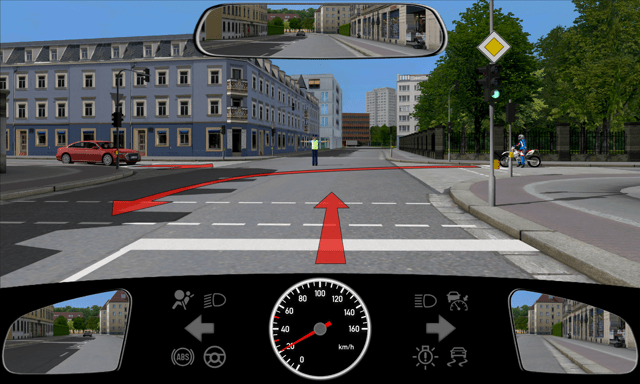
Erklärung
The traffic is regulated by the police so that the red car is allowed to drive first.
-
Frage 10 von 11
Was ist in dieser Situation richtig?
1.2.36-0164 Punkte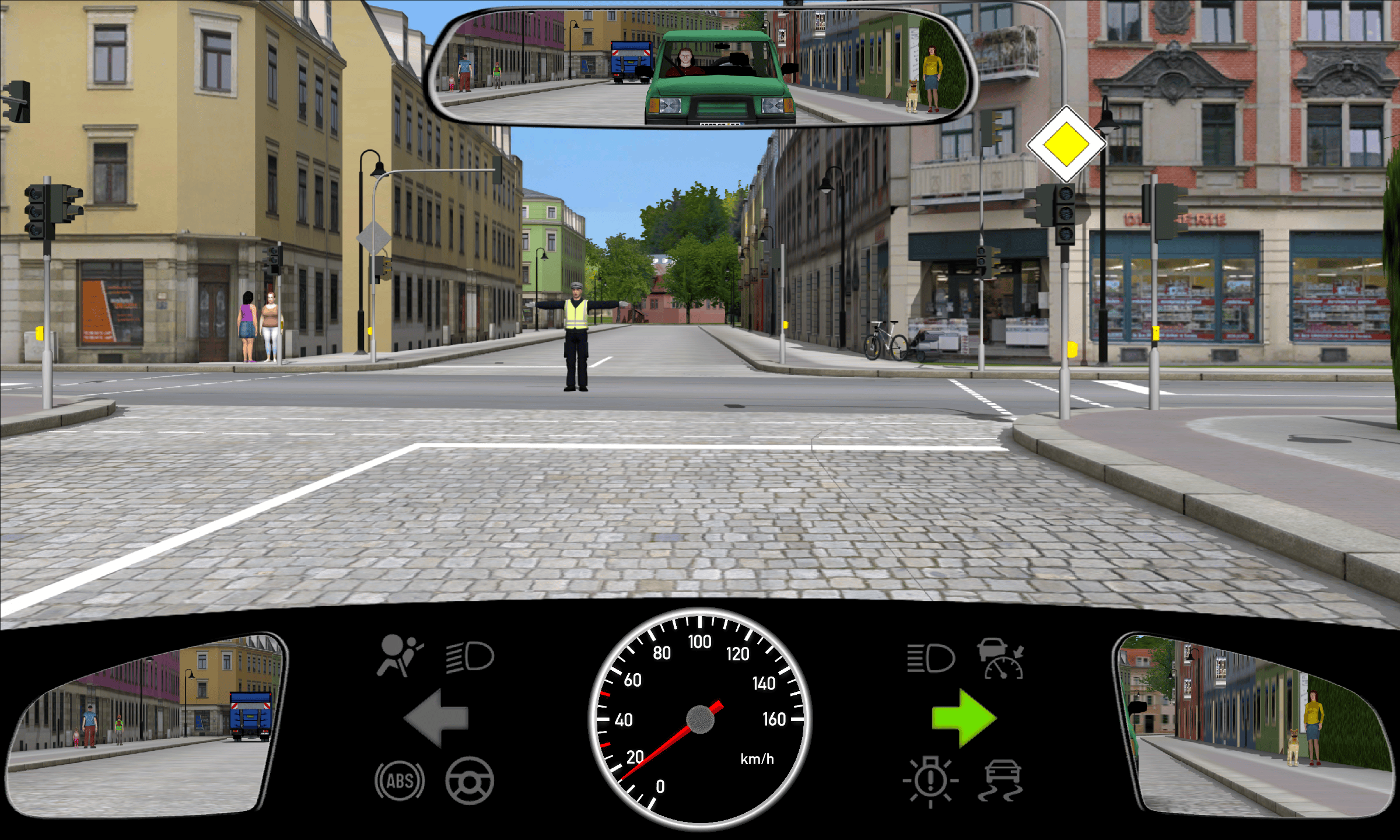
Erklärung
If a traffic police officer is directing traffic, the instructions must be followed. In this situation, the traffic policeman stands in front of you, facing you and with his arms outstretched. This means that you have to wait at the intersection and vehicles from the right and left have the right of way.
-
Frage 11 von 11
Was gilt hier?
1.2.36-1014 Punkte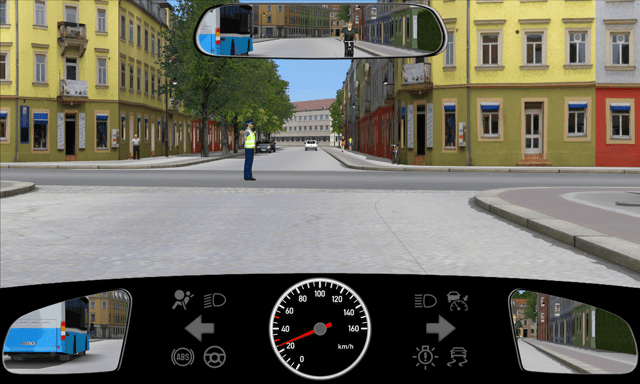
Erklärung
The traffic policeman's gesture dictates the behavior in traffic. If the officer stands lengthways to your direction of travel and you can see his profile, you can continue and turn right. Right-turning drivers should cross the intersection quickly, as long as no pedestrian or cyclist approaches them. If you want to turn left, enter the intersection to ensure undisturbed traffic flow and wait for the policeman's instructions.