
1.02 Form of state, federal states and welfare state
The test is held only in German. This lesson explains everything in your language and shows the German terms in brackets – learn them, because exactly these words appear in the test.
In this lesson you learn what form of state (Staatsform) Germany has, how the federal states (Bundesländer) are organised and what a welfare state (Sozialstaat) is. You also learn about the symbols of the state.
Germany is a republic and a democracy
The form of state (Staatsform) describes who is at the head of a state. Germany is a republic (Republik). This means: there is no king and no prince. So Germany is not a monarchy (Monarchie), not a principality (Fürstentum) and not a dictatorship (Diktatur).
The Basic Law (Grundgesetz) says: Germany is a democratic and social federal state (demokratischer und sozialer Bundesstaat). Germany is also a state under the rule of law (Rechtsstaat). Germany is not a socialist (sozialistisch) state and not a communist (kommunistisch) state.
In a democracy (Demokratie), the people decide. For example, the people who are allowed to vote (das wahlberechtigte Volk) elect the members of the Bundestag (Abgeordnete des Bundestages). The military, the economy or the administration do not elect them. Our democracy includes:
- regular elections (regelmäßige Wahlen)
- freedom of opinion (Meinungsfreiheit)
- different parties (verschiedene Parteien)
Press censorship (Pressezensur) is not part of it. Censorship (Zensur) means: the state controls and bans texts before they are published. This does not exist in Germany.
Often no party has a majority in parliament on its own. Then several parties work together and form a government together. This cooperation is called a coalition (Koalition). A parliamentary group (Fraktion) is something different: it is the group of members of parliament from one party.
The three branches of state power and religion
The power in the state is divided into three areas. These areas are called the branches of state power (staatliche Gewalten):
- law-making (Gesetzgebung) (parliament makes the laws)
- government and administration (Regierung und Verwaltung) (they carry out the laws)
- the courts and their judgments (Rechtsprechung) (the courts decide cases)
The press (Presse) is not a branch of state power. It is free and independent of the state.
In Germany, the state and religious communities are separate (Staat und Religionsgemeinschaften sind voneinander getrennt). The state does not depend on a religion. The religious communities also do not form the state.
A federal state with 16 federal states
A federal state (Bundesstaat) is a state that is made up of several states. Germany has 16 federal states (Bundesländer), for example Nordrhein-Westfalen, Mecklenburg-Vorpommern and Sachsen-Anhalt. Alsace-Lorraine (Elsass-Lothringen) is not a federal state. This region belongs to France today.
Germany is not a centralised state (Zentralstaat). In a centralised state, only the government in the capital decides. Germany is also not a confederation of states (Staatenbund). A confederation of states is a loose union of independent states.
Each federal state has its own parliament and its own government (eigene Regierung). But a federal state has no army of its own, no currency of its own and no foreign minister of its own. These are tasks of the federal level (Bund).
In most federal states, the head of the state government (Landesregierung) is called the Minister-President (Ministerpräsident or Ministerpräsidentin). Only the city states (Stadtstaaten) Berlin, Hamburg and Bremen use other names, for example mayor (Bürgermeister). There, the ministers are called senators (Senatoren).
The welfare state
Germany is a welfare state (Sozialstaat). This means: the state makes sure that people in need get help. This applies, for example, in case of illness, in old age or in case of unemployment.
For this there is social insurance (Sozialversicherung). Health insurance (Krankenversicherung) is a part of it. It creates social security (soziale Sicherheit). Car insurance (Autoversicherung) or liability insurance (Haftpflichtversicherung) is not part of it.
Social insurance is paid mainly with social security contributions (Sozialabgaben). This is money that employees and employers pay every month. Church taxes (Kirchensteuern), donations (Spenden) or club fees (Vereinsbeiträge) do not pay for social insurance.
Most working people (Erwerbstätige) in Germany are employed by a company or a public authority (Behörde). Working people are people who work for money. Only a small part is self-employed (selbstständig) with their own company.
The symbols of the state

The coat of arms (Wappen) is the official sign of the state. The heraldic animal (Wappentier) of Germany is the eagle (Adler). The federal coat of arms (Bundeswappen) shows a black eagle with red claws and a red beak on a golden-yellow shield.
Do not confuse the federal coat of arms with other signs. The coat of arms of the former GDR (DDR) shows a hammer and a compass in a wreath of ears of grain. A cross with wide ends is the sign of the German armed forces (Bundeswehr). The lion, the bear and the horse are not the heraldic animal of the federal state.
The German national anthem (Nationalhymne) begins with the words „Einigkeit und Recht und Freiheit“ (Unity and justice and freedom). Other songs are wrong. „Freude schöner Götterfunken“ belongs to the European anthem (Europahymne). „Deutschland einig Vaterland“ comes from the anthem of the GDR.
Key points to remember
- Germany is a republic (Republik), not a monarchy (Monarchie).
- Germany is a democratic and social federal state (demokratischer und sozialer Bundesstaat).
- Germany has 16 federal states (Bundesländer). Alsace-Lorraine (Elsass-Lothringen) is not one of them.
- Each federal state has its own government. Its head is usually called the Minister-President (Ministerpräsident).
- The people who are allowed to vote (das wahlberechtigte Volk) elect the members of the Bundestag.
- Press censorship (Pressezensur) is not a feature of our democracy. The press (Presse) is not a branch of state power.
- When parties work together to form a government, this is called a coalition (Koalition).
- The state and religious communities (Religionsgemeinschaften) are separate.
- Social insurance (Sozialversicherung) is paid with social security contributions (Sozialabgaben). Health insurance (Krankenversicherung) creates social security.
- The heraldic animal is the eagle (Adler). The anthem begins with „Einigkeit und Recht und Freiheit“ (Unity and justice and freedom).
Important German words
- die Republik – the republic
- A state without a king or queen at its head.
- der Bundesstaat – the federal state
- A state that is made up of several states.
- das Bundesland – the federal state (one of the 16)
- One of the 16 parts of Germany, with its own parliament and its own government.
- der Ministerpräsident – the Minister-President
- The head of government in most federal states.
- die Koalition – the coalition
- The cooperation of parties in order to govern together.
- der Sozialstaat – the welfare state
- A state that helps people in case of illness, old age or unemployment.
- die Sozialabgaben – social security contributions
- Payments from employees and employers for social insurance.
- die Zensur – censorship
- When the state controls and bans texts or reports.
- das Wappen – the coat of arms
- The official sign of a state or a federal state.
Read the lesson first, then practise the official questions in German.
Practice Questions (20)Practice Questions (20)
-
Question 1 of 20
Welches ist das Wappen der Bundesrepublik Deutschland?
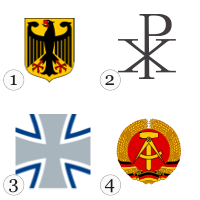
-
Question 2 of 20
Was für eine Staatsform hat Deutschland?
-
Question 3 of 20
In Deutschland sind die meisten Erwerbstätigen …
-
Question 4 of 20
Wie viele Bundesländer hat die Bundesrepublik Deutschland?
-
Question 5 of 20
Was ist kein Bundesland der Bundesrepublik Deutschland?
-
Question 6 of 20
Deutschland ist …
-
Question 7 of 20
Deutschland ist …
-
Question 8 of 20
Wer wählt in Deutschland die Abgeordneten zum Bundestag?
-
Question 9 of 20
Welches Tier ist das Wappentier der Bundesrepublik Deutschland?
-
Question 10 of 20
Was ist kein Merkmal unserer Demokratie?
-
Question 11 of 20
Die Zusammenarbeit von Parteien zur Bildung einer Regierung nennt man in Deutschland …
-
Question 12 of 20
Was ist keine staatliche Gewalt in Deutschland?
-
Question 13 of 20
Welche Aussage ist richtig? In Deutschland …
-
Question 14 of 20
Was ist Deutschland nicht?
-
Question 15 of 20
Womit finanziert der deutsche Staat die Sozialversicherung?
-
Question 16 of 20
Welche Maßnahme schafft in Deutschland soziale Sicherheit?
-
Question 17 of 20
Wie werden die Regierungschefs / Regierungschefinnen der meisten Bundesländer in Deutschland genannt?
-
Question 18 of 20
Die Bundesrepublik Deutschland ist ein demokratischer und sozialer …
-
Question 19 of 20
Was hat jedes deutsche Bundesland?
-
Question 20 of 20
Mit welchen Worten beginnt die deutsche Nationalhymne?