
1.06 Right to vote and electoral system
The test is held only in German. This lesson explains everything in your language and shows the German terms in brackets – learn them, because exactly these words appear in the test.
In this lesson you learn the rules for elections in Germany. After it you will understand the right to vote, the two votes and the 5 % threshold.
Why we vote
Germany is a democracy (Demokratie). The people decide who represents them in parliament. Regular elections have an important function: the majority of voters can change the government (die Regierung wechseln) if they want to.
Taking part in elections is a right (Recht), not a duty (Pflicht). Nobody has to vote. But it is good to use this right.
There are two kinds of right to vote (Wahlrecht):
- Active right to vote (aktives Wahlrecht): you may vote. If you may vote in the Bundestag election, you have the active right to vote.
- Passive right to vote (passives Wahlrecht): you may be elected, for example as a member of parliament (Abgeordneter).
The principles of elections (Wahlgrundsätze)
Elections in Germany follow fixed principles. Principles are important rules. The elections are general (allgemein), direct (unmittelbar), free, equal and secret (frei, gleich und geheim).
- Free (frei): every person decides without pressure if they vote and who they vote for.
- Equal (gleich): every vote counts the same. It does not matter if someone is a man or a woman, poor or rich.
- Secret (geheim): nobody may know who you voted for.
In the past, some countries had unfair election systems. With the census suffrage (Zensuswahlrecht) or the three-class franchise (Dreiklassenwahlrecht), rich people had more influence. For a long time, only men were allowed to vote. This no longer exists in Germany today.
Who is elected?
In the federal election (Bundestagswahl) the people elect the parliament for Germany (Parlament für Deutschland). So the people directly elect the Bundestag. The people who sit in parliament are called members of parliament (Abgeordnete).
The people do not elect other offices directly. The Bundestag elects the Federal Chancellor (Bundeskanzler). The Federal Convention (Bundesversammlung) elects the Federal President (Bundespräsident). The state parliament (Landtag) elects the Minister-President (Ministerpräsident) of a federal state.
In a town or municipality (Gemeinde) there is a mayor (Bürgermeister). The mayor is the head of a municipality (Oberhaupt einer Gemeinde).
The party that gets the most votes (die meisten Stimmen) wins the election. Who voted for whom, for example men or workers, does not matter.
The election system: two votes
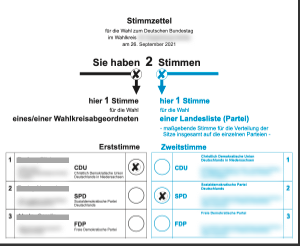
The election system in Germany is a mix of majority voting and proportional representation (Mehrheits- und Verhältniswahlrecht). That is why you have two votes on one ballot paper (Stimmzettel) in the Bundestag election.
- With the first vote (Erststimme) (left column) you vote for a person from your constituency (Wahlkreis). Here majority voting (Mehrheitswahl) applies: the person with the most votes wins the constituency.
- With the second vote (Zweitstimme) (right column) you vote for a party. Here proportional representation (Verhältniswahl) applies: a party gets as many seats as matches its share of the votes.
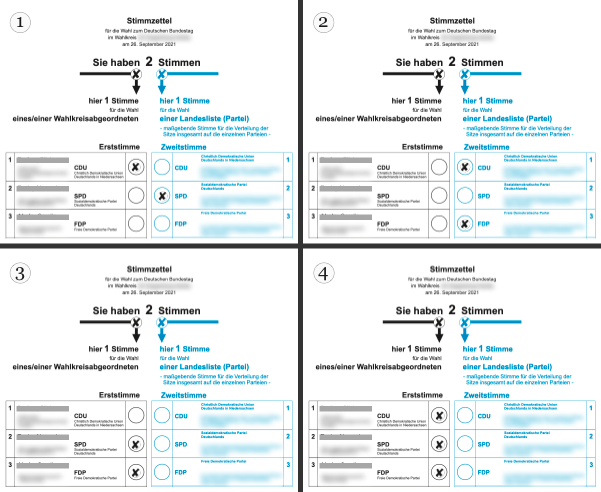
A ballot paper is valid (gültig) if you make one cross in the left column and one cross in the right column. If you make two or more crosses in one column, this vote is invalid (ungültig).
The 5 % threshold (5 %-Hürde)
A party must get at least 5 % of the second votes (Zweitstimmen) to enter the Bundestag. This minimum share of votes (Mindestanteil an Wählerstimmen) is called the 5 % threshold (5 %-Hürde).
Why is there this rule? If there are very many small parties in parliament, it is hard to form a government with a stable majority. The 5 % threshold is meant to make forming a government (Regierungsbildung) easier.
Before the election
Some weeks before the election, everyone who may vote gets a polling card from the municipality (Wahlbenachrichtigung von der Gemeinde). It tells you when and where you can vote. You do not need permission from the Federal President (Bundespräsident).
Open to everyone: Makkabi sports clubs
In Germany there are about 40 Jewish Makkabi sports clubs (Makkabi-Sportvereine). All people (alle Menschen) may become members there. You do not have to be Jewish, religious, German or Israeli.
Key points to remember
- Voting is a right (Recht), not a duty (Pflicht).
- Active right to vote (aktives Wahlrecht): you can vote. Passive right to vote (passives Wahlrecht): you can be elected.
- Elections are free, equal and secret (frei, gleich und geheim). Free means: you decide without pressure if you vote and who you vote for.
- The people elect the Bundestag, the parliament for Germany. Its members are called members of parliament (Abgeordnete).
- The election system is a mix of majority voting and proportional representation (Mehrheits- und Verhältniswahlrecht).
- Valid ballot paper (gültiger Stimmzettel): one cross on the left and one cross on the right.
- 5 % threshold (5 %-Hürde): minimum share of second votes for the Bundestag. It makes forming a government (Regierungsbildung) easier.
- Before the election, the polling card (Wahlbenachrichtigung) comes from the municipality (Gemeinde).
- Elections make a change of government (Regierungswechsel) possible, as the majority wants.
- The mayor (Bürgermeister) is the head of a municipality. Makkabi clubs are open to all people.
Important German words
- das aktive Wahlrecht – the active right to vote
- The right to vote in an election.
- das passive Wahlrecht – the passive right to vote
- The right to be elected in an election.
- der Abgeordnete / die Abgeordnete – the member of parliament
- A member of parliament who was elected by the people.
- die Erststimme – the first vote
- The vote for a person from your own constituency.
- der Stimmzettel – the ballot paper
- The paper on which you make your crosses in the election.
- die 5 %-Hürde – the 5 % threshold
- A party needs at least 5 % of the second votes to enter the Bundestag.
- die Wahlbenachrichtigung – the polling card
- A letter from the municipality. It tells you when and where you can vote.
- der Bürgermeister / die Bürgermeisterin – the mayor
- The head of a town or municipality.
Read the lesson first, then practise the official questions in German.
Practice Questions (19)Practice Questions (19)
-
Question 1 of 19
Wahlen in Deutschland gewinnt die Partei, die …
-
Question 2 of 19
An demokratischen Wahlen in Deutschland teilzunehmen ist …
-
Question 3 of 19
Was bedeutet „aktives Wahlrecht“ in Deutschland?
-
Question 4 of 19
Wenn Sie bei einer Bundestagswahl in Deutschland wählen dürfen, heißt das …
-
Question 5 of 19
Wie viel Prozent der Zweitstimmen müssen Parteien mindestens bekommen, um in den Deutschen Bundestag gewählt zu werden?
-
Question 6 of 19
Wer darf bei den rund 40 jüdischen Makkabi-Sportvereinen Mitglied werden?
-
Question 7 of 19
Wahlen in Deutschland sind frei. Was bedeutet das?
-
Question 8 of 19
Das Wahlsystem in Deutschland ist ein …
-
Question 9 of 19
Eine Partei möchte in den Deutschen Bundestag. Sie muss aber einen Mindestanteil an Wählerstimmen haben. Das heißt …
-
Question 10 of 19
Welchem Grundsatz unterliegen Wahlen in Deutschland? Wahlen in Deutschland sind …
-
Question 11 of 19
Was ist in Deutschland die „5 %-Hürde“?
-
Question 12 of 19
Die Bundestagswahl in Deutschland ist die Wahl …
-
Question 13 of 19
In einer Demokratie ist eine Funktion von regelmäßigen Wahlen, …
-
Question 14 of 19
Was bekommen wahlberechtigte Bürger und Bürgerinnen in Deutschland vor einer Wahl?
-
Question 15 of 19
Warum gibt es die 5 %-Hürde im Wahlgesetz der Bundesrepublik Deutschland? Es gibt sie, weil …
-
Question 16 of 19
Parlamentsmitglieder, die von den Bürgern und Bürgerinnen gewählt werden, nennt man …
-
Question 17 of 19
Vom Volk gewählt wird in Deutschland …
-
Question 18 of 19
Welcher Stimmzettel wäre bei einer Bundestagswahl gültig?
-
Question 19 of 19
In Deutschland ist ein Bürgermeister / eine Bürgermeisterin …