
2.02 The post-war period and divided Germany
The test is held only in German. This lesson explains everything in your language and shows the German terms in brackets – learn them, because exactly these words appear in the test.
In this lesson you learn what happened in Germany after the Second World War (Zweiter Weltkrieg). You find out how one country became two German states.
The end of the war and the four occupation zones
The Second World War (Zweiter Weltkrieg) ended in Europe in May 1945. Germany surrendered unconditionally (bedingungslos kapituliert). This means: Germany gave up without asking for any conditions. The death of Adolf Hitler did not officially end the war. Only the surrender (Kapitulation) was the official end.
After that, the victorious powers (Siegermächte) governed the country. The victorious powers are the countries that won the war. They are also called the Allies (Alliierten). They divided Germany into four occupation zones (vier Besatzungszonen). An occupation zone is an area where a foreign country has the power.
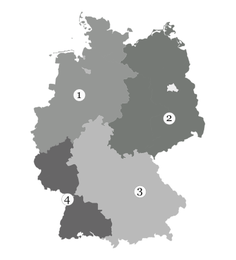
- In the north-west was the British zone (britische Zone, Great Britain).
- In the north-east was the Soviet zone (sowjetische Zone, Soviet Union).
- In the south-east was the American zone (amerikanische Zone, USA). It included, for example, Bavaria (Bayern) and Hesse (Hessen).
- In the south-west was the French zone (französische Zone, France).
On a map, you can remember it like this: top left Great Britain, top right the Soviet Union, bottom right the USA, bottom left France.
Berlin and the airlift
The capital Berlin was in the middle of the Soviet zone (sowjetische Zone). Berlin was also divided, into four sectors (vier Sektoren). A sector is a part of a city. The three western sectors were later called West Berlin (West-Berlin).
In June 1948, the Soviet Union (Sowjetunion) blocked all routes to West Berlin. Because of this, the USA and Great Britain brought food and coal into the city by plane. This is called the airlift (Luftbrücke). It lasted until May 1949. So the reason was the blockade by the Soviet Union, not the costs or the time.
1949: Two German states
In 1949, two German states were founded. In the west, the three western zones became the Federal Republic of Germany (Bundesrepublik Deutschland). Its first Federal Chancellor (Bundeskanzler) was Konrad Adenauer (CDU, Christlich Demokratische Union Deutschlands).
In the Soviet occupation zone (sowjetische Besatzungszone), the GDR (DDR) was founded in October 1949. DDR means German Democratic Republic (Deutsche Demokratische Republik). Despite its name, the GDR was not a democracy. One party, the SED (Sozialistische Einheitspartei Deutschlands), had all the power.
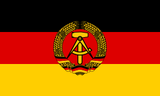
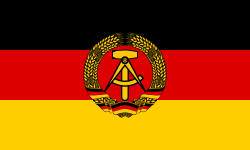
The GDR had its own flag. It was also black-red-gold (schwarz-rot-gold), like the flag of the Federal Republic. But in the middle there was a symbol: a hammer (Hammer) and a compass (Zirkel) in a wreath of ears of grain (Ährenkranz). Ears (Ähren) are the tops of grain plants.
The economy in the west: the social market economy
The Federal Republic chose the social market economy (Soziale Marktwirtschaft). This means: the economy follows supply and demand (Angebot und Nachfrage). But the state makes sure there is social balance (sozialer Ausgleich). For example, it helps people who are poor, sick or unemployed. So the state does not plan the economy.
In the 1950s (50er Jahre), the economy in the west grew very fast. This time is called the economic miracle (Wirtschaftswunder).
The Cold War: East and West
After the war, there were two camps in Europe. In the west were the USA and their partners. In the east was the Soviet Union with its partner countries. The eastern countries formed a military alliance, the Warsaw Pact (Warschauer Pakt). The border between East and West was called the "Iron Curtain" („Eiserner Vorhang“). This meant: the Warsaw Pact closed itself off from the West.
On 17 June 1953 (17. Juni 1953), there was a large uprising (Aufstand) in the GDR (DDR). Many people went on strike and protested against the government. Soviet tanks ended the uprising. After that, 17 June was a public holiday in the Federal Republic for a long time.
Many people fled from the GDR to the West. Because of this, the GDR built the Wall in Berlin (Mauer in Berlin) in 1961.
Germany, Europe and remembrance
The Federal Republic looked for cooperation with its neighbours. It was one of the six states that founded the European Economic Community (Europäische Wirtschaftsgemeinschaft) in 1957. This later became the European Union (EU) (Europäische Union). This is why Germany is a founding member of the EU (Gründungsmitglied der EU). The Federal Republic joined NATO and the United Nations (Vereinte Nationen) only later.
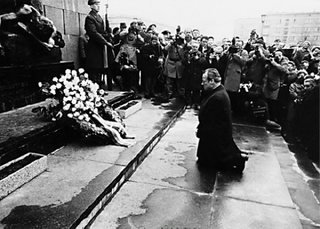
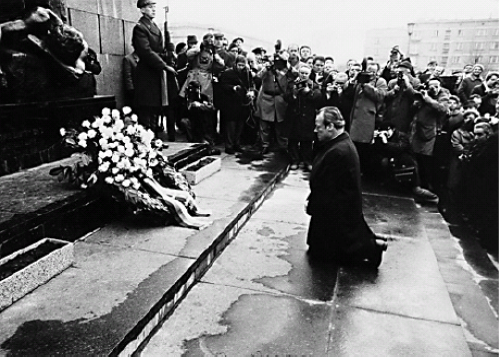
In 1970, Federal Chancellor (Bundeskanzler) Willy Brandt visited Warsaw (Warschau) in Poland. There he knelt down in front of the memorial to the former Jewish ghetto. This is called the Warsaw Genuflection (Kniefall). With it, he asked Poland and the Polish Jews for forgiveness (Vergebung) for the German crimes.
After the Holocaust, the state of Israel was founded in 1948. The legal basis was a resolution of the United Nations (Resolution der Vereinten Nationen). A resolution is an official decision. The Jewish house of prayer is called a synagogue (Synagoge). A mosque (Moschee) is the house of prayer in Islam, a church (Kirche) is the house of prayer in Christianity.
Key points to remember
- The war in Europe ended in 1945 with Germany's unconditional surrender (bedingungslose Kapitulation).
- There were four occupation zones (Besatzungszonen): Great Britain in the north-west, Soviet Union in the north-east, USA in the south-east, France in the south-west.
- Berlin was divided into four sectors (vier Sektoren).
- The airlift (Luftbrücke) of 1948/49 happened because the Soviet Union blocked all land routes to West Berlin.
- In 1949, the Federal Republic (Bundesrepublik) and the GDR (DDR) were founded. The GDR was founded in the Soviet zone (sowjetische Zone).
- The first Federal Chancellor (Bundeskanzler) was Konrad Adenauer.
- Social market economy (Soziale Marktwirtschaft): supply and demand, plus social balance by the state. The economic miracle (Wirtschaftswunder) was in the 1950s.
- On 17 June 1953, there was an uprising in the GDR. In 1961, the GDR built the Wall in Berlin (Mauer in Berlin).
- In 1970 in Warsaw, Willy Brandt asked Poland and the Polish Jews for forgiveness (Vergebung).
- Israel was founded through a resolution of the United Nations (Resolution der Vereinten Nationen). The Jewish house of prayer is called a synagogue (Synagoge).
Important German words
- die Besatzungszone – the occupation zone
- An area that was governed by one of the victorious powers after the war.
- die Alliierten – the Allies
- The countries that fought together against Germany and won the war.
- die Kapitulation – the surrender
- An army or a state gives up in a war.
- die Luftbrücke – the airlift
- Supplying West Berlin by plane from 1948 to 1949.
- die Soziale Marktwirtschaft – the social market economy
- The market decides the prices, and the state helps people in need.
- das Wirtschaftswunder – the economic miracle
- The very fast growth of the economy in the west in the 1950s.
- der Eiserne Vorhang – the Iron Curtain
- The heavily guarded border between East and West in Europe.
- der Warschauer Pakt – the Warsaw Pact
- The military alliance of the Soviet Union and the eastern states, including the GDR.
- die Synagoge – the synagogue
- The house of prayer of the Jews.
Read the lesson first, then practise the official questions in German.
Practice Questions (20)Practice Questions (20)
-
Question 1 of 20
Soziale Marktwirtschaft bedeutet, die Wirtschaft …
-
Question 2 of 20
In welcher Besatzungszone wurde die DDR gegründet? In der …
-
Question 3 of 20
Die Bundesrepublik Deutschland ist ein Gründungsmitglied …
-
Question 4 of 20
Wann wurde die DDR gegründet?
-
Question 5 of 20
Wie viele Besatzungszonen gab es in Deutschland nach dem Zweiten Weltkrieg?
-
Question 6 of 20
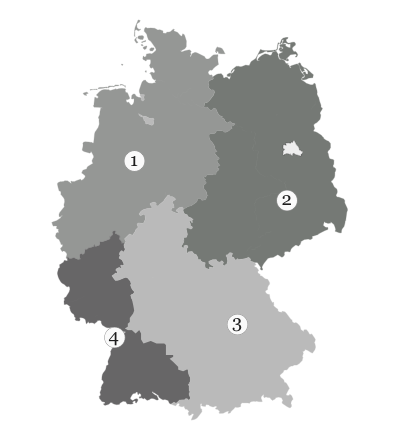
Wie waren die Besatzungszonen Deutschlands nach 1945 verteilt?
-
Question 7 of 20
Welche deutsche Stadt wurde nach dem Zweiten Weltkrieg in vier Sektoren aufgeteilt?
-
Question 8 of 20
Vom Juni 1948 bis zum Mai 1949 wurden die Bürger und Bürgerinnen von West-Berlin durch eine Luftbrücke versorgt. Welcher Umstand war dafür verantwortlich?
-
Question 9 of 20
Wie endete der Zweite Weltkrieg in Europa offiziell?
-
Question 10 of 20
Der erste Bundeskanzler der Bundesrepublik Deutschland war …
-
Question 11 of 20
Was wollte Willy Brandt mit seinem Kniefall 1970 im ehemaligen jüdischen Ghetto in Warschau ausdrücken?
-
Question 12 of 20
Wie heißt das jüdische Gebetshaus?
-
Question 13 of 20
Wann war in der Bundesrepublik Deutschland das „Wirtschaftswunder“?
-
Question 14 of 20
Auf welcher rechtlichen Grundlage wurde der Staat Israel gegründet?
-
Question 15 of 20
Wofür stand der Ausdruck „Eiserner Vorhang“? Für die Abschottung …
-
Question 16 of 20
Im Jahr 1953 gab es in der DDR einen Aufstand, an den lange Zeit in der Bundesrepublik Deutschland ein Feiertag erinnerte. Wann war das?
-
Question 17 of 20
Welcher deutsche Staat hatte eine schwarz-rot-goldene Flagge mit Hammer, Zirkel und Ährenkranz?
-
Question 18 of 20
In welchem Jahr wurde die Mauer in Berlin gebaut?
-
Question 19 of 20
Wann baute die DDR die Mauer in Berlin?
-
Question 20 of 20
Was bedeutet die Abkürzung DDR?