
2.1.03 Condizioni di strada e meteorologiche
Regola d'oro ⭐
Maltempo = Meno aderenza + Spazio di frenata più lungo + Scarsa visibilità.
👉 Ridurre sempre la velocità, aumentare la distanza ed evitare sterzate o frenate improvvise.
🌧️ Pioggia e strade bagnate
- La prima pioggia dopo la siccità crea una pellicola d'olio scivolosa.
- Lo spazio di frenata diventa più lungo.
- La visibilità peggiora a causa degli spruzzi d'acqua e della visiera appannata.
- Evitare frenate o accelerazioni improvvise.
- Aumentare subito la distanza di sicurezza.
- La segnaletica stradale diventa molto scivolosa quando è bagnata.
La “prima pioggia dopo la siccità” è particolarmente pericolosa.
💧Aquaplaning
- Si verifica ad alta velocità su strade bagnate.
- I pneumatici perdono il contatto con la strada.
- Non è possibile sterzare o frenare correttamente.
- Il rischio è maggiore in presenza di solchi di ruote e acqua stagnante.
- Togli lentamente il piede dall'acceleratore.
- Mantenere il volante dritto.
- NON frenare improvvisamente.
🌬️Venti trasversali
- Il pericolo aumenta vicino a ponti, tunnel e camion.
- Le motociclette possono sterzare improvvisamente lateralmente.
- La scia del camion cambia improvvisamente la pressione del vento.
- L’alta velocità rende i venti trasversali più pericolosi.
Ridurre la velocità e controsterzare con cautela.
⚠️ Superfici scivolose
- Segnaletica stradale
- Macchie d'olio
- Ciottoli
- Foglie e sabbia
- Tombino e rotaie del tram
- Strade bagnate e ghiaia
Aumento del rischio di scivolamento e caduta.
🌫️ Nebbia e scarsa visibilità
- Utilizzare i fari anabbaglianti.
- Fendinebbia posteriore solo al di sotto di 50 m di visibilità.
- Velocità massima con retronebbia = 50 km/h.
- Non guidare sulla linea centrale.
- Orientarsi sul lato destro della strada.
In caso di nebbia NON sono ammesse le sole luci di parcheggio.
❄️ Neve e ghiaccio
- La strada diventa estremamente scivolosa.
- I cumuli di neve riducono la visibilità.
- Lo spazio di frenata aumenta notevolmente.
- Evitare i sorpassi nel fango.
- Guidare dolcemente senza sterzare a scatti.
Frenare presto e guidare in modo prevedibile.
🏍️Rischi Speciali Moto
- I venti trasversali possono spingere la motocicletta lateralmente.
- La segnaletica orizzontale delle corsie bagnate è molto scivolosa.
- I binari del tram devono essere attraversati il più perpendicolarmente possibile.
- I ciottoli riducono fortemente la presa.
- Foglie, sabbia e olio aumentano il rischio di caduta in curva.
- Mantenere una distanza sufficiente durante la guida in gruppo.
- Evitare frenate brusche in piega.
- La ruota posteriore potrebbe bloccarsi più facilmente su strade bagnate.
🧠 Formula per la memoria rapida
🌧️ Pioggia = Scivoloso + Scarsa visibilità
💧 Aquaplaning = Senza sterzata + Senza frenata
🌬️ Vento al traverso = Controsterzare con attenzione
❄️ Neve/ghiaccio = Frena presto + Guida lentamente
⚠️ Superfici scivolose = Evitare movimenti bruschi
Domande di Pratica (9)
-
Domanda 1 di 9
Perché dovresti frenare proprio ora?
2.1.03-0293 PuntiSpiegazione
Snow is a special danger for you as a car driver. Your lane is covered in snow. In addition, your view is restricted by a heap of snow. The upcoming green car does not respect the right of way. Therefore, you should brake early, because due to the slipperiness of the braking distance is extended. Probably the green car is also hampered by the snow pile.
-
Domanda 2 di 9
Qual è la giusta linea d'azione ora?
2.1.03-0334 PuntiSpiegazione
Due to the bad weather conditions, you should reduce your speed and avoid jerky steering movements (see danger sign) as you could otherwise skid.
-
Domanda 3 di 9
Quali possono essere gli effetti dell'aquaplaning?
2.1.03-0344 PuntiSpiegazione
In the event of aquaplaning, your vehicle has no direct contact with the road surface, so the steering command and the braking command cannot be implemented.
-
Domanda 4 di 9
A cosa devi prepararti qui?
2.1.03-0374 Punti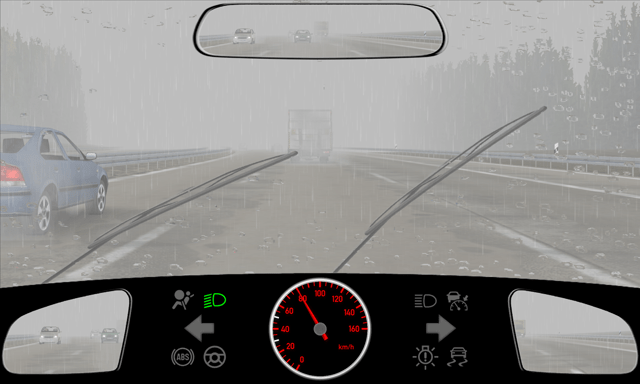
Spiegazione
Because of the rain, you should be prepared for the fact that other vehicles will not be able to see your vehicle and that your braking distance will be longer due to the reduced grip.
-
Domanda 5 di 9
Qual è la giusta linea d'azione?
2.1.03-1154 PuntiSpiegazione
There are two lanes in your direction of travel. You drive on the right side of the two tracks. In oncoming traffic, a snow plow truck approaches. You see in the mirror that a vehicle in the left lane next to you wants to overtake. Snowdrifts hinder you while driving on the lane. You cannot turn left unless the overtaking is completed. Therefore, you must delay further and wait in front of the obstacle until you can dodge to the left.
-
Domanda 6 di 9
Cosa dovresti fare qui?
2.1.03-1164 Punti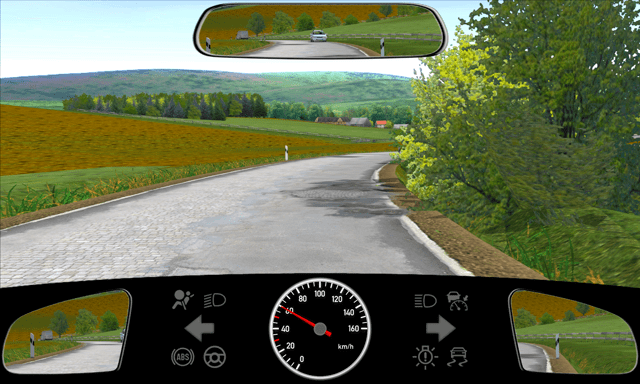
Spiegazione
In the event of lane damage before a turn, you should reduce your speed considerably to avoid damaging the vehicle. Due to the confusion of the curve, you should not drive past the lane damage on the left, but continue on the right on your lane.
-
Domanda 7 di 9
Stai guidando in autostrada. Qual è la cosa giusta da fare in questa situazione?
2.1.03-1175 PuntiSpiegazione
Due to the severely restricted view on the motorway, you can switch on your rear fog light and drive a maximum of 50 km / h.
-
Domanda 8 di 9
State percorrendo un viale stretto. A cosa dovete prestare attenzione?
2.1.03-1204 PuntiSpiegazione
The narrow width of the road and its often curved shape due to tree roots force you to take extra care when cornering and when facing oncoming traffic. Choose your speed in such a way that the vehicle can be brought to a halt within half the visible distance. Example: With a visibility of approx. 40 metres, you should choose your speed so that you come to a stop within approx. 20 metres. In purely mathematical terms, the stopping distance at 30 km/h is 18 metres.
-
Domanda 9 di 9
Cosa devi aspettarti qui?
2.1.03-1224 Punti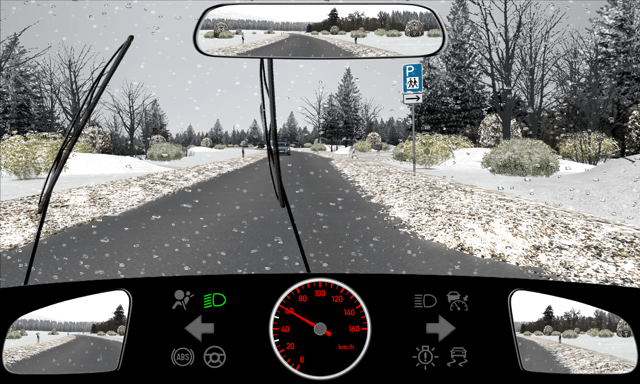
Spiegazione
The snow on the right and left sides of the road may limit the lane. Therefore, you must expect that the distance to oncoming traffic is reduced. In addition, you can see from the traffic sign that there is a parking area for walkers on the right-hand side. Therefore, you must expect that there are pedestrians on the roadway.