
1.03 Constitutional bodies, separation of powers and administration
The test is held only in German. This lesson explains everything in your language and shows the German terms in brackets – learn them, because exactly these words appear in the test.
In this lesson you learn how power is divided in the state and which state bodies (Staatsorgane) exist. You also learn how the federal level, the federal states and the municipalities (Bund, Länder und Gemeinden) work together.
Sovereignty of the people and the rule of law
The Basic Law (Grundgesetz) says: „Alle Staatsgewalt geht vom Volke aus.“ (All state power comes from the people.) This is called sovereignty of the people (Volkssouveränität). Sovereign (souverän) means: you have the highest power. So in Germany the people have the highest power, not a king, not the Bundestag and not a court.
The people show their power mainly in elections (Wahlen). That is why there is more than one party. In this way, the different opinions of the citizens are represented in parliament.
Germany is a state under the rule of law (Rechtsstaat). This means: the state must obey the laws. In a state under the rule of law, people must not be arrested without a reason, and there is no private police (Privatpolizei). But a person who commits a crime can be arrested. People may criticise the government and demonstrate peacefully.
A party can be banned if it fights against the constitution (Verfassung). The Federal Constitutional Court (Bundesverfassungsgericht) decides this. Criticism of the head of state (Staatsoberhaupt), new ideas or an expensive election campaign (Wahlkampf) are not a reason for a ban.
The separation of powers
The power in the state is divided into three areas. This is called the separation of powers (Gewaltenteilung). In this way, nobody can have all the power alone. The three powers have Latin names:
- Legislative (Legislative, law-making, Gesetzgebung): it passes the laws. The Bundestag and the Bundesrat belong to it. So a new law is passed by parliament (Parlament), not by the government (Regierung).
- Executive (Exekutive, the power that carries out the laws, ausführende Gewalt): it carries out the laws. The government, the ministries (Ministerien), the police (Polizei) and public authorities such as the tax office (Finanzamt) belong to it.
- Judiciary (Judikative, the courts and their judgments, Rechtsprechung): these are the courts (Gerichte). They do not belong to the executive.
A "Direktive" does not exist as a branch of state power. Remember: there are only the Legislative, the Exekutive and the Judikative.
The constitutional bodies
Constitutional bodies (Verfassungsorgane) are the most important institutions of the state. The Basic Law (Grundgesetz) describes their tasks. They include:
- the Bundestag, the parliament
- the Bundesrat, the body that represents the federal states
- the Federal President (Bundespräsident or Bundespräsidentin)
- the Federal Government (Bundesregierung)
- the Federal Constitutional Court (Bundesverfassungsgericht)
A "citizens' assembly" (Bürgerversammlung) is not a constitutional body.
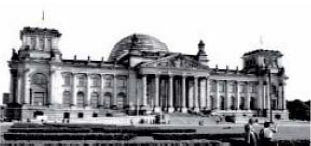
The Bundestag has its seat in Berlin in the Reichstag building (Reichstagsgebäude). This is a large, old building with a tower at each corner. In the middle of the roof there is a dome made of glass. The Federal Constitutional Court, however, is in Karlsruhe.
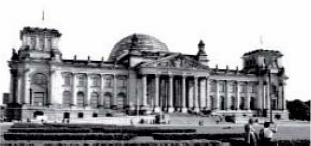
The tasks of the Bundestag are: drafting and passing laws, electing the Federal Chancellor (Bundeskanzler) and controlling the Federal Government. But the Bundestag does not form the Federal Cabinet (Bundeskabinett). The cabinet is the group of the Federal Chancellor and the ministers (Minister). The Federal Chancellor proposes the ministers. Then the Federal President appoints them.
The President of the Bundestag (Präsident des Bundestages) is elected by the members of parliament (Abgeordnete). Usually it is a member from the strongest parliamentary group (Fraktion). A parliamentary group is the group of members of parliament from one party.
The citizens elect the Bundestag, the state parliament (Landtag) and the EU Parliament (EU-Parlament) directly. They do not elect the Federal President directly (nicht direkt). A special assembly elects the Federal President: the Federal Convention (Bundesversammlung).
Federal level, federal states and municipalities
Today Germany is divided into the federal level, the federal states and the local authorities (Bund, Länder und Kommunen). So the administration has three levels. The lowest level is the municipalities (Gemeinden), also called local authorities (Kommunen).
Each federal state has its own parliament. It is called the state parliament (Landtag). The election for it is called the state election (Landtagswahl). The election in the municipality is called the local election (Kommunalwahl).
The municipal administration includes, for example, the public order office (Ordnungsamt). It takes care of order and safety in the town. The tax office (Finanzamt) is an authority of the federal state. The Federal Foreign Office (Auswärtiges Amt) is the foreign ministry of the federal level. A parish office (Pfarramt) belongs to the church.
School policy (Schulpolitik) is mainly a task of the federal states (Bundesländer). That is why schools are often different in each federal state. The state controls the school system (Schulwesen), because the Basic Law gives it this task. Foreign policy (Außenpolitik) and defence (Verteidigung), however, are tasks of the federal level (Bund).
Tasks of the state and the economy
The state has many tasks. It builds roads and schools. It pays child benefit (Kindergeld). It supports museums and promotes athletes. But it does not pay for holiday trips. It also does not sell food and does not produce cars.
Long-term care insurance (Pflegeversicherung) is part of social insurance (Sozialversicherung). It helps people who need help in daily life for a long time.
The economic system in Germany is called the social market economy (soziale Marktwirtschaft). Companies work freely and compete with each other. But the state makes sure that there is social balance. A planned economy (Planwirtschaft), in which the state plans everything, does not exist.
Jewish life in Germany
Jewish life (jüdisches Leben) has a long history in Germany. The first Jewish community (jüdische Gemeinde) in the area of today's Germany existed about 1700 years ago. Today the largest Jewish communities are in Berlin and Munich (München).
Key points to remember
- Sovereignty of the people (Volkssouveränität): „Alle Staatsgewalt geht vom Volke aus.“ (All state power comes from the people.)
- The three powers are the Legislative, the Exekutive and the Judikative. A Direktive does not exist.
- The Bundestag and the Bundesrat belong to the legislative (Legislative). The courts (Gerichte) do not belong to the executive (Exekutive).
- Parliament (Parlament) passes the laws. The Federal President (Bundespräsident) appoints the ministers.
- You cannot elect the Federal President directly.
- A party can be banned if it fights against the constitution (Verfassung).
- Germany is divided into the federal level, the federal states and the local authorities (Bund, Länder und Kommunen). The lowest level is the municipalities (Gemeinden).
- School policy (Schulpolitik) is a task of the federal states. The public order office (Ordnungsamt) belongs to the municipality.
- The economic system is called the social market economy (soziale Marktwirtschaft).
- Jewish communities (jüdische Gemeinden) have existed for about 1700 years. The largest are in Berlin and Munich (München).
Important German words
- die Volkssouveränität – sovereignty of the people
- The people have the highest power in the state.
- die Gewaltenteilung – the separation of powers
- The power in the state is divided into three separate areas.
- die Legislative – the legislative
- The law-making power, that is, parliament.
- die Exekutive – the executive
- The power that carries out the laws: government, administration and police.
- die Judikative – the judiciary
- The power that judges, that is, the courts.
- das Verfassungsorgan – the constitutional body
- An important institution of the state that is described in the Basic Law.
- der Landtag – the state parliament
- The parliament of a federal state.
- die Gemeinde – the municipality
- A village or a town with its own administration, the lowest level in the state.
- die soziale Marktwirtschaft – the social market economy
- A free market with competition, in which the state makes sure there is social balance.
Read the lesson first, then practise the official questions in German.
Practice Questions (29)Practice Questions (29)
-
Question 1 of 29
Warum gibt es in einer Demokratie mehr als eine Partei?
-
Question 2 of 29
Wer beschließt in Deutschland ein neues Gesetz?
-
Question 3 of 29
Wann kann in Deutschland eine Partei verboten werden?
-
Question 4 of 29
Wen kann man als Bürger / Bürgerin in Deutschland nicht direkt wählen?
-
Question 5 of 29
Zu welcher Versicherung gehört die Pflegeversicherung?
-
Question 6 of 29
Der deutsche Staat hat viele Aufgaben. Welche Aufgabe gehört dazu?
-
Question 7 of 29
Der deutsche Staat hat viele Aufgaben. Welche Aufgabe gehört nicht dazu?
-
Question 8 of 29
Welches Organ gehört nicht zu den Verfassungsorganen Deutschlands?
-
Question 9 of 29
Wer bestimmt in Deutschland die Schulpolitik?
-
Question 10 of 29
Die Wirtschaftsform in Deutschland nennt man …
-
Question 11 of 29
Zu einem demokratischen Rechtsstaat gehört es nicht, dass …
-
Question 12 of 29
Was bedeutet „Volkssouveränität“? Alle Staatsgewalt geht vom …
-
Question 13 of 29
Was bedeutet „Rechtsstaat“ in Deutschland?
-
Question 14 of 29
Was ist keine staatliche Gewalt in Deutschland?
-
Question 15 of 29
Was zeigt dieses Bild?
-
Question 16 of 29
Welches Amt gehört in Deutschland zur Gemeindeverwaltung?
-
Question 17 of 29
Wer wird meistens zum Präsidenten / zur Präsidentin des Deutschen Bundestages gewählt?
-
Question 18 of 29
Wer ernennt in Deutschland die Minister / die Ministerinnen der Bundesregierung?
-
Question 19 of 29
Vor wie vielen Jahren gab es erstmals eine jüdische Gemeinde auf dem Gebiet des heutigen Deutschlands?
-
Question 20 of 29
In Deutschland gehören der Bundestag und der Bundesrat zur …
-
Question 21 of 29
Was bedeutet „Volkssouveränität“?
-
Question 22 of 29
Wenn das Parlament eines deutschen Bundeslandes gewählt wird, nennt man das …
-
Question 23 of 29
Was gehört in Deutschland nicht zur Exekutive?
-
Question 24 of 29
Die Bundesrepublik Deutschland ist heute gegliedert in …
-
Question 25 of 29
Es gehört nicht zu den Aufgaben des Deutschen Bundestages, …
-
Question 26 of 29
Welche Städte haben die größten jüdischen Gemeinden in Deutschland?
-
Question 27 of 29
Was ist in Deutschland vor allem eine Aufgabe der Bundesländer?
-
Question 28 of 29
Warum kontrolliert der Staat in Deutschland das Schulwesen?
-
Question 29 of 29
Die Bundesrepublik Deutschland hat einen dreistufigen Verwaltungsaufbau. Wie heißt die unterste politische Stufe?