
1.04 Government, parliament and parties
The test is held only in German. This lesson explains everything in your language and shows the German terms in brackets – learn them, because exactly these words appear in the test.
In this lesson you learn about the most important offices (Ämter) and bodies (Organe) at the federal level (Bundesebene). You learn who elects whom, who decides what and which parties exist.
The Federal President: the head of state
The head of state (Staatsoberhaupt) is the person who represents the state to the outside world. In Germany this is the Federal President (Bundespräsident or Bundespräsidentin). The current head of state is Frank-Walter Steinmeier.
The main task of the Federal President is: he represents (repräsentiert) the country. This means he speaks and acts for Germany, for example on visits abroad. But he does not govern and does not draft laws.
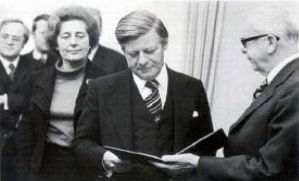
The Federal President proposes the Federal Chancellor (Bundeskanzler) to the Bundestag for election. After the election, he appoints him. A well-known photo shows this: in 1974, Federal President Gustav Heinemann gives the new Federal Chancellor Helmut Schmidt the certificate of appointment (Ernennungsurkunde). The Federal President also appoints the ministers (Minister). But the Federal Chancellor chooses them.
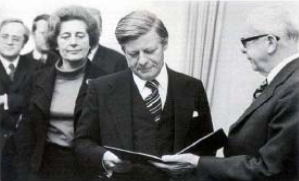
The Federal President is elected by the Federal Convention (Bundesversammlung). It is made up of all members of the Bundestag (Abgeordnete des Bundestages) and the same number of representatives from the federal states (Bundesländer). His official residence is Bellevue Palace (Schloss Bellevue) in Berlin.
The Federal Chancellor and the Federal Government
The Federal Chancellor (Bundeskanzler or Bundeskanzlerin) is the head of the Federal Government (Bundesregierung). He leads the Federal Cabinet (Bundeskabinett). The cabinet is made up of the Federal Chancellor and the federal ministers (Bundesminister).
The Federal Chancellor is elected by the Bundestag. The people do not elect him directly. The Bundesrat and the Federal Convention (Bundesversammlung) do not elect him either.
The Federal Chancellor is most often in Berlin. The Federal Chancellery (Bundeskanzleramt) and the Bundestag are there. Bonn used to be the capital, but today the Federal Chancellery is no longer there.
Note: in the official question catalogue (Fragenkatalog), the correct answer is "Olaf Scholz". After the Bundestag election (Bundestagswahl) in 2025, Friedrich Merz (CDU) became Federal Chancellor in May 2025.
Bundestag and Bundesrat
The Bundestag is the parliament for all of Germany. Its members (Abgeordnete) are elected by the people. The Volkskammer was the parliament of the former GDR (DDR). The Federal Court of Justice (Bundesgerichtshof) is a court.
The members of parliament from one party form a parliamentary group (Fraktion) in parliament. The parties that are not part of the government are the opposition (Opposition). The opposition controls the government. But it does not decide who becomes a minister.
Note: in the official question catalogue (Fragenkatalog), the two largest parliamentary groups are "CDU/CSU and SPD". Since the Bundestag election in 2025, the two largest parliamentary groups have been CDU/CSU and AfD. In the test, you choose the answer from the catalogue.
The Bundesrat is the body that represents the federal states (Vertretung der Bundesländer). It is made up of representatives of the state governments (Landesregierungen). Through the Bundesrat, the federal states take part in federal law-making (Gesetzgebung des Bundes).
When a new government is elected in a federal state, its representatives in the Bundesrat also change. Because of this, the majority in the Bundesrat can change. Then governing can become more difficult for the Federal Government (Bundesregierung). It needs the approval (Zustimmung) of the Bundesrat for many laws.
The Federal Constitutional Court and the Bundeswehr
The Federal Constitutional Court (Bundesverfassungsgericht) in Karlsruhe interprets (legt aus) the Basic Law (Grundgesetz). To interpret (auslegen) means: to explain what a text means exactly. The court checks if laws agree with the Basic Law. Local courts (Amtsgerichte), higher regional courts (Oberlandesgerichte) and administrative courts (Verwaltungsgerichte) have other tasks.
The Bundeswehr is the German army. It is not the police (Polizei).
The parties and their abbreviations
In the test you must know what the abbreviations of the parties stand for:
- CDU: Christlich Demokratische Union (Christian Democratic Union)
- CSU: Christlich Soziale Union (Christian Social Union). It exists only in Bavaria (Bayern). In the Bundestag, the CDU and the CSU form one joint parliamentary group (Fraktion).
- SPD: Sozialdemokratische Partei Deutschlands (Social Democratic Party of Germany)
- FDP: Freie Demokratische Partei (Free Democratic Party)
Pay attention to the exact words. The CDU is not the "Christliche Deutsche Union". The SPD is not "sozialistisch" (socialist), but "sozialdemokratisch" (social democratic).
Key points to remember
- The head of state (Staatsoberhaupt) is the Federal President (Bundespräsident). Today this is Frank-Walter Steinmeier.
- The Federal President represents (repräsentiert) the country and proposes the Chancellor (Kanzler) for election.
- The Federal Convention (Bundesversammlung) elects the Federal President.
- The Bundestag elects the Federal Chancellor (Bundeskanzler). The Federal Chancellor leads the cabinet (Kabinett).
- The Federal Chancellor works mostly in Berlin, in the Federal Chancellery (Bundeskanzleramt).
- The Bundestag is the parliament for all of Germany.
- The Bundesrat is made up of representatives of the state governments (Landesregierungen). In this way, the federal states take part in making laws.
- The opposition (Opposition) controls the government. The members of parliament from one party form a parliamentary group (Fraktion).
- The Federal Constitutional Court (Bundesverfassungsgericht) interprets the Basic Law (Grundgesetz). The Bundeswehr is the army.
- CDU, CSU, SPD and FDP: learn the full names exactly.
Important German words
- das Staatsoberhaupt – the head of state
- The person at the head of the state. In Germany this is the Federal President.
- die Bundesversammlung – the Federal Convention
- The assembly that elects the Federal President.
- das Bundeskabinett – the Federal Cabinet
- The Federal Chancellor and the federal ministers together.
- der Bundesrat – the Bundesrat
- The body that represents the state governments at the federal level.
- die Fraktion – the parliamentary group
- The group of members of parliament from one party.
- die Opposition – the opposition
- The parties in parliament that do not govern and that control the government.
- repräsentieren – to represent
- To speak and act for a country or a group to the outside world.
- die Ernennungsurkunde – the certificate of appointment
- An official document with which a person receives an office.
Read the lesson first, then practise the official questions in German.
Practice Questions (23)Practice Questions (23)
-
Question 1 of 23
Der deutsche Bundespräsident Gustav Heinemann gibt Helmut Schmidt 1974 die Ernennungsurkunde zum deutschen Bundeskanzler. Was gehört zu den Aufgaben des deutschen Bundespräsidenten / der deutschen Bundespräsidentin?
-
Question 2 of 23
Wo hält sich der deutsche Bundeskanzler / die deutsche Bundeskanzlerin am häufigsten auf? Am häufigsten ist er / sie …
-
Question 3 of 23
Wie heißt der jetzige Bundeskanzler / die jetzige Bundeskanzlerin von Deutschland?
-
Question 4 of 23
Die beiden größten Fraktionen im Deutschen Bundestag heißen zurzeit …
-
Question 5 of 23
Wie heißt das Parlament für ganz Deutschland?
-
Question 6 of 23
Wie heißt Deutschlands heutiges Staatsoberhaupt?
-
Question 7 of 23
Was bedeutet die Abkürzung CDU in Deutschland?
-
Question 8 of 23
Was ist die Bundeswehr?
-
Question 9 of 23
Was bedeutet die Abkürzung SPD?
-
Question 10 of 23
Was bedeutet die Abkürzung FDP in Deutschland?
-
Question 11 of 23
Welches Gericht in Deutschland ist zuständig für die Auslegung des Grundgesetzes?
-
Question 12 of 23
Wer wählt den Bundeskanzler / die Bundeskanzlerin in Deutschland?
-
Question 13 of 23
Wer leitet das deutsche Bundeskabinett?
-
Question 14 of 23
Wer wählt den deutschen Bundeskanzler / die deutsche Bundeskanzlerin?
-
Question 15 of 23
Welche Hauptaufgabe hat der deutsche Bundespräsident / die deutsche Bundespräsidentin? Er / Sie …
-
Question 16 of 23
Wer bildet den deutschen Bundesrat?
-
Question 17 of 23
Wer wählt in Deutschland den Bundespräsidenten / die Bundespräsidentin?
-
Question 18 of 23
Wer ist das Staatsoberhaupt der Bundesrepublik Deutschland?
-
Question 19 of 23
Die parlamentarische Opposition im Deutschen Bundestag …
-
Question 20 of 23
Wie nennt man in Deutschland die Vereinigung von Abgeordneten einer Partei im Parlament?
-
Question 21 of 23
Die deutschen Bundesländer wirken an der Gesetzgebung des Bundes mit durch …
-
Question 22 of 23
In Deutschland kann ein Regierungswechsel in einem Bundesland Auswirkungen auf die Bundespolitik haben. Das Regieren wird …
-
Question 23 of 23
Was bedeutet die Abkürzung CSU in Deutschland?