
1.2.09 Tourner, tourner et inverser
1. Tournage tangentiel
Lorsque deux véhicules venant en sens inverse veulent tous deux tourner à gauche, vous devez tourner devant l'autre (tangentiellement).
2. Céder (droit de passage)
- 🛑 Trafic venant en sens inverse : A toujours la priorité sur les virages à gauche.
- 🛑 Piétons : Ayez la priorité lorsque vous tournez dans leur rue.
- 🛑 Cyclistes/Scooters : Ayez la priorité s’ils passent directement à côté de vous.
- 🛑 Tramways : Cédez toujours le passage aux tramways lorsque vous tournez.
3. Indication des règles
Vous devez toujours indiquer lors d’un changement de direction.
- Indiquez lorsque vous suivez une route à virage prioritaire.
- Indiquez-le lorsque vous vous transformez en propriété/intersection en T.
- Ronds-points : Indiquez UNIQUEMENT en sortant, JAMAIS en entrant !
4. Positionnement
La routine : 1. Regardez (miroir et épaule) ➔ 2. Indiquez ➔ 3. Disposez le véhicule.
Rues à sens unique : Déplacez-vous vers la voie la plus à gauche pour tourner à gauche.
Virages à plusieurs voies : Restez dans votre voie ! Ne dérivez pas dans des voies parallèles. Si vous tournez à droite immédiatement après, utilisez la voie de virage à gauche la plus à droite.
⚠️ Avertissement de piège d'examen
Même si vous êtes sur une route prioritaire, si vous tournez dans une circulation en ligne droite (comme un tramway), vous devez vous arrêter et céder.
Questions d’entraînement (40)
-
Question 1 sur 40
Vous voulez tourner à gauche. À quel moment devez-vous faire attention aux véhicules qui suivent?
1.2.09-0164 pointsExplication
When turning left, you should be aware of following traffic before turning and before merging.
-
Question 2 sur 40
Deux véhicules se rencontrent à un croisement. Chacun des deux véhicules veut tourner à gauche. Dans quelle situation exceptionnelle doivent-ils tourner l'un après l'autre?
1.2.09-0173 pointsExplication
Always turn in front of each other. If the traffic situation or the design of the intersection, e.g. lane markings, requires it, you must turn one behind the other.
-
Question 3 sur 40
Deux véhicules se rencontrent à un croisement. Chacun des deux véhicules veut tourner à gauche. Quel comportement doivent généralement adopter les deux conducteurs?
1.2.09-0183 pointsExplication
If two left-turning vehicles come towards each other, they turn in front of each other (tangentially).
-
Question 4 sur 40
Vous voulez tourner à gauche. Quelle trajectoire devez-vous garder?
1.2.09-0194 points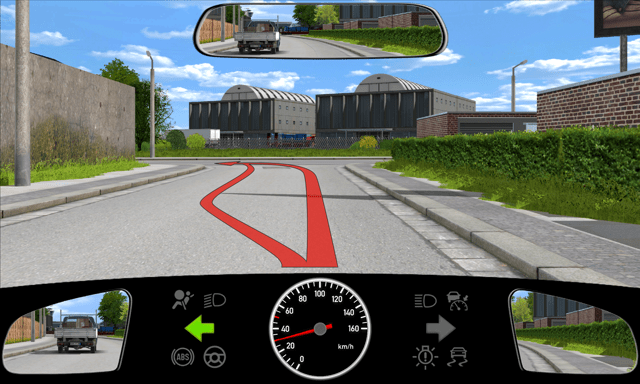
Explication
Use the right-hand driving line. The left-hand driving line is intended for oncoming traffic.
-
Question 5 sur 40
À quel usager de la route devez-vous ici céder la priorité?
1.2.09-0205 pointsExplication
When turning, you must give priority to oncoming traffic and cross traffic - in this case cyclists and pedestrians. Although your traffic lights are green, you must wait until the pedestrian has crossed the road. Pedestrians have priority over turning vehicles.
-
Question 6 sur 40
Vous voulez quitter le rond-point à cette sortie. Quel est le bon comportement à adopter?
1.2.09-0214 points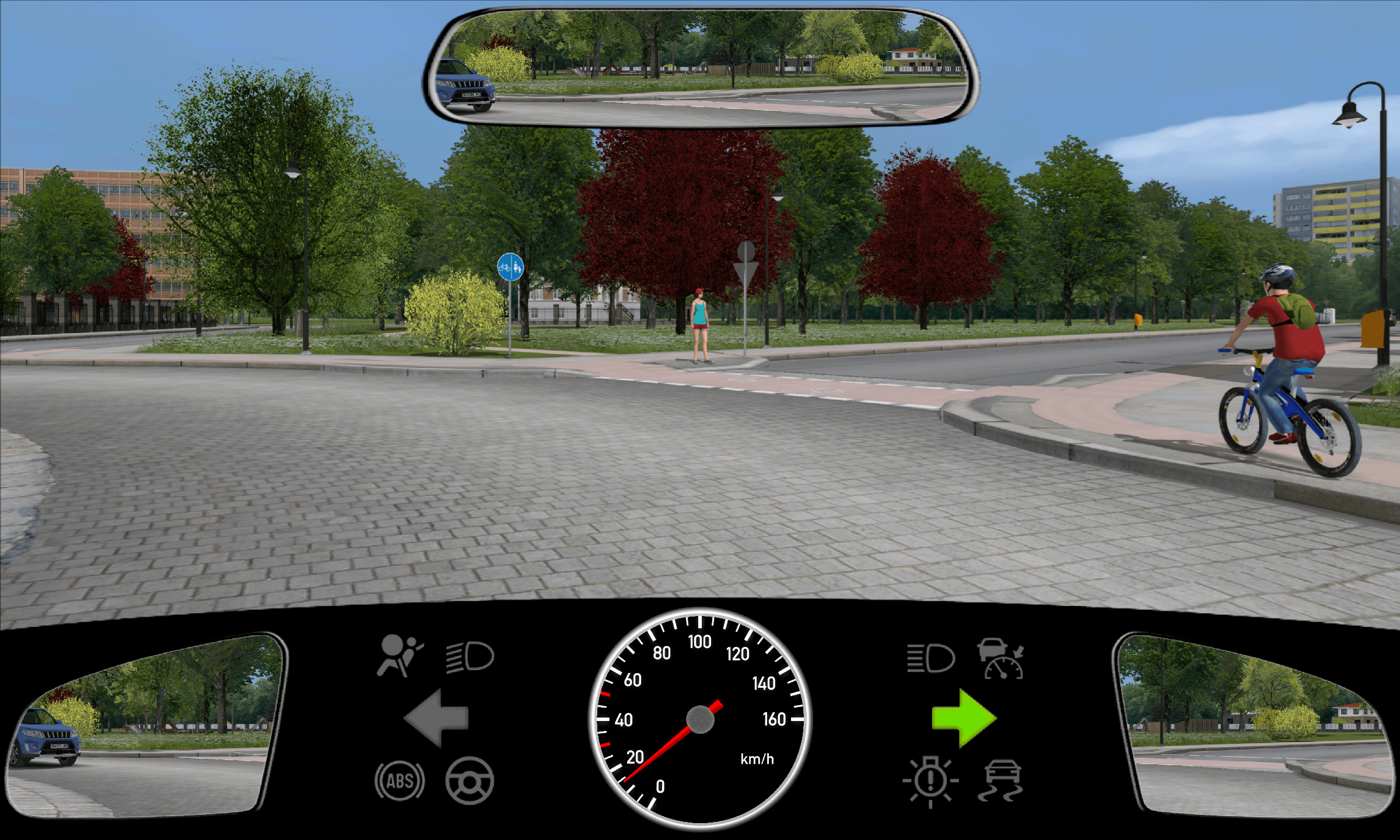
-
Question 7 sur 40
Vous voulez tourner à droite ici. Que faut-il faire?
1.2.09-0224 points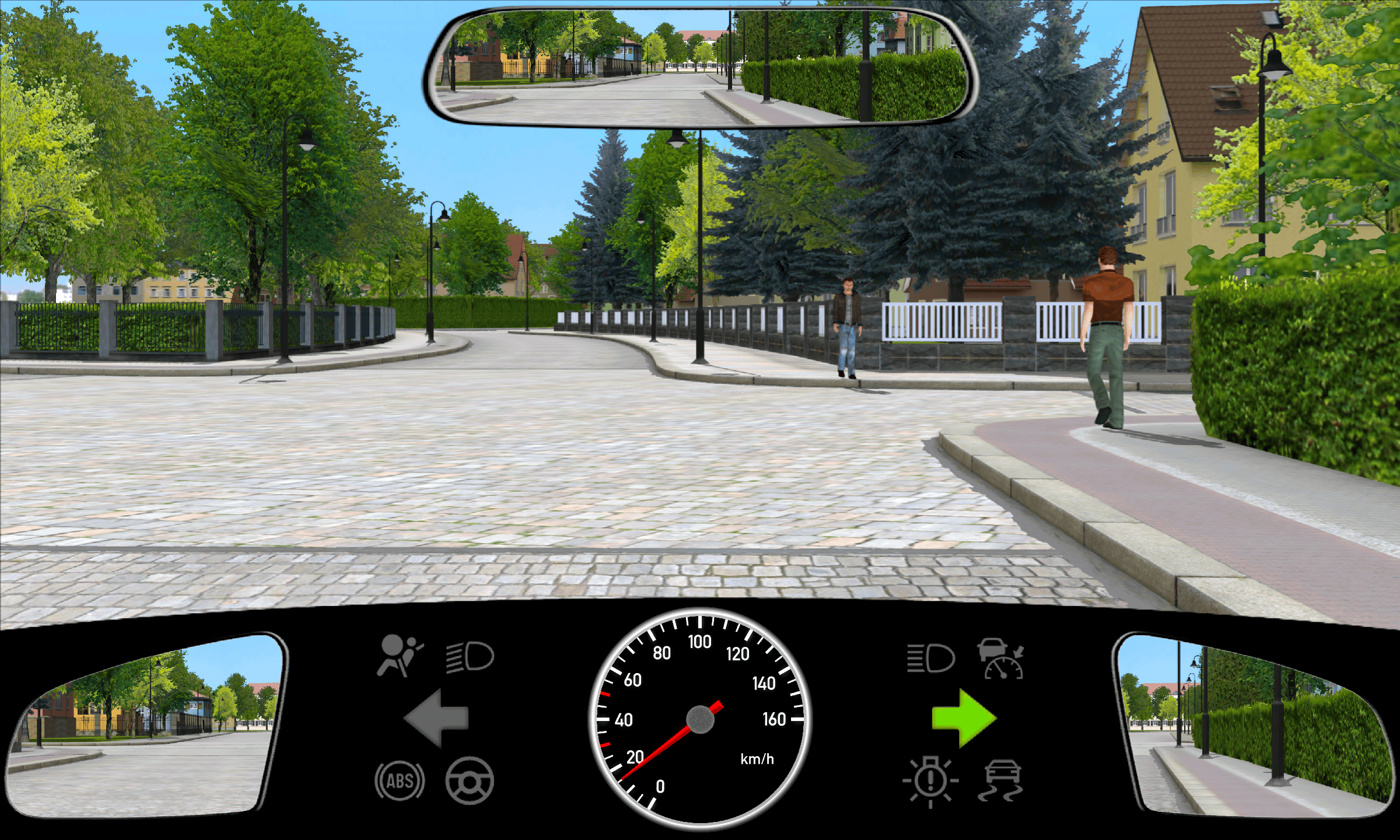
Explication
You must let both pedestrians cross the road. They do not change their direction of movement and therefore have priority over you.
-
Question 8 sur 40
Lorsque pour tourner il existe plusieurs voies, quelles sont les situations dangereuses pouvant se présenter?
1.2.09-1014 pointsExplication
Drive at moderate speed into multi-lane turns. At too fast a pace you could get out of your lane and get into the lane of parallel driving vehicles. Avoid a lane change within this turning situation. There is a risk that a vehicle is directly behind you in your blind spot.
-
Question 9 sur 40
Les trois véhicules veulent tourner à gauche. Qui s'est correctement placé?
1.2.09-1033 points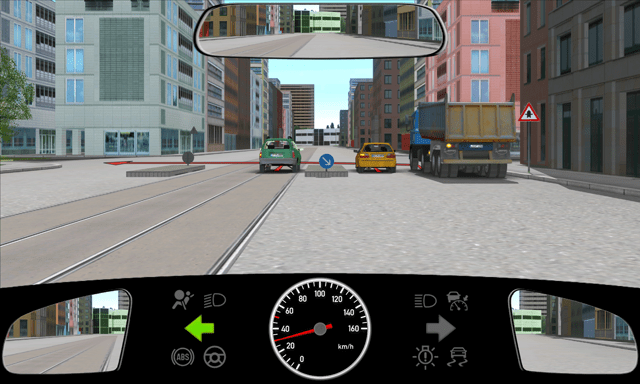
Explication
Only the yellow car merged into the lane correctly. He passed right, as it says on the road sign on the safety island, in order to then get in proper lane as left as possible to prepare his turn to the left. The green car is completely wrong on the rails; In this situation, the truck may only drive straight ahead or turn right.
-
Question 10 sur 40
Après avoir tourné à gauche, vous voulez tourner immédiatement à droite. Comment vous placez-vous?
1.2.09-1043 points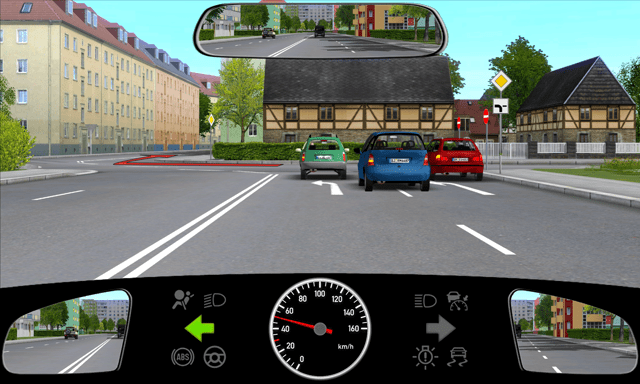
Explication
If you want to turn right again immediately after turning left, you get in proper lane on the right, if there are two lanes for turning left. Otherwise, keep as far to the right as possible. This is the only way you can turn right after a left turn without hindering other road users.
-
Question 11 sur 40
Qui doit indiquer ici son changement de direction?
1.2.09-1073 points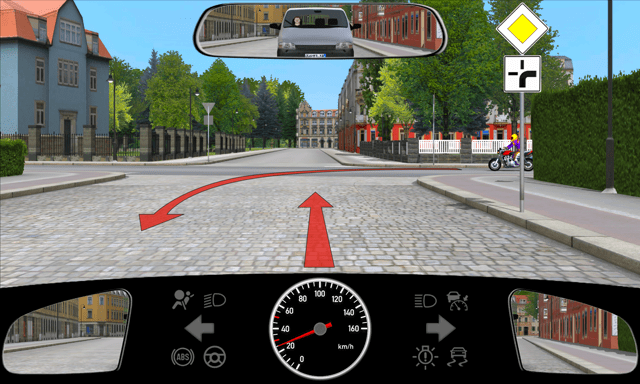
-
Question 12 sur 40
Vous vous trouvez sur un rond-point. Que devez-vous observer?
1.2.09-1093 pointsExplication
In a roundabout you may only stop if this is unavoidable due to traffic, for example due to a traffic jam. Indicate when leaving the roundabout. You can only drive over paved or asphalted central islands if it is unavoidable due to the size of the vehicle. Always give priority to cyclists traveling on your right side and remaining in the roundabout.
-
Question 13 sur 40
Dans quelle situation faire demi-tour est particulièrement dangereux?
1.2.09-1114 pointsExplication
When turning in poor visibility (fog), dangerous situations can arise. The same applies when turning in curves and before crests.
-
Question 14 sur 40
Qui doit mettre le clignotant?
1.2.09-1123 points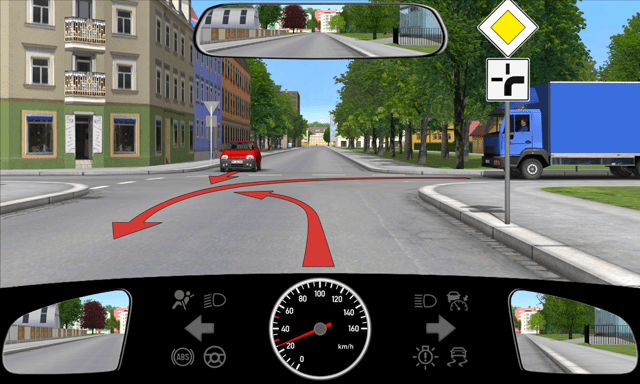
Explication
Changing the direction of travel must always be indicated by pressing the indicator. If you stay on a turning priority road you should also indicate that. Therefore, the blue truck must indicate. You, who's turning left, must also indicate.
-
Question 15 sur 40
Qui doit indiquer ici son changement de direction?
1.2.09-1133 points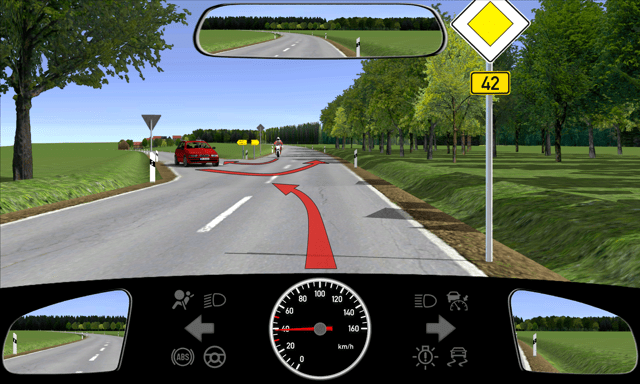
Explication
The change of the direction of travel must always be indicated early enough. All three drivers intend to turn. Therefore, all three vehicles must indicate.
-
Question 16 sur 40
Dans quels cas devez-vous indiquer un changement de direction?
1.2.09-1174 pointsExplication
If you want to turn into a T-junction or a property, you have to indicate. The same applies if you follow a turning priority road - here, too, the change of the direction of travel must be indicated.
-
Question 17 sur 40
Pourquoi devez-vous, maintenant, attendre?
1.2.09-1194 pointsExplication
Drivers who turn need to wait for vehicles from the opposite direction, even for cyclists. The red car has to wait until the green car and the cyclist are gone.
-
Question 18 sur 40
Vous voulez tourner à gauche. Dans quel ordre devez-vous préparer votre manœuvre?
1.2.09-1204 pointsExplication
If you want to turn left, prepare the turn in the following order: 1. look, 2. indicate, 3. arrange. Looking means that you are observing follow-up traffic in the mirror and over your shoulder. Then press the indicator to the left side. Only if you can rule out danger for other road users, you may merge left in order to turn.
-
Question 19 sur 40
Quel comportement est correct?
1.2.09-1215 points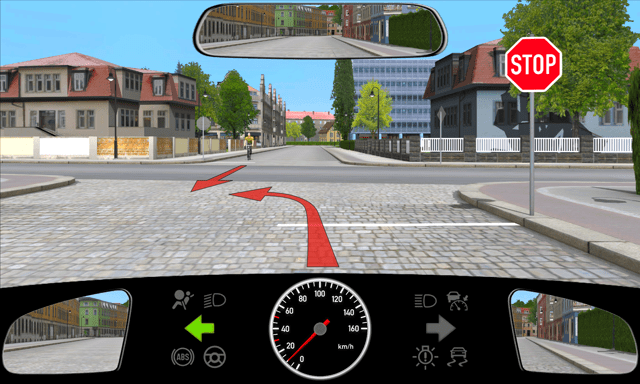
Explication
In front of the traffic sign "Stop! Give way!", colloquially also called stop sign, you must always stop. Mostly there is a stop line. The wheels must be stationary for at least a short amount of time. The cross traffic has right of way - then the cyclists on the opposite side. As a driver turning left, you have to grant him the right of way.
-
Question 20 sur 40
Vous voulez tourner à gauche. À qui devez-vous laisser la priorité?
1.2.09-1234 pointsExplication
The oncoming traffic when turning left, has always right of way. This also applies to cyclists; they are granted priority. If pedestrians cross the street you want to turn into, the pedestrians have priority too.
-
Question 21 sur 40
Vous voulez tourner à gauche. Quelles sont les difficultés que vous risquez de rencontrer?
1.2.09-1243 pointsExplication
When turning left, vehicles approaching each other have to turn in front of each other (tangent turning). This can lead to poor visibility of the straight-ahead traffic. Especially left-turning trucks can lead to massive obstructions and make it safer to turn in a wide arc (turning behind each other). There may be misunderstandings between drivers when one wants to turn behind and the other in front.
-
Question 22 sur 40
Pourquoi devez-vous vous arrêter maintenant?
1.2.09-1254 pointsExplication
You are on a priority road and therefore you're allowed to drive before the white car coming from the right. However, as a driver who wants to turn, you have a subordinate position to traffic driving straight-ahead, in this case the tram. You have to stop.
-
Question 23 sur 40
Quel doit être ici le comportement correct?
1.2.09-1264 pointsExplication
You must not overtake the moped before the level crossing. In general, no vehicles may be overtaken at level crossings from signs 151, 156 to the rails.
-
Question 24 sur 40
Pourquoi devez-vous freiner ici?
1.2.09-1275 pointsExplication
The motorcyclist comes from the left at high speed. He probably did not see you because of the oncoming vehicle. Although you have the right of way, you have to slow down, as otherwise an accident will occur.
-
Question 25 sur 40
Pourquoi devez-vous attendre avant de tourner à droite?
1.2.09-1285 pointsExplication
If you want to turn, you must give priority to road users traveling straight ahead. In this case, you have lower priority to the pedestrian and the cyclist and must allow them a safe crossing.
-
Question 26 sur 40
Que faut-il faire face à cette situation?
1.2.09-1293 pointsExplication
Since the blue car is already in the roundabout, you have to slow down. Only when leaving the roundabout, you must indicate.
-
Question 27 sur 40
[Le cycliste] veut continuer tout droit. Quel est le comportement correct à adopter dans cette situation?
1.2.09-1314 points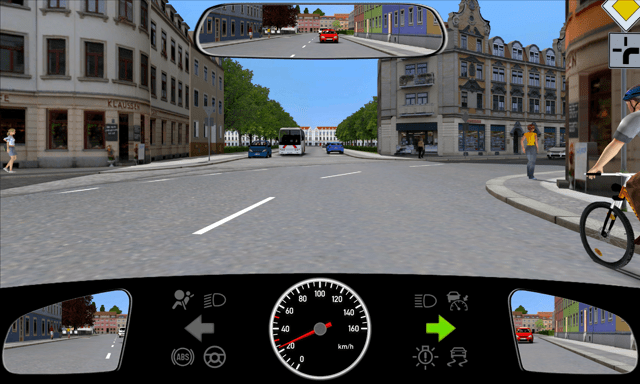
Explication
Vehicles that want to turn need to let bicycles pass that drive in their direction on or next to the road, before turning. It does not matter if their wheels are motorized or not.
-
Question 28 sur 40
Dans cette situation, pourquoi êtes-vous obligé(e) d'attendre avant de tourner?
1.2.09-1325 pointsExplication
Because of the truck and the motorcycle. Here you have to pay attention to the turning rules. Wait for the vehicles to complete the maneuver and then continue turning.
-
Question 29 sur 40
Qui doit mettre son clignotant dans cette situation?
1.2.09-1333 points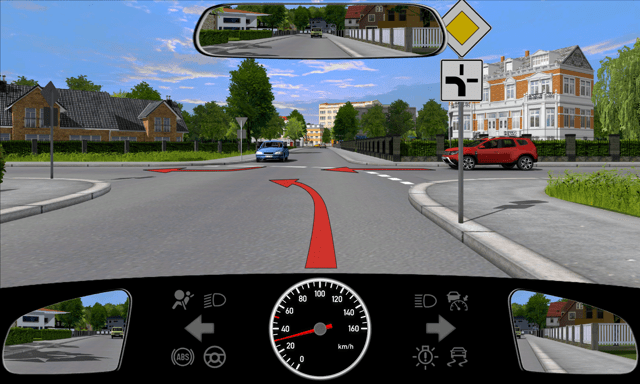
Explication
You and the blue car are changing direction for this reason you must indicate the change of direction.
-
Question 30 sur 40
Quel doit être maintenant le bon comportement?
1.2.09-1344 pointsExplication
The motorbike behind you has already changed to the left lane and will overtake you on the left. In order to merge into the left-turning lane in time, you must slow down.
-
Question 31 sur 40
Pourquoi n'avez-vous pas le droit de tourner maintenant?
1.2.09-1355 pointsExplication
At an intersection, drivers going straight ahead have the right of way. You must wait to turn until the yellow car has crossed the intersection.
-
Question 32 sur 40
À quoi devez-vous vous attendre dans cette situation?
1.2.09-1365 pointsExplication
The blue car drives past the stopping bus and may want to continue straight on, even though it is in the turning lane. Since you turn left, he has right of way.
-
Question 33 sur 40
Pourquoi devez-vous vous arrêter maintenant?
1.2.09-1375 pointsExplication
There is an electric scooter in the blind spot, so you must stop to avoid endangering it.
-
Question 34 sur 40
Quel est le bon comportement à adopter maintenant?
1.2.09-1384 pointsExplication
The straight ahead traffic always has priority, whether the cyclist is riding on the road or on a cycle path. To make sure that no other cyclist is approaching, you must look over your shoulder to the right.
-
Question 35 sur 40
Pourquoi êtes-vous obligé(e) d'attendre maintenant?
1.2.09-2014 pointsExplication
Because you want to turn left, you should wait for the tram before turning.
-
Question 36 sur 40
Pourquoi devez-vous dans cette situation attendre avant de tourner à droite?
1.2.09-2025 pointsExplication
When turning, you must give priority to longitudinal traffic, for this reason you must wait for pedestrians and cyclists to pass.
-
Question 37 sur 40
Pourquoi n'avez-vous pas le droit de tourner maintenant?
1.2.09-2034 points -
Question 38 sur 40
Pourquoi devez-vous dans cette situation attendre avant de tourner à gauche?
1.2.09-2045 pointsExplication
You are changing the direction of travel, so you must give the tram priority.
-
Question 39 sur 40
Pourquoi devez-vous dans cette situation attendre avant de tourner à gauche?
1.2.09-2054 pointsExplication
A motorbike is driving behind a red car; due to your change of direction, you must give the motorcyclist priority.
-
Question 40 sur 40
Pouquoi devez-vous attendre maintenant?
1.2.09-2065 pointsExplication
The blue car and the cyclist are both going straight ahead, so they have the right of way, even if the cyclist is riding on the pavement.