
1.2.05 Wyprzedzanie
🚗 Wyprzedzanie i bezpieczna odległość
Zachowanie bezpiecznej odległości jest jedną z najważniejszych zasad bezpieczeństwa w niemieckiej teorii jazdy.
Właściwa odległość pomaga:
- Unikaj kolizji tylnych
- Reaguj bezpiecznie na nagłe hamowanie
- Popraw widoczność przed sobą
- Jedź płynniej i spokojniej
„Większy dystans = więcej czasu na reakcję”.
📏 Zasada bezpiecznego odstępu
Odległość bezpieczeństwa zależy od:
👀Widoczność
Mgła, deszcz, śnieg lub ciemność wymagają większego dystansu.
🚗 Prędkość
Większa prędkość oznacza dłuższą drogę hamowania.
🌧 Nawierzchnia drogi
Mokra lub oblodzona droga zmniejsza przyczepność opon.
Utrzymuj co najmniej połowę prędkości w metrach.
100 km/h → Minimalna odległość 50 metrów
80 km/h → Minimalna odległość 40 metrów
„Odległość = połowa Twojej prędkości”.
🚲 Odległość podczas wyprzedzania rowerów i hulajnogów
Rowerzyści i osoby poruszające się na hulajnogach elektrycznych są mniej chronione i mogą nagle przesunąć się na bok z powodu wiatru, dziur w jezdni, zaparkowanych samochodów lub utraty równowagi.
Dlatego niemieckie prawo drogowe wymaga minimalnej odległości wyprzedzania.
🏙 Wewnątrz obszarów zabudowanych
Zachowaj chociaż 1,5 m odległość przy wyprzedzaniu:
- Rowery
- Hulajnogi elektryczne
- Małe pojazdy dwukołowe
🛣Poza terenem zabudowanym
Poza miastami musisz zachować przynajmniej 2 m dystans.
Wyższe prędkości poza miastami stwarzają większe zagrożenie, dlatego wymagana jest większa luka bezpieczeństwa.
⚠ Ważna zasada
Jeżeli NIE ma wystarczającej ilości miejsca do zachowania wymaganej odległości, NIE wolno Ci wyprzedzać.
⚠ Prawidłowe działania w ruchu drogowym
Kiedy inny pojazd wjedzie na Twój pas
Należy natychmiast zachować bezpieczną odległość.
Jeśli inny samochód wjedzie na Twój pas, Twoja bezpieczna odległość zmniejsza się. Musisz zwolnić, aby odzyskać bezpieczną odległość.
Gdy wyprzedzi Cię inny samochód
Nigdy nie przyspieszaj, gdy jesteś wyprzedzany.
Zwolnienie pomaga pojazdowi wyprzedzającemu bezpiecznie powrócić na pas ruchu. Przyspieszanie jest niebezpieczne i nielegalne.
✅Korzyści z utrzymywania wystarczającej odległości
👀 Lepsza widoczność
Możesz wcześniej zobaczyć sytuację na drodze i jeździć płynniej.
🛡 Mniejsze ryzyko wypadku
Większa odległość oznacza dłuższy czas reakcji.
Prawidłowa i zła odpowiedź
🧠 Podsumowanie egzaminu dotyczącego wyprzedzania i dystansu
Practice Questions (19)
-
Question 1 of 19
Chcieliby Państwo wyprzedzić poza miastem rowerzystę lub pieszego. Jaką minimalną odległość boczną muszą Państwo zachować?
1.2.05-0034 PunktówPoprawnie: 2
Wyjaśnienie
Outside built-up areas, the minimum distance to be maintained for pedestrians, cyclists and personal transporters is 2 metres.
-
Question 2 of 19
Chcieliby Państwo wyprzedzić w obszarze miasta rowerzystę. Jaką minimalną odległość boczną muszą Państwo zachować?
1.2.05-0044 PunktówPoprawnie: 1,5
Wyjaśnienie
When overtaking, you must keep a sufficient distance to the side so as not to endanger other road users. In built-up areas, the minimum distance for pedestrians, cyclists and personal transporters is 1.5 metres.
-
Question 3 of 19
Chcieliby Państwo wyprzedzić w obszarze miasta osobę jadącą na hulajnodze elektrycznej. Jaką minimalną odległość boczną muszą Państwo zachować?
1.2.05-0054 PunktówPoprawnie: 1,5
Wyjaśnienie
When overtaking, you must keep a sufficient distance to the side so as not to endanger other road users. In built-up areas, the minimum distance for pedestrians, cyclists and personal transporters is 1.5 metres.
-
Question 4 of 19
Gdzie jest zabronione wyprzedzanie?
1.2.05-1014 PunktówWyjaśnienie
Overtaking is prohibited in the following cases: 1. in the event of an unclear traffic situation; 2. in the event of violation of traffic regulations. In one-way streets, however, there is no general rule of no overtaking. Before you start the overtaking process, look back in the mirror and over your shoulder to make sure you are not hindering or jeopardizing other road users.
-
Question 5 of 19
Co jest warunkiem wychylenia się dla rozpoczęcia manewru wyprzedzania?
1.2.05-1034 PunktówWyjaśnienie
For pulling out when overtaking the following rules apply: You need to convince yourself with a look in the mirror and a glance over the shoulder that your overtaking maneuver will neither jeopardize nor hinder subsequent traffic. Only then you are allowed to indicate and pull out. During the overtaking process you must take care not to hinder oncoming traffic. If the driver in front of you is flashing to the right, you should not be tempted to overtake.
-
Question 6 of 19
W jaki sposób musi Pani/Pan zakończyć manewr wyprzedzania?
1.2.05-1043 PunktówWyjaśnienie
As an overtaking driver, you must merge right as soon as possible. However, do not go back into the lane as long as you're still too close to the driver you just overtook, as you may obstruct or even endanger him. Use the turn signal in good time before starting to pull out and merging back into the lane again.
-
Question 7 of 19
Jakie przepisy obowiązują na temat szybkości podczas wyprzedzania?
1.2.05-1054 PunktówWyjaśnienie
You may only overtake a vehicle in front of you if you are significantly (at least 20 km/h) faster. Also, when overtaking: Do not exceed the maximum speed limit. The one who is being overtaken must not increase its initial speed during the maneuver.
-
Question 8 of 19
Jak należy się zachować, jeżeli jest się wyprzedzanym?
1.2.05-1064 PunktówWyjaśnienie
Drive as far to the right as possible so as not to jeopardize the oncoming traffic and overtaking vehicle. During the entire overtaking process, you, as the one who is being overtaken, must not increase the speed, as otherwise safe overtaking would not be possible.
-
Question 9 of 19
Z której strony należy wyprzedzać tramwaj, jadący środkiem jezdni (ulica nie jest jednokierunkowa)?
1.2.05-1073 PunktówWyjaśnienie
Trams must in general be overtaken on the right. If vehicles are parked here, you have to drive behind the tram. If the rails are too far to the right, trams may also be overtaken on the left.
-
Question 10 of 19
W jakich przypadkach można wyprzedzać tramwaj z lewej strony?
1.2.05-1083 PunktówWyjaśnienie
Rail vehicles such as trams may basically only be overtaken on the right. For once, you can overtake on the left when the rails are too far to the right or when the rail vehicle is traveling in a one-way street. The right-hand traffic obstructing vehicles are not a sufficient reason to overtake rail vehicles on the left.
-
Question 11 of 19
Jakie pojazdy można wyprzedzać tylko przy zachowaniu szczególnie dużego odstępu bocznego?
1.2.05-1094 PunktówWyjaśnienie
When overtaking you must always keep sufficient distance to the road users next to you. This must be particularly large with motorcycle and bicycle riders. Single lane vehicles are more unstable and can sway. The lateral minimum distance to two-wheeled vehicles is 1.5 meters.
-
Question 12 of 19
W jakich przypadkach należy załączać kierunkowskaz (migać)?
1.2.05-1103 PunktówWyjaśnienie
Whenever you want to make a lane change or turn, you need to indicate. This also applies when following a turning priority road, but not when you leave the priority road straight ahead. Even if the direction indicator is set: always make sure that you do not endanger anyone when pulling out or going back into a lane.
-
Question 13 of 19
Poruszasz się wolniejszym pojazdem na drodze lokalnej. Jak możesz umożliwić szybciej poruszającemu się pojazdowi wyprzedzanie?
1.2.05-1164 PunktówWyjaśnienie
To allow faster vehicles to overtake you on a country road, you can dodge on a suitable side stripe, a lay by or in a rest stop. It is also possible to slow down or even stop at a suitable location.
-
Question 14 of 19
Po czym można rozpoznać, że dorożka chce zmienić kierunek jazdy?
1.2.05-1193 PunktówWyjaśnienie
When a horse-drawn carriage wants to change its driving direction, it can be recognized by one of the following signs: The horse-drawn carriage indicates; the coachman beckons with his arm or with a signaling disk.
-
Question 15 of 19
Chcą Państwo wyprzedzić dorożkę na drodze krajowej. Jak należy się zachować?
1.2.05-1204 PunktówWyjaśnienie
Drive past the horses at an appropriate speed and with as much distance as possible. The animals may be frightened by sudden and loud noises such as a car horn or high engine speed, and may bolt. Therefore, avoid noise and proximity.
-
Question 16 of 19
Chcieliby Państwo wyprzedzić wóz konny na drodze lokalnej. Jak zachowają się Państwo właściwie?
1.2.05-1234 PunktówWyjaśnienie
When overtaking a carriage, you must pay attention to hand signals from the coachman, who may give you separate instructions. Carriages should always be overtaken at a safe distance so as not to frighten the horse.
-
Question 17 of 19
Jaką odległość muszą Państwo zachować przy wyprzedzaniu pieszych i rowerzystów?
1.2.05-1244 PunktówWyjaśnienie
To protect cyclists and pedestrians, you must keep a distance of at least 1.5 metres to the side in built-up areas and at least 2 metres outside built-up areas.
-
Question 18 of 19
Na co muszą Państwo zwrócić uwagę w tej sytuacji przy wyprzedzaniu rowerzysty?
1.2.05-1254 Punktów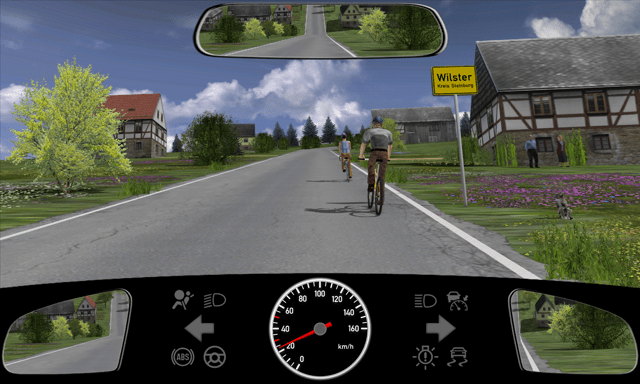
Wyjaśnienie
When overtaking in built-up areas, you must maintain a distance of at least 1.5 metres to the side of the cyclist. Due to the commuting of cyclists, a larger minimum distance is recommended.
-
Question 19 of 19
Jak właściwie zachować się w tej sytuacji?
1.2.05-1265 PunktówWyjaśnienie
The driving lane line is solid. Therefore, overtaking is forbidden here.