
2.2.04 Distance
Keep enough distance so you can react and brake safely if the vehicle ahead suddenly slows down. In good conditions, remember the simple rule: outside towns keep about half your speed in meters.
Two-second rule
2 sec
Choose a fixed point. When the vehicle ahead passes it, you should pass it at least two seconds later.
Half-speed rule
100 → 50 m
Outside built-up areas, distance should be at least half your speed in meters.
Bad weather
×2
Rain, snow, ice, darkness, or poor visibility mean you need much more distance.
Core Rules to Memorize
Normal safe distance
Keep enough distance to stop safely if the vehicle in front brakes suddenly.
Outside towns
Use the half-speed rule: at 80 km/h keep about 40 m; at 100 km/h keep about 50 m.
In town
In urban traffic, shorter distances can be acceptable when driving attentively and road conditions are good.
Bad conditions
On wet, snowy, or icy roads, increase the distance clearly — often at least double.
Easy Distance Examples
| Speed | Rule | Distance |
|---|---|---|
| 50 km/h | City, about 1 second | ≈ 15 m |
| 80 km/h | Half-speed rule | ≈ 40 m |
| 100 km/h | Half-speed rule | ≈ 50 m |
| Bad weather | Increase safety margin | Often ×2 |
Memory trick
Outside towns: divide your speed by 2 and use that number as meters. Example: 80 km/h ÷ 2 = 40 m.
Special Rule: Long Vehicles, Trucks, and Trailers
Vehicles longer than 7 m
Outside built-up areas, long vehicle combinations must keep enough distance so overtaking vehicles can safely pull back into the lane.
Trucks over 3.5 t
They must leave an insertion distance, called Einscherabstand, so another vehicle can move back in after overtaking.
Car with trailer
Outside towns, cars with trailers are usually limited to 80 km/h, so the half-speed distance is about 40 m.
Heavy truck on motorway
For a truck around 12 t at 80 km/h on the Autobahn, remember the exam value: at least 50 m distance.
Why Distance Matters
Reaction time: More distance gives you more time to notice danger and react.
Braking distance: Extra weight, trailers, wet roads, and high speed increase the distance needed to stop.
Overtaking safety: Long vehicles must create space so overtaking vehicles can safely return to the lane.
Collision prevention: Distance is not a goal by itself; it exists to prevent rear-end crashes.
Exam Checklist
- ✓Can I stop safely if the vehicle ahead brakes?
- ✓Outside town: is my distance at least half my speed in meters?
- ✓Is the road wet, icy, snowy, or dark? Then increase distance.
- ✓Am I driving a long vehicle or trailer? Leave space for overtaking vehicles.
Mini Quiz
At 100 km/h outside town, how much distance?
About 50 meters.
At 80 km/h with a trailer, what distance?
About 40 meters using the half-speed rule.
What should you do on icy roads?
Increase the distance greatly, often at least double.
Practice Questions (3)
-
Question 1 of 3
Your are driving a coach at a speed in excess of 50 km/h on the motorway. Why do you have to maintain a minimum distance of 50 m to the vehicle ahead?
2.2.04-1043 Points -
Question 2 of 3
You are driving at approximately 80 km/h on the autobahn. Which distance must you keep from the vehicle travelling in front?
2.2.04-2053 PointsCorrect: 50
-
Question 3 of 3
What is true here regarding the distance between you and the vehicle ahead?
2.2.04-2074 Points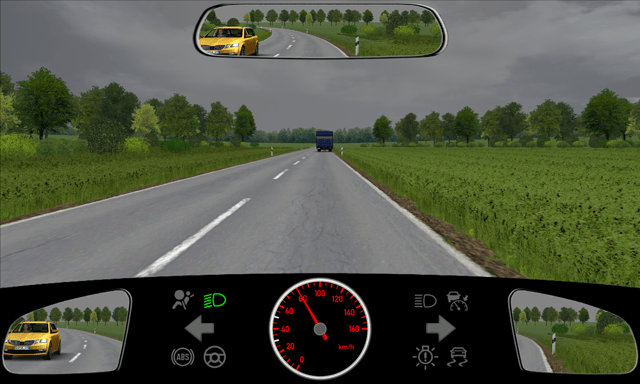
Explanation
The distance is appropriate because the overtaking car can insert in front of you. As soon as the overtaking car is freezing in front of you, you have to make a sufficient distance from it.