
1.1.03 Road and weather conditions
Master the rules for driving in adverse weather and road conditions. This module covers critical safety rules frequently tested in the theory exam.
warning Dirt, Mud & Oil on the Road
Road surfaces can become dangerously slippery even without rain. This is common in agricultural areas or after accidents. The danger is that the slippery film is often invisible until you lose traction.
Watch out for:
- agriculture Farm Vehicles: They often leave large clumps of mud on the road, especially during harvest season.
- water_drop Oil Spills: Look for rainbow-colored sheens on the asphalt. Extremely slippery.
- nature Wet Leaves: In autumn, wet leaves can be as slippery as ice (black ice effect).
lightbulb Exam Tip
If you see a sign warning of "Dirty Road" or "Construction Site," the correct answer is always to reduce speed immediately, not just "be ready to brake."
rainy Wet Roads & Heavy Rain
Aquaplaning (Hydroplaning) occurs when a layer of water builds up between the wheels of the vehicle and the road surface, leading to a loss of traction. You are essentially "floating" on the water.
Causes of Aquaplaning
- High Speed (Main factor)
- Worn tires (Low tread depth)
- Grooves in the road (Spurrillen)
Correct Reaction
- Do not steer abruptly.
- Do not brake hard.
- Take your foot off the accelerator.
- Disengage the clutch (if manual).
- Wait for tires to regain contact.
ac_unit Ice, Frost & Winter Conditions
Black ice is one of the most dangerous conditions because it's invisible. Be extra cautious on bridges and in forest aisles where the sun doesn't reach the road.
Do This (Correct)
- check_small Drive at low RPM in a high gear to prevent wheel spin.
- check_small Test brake response gently at low speed to check grip.
- check_small Allow 3x normal braking distance.
Avoid This (Wrong)
- close_small Driving with high RPM (causes wheels to lose grip).
- close_small Jerky steering movements.
- close_small Warming up the engine while stationary (Illegal in Germany).
texture Tram Tracks & Cobblestones
Tram Tracks
Metal tracks provide almost zero grip, especially when wet. Two-wheeled vehicles (motorcycles, bicycles) are at extreme risk here.
Cobblestones (Kopfsteinpflaster)
Common in historic German city centers. They are noisy and extend braking distance significantly when wet.
foggy Fog & Visibility
Adjusting Speed to Visibility
The golden rule for visibility is: "If visibility is X meters, your speed cannot exceed X km/h."
Rear Fog Light Rule
You may ONLY switch on the rear fog light if visibility is less than 50 meters due to fog.
Core Exam Principle
In any question involving bad weather (rain, fog, snow) or poor road conditions (mud, oil, leaves), the correct answer almost always involves:
- arrow_downward Reducing speed significantly
- space_bar Increasing safety distance
- visibility Anticipating sudden hazards
- do_not_touch Avoiding abrupt braking/steering
assignment Universal Exam Pattern
When facing questions about road conditions, look for these keywords. They often indicate the correct answer.
Practice Questions (16)
-
Question 1 of 16
Where must you particularly reckon with dirt on the roadway and therefore danger of skidding?
1.1.03-0013 PointsExplanation
At junctions of dirt roads and at construction sites, the roadway is likely to be heavily soiled with soil, clay and dirt. Vehicles coming from there bring the dirt onto the road with the tread grooves of their tyres. In wet conditions, this means an increased risk of slipping.
-
Question 2 of 16
Where must you especially reckon with ice on the roadway?
1.1.03-0034 PointsExplanation
You must expect increased icing on the road in the following areas: in damp, shady and windy locations that favour the formation of ice on the road. These include, above all, forest locations and bridges. In forests, the cold lasts longer than in open fields. Because of the shade, moisture takes longer to evaporate here. On bridges, roadways store less heat than on the ground. Bridge roadways are therefore colder and ice up faster. The moisture of the surrounding water and the increased wind due to the unprotected location also promote icing.
-
Question 3 of 16
There is oil on the road. What should you do now?
1.1.03-0054 Points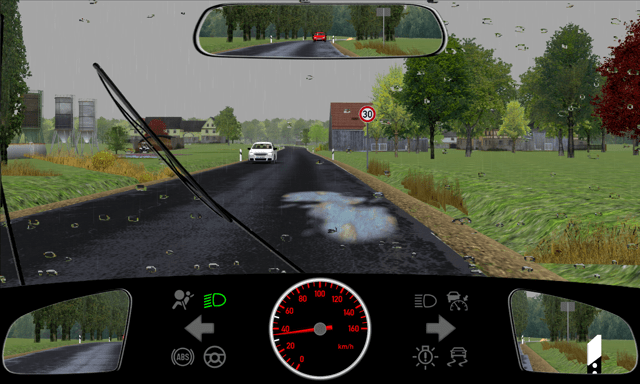
Explanation
If there is oil on the road, avoid jerky steering and heavy braking; there is a risk of slipping. Provided other road users are not endangered, you can move to the left lane. Notify the fire brigade so that the oil can be bound.
-
Question 4 of 16
What must you be prepared for here?
1.1.03-0063 Points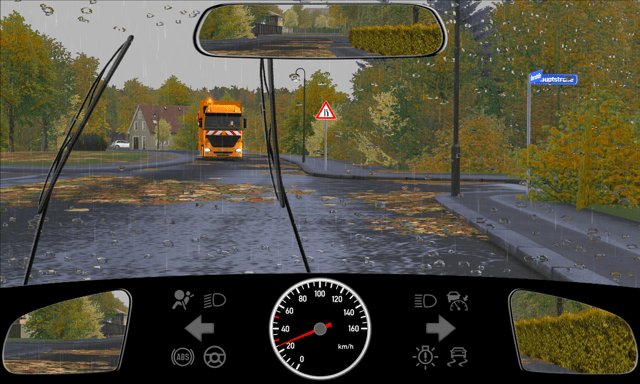
Explanation
Due to the weather and the corresponding conditions on the road, you have to be prepared for an extended braking distance, for a vehicle coming from the right (right before left) and for a narrowed lane.
-
Question 5 of 16
You are driving following a heavy rain shower. What should you be aware of in this situation?
1.1.03-0074 Points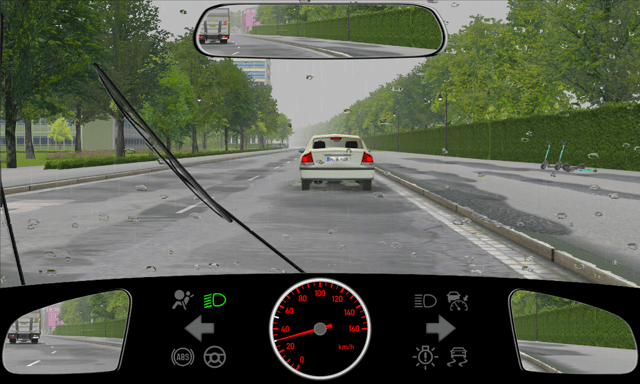
Explanation
When it rains, your view worsens. Therefore, you should enlarge your safety distance to the vehicle in front, as your braking distance is extended. Spray water can be whirled up from the vehicle in front by a wet road. This means that bumps are difficult to recognize.
-
Question 6 of 16
Why does driving on this stretch of road require greater alertness on the part of the motorist?
1.1.03-1024 Points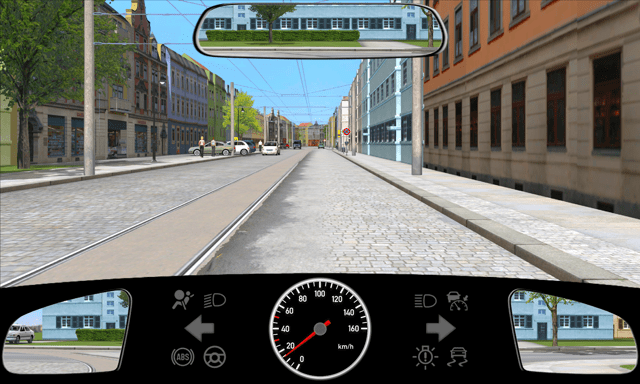
Explanation
A tram may come towards you on the tracks, in which case the lane becomes much narrower for you. Tram tracks are also dangerous, especially when wet, because they become slippery. In addition, as there are also cobblestones, the road surface is uneven and has varying degrees of grip. This can increase the braking distance.
-
Question 7 of 16
The road is icy for a short distance. What should you avoid here, if possible?
1.1.03-1044 PointsExplanation
On icy roads, your tyres do not grip as well as usual. Therefore, you should avoid dangerous situations, i.e. neither brake nor accelerate abruptly. You should also refrain from sudden steering movements. This could cause your vehicle to skid. Only brake and steer away from the icy surface.
-
Question 8 of 16
While driving, how can you safely check whether the road is icy?
1.1.03-1054 PointsExplanation
Test the condition of the road by braking carefully at low speed. Be sure to pay attention to the traffic behind you. Avoid jerking the steering or accelerating sharply. This could cause your vehicle to swerve and become uncontrollable.
-
Question 9 of 16
Why must you drive with particular caution here?
1.1.03-1083 Points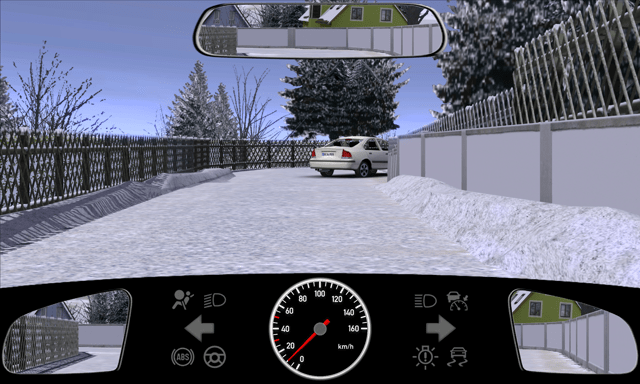
Explanation
Snow makes the road slippery. There is a curve in front of you that is difficult to see and a car is parked there. You will have to pull out into the oncoming lane to drive around it. Therefore, drive extra carefully to be able to react at any time. In addition, your vehicle needs suitable tyres for good grip.
-
Question 10 of 16
Where must you be prepared to encounter sudden fog?
1.1.03-1093 PointsExplanation
Humidity at low temperatures favours the formation of fog. Therefore, fog is more likely to occur around lakes, watercourses and rivers as well as moorland areas.
-
Question 11 of 16
What do you do if visibility is drastically reduced by fog?
1.1.03-1104 PointsExplanation
Adjust your speed and driving style to the visibility conditions. Make sure that you can stop within sight. If necessary, increase the safety distance to the vehicle in front. Fog with a visibility of 50 metres, for example, means that you may drive at a maximum of 50 km/h.
-
Question 12 of 16
What is the right course of action here?
1.1.03-1124 Points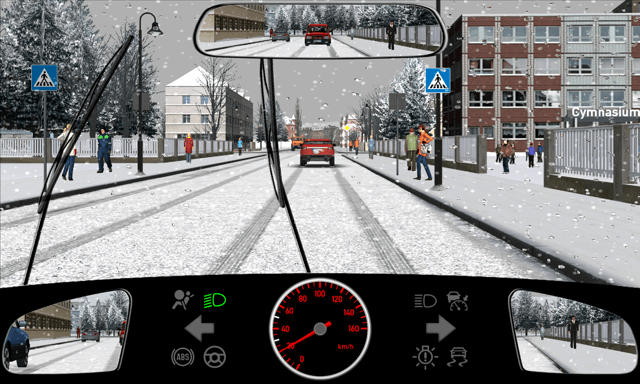
Explanation
Even if the lane marking is not visible, the traffic signs show the presence of the pedestrian crossing. Brake carefully to prevent your vehicle from skidding.
-
Question 13 of 16
Why do you have to pay particular attention here?
1.1.03-1144 Points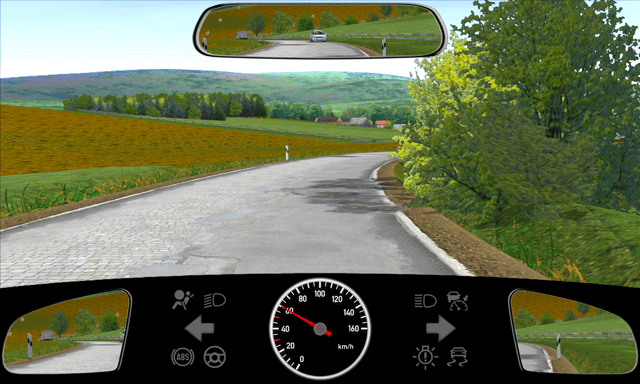
Explanation
There is a long curve in front of you, the end of which you cannot see. A fast-moving vehicle could come towards you from there and cut your lane. The road surface is also uneven and does not have an even surface. So anticipate insufficient grip and drive at an adapted speed.
-
Question 14 of 16
Why might taking the right turn be dangerous here?
1.1.03-1164 Points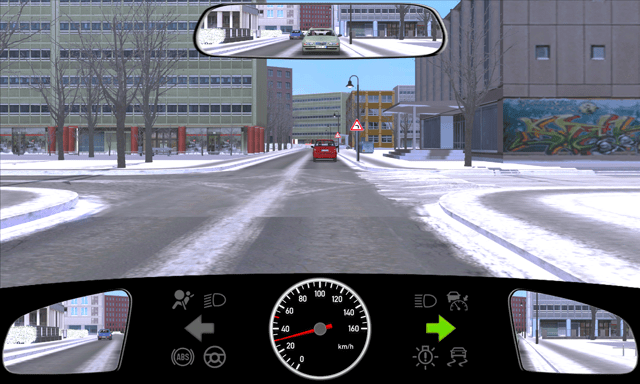
Explanation
The winter weather makes the road slippery and increases the braking distance at the intersection. Your car or oncoming vehicles could skid or slide away uncontrollably. Therefore, reduce your speed in good time and do not brake abruptly. The road on the right is still full of snow and therefore even slicker. Watch out for pedestrians when turning. They always have priority when you turn.
-
Question 15 of 16
What is the correct course of action in this situation?
1.1.03-1203 Points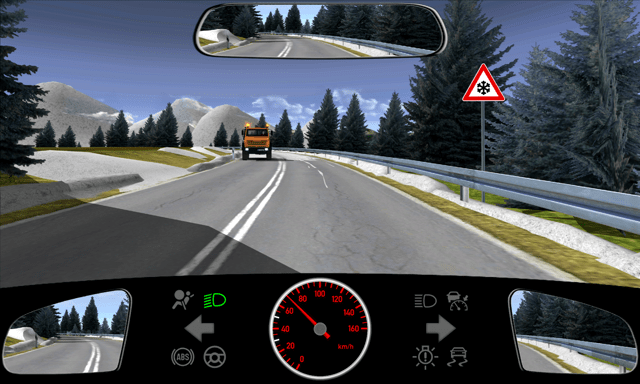
Explanation
Drive carefully, slowly and avoid abrupt steering or braking, because slippery snow or ice can occur at any time.
-
Question 16 of 16
While driving, it suddenly begins to rain heavily. What should you do?
1.1.03-1214 PointsExplanation
Extra care should be taken when driving in heavy rain. This includes adjusting speed, increasing the safe distance and avoiding heavy acceleration, which creates a risk of slipping.