
1.1.03 Condiciones de carretera y clima
Domina las reglas para conducir en condiciones climáticas y de carretera adversas. Este módulo cubre reglas de seguridad críticas que se prueban con frecuencia en el examen teórico.
warning Suciedad, barro y aceite en la carretera
Las superficies de las carreteras pueden volverse peligrosamente resbaladizas incluso sin lluvia. Esto es común en zonas agrícolas o después de accidentes. El peligro es que la película resbaladiza suele ser invisible hasta que se pierde tracción.
Cuidado con:
- agriculture Vehículos agrícolas: A menudo dejan grandes terrones de barro en el camino, especialmente durante la temporada de cosecha.
- water_drop Derrames de petróleo: Busque brillos de colores del arco iris en el asfalto. Extremadamente resbaladizo.
- nature Hojas Mojadas: En otoño, las hojas mojadas pueden resultar tan resbaladizas como el hielo (efecto hielo negro).
lightbulb Consejo de examen
Si ve una señal de advertencia de "camino sucio" o "sitio en construcción", la respuesta correcta siempre es reducir la velocidad inmediatamente, no simplemente "estar preparado para frenar".
rainy Carreteras mojadas y fuertes lluvias
Aquaplaning (hidroplaneo) Ocurre cuando se acumula una capa de agua entre las ruedas del vehículo y la superficie de la carretera, provocando una pérdida de tracción. Básicamente estás "flotando" en el agua.
Causas del aquaplaning
- Alta velocidad (factor principal)
- Neumáticos gastados (baja profundidad de la banda de rodadura)
- Surcos en el camino (Spurrillen)
Reacción correcta
- Hacer no conducir bruscamente.
- Hacer no frenar fuerte.
- Quita el pie del acelerador.
- Desengrane el embrague (si es manual).
- Espere a que los neumáticos recuperen el contacto.
ac_unit Hielo, heladas y condiciones invernales
El hielo negro es una de las condiciones más peligrosas porque es invisible. Tenga mucho cuidado en puentes y pasillos del bosque donde el sol no llega a la carretera.
Haz esto (correcto)
- check_small Conduzca a bajas RPM en una marcha alta para evitar que las ruedas patinen.
- check_small Pruebe la respuesta de los frenos suavemente a baja velocidad para comprobar el agarre.
- check_small Permitir 3 veces la distancia de frenado normal.
Evite esto (incorrecto)
- close_small Conducir a altas RPM (hace que las ruedas pierdan agarre).
- close_small Movimientos bruscos de dirección.
- close_small Calentar el motor estando parado (Ilegal en Alemania).
texture Vías de tranvía y adoquines
Vías del tranvía
Las orugas de metal proporcionan un agarre casi nulo, especialmente cuando están mojadas. Los vehículos de dos ruedas (motocicletas, bicicletas) corren aquí un riesgo extremo.
Adoquines (Kopfsteinpflaster)
Común en los centros históricos de las ciudades alemanas. Son ruidosos y amplían significativamente la distancia de frenado cuando están mojados.
foggy Niebla y visibilidad
Ajustar la velocidad a la visibilidad
La regla de oro para la visibilidad es: "Si la visibilidad es de X metros, tu velocidad no puede exceder los X km/h."
Regla de la luz antiniebla trasera
SÓLO podrá encender la luz antiniebla trasera si la visibilidad es menos de 50 metros debido a la niebla.
Principio del examen básico
En cualquier cuestión que involucre mal tiempo (lluvia, niebla, nieve) o malas condiciones de la carretera (barro, aceite, hojas), la respuesta correcta casi siempre implica:
- arrow_downward Reducir significativamente la velocidad
- space_bar Aumento de la distancia de seguridad
- visibility Anticipar peligros repentinos
- do_not_touch Evitar frenar o girar bruscamente
assignment Patrón de examen universal
Cuando tenga preguntas sobre las condiciones de la carretera, busque estas palabras clave. A menudo indican la respuesta correcta.
Preguntas de práctica (16)
-
Pregunta 1 de 16
¿Dónde hay que contar especialmente con un fuerte ensuciamiento de la calzada y, por ello con el peligro de patinar?
1.1.03-0013 puntosExplicación
At junctions of dirt roads and at construction sites, the roadway is likely to be heavily soiled with soil, clay and dirt. Vehicles coming from there bring the dirt onto the road with the tread grooves of their tyres. In wet conditions, this means an increased risk of slipping.
-
Pregunta 2 de 16
¿Dónde hay que contar especialmente con peligro de hielo en la calzada?
1.1.03-0034 puntosExplicación
You must expect increased icing on the road in the following areas: in damp, shady and windy locations that favour the formation of ice on the road. These include, above all, forest locations and bridges. In forests, the cold lasts longer than in open fields. Because of the shade, moisture takes longer to evaporate here. On bridges, roadways store less heat than on the ground. Bridge roadways are therefore colder and ice up faster. The moisture of the surrounding water and the increased wind due to the unprotected location also promote icing.
-
Pregunta 3 de 16
En la calzada hay aceite. ¿Cómo debe comportarse usted en este caso?
1.1.03-0054 puntos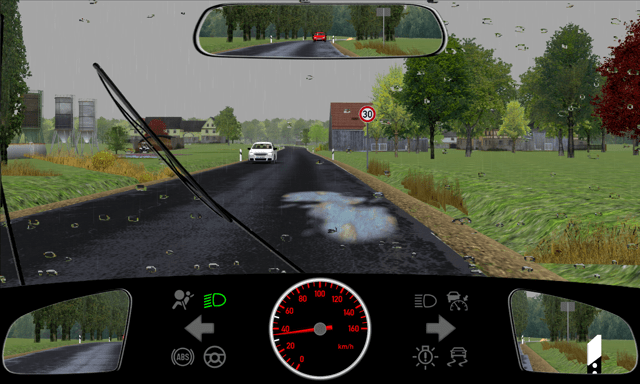
Explicación
If there is oil on the road, avoid jerky steering and heavy braking; there is a risk of slipping. Provided other road users are not endangered, you can move to the left lane. Notify the fire brigade so that the oil can be bound.
-
Pregunta 4 de 16
¿Qué ha de esperar que ocurra en esta situación?
1.1.03-0063 puntos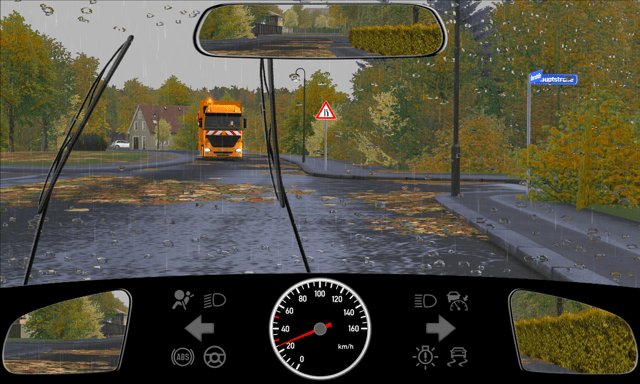
Explicación
Due to the weather and the corresponding conditions on the road, you have to be prepared for an extended braking distance, for a vehicle coming from the right (right before left) and for a narrowed lane.
-
Pregunta 5 de 16
Va circulando después de haber llovido con intensidad. ¿Qué debería tener en cuenta en esta situación?
1.1.03-0074 puntos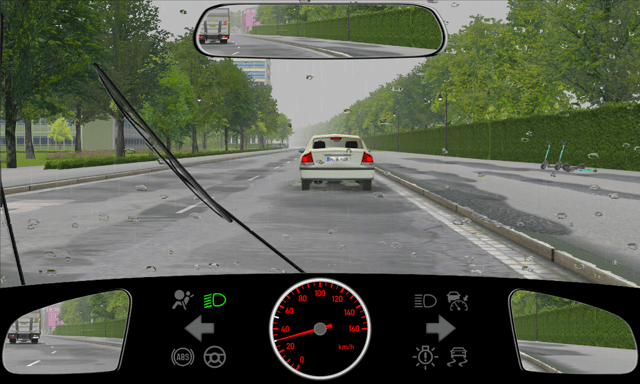
Explicación
When it rains, your view worsens. Therefore, you should enlarge your safety distance to the vehicle in front, as your braking distance is extended. Spray water can be whirled up from the vehicle in front by a wet road. This means that bumps are difficult to recognize.
-
Pregunta 6 de 16
¿Por qué tiene que circular con atención especial en esta carretera?
1.1.03-1024 puntos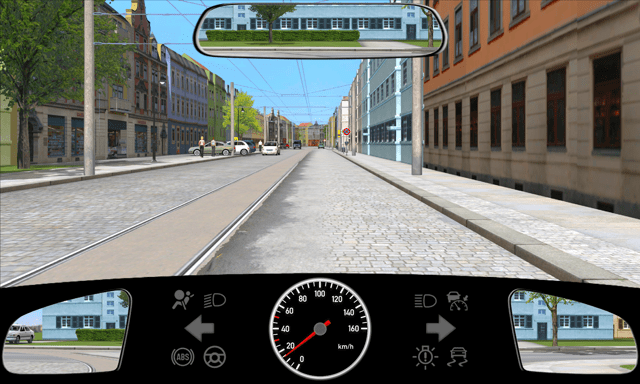
Explicación
A tram may come towards you on the tracks, in which case the lane becomes much narrower for you. Tram tracks are also dangerous, especially when wet, because they become slippery. In addition, as there are also cobblestones, the road surface is uneven and has varying degrees of grip. This can increase the braking distance.
-
Pregunta 7 de 16
En un tramo corto la carretera está cubierta de hielo. ¿Qué debe Ud. evitar aquí, en lo posible?
1.1.03-1044 puntosExplicación
On icy roads, your tyres do not grip as well as usual. Therefore, you should avoid dangerous situations, i.e. neither brake nor accelerate abruptly. You should also refrain from sudden steering movements. This could cause your vehicle to skid. Only brake and steer away from the icy surface.
-
Pregunta 8 de 16
¿Cómo puede comprobar sin peligro durante la marcha si la calzada está helada?
1.1.03-1054 puntosExplicación
Test the condition of the road by braking carefully at low speed. Be sure to pay attention to the traffic behind you. Avoid jerking the steering or accelerating sharply. This could cause your vehicle to swerve and become uncontrollable.
-
Pregunta 9 de 16
¿Por qué debe Ud. circular aquí con especial precaución?
1.1.03-1083 puntos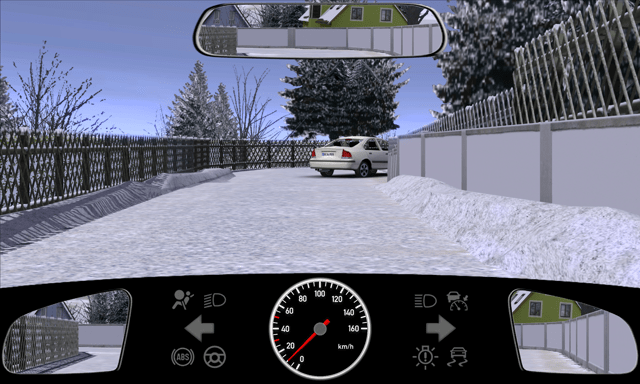
Explicación
Snow makes the road slippery. There is a curve in front of you that is difficult to see and a car is parked there. You will have to pull out into the oncoming lane to drive around it. Therefore, drive extra carefully to be able to react at any time. In addition, your vehicle needs suitable tyres for good grip.
-
Pregunta 10 de 16
¿Dónde debe Ud. contar especialmente con la aparición repentina de niebla?
1.1.03-1093 puntosExplicación
Humidity at low temperatures favours the formation of fog. Therefore, fog is more likely to occur around lakes, watercourses and rivers as well as moorland areas.
-
Pregunta 11 de 16
¿Qué debe Ud. hacer si una cortina de niebla impide fuertemente la visibilidad?
1.1.03-1104 puntosExplicación
Adjust your speed and driving style to the visibility conditions. Make sure that you can stop within sight. If necessary, increase the safety distance to the vehicle in front. Fog with a visibility of 50 metres, for example, means that you may drive at a maximum of 50 km/h.
-
Pregunta 12 de 16
¿Qué es correcto hacer en esta situación?
1.1.03-1124 puntos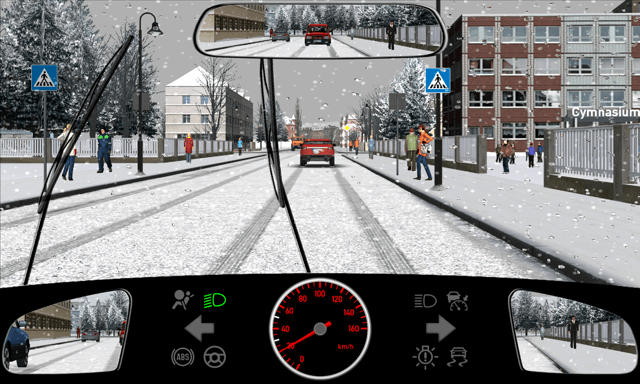
Explicación
Even if the lane marking is not visible, the traffic signs show the presence of the pedestrian crossing. Brake carefully to prevent your vehicle from skidding.
-
Pregunta 13 de 16
¿Por qué ha de estar especialmente atento en esta situación?
1.1.03-1144 puntos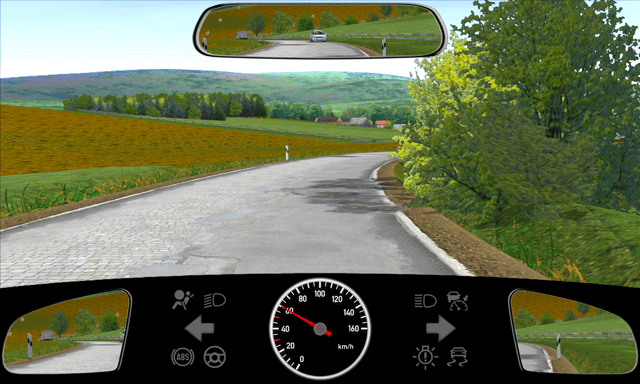
Explicación
There is a long curve in front of you, the end of which you cannot see. A fast-moving vehicle could come towards you from there and cut your lane. The road surface is also uneven and does not have an even surface. So anticipate insufficient grip and drive at an adapted speed.
-
Pregunta 14 de 16
¿Por qué podría resultar peligroso girar a la derecha en esta situación?
1.1.03-1164 puntos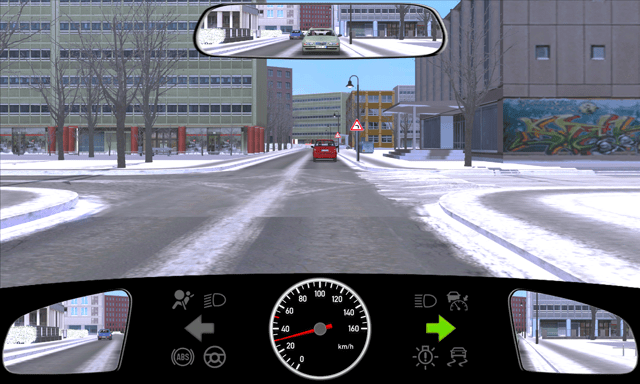
Explicación
The winter weather makes the road slippery and increases the braking distance at the intersection. Your car or oncoming vehicles could skid or slide away uncontrollably. Therefore, reduce your speed in good time and do not brake abruptly. The road on the right is still full of snow and therefore even slicker. Watch out for pedestrians when turning. They always have priority when you turn.
-
Pregunta 15 de 16
¿Qué es correcto hacer en esta situación?
1.1.03-1203 puntos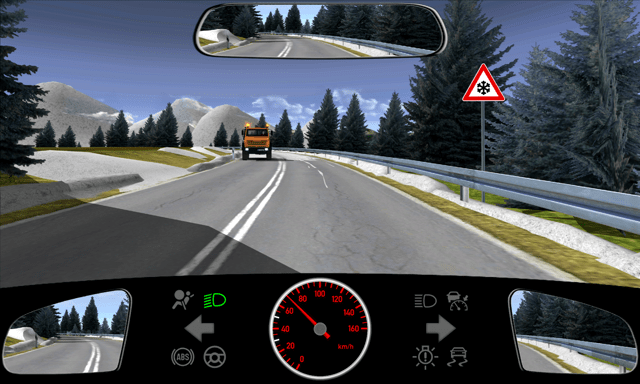
Explicación
Drive carefully, slowly and avoid abrupt steering or braking, because slippery snow or ice can occur at any time.
-
Pregunta 16 de 16
Se encuentra circulando y, de repente, comienza a llover con intensidad. ¿Qué debería hacer?
1.1.03-1214 puntosExplicación
Extra care should be taken when driving in heavy rain. This includes adjusting speed, increasing the safe distance and avoiding heavy acceleration, which creates a risk of slipping.