
1.2.12 Arrêt et stationnement
Apprenons rapidement les règles d'arrêt et de stationnement les plus importantes avec des explications simples, des astuces de mémoire et des distances importantes.
🧠 Règles de mémoire rapide
⏱ Règle des 3 minutes
Moins de 3 minutes + le conducteur reste à l'intérieur = Arrêt
Plus de 3 minutes OU quitter le véhicule = Parking
🚷 Passage piéton
Pas d'arrêt ni de stationnement : sur ou 5 mètres avant la traversée.
🛑 Arrêts de bus
Parking interdit: 15 mètres avant et après arrêts de bus/tram.
🚦 Jonctions
Conservez généralement :
5 mètres distance.
Parfois:
8 mètres si la visibilité est réduite.
🚘 Différence entre l'arrêt et le stationnement
⛔ Arrêt
- Le véhicule s'arrête moins de 3 minutes
- Le conducteur reste à l'intérieur du véhicule
- La raison n'est PAS liée au trafic
- Exemple : Récupérer quelqu'un rapidement
🅿Stationnement
- Plus de 3 minutes
- OU le conducteur quitte le véhicule
- Départ même court = stationnement
- Exemple : Quitter la voiture pour acheter du café
📏 Distances importantes dont vous DEVEZ vous souvenir
| Lieu | Règle de distance | Signification |
|---|---|---|
| Passage pour piétons | 5 mètres avant | Pas d'arrêt ni de stationnement |
| Jonction / Intersection | 5 mètres | Gardez une visibilité claire |
| Grandes jonctions | 8 mètres | S'il existe une piste cyclable ou un problème de visibilité |
| Arrêts de bus/tramway | 15 mètres avant et après | Autoriser la circulation des transports en commun |
| Passage à niveau | 5 mètres minimum | Ne bloquez pas la visibilité des voies ferrées |
| Région de la Croix de Saint-André | 50 mètres hors des villes | Gardez suffisamment d'espace d'attente |
🚫 Où vous ne devez PAS vous arrêter ou vous garer
🚶 Passages pour piétons
Pas d'arrêt ni de stationnement 5 m avant les passages à niveau.
🚌 Arrêts de bus
Parking interdit 15 m avant et après les arrêts de bus/tram.
🚦 Jonctions
Pas de stationnement à proximité des intersections car la visibilité est bloquée.
🚂 Passages à niveau
Ne vous arrêtez jamais et ne vous garez jamais là où les trains pourraient être obstrués.
🛣 Autoroutes
L'arrêt sur l'autoroute ou sur la bande d'arrêt d'urgence est interdit sauf urgence.
🚪 Allées
Ne vous garez jamais devant des bordures ou des entrées abaissées.
⭐ Règles d'examen spécial
🚕 Stationnement de la deuxième rangée
Seuls les taxis peuvent s'arrêter brièvement dans la deuxième rangée pour les passagers. Les autres véhicules sont généralement interdits.
➡ Sens de stationnement
Garez-vous généralement sur le côté droit dans le sens de la marche. Exception : rues à sens unique ou voies de tramway du côté droit.
⚠ Feux de détresse
Les feux de détresse ne permettent PAS d'attendre ou de stationner illégalement.
🛣 Épaule dure
L'attente est autorisée uniquement du côté de l'épaule, PAS à gauche de la ligne blanche continue.
🎯 Conseils d'examen faciles
- 3 minutes = frontière importante
- 5 mètres = croisements/jonctions
- 15 mètres = arrêts de bus
- La visibilité ne doit jamais être bloquée
- Stationnement avant les passages piétons
- Arrêt sur l'accotement de l'autoroute
- Blocage des bordures abaissées
- En attente au deuxième rang
Questions d’entraînement (22)
-
Question 1 sur 22
Où l'arrêt est-il interdit?
1.2.12-0013 pointsExplication
A "stop" is when a vehicle stops for less than 3 minutes for reasons unrelated to traffic without the driver getting out of the vehicle. If the driver stops for a longer time and/or leaves his vehicle, this is called parking. However, drivers are not allowed to stop everywhere so as not to endanger other road users. Exceptions are: - Non-stop zones - Transitions through levels as there is a risk of collision with the train - Narrow and incomprehensible places with a clearance width of less than 3 m blind turns - Hilltops - Pedestrian crossings and the area in front of them (distance not less than 5 m), but not the area behind them.
-
Question 2 sur 22
Où le stationnement est-il interdit?
1.2.12-0023 pointsExplication
As soon as you stop or leave your vehicle for more than three minutes without any traffic-related reason, this is called parking. This is not allowed everywhere. You may not park in areas with stopping restrictions or parking prohibition - nor where you impede or obstruct other road users. Parking restrictions also apply to priority roads outside built-up areas. Use side strips or parking bays.
-
Question 3 sur 22
Où l'arrêt est-il interdit?
1.2.12-1033 pointsExplication
You may only stop where you do not endanger other road users. This is the case, for example, if there is a hard shoulder separated from the carriageway by a continuous white line. You are not allowed to stop - on marked lanes that are used for getting into the right of way - on the carriageway if there is a hard shoulder - at bus stops or other public transport stops - at taxi ranks, so as not to block the access of taxis - on motorways or motorways, not even on the hard shoulder. Watch out for two-wheelers!
-
Question 4 sur 22
Où l'arrêt est-il interdit?
1.2.12-1043 pointsExplication
On and up to five meters in front of a pedestrian crossing, you must not stop because you obstruct the clear view of other drivers on pedestrians. These could then be recognized too late. After a pedestrian crossing you may stop. Waiting is allowed on manhole covers, but not parking.
-
Question 5 sur 22
Où le stationnement est-il interdit?
1.2.12-1053 pointsExplication
You are not allowed to park at the edge of the road, where you block marked parking areas and thus hinder other road users. Parking is also prohibited in front of lowered curbs, which are for example located in front of driveways. Lowered curbs should allow wheelchair users to cross the road. Safe and therefore allowed is parking after a pedestrian crossing.
-
Question 6 sur 22
Où pouvez-vous stationner dans le sens de la marche à gauche?
1.2.12-1063 pointsExplication
You may only park in the direction of travel on the right-hand side of the road. This also applies if all parking spaces are on the left side. You may have to turn if allowed. The only exception are one-way streets, as they are only used in one direction of travel. If there are rails on the right, you must also park on the left, but always observe parking restrictions.
-
Question 7 sur 22
Dans quel cas parle-t-on de stationnement?
1.2.12-1073 pointsExplication
If the car driver deliberately stops the vehicle and stays there for more than three minutes or leaves the stopped vehicle, this is considered parking. The stopping and waiting in front of a gate is not considered parking, no matter how long it takes, because the break is due to traffic.
-
Question 8 sur 22
A l'arrêt ou en stationnement, quelle distance minimale doit-on observer avant un passage pour piétons?
1.2.12-1083 pointsCorrect: 5
Explication
On a pedestrian crossing and up to 5 m in front no stopping or parking is allowed. So, you can freely view the pedestrian crossing as a car driver and passers-by have a good overview of the traffic.
-
Question 9 sur 22
En dehors d'une agglomération, quelle distance minimale doit-il y avoir entre un véhicule en stationnement et la croix de Saint-André?
1.2.12-1102 pointsCorrect: 50
Explication
At a railroad crossing with a St. Andrew's Cross sign, the view of the level crossing must not be obstructed with a distance of 50m to have enough space for waiting vehicles.
-
Question 10 sur 22
A l'intérieur d'une agglomération, vous voulez stationner devant une croix de Saint-André. Quelle distance minimale devez-vous respecter?
1.2.12-1112 pointsCorrect: 5
Explication
At a railroad crossing with St. Andrew's Cross, the rail vehicle has priority. To avoid obscuring the view of the railway line, a safety distance of 5 meters must be maintained.
-
Question 11 sur 22
Jusqu'à quelle distance de part et d'autre d'un panneau d'arrêt de transport en commun est-il interdit de stationner?
1.2.12-1122 pointsCorrect: 15
Explication
It is not allowed to park 15 meters before and after the stop sign to allow public transports to approach, stop and leave without encumbrance.
-
Question 12 sur 22
Combien de temps pouvez-vous au maximum être à l'arrêt dans une zone d'arrêt d'autobus dans la mesure où vous ne gênez aucun autobus?
1.2.12-1132 pointsCorrect: 3
Explication
The stopping time is limited to a maximum of 3 minutes. If a vehicle is stopped for more than 3 minutes, the vehicle is considered as parked. Thus it is only alowed to stop for 3 minutes
-
Question 13 sur 22
Qui se gare mal?
1.2.12-1212 points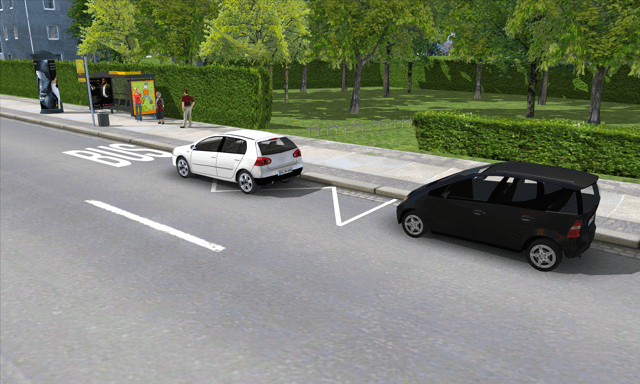
Explication
The zigzagged line shortens or extends a waiting or parking ban. As far as there is no border marking on the road, a parking ban of up to 15 meters in front of and behind the stop sign applies. In this situation, the white car parked incorrectly because it stands on the marking. The dark car, however, parks properly.
-
Question 14 sur 22
Quand n'avez-vous pas le droit de vous garer sur la voie de droite?
1.2.12-1223 pointsExplication
In general, parking is prohibited if it could endanger other road users. Visual disability is also included. Therefore, parking is not allowed in all three situations.
-
Question 15 sur 22
A quoi devez-vous ici être attentif?
1.2.12-1233 points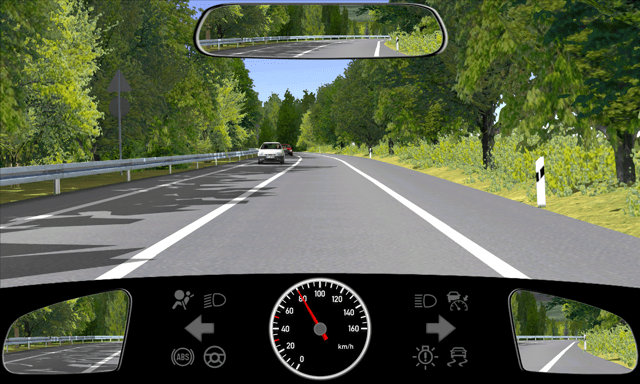
Explication
Never wait on the left of the lane mark. You would impede or even endanger subsequent vehicles. The side strip is designed for parking, waiting and slow vehicles. As a slow-moving driver you must use such a sufficiently wide and well-fastened strip for driving. In this case, you may drive over the thick solid line with your vehicle representing an official lane boundary.
-
Question 16 sur 22
Quels véhicules peuvent s'arrêter en double file sur les chaussées?
1.2.12-1242 pointsExplication
In exceptional cases, taxis are only allowed to stop in the second row when passengers are getting on or off.
-
Question 17 sur 22
A quel endroit est-il interdit de s'arrêter?
1.2.12-1253 pointsExplication
You are not allowed to wait on acceleration or on deceleration lanes. Also, on lanes with directional arrows you must not stop. This does not apply to driveways in front of properties.
-
Question 18 sur 22
Qui n'est pas stationné correctement?
1.2.12-1263 points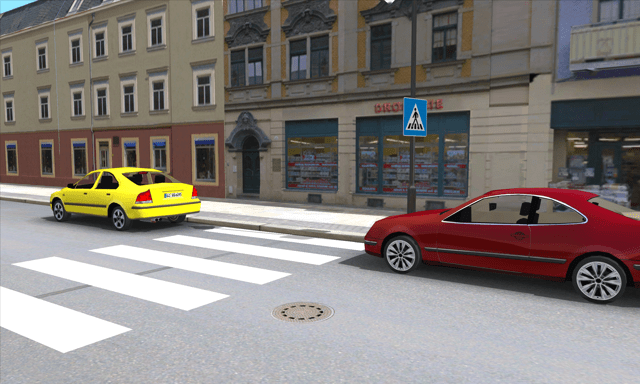
Explication
On pedestrian crossings and five meters before, waiting is prohibited. The aim of this provision is to ensure a clear view of approaching vehicles and pedestrians who are willing to cross in this traffic situation.
-
Question 19 sur 22
Où pouvez-vous vous garer ici?
1.2.12-1283 points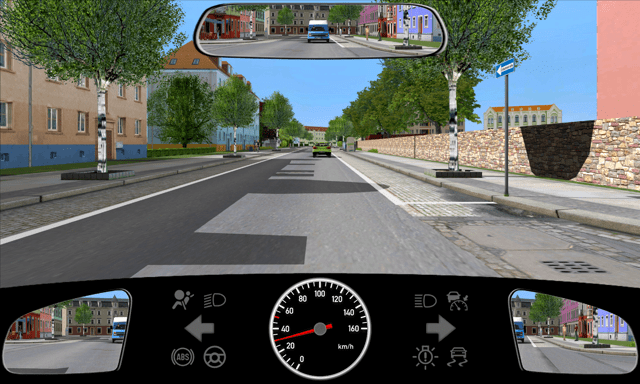
-
Question 20 sur 22
Vous cherchez une aire de stationnement sur le côté droit de la chaussée. Il n'y a aucune piste cyclable à droite de votre voie. À combien de mètres en amont et en aval d'un croisement ne devez-vous pas stationner?
1.2.12-1313 pointsCorrect: 5
Explication
In order not to limit the view, you are not allowed to park 5 meters before and after an intersection.
-
Question 21 sur 22
Où est-il interdit de s'arrêter?
1.2.12-1323 pointsExplication
Stopping occurs when a vehicle is stopped for less than 3 minutes for non-traffic reasons while the driver does not leave the vehicle. If the driver stops longer and/or leaves his vehicle, this is referred to as parking. You are not allowed to stop everywhere, for example so as not to endanger other road users. Fire brigade access roads and no-stopping zones, among other things, are excluded; a distinction is made here between parking and stopping. This does not apply to all one-way streets.
-
Question 22 sur 22
Vous êtes en train de chercher un parking sur le côté droit de la route. À droite à côté de la chaussée se trouve une piste cyclable. Combien de mètres avant un carrefour ou avant une intersection n'avez-vous pas le droit de vous garer?
1.2.12-1333 pointsCorrect: 8
Explication
To avoid obstructing visibility, you are not allowed to park 8 meters in front of and behind a junction or intersection.