
1.2.36 Signes et instructions des policiers
👮 Comment les policiers contrôlent la circulation, que signifient leurs signaux et pourquoi les instructions de la police ont toujours la plus haute priorité ? Apprenons-les.
🧠 Ordre prioritaire dans le trafic
1. Policier
Plus haute autorité
2. Feux de circulation
Remplacer les panneaux
3. Panneaux de signalisation
Remplacer les règles de base
4. Droite avant la gauche
Règle de base
🚦 Signaux de policier
Face à vous
Si l'agent vous fait face, la poitrine ou le dos, vous devez vous arrêter et attendre.
De côté / Profil
Si vous voyez le profil de l'agent, vous pouvez continuer à conduire prudemment.
Bras levé
Arrêtez-vous et préparez-vous aux nouvelles instructions de circulation.
🚓 Signal « VEUILLEZ SUIVRE »
📢 Ce que cela signifie
- La police veut arrêter votre véhicule
- Vous devez suivre la voiture de police
- Ne dépassez pas le véhicule de police
- Arrêtez-vous quand la police s'arrête
⚠ Règle importante
Le signal s'applique généralement au véhicule situé directement derrière la voiture de police.
⚠ Situations de circulation importantes
🚗 Tourner à droite
Si l'agent se tient de côté, vous pouvez continuer et tourner à droite avec précaution.
↩ Tourner à gauche
Entrez prudemment dans l’intersection et attendez la prochaine instruction de la police.
🚦 Feu rouge ?
Ignorez le feu tricolore si le policier donne des instructions différentes.
👀 Restez prudent
Même lorsque la police contrôle la circulation, surveillez toujours les piétons, les cyclistes et les autres véhicules.
📚 Table de mémoire facile
| Poste de policier | Signification | Votre action |
|---|---|---|
| Face à toi | ROUTE BARRÉE | ARRÊT |
| De côté/profil | Route ouverte | Conduisez prudemment |
| Bras levé | Attention/transition | Attendez les instructions |
🎯 Conseils d'examen faciles
- Officier de police = autorité suprême
- Face à toi = STOP
- Profil/latéral = GO
- "VEUILLEZ SUIVRE" doit être respecté
- Suivre les feux de circulation au lieu de la police
- Ignorer "VEUILLEZ SUIVRE"
- Conduire trop vite à une intersection
- Ne pas surveiller les piétons
Questions d’entraînement (11)
-
Question 1 sur 11
A une intersection, un agent de police règle la circulation bien que les feux de signalisation fonctionnent. A qui faut-il obéir?
1.2.36-0014 points -
Question 2 sur 11
Comment faut-il interpréter les injonctions d'un agent de police?
1.2.36-0034 pointsExplication
The driver must always follow the signs and instructions of police officers. Other arrangements and rules, such as traffic lights or traffic signs, are put last. However, the road user must not neglect due diligence.
-
Question 3 sur 11
Quel est le comportement correct?
1.2.36-0044 points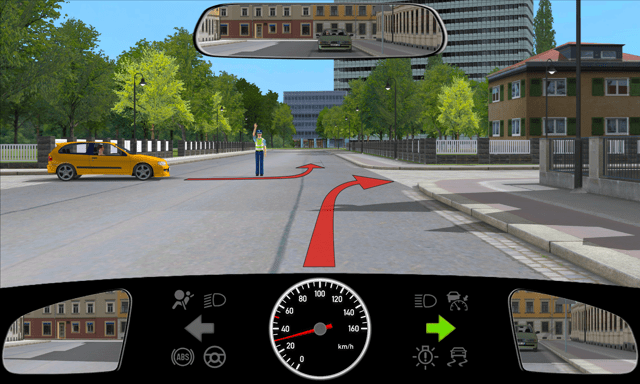
Explication
The police officer gives the traffic instructions by his body position and with specific arm movements. A raised arm means: The drivers waiting at the intersection are not allowed to continue driving, previously locked drivers should prepare for the onward journey. For this, the policeman spreads his arms from the body or puts them on the body, depending on the instructions. If the police officer stands with his chest to the driver, the driver must stop. If the police officer stands sideways and the driver sees his profile, the driver may continue driving at a moderate speed.
-
Question 4 sur 11
Dans le rétroviseur, vous voyez sur le toit d'un véhicule de police roulant derrière vous l'inscription rouge allumée "STOP POLIZEI" (STOP POLICE). A qui est destinée cette injonction?
1.2.36-0073 pointsExplication
Since the request is displayed to the front and you are directly front of the police car, the request is addressed to you. You are required by law to follow the instructions from police officers.
-
Question 5 sur 11
Un véhicule de police vous dépasse et se rabat directement devant vous. Sur le toit apparaît le signal lumineux "BITTE FOLGEN" (SUIVRE SVP). Comment devez-vous vous comporter?
1.2.36-0113 pointsExplication
The signal "PLEASE FOLLOW" always applies to the driver directly behind the police car. So, you have to follow the instructions of the police, drive after the officers and stop behind the police car as soon as it stops.
-
Question 6 sur 11
Un véhicule de police vous dépasse et se rabat directement devant vous. Sur le toit apparaît le signal lumineux "BITTE FOLGEN" (SUIVRE SVP). A qui est adressé cet ordre?
1.2.36-0123 pointsExplication
The signal "PLEASE FOLLOW" on a police car applies to the vehicle immediately behind the police, in this case for you. The police may stop you for traffic control. Follow the police vehicle and stop when it stops.
-
Question 7 sur 11
Le véhicule qui vous précède directement vous fait signe avec un disque de signalisation "police". Qu'est-ce-que cela signifie?
1.2.36-0133 pointsExplication
Basically, the driver who drives directly behind the police car has to follow the signal given by the police. If this is recognizable, the police signaling disc may also apply to drivers in front. You must not overtake the police car and you have to follow it.
-
Question 8 sur 11
Quel est le bon comportement à adopter maintenant?
1.2.36-0144 points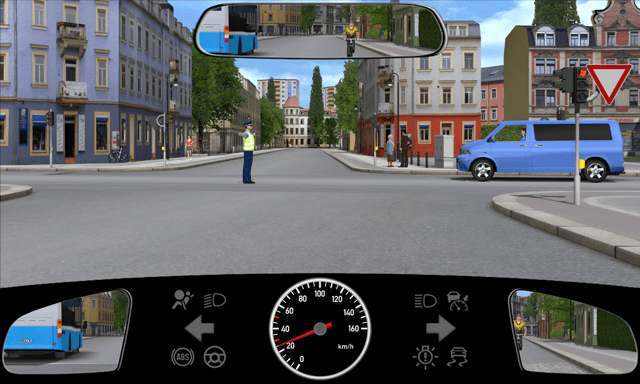
Explication
The police officer is hierarchically first in the right-of-way. Basic rule "right before left", traffic signs and light signals have no effect at this moment. Nevertheless, be attentive because other road users could still behave incorrectly.
-
Question 9 sur 11
Qui est en droit de rouler le premier?
1.2.36-0154 points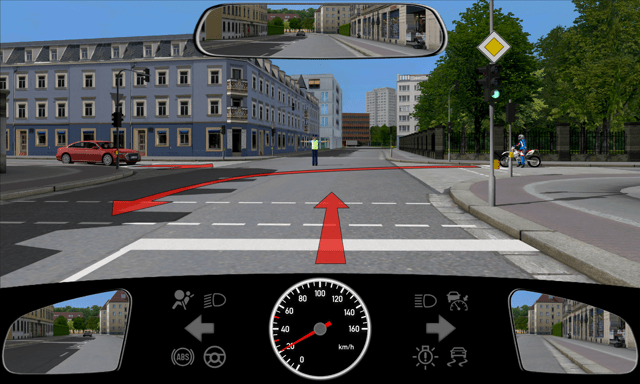
Explication
The traffic is regulated by the police so that the red car is allowed to drive first.
-
Question 10 sur 11
Quelle est la bonne chose à faire dans cette situation?
1.2.36-0164 points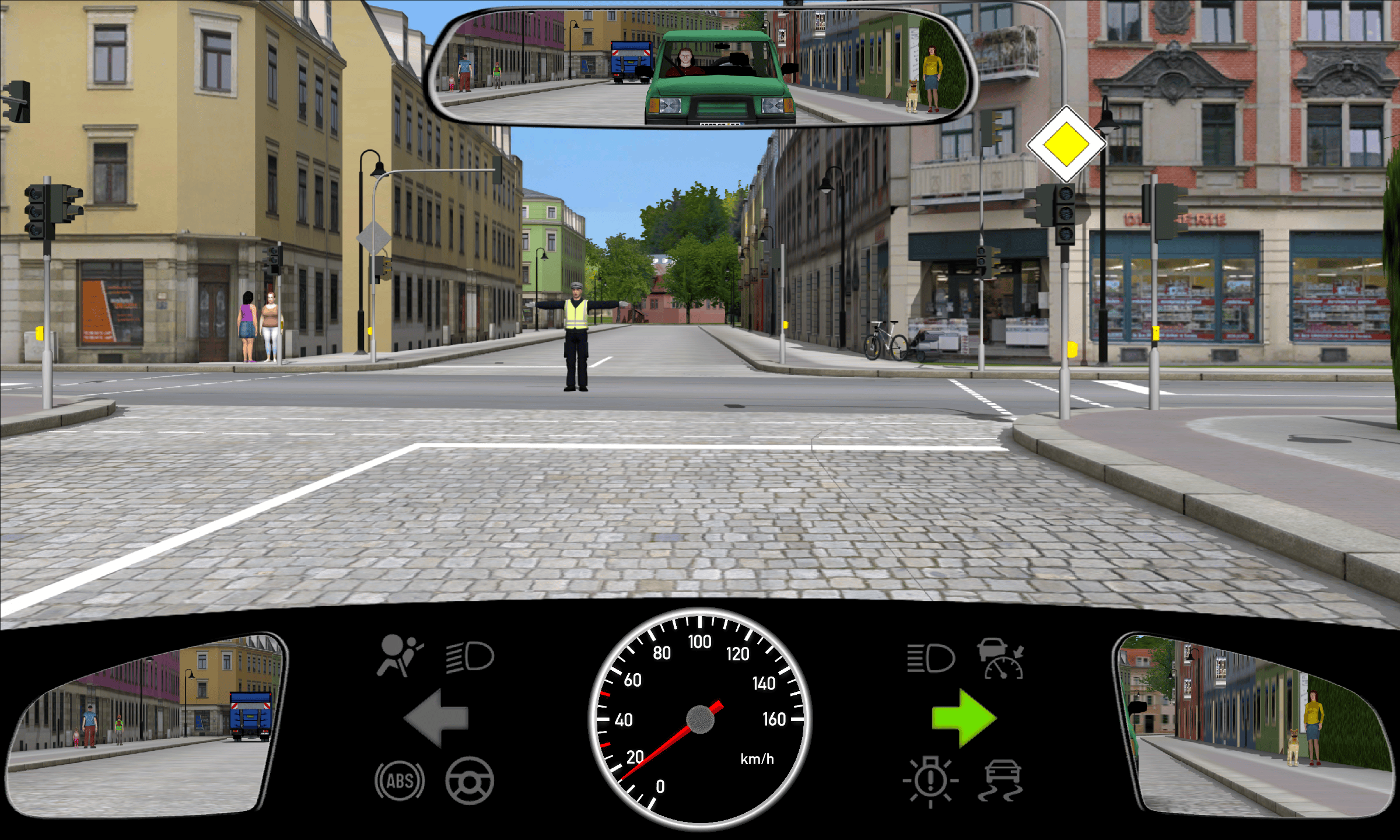
Explication
If a traffic police officer is directing traffic, the instructions must be followed. In this situation, the traffic policeman stands in front of you, facing you and with his arms outstretched. This means that you have to wait at the intersection and vehicles from the right and left have the right of way.
-
Question 11 sur 11
Que faut-il faire ici?
1.2.36-1014 points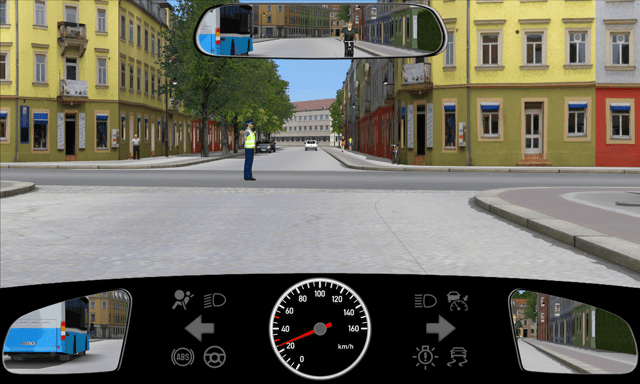
Explication
The traffic policeman's gesture dictates the behavior in traffic. If the officer stands lengthways to your direction of travel and you can see his profile, you can continue and turn right. Right-turning drivers should cross the intersection quickly, as long as no pedestrian or cyclist approaches them. If you want to turn left, enter the intersection to ensure undisturbed traffic flow and wait for the policeman's instructions.