
1.2.12 Fermarsi e parcheggio
Impariamo velocemente le regole più importanti per la sosta e il parcheggio con semplici spiegazioni, trucchi di memoria e distanze importanti.
🧠 Regole di memoria rapida
⏱ La regola dei 3 minuti
Meno di 3 minuti + l'autista rimane all'interno = Fermarsi
Più di 3 minuti OPPURE lasciando il veicolo = Parcheggio
🚷 Attraversamento pedonale
Divieto di sosta o parcheggio: SU O 5 metri prima l'attraversamento.
🛑 Fermate dell'autobus
Parcheggio vietato: 15 metri prima e dopo fermate dell'autobus/tram.
🚦 Giunzioni
Di solito tieni:
5 metri distanza.
A volte:
8 metri se la visibilità è ridotta.
🚘 Differenza tra fermarsi e parcheggiare
⛔ Fermarsi
- Il veicolo si ferma per meno di 3 minuti
- Il conducente rimane all'interno del veicolo
- Il motivo NON è legato al traffico
- Esempio: prendere in braccio qualcuno velocemente
🅿 Parcheggio
- Più di 3 minuti
- OPPURE il conducente scende dal veicolo
- Partenza anche breve = parcheggio
- Esempio: uscire dall'auto per andare a comprare il caffè
📏 Distanze importanti che DEVI ricordare
| Posto | Regola della distanza | Senso |
|---|---|---|
| Passaggio pedonale | 5 metri prima | Divieto di sosta o parcheggio |
| Giunzione/Intersezione | 5 metri | Mantieni la visibilità chiara |
| Grandi giunzioni | 8 metri | Se esiste una pista ciclabile o problemi di visibilità |
| Fermate dell'autobus/tram | 15 metri prima e dopo | Consentire la circolazione dei trasporti pubblici |
| Attraversamento della ferrovia | Minimo 5 metri | Non ostacolare la visibilità ferroviaria |
| Zona Croce di Sant'Andrea | 50 metri fuori città | Mantieni abbastanza spazio di attesa |
🚫 Dove NON devi fermarti o parcheggiare
🚶 Attraversamenti pedonali
Divieto di sosta o parcheggio nei 5 metri prima degli incroci.
🚌 Fermate dell'autobus
Divieto di parcheggio 15 metri prima e dopo le fermate dell'autobus/tram.
🚦 Giunzioni
Divieto di sosta in prossimità degli incroci perché la visibilità è bloccata.
🚂 Passaggi a livello
Non fermarsi o parcheggiare mai dove i treni potrebbero essere ostacolati.
🛣 Autostrade
È vietato fermarsi in autostrada o sulla corsia d'emergenza, tranne in caso di emergenza.
🚪 Vialetti
Non parcheggiare mai davanti a cordoli o ingressi ribassati.
⭐ Regole speciali per l'esame
🚕 Parcheggio in seconda fila
Solo i taxi possono sostare brevemente in seconda fila per i passeggeri. In generale sono vietati gli altri veicoli.
➡ Direzione del Parcheggio
Solitamente parcheggiare sul lato destro rispetto al senso di marcia. Eccezione: strade a senso unico o binari del tram sul lato destro.
⚠ Luci di emergenza
Le luci di emergenza NON consentono attese o parcheggi illegali.
🛣 Spalla dura
Attesa consentita solo sul lato della spalla, NON a sinistra della linea bianca continua.
🎯 Suggerimenti facili per l'esame
- 3 minuti = confine importante
- 5 metri = incroci/congiunzioni
- 15 metri = fermate dell'autobus
- La visibilità non deve mai essere bloccata
- Parcheggio prima delle strisce pedonali
- Fermata sulla spalla dell'autostrada
- Blocco dei cordoli abbassati
- Attesa in seconda fila
Domande di Pratica (22)
-
Domanda 1 di 22
Dove è vietato fermarsi?
1.2.12-0013 PuntiSpiegazione
A "stop" is when a vehicle stops for less than 3 minutes for reasons unrelated to traffic without the driver getting out of the vehicle. If the driver stops for a longer time and/or leaves his vehicle, this is called parking. However, drivers are not allowed to stop everywhere so as not to endanger other road users. Exceptions are: - Non-stop zones - Transitions through levels as there is a risk of collision with the train - Narrow and incomprehensible places with a clearance width of less than 3 m blind turns - Hilltops - Pedestrian crossings and the area in front of them (distance not less than 5 m), but not the area behind them.
-
Domanda 2 di 22
Dove è vietato parcheggiare?
1.2.12-0023 PuntiSpiegazione
As soon as you stop or leave your vehicle for more than three minutes without any traffic-related reason, this is called parking. This is not allowed everywhere. You may not park in areas with stopping restrictions or parking prohibition - nor where you impede or obstruct other road users. Parking restrictions also apply to priority roads outside built-up areas. Use side strips or parking bays.
-
Domanda 3 di 22
Dove è vietato fermarsi?
1.2.12-1033 PuntiSpiegazione
You may only stop where you do not endanger other road users. This is the case, for example, if there is a hard shoulder separated from the carriageway by a continuous white line. You are not allowed to stop - on marked lanes that are used for getting into the right of way - on the carriageway if there is a hard shoulder - at bus stops or other public transport stops - at taxi ranks, so as not to block the access of taxis - on motorways or motorways, not even on the hard shoulder. Watch out for two-wheelers!
-
Domanda 4 di 22
Dove è vietato fermarsi?
1.2.12-1043 PuntiSpiegazione
On and up to five meters in front of a pedestrian crossing, you must not stop because you obstruct the clear view of other drivers on pedestrians. These could then be recognized too late. After a pedestrian crossing you may stop. Waiting is allowed on manhole covers, but not parking.
-
Domanda 5 di 22
Dove è vietato parcheggiare?
1.2.12-1053 PuntiSpiegazione
You are not allowed to park at the edge of the road, where you block marked parking areas and thus hinder other road users. Parking is also prohibited in front of lowered curbs, which are for example located in front of driveways. Lowered curbs should allow wheelchair users to cross the road. Safe and therefore allowed is parking after a pedestrian crossing.
-
Domanda 6 di 22
Dove è consentito parcheggiare a sinistra nella direzione di marcia?
1.2.12-1063 PuntiSpiegazione
You may only park in the direction of travel on the right-hand side of the road. This also applies if all parking spaces are on the left side. You may have to turn if allowed. The only exception are one-way streets, as they are only used in one direction of travel. If there are rails on the right, you must also park on the left, but always observe parking restrictions.
-
Domanda 7 di 22
Chi è parcheggiato?
1.2.12-1073 PuntiSpiegazione
If the car driver deliberately stops the vehicle and stays there for more than three minutes or leaves the stopped vehicle, this is considered parking. The stopping and waiting in front of a gate is not considered parking, no matter how long it takes, because the break is due to traffic.
-
Domanda 8 di 22
Qual è la distanza minima da mantenere quando ci si ferma o si parcheggia davanti a un attraversamento pedonale?
1.2.12-1083 PuntiCorretto: 5
Spiegazione
On a pedestrian crossing and up to 5 m in front no stopping or parking is allowed. So, you can freely view the pedestrian crossing as a car driver and passers-by have a good overview of the traffic.
-
Domanda 9 di 22
Qual è la distanza minima da mantenere libera quando si parcheggia fuori da un'area edificata, prima di una croce di Sant'Andrea?
1.2.12-1102 PuntiCorretto: 50
Spiegazione
At a railroad crossing with a St. Andrew's Cross sign, the view of the level crossing must not be obstructed with a distance of 50m to have enough space for waiting vehicles.
-
Domanda 10 di 22
Vuoi parcheggiare di fronte a una croce di Sant'Andrea in una zona residenziale. Qual è la distanza minima che devi mantenere libera?
1.2.12-1112 PuntiCorretto: 5
Spiegazione
At a railroad crossing with St. Andrew's Cross, the rail vehicle has priority. To avoid obscuring the view of the railway line, a safety distance of 5 meters must be maintained.
-
Domanda 11 di 22
Fino a che distanza è vietato parcheggiare prima o dopo un segnale di fermata dell'autobus o del tram?
1.2.12-1122 PuntiCorretto: 15
Spiegazione
It is not allowed to park 15 meters before and after the stop sign to allow public transports to approach, stop and leave without encumbrance.
-
Domanda 12 di 22
Qual è la durata massima di sosta consentita a una fermata dell'autobus, a condizione di non intralciare il passaggio dei mezzi?
1.2.12-1132 PuntiCorretto: 3
Spiegazione
The stopping time is limited to a maximum of 3 minutes. If a vehicle is stopped for more than 3 minutes, the vehicle is considered as parked. Thus it is only alowed to stop for 3 minutes
-
Domanda 13 di 22
Chi ha parcheggiato in modo scorretto?
1.2.12-1212 Punti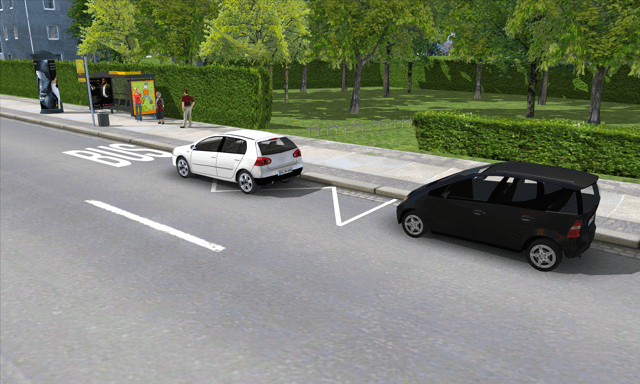
Spiegazione
The zigzagged line shortens or extends a waiting or parking ban. As far as there is no border marking on the road, a parking ban of up to 15 meters in front of and behind the stop sign applies. In this situation, the white car parked incorrectly because it stands on the marking. The dark car, however, parks properly.
-
Domanda 14 di 22
Quando è vietato parcheggiare nella corsia di destra?
1.2.12-1223 PuntiSpiegazione
In general, parking is prohibited if it could endanger other road users. Visual disability is also included. Therefore, parking is not allowed in all three situations.
-
Domanda 15 di 22
Di cosa devi tenere conto in questo caso?
1.2.12-1233 Punti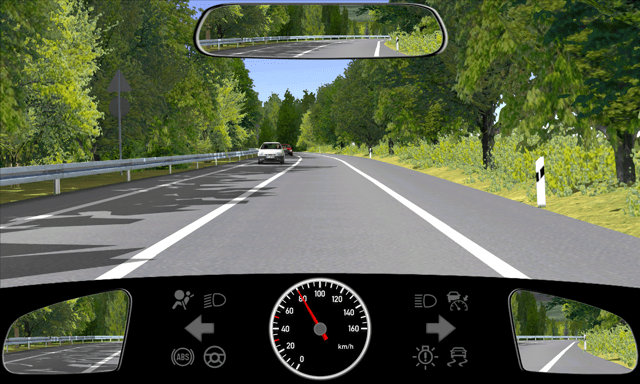
Spiegazione
Never wait on the left of the lane mark. You would impede or even endanger subsequent vehicles. The side strip is designed for parking, waiting and slow vehicles. As a slow-moving driver you must use such a sufficiently wide and well-fastened strip for driving. In this case, you may drive over the thick solid line with your vehicle representing an official lane boundary.
-
Domanda 16 di 22
Quali veicoli possono essere parcheggiati accanto ad altre auto già parcheggiate sulla carreggiata?
1.2.12-1242 PuntiSpiegazione
In exceptional cases, taxis are only allowed to stop in the second row when passengers are getting on or off.
-
Domanda 17 di 22
Dove è vietato fermarsi?
1.2.12-1253 PuntiSpiegazione
You are not allowed to wait on acceleration or on deceleration lanes. Also, on lanes with directional arrows you must not stop. This does not apply to driveways in front of properties.
-
Domanda 18 di 22
Chi si è fermato in modo errato?
1.2.12-1263 Punti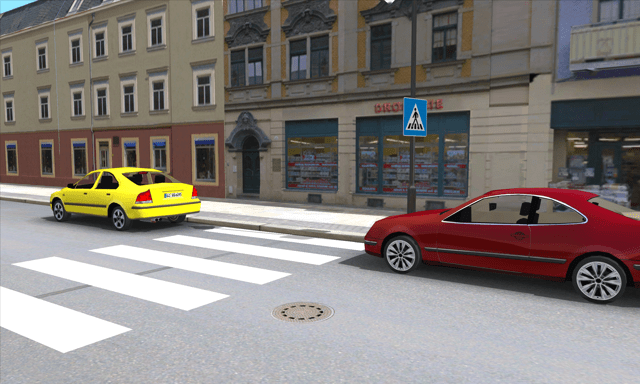
Spiegazione
On pedestrian crossings and five meters before, waiting is prohibited. The aim of this provision is to ensure a clear view of approaching vehicles and pedestrians who are willing to cross in this traffic situation.
-
Domanda 19 di 22
Dove posso parcheggiare qui?
1.2.12-1283 Punti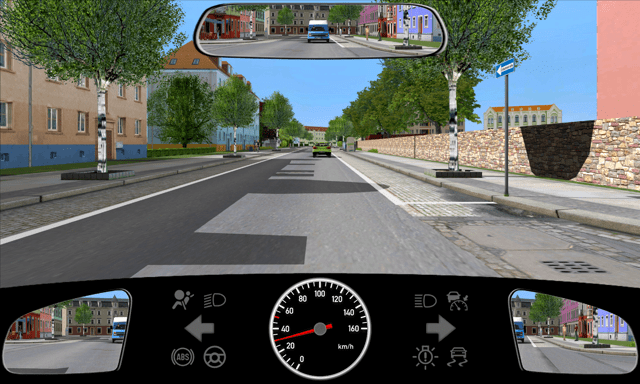
-
Domanda 20 di 22
Stai cercando un posto dove parcheggiare sul lato destro della strada. Non c'è una pista ciclabile a destra della tua corsia. Quanti metri prima e dopo un incrocio è vietato parcheggiare?
1.2.12-1313 PuntiCorretto: 5
Spiegazione
In order not to limit the view, you are not allowed to park 5 meters before and after an intersection.
-
Domanda 21 di 22
Dove è vietato fermarsi?
1.2.12-1323 PuntiSpiegazione
Stopping occurs when a vehicle is stopped for less than 3 minutes for non-traffic reasons while the driver does not leave the vehicle. If the driver stops longer and/or leaves his vehicle, this is referred to as parking. You are not allowed to stop everywhere, for example so as not to endanger other road users. Fire brigade access roads and no-stopping zones, among other things, are excluded; a distinction is made here between parking and stopping. This does not apply to all one-way streets.
-
Domanda 22 di 22
Stai cercando un posto dove parcheggiare sul lato destro della carreggiata. Una pista ciclabile corre parallela alla carreggiata sul lato destro. A quanti metri prima di un incrocio o di una biforcazione è vietato parcheggiare?
1.2.12-1333 PuntiCorretto: 8
Spiegazione
To avoid obstructing visibility, you are not allowed to park 8 meters in front of and behind a junction or intersection.