
1.2.12 Parando e estacionando
Vamos aprender rapidamente as regras de parada e estacionamento mais importantes com explicações simples, truques de memória e distâncias importantes.
🧠 Regras de memória rápida
⏱ Regra dos 3 minutos
Menos de 3 minutos + motorista permanece dentro = Parando
Mais de 3 minutos OU saída do veículo = Estacionamento
🚷 Passagem de pedestres
Sem parar ou estacionar: sobre ou 5 metros antes a travessia.
🛑 Paradas de ônibus
Proibido Estacionar: 15 metros antes e depois paragens de autocarro/eléctrico.
🚦 Junções
Geralmente mantenha:
5 metros distância.
Às vezes:
8 metros se a visibilidade for reduzida.
🚘 Diferença entre parar e estacionar
⛔ Parando
- Veículo para por menos de 3 minutos
- Motorista permanece dentro do veículo
- O motivo NÃO está relacionado ao tráfego
- Exemplo: pegar alguém rapidamente
🅿 Estacionamento
- Mais de 3 minutos
- OU o motorista sai do veículo
- Mesmo saída curta = estacionamento
- Exemplo: Sair do carro para comprar café
📏 Distâncias importantes que você DEVE lembrar
| Lugar | Regra de distância | Significado |
|---|---|---|
| Passagem de pedestres | 5 metros antes | Sem parar ou estacionar |
| Junção / Intersecção | 5 metros | Mantenha a visibilidade clara |
| Grandes Junções | 8 metros | Se houver problema de ciclovia ou visibilidade |
| Paradas de ônibus/bonde | 15 metros antes e depois | Permitir circulação de transporte público |
| Cruzamento de linha férrea | 5 metros no mínimo | Não bloqueie a visibilidade ferroviária |
| Área Cruzada de Santo André | 50 metros fora das cidades | Mantenha espaço de espera suficiente |
🚫 Onde você NÃO deve parar ou estacionar
🚶 Passagens de pedestres
Não é permitido parar ou estacionar 5m antes dos cruzamentos.
🚌 Paradas de ônibus
Não há estacionamento 15m antes e depois das paradas de ônibus/bonde.
🚦 Junções
Não é permitido estacionar perto de cruzamentos porque a visibilidade está bloqueada.
🚂 Travessias Ferroviárias
Nunca pare ou estacione onde os trens possam estar obstruídos.
🛣 Autoestradas
É proibido parar na autobahn ou acostamento, exceto em emergências.
🚪 Calçadas
Nunca estacione em frente a calçadas ou entradas rebaixadas.
⭐ Regras especiais do exame
🚕 Estacionamento na segunda fila
Apenas os táxis podem parar brevemente na segunda fila para passageiros. Outros veículos são geralmente proibidos.
➡ Direção do Estacionamento
Normalmente estacione do lado direito na direção da viagem. Exceção: Ruas de mão única ou trilhos de bonde do lado direito.
⚠ Luzes de perigo
As luzes de perigo NÃO permitem espera ou estacionamento ilegal.
🛣 Ombro Duro
Esperar é permitido apenas no lado do ombro, NÃO à esquerda da linha branca sólida.
🎯 Dicas fáceis para exames
- 3 minutos = fronteira importante
- 5 metros = cruzamentos/entroncamentos
- 15 metros = pontos de ônibus
- A visibilidade nunca deve ser bloqueada
- Estacionar antes da passadeira
- Parando no acostamento da autoestrada
- Bloqueio de meio-fio rebaixado
- Espera na segunda fila
Perguntas de Prática (22)
-
Pergunta 1 de 22
Where is stopping prohibited?
1.2.12-0013 PontosExplicação
A "stop" is when a vehicle stops for less than 3 minutes for reasons unrelated to traffic without the driver getting out of the vehicle. If the driver stops for a longer time and/or leaves his vehicle, this is called parking. However, drivers are not allowed to stop everywhere so as not to endanger other road users. Exceptions are: - Non-stop zones - Transitions through levels as there is a risk of collision with the train - Narrow and incomprehensible places with a clearance width of less than 3 m blind turns - Hilltops - Pedestrian crossings and the area in front of them (distance not less than 5 m), but not the area behind them.
-
Pergunta 2 de 22
Where is parking prohibited?
1.2.12-0023 PontosExplicação
As soon as you stop or leave your vehicle for more than three minutes without any traffic-related reason, this is called parking. This is not allowed everywhere. You may not park in areas with stopping restrictions or parking prohibition - nor where you impede or obstruct other road users. Parking restrictions also apply to priority roads outside built-up areas. Use side strips or parking bays.
-
Pergunta 3 de 22
Where is stopping prohibited?
1.2.12-1033 PontosExplicação
You may only stop where you do not endanger other road users. This is the case, for example, if there is a hard shoulder separated from the carriageway by a continuous white line. You are not allowed to stop - on marked lanes that are used for getting into the right of way - on the carriageway if there is a hard shoulder - at bus stops or other public transport stops - at taxi ranks, so as not to block the access of taxis - on motorways or motorways, not even on the hard shoulder. Watch out for two-wheelers!
-
Pergunta 4 de 22
Where is stopping prohibited?
1.2.12-1043 PontosExplicação
On and up to five meters in front of a pedestrian crossing, you must not stop because you obstruct the clear view of other drivers on pedestrians. These could then be recognized too late. After a pedestrian crossing you may stop. Waiting is allowed on manhole covers, but not parking.
-
Pergunta 5 de 22
Where is parking prohibited?
1.2.12-1053 PontosExplicação
You are not allowed to park at the edge of the road, where you block marked parking areas and thus hinder other road users. Parking is also prohibited in front of lowered curbs, which are for example located in front of driveways. Lowered curbs should allow wheelchair users to cross the road. Safe and therefore allowed is parking after a pedestrian crossing.
-
Pergunta 6 de 22
Where are you allowed to park on the left in the direction of travel?
1.2.12-1063 PontosExplicação
You may only park in the direction of travel on the right-hand side of the road. This also applies if all parking spaces are on the left side. You may have to turn if allowed. The only exception are one-way streets, as they are only used in one direction of travel. If there are rails on the right, you must also park on the left, but always observe parking restrictions.
-
Pergunta 7 de 22
Who is parked?
1.2.12-1073 PontosExplicação
If the car driver deliberately stops the vehicle and stays there for more than three minutes or leaves the stopped vehicle, this is considered parking. The stopping and waiting in front of a gate is not considered parking, no matter how long it takes, because the break is due to traffic.
-
Pergunta 8 de 22
What is the minimum distance you must leave clear when stopping or parking in front of a pedestrian crossing?
1.2.12-1083 PontosCorreto: 5
Explicação
On a pedestrian crossing and up to 5 m in front no stopping or parking is allowed. So, you can freely view the pedestrian crossing as a car driver and passers-by have a good overview of the traffic.
-
Pergunta 9 de 22
What is the minimum distance you must leave clear when parking outside a built-up area before a St. Andrew's Cross?
1.2.12-1102 PontosCorreto: 50
Explicação
At a railroad crossing with a St. Andrew's Cross sign, the view of the level crossing must not be obstructed with a distance of 50m to have enough space for waiting vehicles.
-
Pergunta 10 de 22
You want to park in front of a St. Andrew's Cross in a built-up area. What is the minimum distance you must leave clear?
1.2.12-1112 PontosCorreto: 5
Explicação
At a railroad crossing with St. Andrew's Cross, the rail vehicle has priority. To avoid obscuring the view of the railway line, a safety distance of 5 meters must be maintained.
-
Pergunta 11 de 22
Up to what distance is it prohibited to park before or after a bus or tram stop sign?
1.2.12-1122 PontosCorreto: 15
Explicação
It is not allowed to park 15 meters before and after the stop sign to allow public transports to approach, stop and leave without encumbrance.
-
Pergunta 12 de 22
What is the maximum length of time you are allowed to stop at a bus stop provided you do not present an obstruction to buses?
1.2.12-1132 PontosCorreto: 3
Explicação
The stopping time is limited to a maximum of 3 minutes. If a vehicle is stopped for more than 3 minutes, the vehicle is considered as parked. Thus it is only alowed to stop for 3 minutes
-
Pergunta 13 de 22
Who is wrongly parked?
1.2.12-1212 Pontos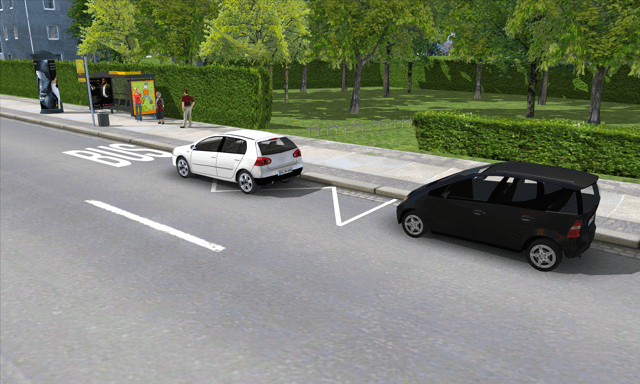
Explicação
The zigzagged line shortens or extends a waiting or parking ban. As far as there is no border marking on the road, a parking ban of up to 15 meters in front of and behind the stop sign applies. In this situation, the white car parked incorrectly because it stands on the marking. The dark car, however, parks properly.
-
Pergunta 14 de 22
When are you not allowed to park on the right-hand lane?
1.2.12-1223 PontosExplicação
In general, parking is prohibited if it could endanger other road users. Visual disability is also included. Therefore, parking is not allowed in all three situations.
-
Pergunta 15 de 22
What must you be aware of here?
1.2.12-1233 Pontos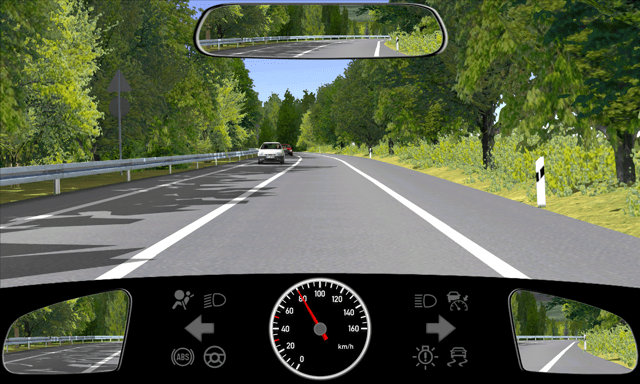
Explicação
Never wait on the left of the lane mark. You would impede or even endanger subsequent vehicles. The side strip is designed for parking, waiting and slow vehicles. As a slow-moving driver you must use such a sufficiently wide and well-fastened strip for driving. In this case, you may drive over the thick solid line with your vehicle representing an official lane boundary.
-
Pergunta 16 de 22
What vehicles may be parked alongside other parked cars on the roadway?
1.2.12-1242 PontosExplicação
In exceptional cases, taxis are only allowed to stop in the second row when passengers are getting on or off.
-
Pergunta 17 de 22
Where is it forbidden to stop?
1.2.12-1253 PontosExplicação
You are not allowed to wait on acceleration or on deceleration lanes. Also, on lanes with directional arrows you must not stop. This does not apply to driveways in front of properties.
-
Pergunta 18 de 22
Who has stopped incorrectly?
1.2.12-1263 Pontos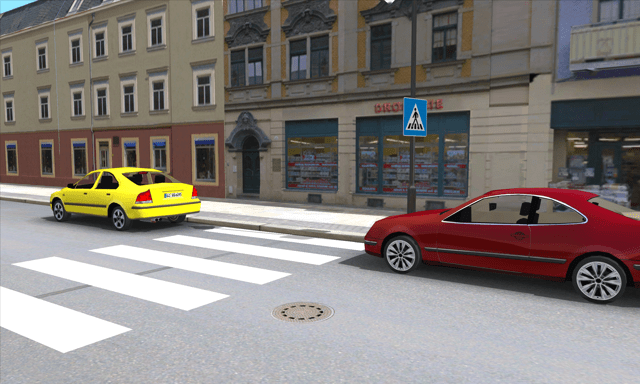
Explicação
On pedestrian crossings and five meters before, waiting is prohibited. The aim of this provision is to ensure a clear view of approaching vehicles and pedestrians who are willing to cross in this traffic situation.
-
Pergunta 19 de 22
Where may you park here?
1.2.12-1283 Pontos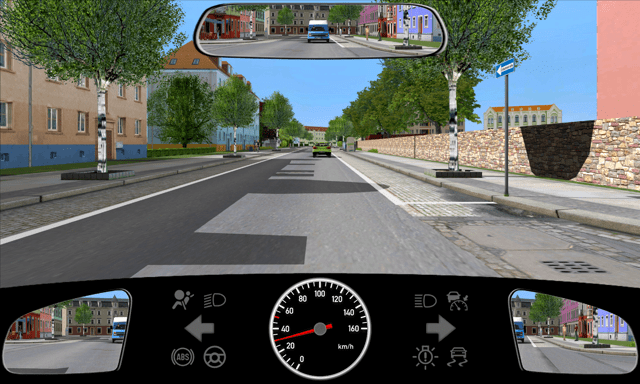
-
Pergunta 20 de 22
You are looking for somewhere to park on the right edge of the street. There is no cycle path to the right of your lane. How many metres before and after a junction are you not allowed to park?
1.2.12-1313 PontosCorreto: 5
Explicação
In order not to limit the view, you are not allowed to park 5 meters before and after an intersection.
-
Pergunta 21 de 22
Where is it forbidden to stop?
1.2.12-1323 PontosExplicação
Stopping occurs when a vehicle is stopped for less than 3 minutes for non-traffic reasons while the driver does not leave the vehicle. If the driver stops longer and/or leaves his vehicle, this is referred to as parking. You are not allowed to stop everywhere, for example so as not to endanger other road users. Fire brigade access roads and no-stopping zones, among other things, are excluded; a distinction is made here between parking and stopping. This does not apply to all one-way streets.
-
Pergunta 22 de 22
You are looking for a place to park on the right edge of the carriageway. A cycle path runs alongside to the right of the carriageway. How many metres before a junction or an intersection are you prohibited from parking?
1.2.12-1333 PontosCorreto: 8
Explicação
To avoid obstructing visibility, you are not allowed to park 8 meters in front of and behind a junction or intersection.