
2.2.22 Carico
Impara in modo semplice le regole più importanti per il fissaggio del carico e il trasporto. Concentrati sulla sicurezza, sull'equilibrio, sulla visibilità e sulla stabilità del veicolo.
🚗 Carico sul tetto e box da tetto
Effetti importanti
- Il baricentro si sposta verso l'alto
- Il veicolo diventa instabile in curva
- Più sensibile ai venti trasversali
- Lo spazio di frenata aumenta
- L'accelerazione diventa più lenta
- Il consumo di carburante aumenta
Ricorda sempre
- Non superare mai il limite di carico sul tetto
- Fissare attentamente i bagagli
- Evitare l'alta velocità
- Controllare gli attacchi durante le pause
- La stabilità di guida peggiora in curva
🏍Carico moto
Errori pericolosi
- Troppo peso posteriore → traballante
- Carico laterale irregolare → movimentazione instabile
- Bagaglio alto → effetto del vento laterale più forte
- Caricamento errato → vibrazioni e oscillazioni
Comportamento corretto
- Distribuire i bagagli in modo uniforme
- Se necessario, aumentare la pressione dei pneumatici
- Regolare sospensioni/telaio
- Seguire i limiti di velocità del produttore
- Oggetti pesanti in basso, oggetti leggeri in alto
📦 Messa in sicurezza del carico
Strumenti di protezione corretti
- Cinghie di tensione
- Reti di sicurezza
- Tappetini antiscivolo
Devi assicurarti
- Il carico non può scivolare o cadere
- Nessun rumore evitabile
- La sicurezza del veicolo non è compromessa
- Lo sterzo rimane controllabile
Se il cinturino è danneggiato
- Sostituire immediatamente
- Proseguire solo con il fissaggio sicuro
- Il conducente è responsabile
🚨 Regole di carico a sbalzo
| Regola | Requisito |
|---|---|
| Sbalzo posteriore ≤ 100 km | Massimo 3 metri |
| Sbalzo posteriore > 100 km | Massimo 1,5 metri |
| Sbalzo anteriore | Max 50 cm sopra i 2,50 m di altezza |
| Marcatura notturna | Luce bianca davanti, luce rossa dietro |
| Proiezione laterale | Segnare se luci esterne > 40 cm |
🚛 Camion, furgoni e rimorchi
Fatti importanti
- Il carico pesante all'indietro provoca il movimento del pendolo
- Il carico irregolare influisce sulla frenata e sullo sterzo
- Rispettare i limiti di carico sull'asse
- Utilizzare il piano di distribuzione del carico
- Lunghezza totale del treno max: 20,75 m
Regole speciali
- Le merci pericolose necessitano del certificato ADR
- Il camion che trasporta rifiuti utilizza il segno "A" nero
- Il conducente e il detentore sono responsabili
- Fissare il carico durante le frenate e le curve
🧠 Trucchi di memoria facili
Carico elevato = pericolo elevato → Baricentro più alto = minore stabilità.
Oggetti pesanti bassi → Migliore equilibrio e frenata più sicura.
Il carico sciolto uccide → Fissare sempre con cinture, reti o tappetini antiscivolo.
Carico sul tetto = più vento → Guidare più lentamente in curva e con vento laterale.
❓ Quiz veloce
1. Cosa succede con i bagagli sul tetto?
✔ Il baricentro si alza e la guida diventa instabile.
2. Quali strumenti fissano il carico?
✔ Nastri di tensione, reti, tappetini antiscivolo.
3. Di che colore sono le luci che segnalano il carico sporgente?
✔ Anteriore bianco, posteriore rosso.
4. Cosa succede con il carico posteriore pesante della motocicletta?
✔ Sterzo traballante e instabile.
Domande di Pratica (10)
-
Domanda 1 di 10
Come si deve segnalare un carico al buio o in condizioni di scarsa visibilità quando sporge lateralmente di oltre 40 cm oltre le luci di posizione del veicolo?
2.2.22-1083 PuntiSpiegazione
In the dark or in poor visibility conditions, a cargo that laterally protrudes more than 40 cm beyond the marker lights of the vehicle must be marked with additional lights. These are to be attached laterally no more than 40 cm from the edge and no more than 1.5 m above the roadway. For the front, a white lamp is required, for the back you need to install a red light. The hazard lights must not be switched on by you as a car driver while driving.
-
Domanda 2 di 10
Qual è l'altezza massima consentita rispetto alla carreggiata per un semaforo rosso che segnala un carico che si estende posteriormente?
2.2.22-1093 PuntiSpiegazione
The maximum height for attaching the lamp is 1.5 meters. This is to ensure that the marking is in the field of vision of other road users. If the red light is higher above the road, it could be overlooked.
-
Domanda 3 di 10
Fino a quale altezza è vietato che un carico sporga dalla parte anteriore del veicolo?
2.2.22-1113 PuntiCorretto: 2
Spiegazione
The red lamp, which marks the rear projecting cargo, may be installed at a maximum height of 2.50 m. If it were higher, other road users might oversee it. To prevent a hazard, a maximum height of 2.50 m is set.
-
Domanda 4 di 10
Quali sono le precauzioni da tenere presenti durante il carico dei veicoli?
2.2.22-1173 PuntiSpiegazione
Cargo may protrude above a height of 2.50 m forward up to 50 cm above the vehicle. If the load protrudes more than 1 m beyond the rear reflectors of the vehicle, the end must be visually marked. Cargo needs to be secured carefully. Back-heavy loading causes dangerous pendular movements when driving faster. For motorcycles, ensure that the load is evenly distributed on the sides.
-
Domanda 5 di 10
Quando si esercita una forza centrifuga sul carico di un camion?
2.2.22-1203 PuntiSpiegazione
The centrifugal force affects your truck when cornering. go straight brakes or have no circular motion and are therefore not decisive.
-
Domanda 6 di 10
Fino a che punto un carico etichettato può sporgere dalla parte posteriore del veicolo se il tragitto è superiore a 100 km?
2.2.22-1292 PuntiCorretto: 1
Spiegazione
For distances up to 100 Kilometers, the load is allowed to overhang up to 3 meters. For distances over 100 Kilometers, the load is allowed to overhang up to 1.50 meters to the rear.
-
Domanda 7 di 10
Quale targa di avvertimento è montata correttamente?
2.2.22-2012 Punti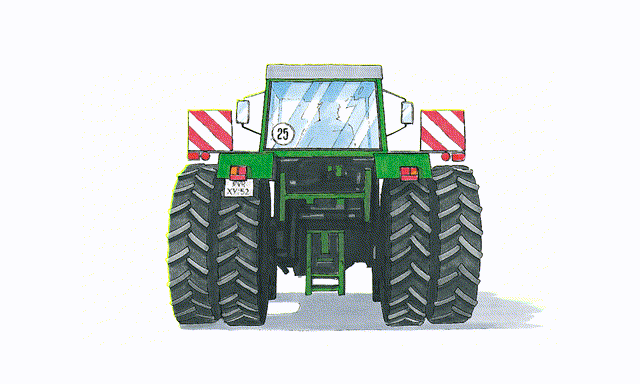
Spiegazione
As we need an A for (attention) the right warning sign is in place.
-
Domanda 8 di 10
Quali aspetti occorre considerare nella scelta delle attrezzature di ancoraggio per il fissaggio del carico?
2.2.22-2233 PuntiSpiegazione
Among other things, the face and shape of the load are decisive for the selection of suitable and necessary lashing equipment. Equally important are the requirements of the vehicle, such as the permissible payload and the attachment points.
-
Domanda 9 di 10
Vuoi fissare il tuo carico legandolo saldamente. Cosa devi tenere presente?
2.2.22-2243 PuntiSpiegazione
When lashing down, the load is pressed onto the loading area using lashing devices to increase the friction force and prevent slipping. It is important to check the tension of the lashing devices, as the necessary contact force and thus the required friction can only be achieved with sufficient tension. In addition, this method is only suitable for dimensionally stable loads; flexible goods can deform under the tension, which means that the pre-tensioning force is lost and load securing is no longer guaranteed.
-
Domanda 10 di 10
Quando le attrezzature di lavoro collegate devono essere contrassegnate con targhette di segnalazione rosse e bianche?
2.2.22-3033 PuntiSpiegazione
A red and white warning board is then to mount when it protrudes rearward more than 1 m on the rear lamps of the tractor if it has traffic hazardous parts and also when it laterally by more than 40 cm beyond the boundary or rear lamps of the tractor protrudes. All three are correct.