
2.2.22 Load
Learn the most important load securing and transport rules in a simple way. Focus on safety, balance, visibility, and vehicle stability.
🚗 Roof Load & Roof Boxes
Important Effects
- Center of gravity moves upwards
- Vehicle becomes unstable in curves
- More sensitive to crosswinds
- Braking distance increases
- Acceleration becomes slower
- Fuel consumption increases
Always Remember
- Never exceed roof load limit
- Secure luggage carefully
- Avoid high speed
- Check fastenings during breaks
- Driving stability becomes worse in curves
🏍 Motorcycle Loading
Dangerous Mistakes
- Too much rear weight → wobbling
- Uneven side loading → unstable handling
- High luggage → stronger crosswind effect
- Bad loading → vibration and swinging
Correct Behavior
- Distribute luggage evenly
- Increase tire pressure if necessary
- Adjust suspension/chassis
- Follow manufacturer speed limits
- Heavy items low, light items high
📦 Cargo Securing
Correct Securing Tools
- Tension belts
- Safety nets
- Anti-slip mats
You Must Ensure
- Load cannot slip or fall
- No avoidable noise
- Vehicle safety not affected
- Steering remains controllable
If Strap is Damaged
- Replace immediately
- Continue only with safe securing
- Driver is responsible
🚨 Overhanging Load Rules
| Rule | Requirement |
|---|---|
| Rear Overhang ≤ 100 km | Max 3 meters |
| Rear Overhang > 100 km | Max 1.5 meters |
| Front Overhang | Max 50 cm above 2.50 m height |
| Night Marking | White light front, red light rear |
| Lateral Projection | Mark if > 40 cm outside lights |
🚛 Trucks, Vans & Trailers
Important Facts
- Back-heavy loading causes pendulum movement
- Uneven load affects braking and steering
- Observe axle load limits
- Use load distribution plan
- Total train length max: 20.75 m
Special Rules
- Dangerous goods need ADR certificate
- Truck carrying litter uses black "A" sign
- Driver and holder are responsible
- Secure cargo during braking and curves
🧠 Easy Memory Tricks
High load = High danger → Higher center of gravity = less stability.
Heavy items low → Better balance and safer braking.
Loose cargo kills → Always secure with belts, nets, or anti-slip mats.
Roof load = more wind → Drive slower in curves and crosswinds.
❓ Quick Quiz
1. What happens with roof luggage?
✔ Center of gravity rises and driving becomes unstable.
2. Which tools secure cargo?
✔ Tension belts, nets, anti-slip mats.
3. What color lights mark protruding cargo?
✔ White front, red rear.
4. What happens with rear-heavy motorcycle loading?
✔ Wobbling and unstable steering.
Practice Questions (10)
-
Question 1 of 10
How must a load be marked in darkness or bad visibility when it extends laterally more than 40 cm beyond the side lights of the vehicle?
2.2.22-1083 PointsExplanation
In the dark or in poor visibility conditions, a cargo that laterally protrudes more than 40 cm beyond the marker lights of the vehicle must be marked with additional lights. These are to be attached laterally no more than 40 cm from the edge and no more than 1.5 m above the roadway. For the front, a white lamp is required, for the back you need to install a red light. The hazard lights must not be switched on by you as a car driver while driving.
-
Question 2 of 10
What is the maximum height allowed above the roadway for a red light marking a load extending to the back?
2.2.22-1093 PointsExplanation
The maximum height for attaching the lamp is 1.5 meters. This is to ensure that the marking is in the field of vision of other road users. If the red light is higher above the road, it could be overlooked.
-
Question 3 of 10
Up to what height is a load not allowed to project over the front of the vehicle?
2.2.22-1113 PointsCorrect: 2
Explanation
The red lamp, which marks the rear projecting cargo, may be installed at a maximum height of 2.50 m. If it were higher, other road users might oversee it. To prevent a hazard, a maximum height of 2.50 m is set.
-
Question 4 of 10
What should be noted when loading vehicles?
2.2.22-1173 PointsExplanation
Cargo may protrude above a height of 2.50 m forward up to 50 cm above the vehicle. If the load protrudes more than 1 m beyond the rear reflectors of the vehicle, the end must be visually marked. Cargo needs to be secured carefully. Back-heavy loading causes dangerous pendular movements when driving faster. For motorcycles, ensure that the load is evenly distributed on the sides.
-
Question 5 of 10
When is a centrifugal force exerted on the load of a truck?
2.2.22-1203 PointsExplanation
The centrifugal force affects your truck when cornering. go straight brakes or have no circular motion and are therefore not decisive.
-
Question 6 of 10
How far may a labelled load protrude beyond the rear of your vehicle if your journey is more than 100 km?
2.2.22-1292 PointsCorrect: 1
Explanation
For distances up to 100 Kilometers, the load is allowed to overhang up to 3 meters. For distances over 100 Kilometers, the load is allowed to overhang up to 1.50 meters to the rear.
-
Question 7 of 10
Which warning plate is correctly mounted?
2.2.22-2012 Points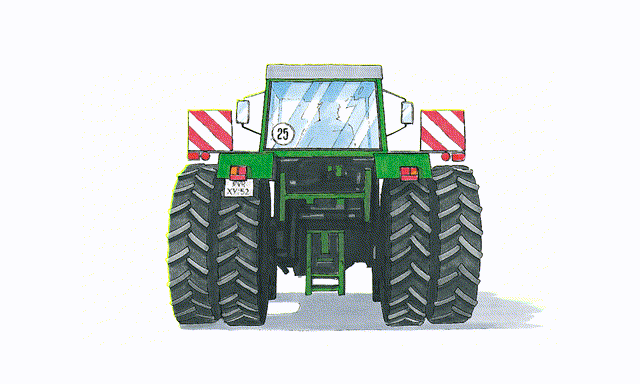
Explanation
As we need an A for (attention) the right warning sign is in place.
-
Question 8 of 10
What should be taken into consideration when selecting load-securing lashing equipment?
2.2.22-2233 PointsExplanation
Among other things, the face and shape of the load are decisive for the selection of suitable and necessary lashing equipment. Equally important are the requirements of the vehicle, such as the permissible payload and the attachment points.
-
Question 9 of 10
You want to secure your load by lashing it down. What should you bear in mind?
2.2.22-2243 PointsExplanation
When lashing down, the load is pressed onto the loading area using lashing devices to increase the friction force and prevent slipping. It is important to check the tension of the lashing devices, as the necessary contact force and thus the required friction can only be achieved with sufficient tension. In addition, this method is only suitable for dimensionally stable loads; flexible goods can deform under the tension, which means that the pre-tensioning force is lost and load securing is no longer guaranteed.
-
Question 10 of 10
When must attached working equipment be marked with red-white warning plates?
2.2.22-3033 PointsExplanation
A red and white warning board is then to mount when it protrudes rearward more than 1 m on the rear lamps of the tractor if it has traffic hazardous parts and also when it laterally by more than 40 cm beyond the boundary or rear lamps of the tractor protrudes. All three are correct.