
2.2.22 Carga
Aprende las normas más importantes de sujeción y transporte de carga de forma sencilla. Concéntrese en la seguridad, el equilibrio, la visibilidad y la estabilidad del vehículo.
🚗 Carga de techo y cajas de techo
Efectos importantes
- El centro de gravedad se mueve hacia arriba.
- El vehículo se vuelve inestable en las curvas.
- Más sensible a los vientos cruzados
- La distancia de frenado aumenta
- La aceleración se vuelve más lenta
- El consumo de combustible aumenta
Recuerda siempre
- Nunca exceda el límite de carga del techo
- Asegure el equipaje con cuidado
- Evite la alta velocidad
- Revisar las fijaciones durante los descansos.
- La estabilidad de conducción empeora en las curvas
🏍 Carga de motocicletas
Errores peligrosos
- Demasiado peso trasero → tambaleo
- Carga lateral desigual → manejo inestable
- Equipaje alto → efecto de viento cruzado más fuerte
- Mala carga → vibración y balanceo
Comportamiento correcto
- Distribuya el equipaje de manera uniforme
- Aumente la presión de los neumáticos si es necesario
- Ajustar suspensión/chasis
- Siga los límites de velocidad del fabricante
- Artículos pesados bajos, artículos livianos altos
📦 Aseguramiento de la carga
Herramientas de seguridad correctas
- Cinturones tensores
- Redes de seguridad
- Alfombrillas antideslizantes
Debes asegurarte
- La carga no puede resbalar ni caer
- Ningún ruido evitable
- La seguridad del vehículo no se ve afectada
- La dirección sigue siendo controlable
Si la correa está dañada
- Reemplazar inmediatamente
- Continúe solo con seguridad
- El conductor es responsable
🚨 Reglas de carga colgante
| Regla | Requisito |
|---|---|
| Voladizo trasero ≤ 100 km | Máximo 3 metros |
| Voladizo trasero > 100 km | Máximo 1,5 metros |
| Voladizo delantero | Máximo 50 cm por encima de 2,50 m de altura |
| Marcado nocturno | Luz blanca delantera, luz roja trasera. |
| Proyección lateral | Marcar si > 40 cm luces exteriores |
🚛 Camiones, furgonetas y remolques
Hechos importantes
- Una carga pesada en la espalda provoca un movimiento pendular
- La carga desigual afecta el frenado y la dirección
- Respete los límites de carga por eje
- Usar plan de distribución de carga
- Longitud total del tren máx.: 20,75 m
Reglas especiales
- Las mercancías peligrosas necesitan certificado ADR
- El camión que transporta basura utiliza el signo "A" negro
- El conductor y el titular son responsables.
- Carga segura durante frenadas y curvas.
🧠 Trucos fáciles de memoria
Carga alta = Alto peligro → Centro de gravedad más alto = menos estabilidad.
Artículos pesados bajos → Mejor equilibrio y frenado más seguro.
Carga suelta mata → Asegúrelo siempre con cinturones, redes o tapetes antideslizantes.
Carga del techo = más viento → Conduzca más despacio en curvas y con viento cruzado.
❓ Prueba rápida
1. ¿Qué pasa con el equipaje en el techo?
✔ El centro de gravedad aumenta y la conducción se vuelve inestable.
2. ¿Qué herramientas aseguran la carga?
✔ Cinturones tensores, redes, tapetes antideslizantes.
3. ¿Qué color de luces marcan la carga que sobresale?
✔ Delantero blanco, trasero rojo.
4. ¿Qué sucede con la carga pesada trasera de una motocicleta?
✔ Dirección tambaleante e inestable.
Preguntas de práctica (10)
-
Pregunta 1 de 10
¿Cómo hay que marcar una carga que sobresale por los costados más de 40 cm de las luces de posición del vehículo cuando hay poca visibilidad o en la oscuridad?
2.2.22-1083 puntosExplicación
In the dark or in poor visibility conditions, a cargo that laterally protrudes more than 40 cm beyond the marker lights of the vehicle must be marked with additional lights. These are to be attached laterally no more than 40 cm from the edge and no more than 1.5 m above the roadway. For the front, a white lamp is required, for the back you need to install a red light. The hazard lights must not be switched on by you as a car driver while driving.
-
Pregunta 2 de 10
¿A qué altura máxima sobre la calzada puede estar puesta una lámpara roja que marca una carga que sobresale hacia atrás?
2.2.22-1093 puntosExplicación
The maximum height for attaching the lamp is 1.5 meters. This is to ensure that the marking is in the field of vision of other road users. If the red light is higher above the road, it could be overlooked.
-
Pregunta 3 de 10
¿Hasta qué altura la carga no puede sobresalir del vehículo hacia delante?
2.2.22-1113 puntosCorrecto: 2
Explicación
The red lamp, which marks the rear projecting cargo, may be installed at a maximum height of 2.50 m. If it were higher, other road users might oversee it. To prevent a hazard, a maximum height of 2.50 m is set.
-
Pregunta 4 de 10
¿Qué ha de tenerse en cuenta al cargar un vehículo?
2.2.22-1173 puntosExplicación
Cargo may protrude above a height of 2.50 m forward up to 50 cm above the vehicle. If the load protrudes more than 1 m beyond the rear reflectors of the vehicle, the end must be visually marked. Cargo needs to be secured carefully. Back-heavy loading causes dangerous pendular movements when driving faster. For motorcycles, ensure that the load is evenly distributed on the sides.
-
Pregunta 5 de 10
¿Cuando actúa la fuerza centrífuga sobre la carga de un camión?
2.2.22-1203 puntosExplicación
The centrifugal force affects your truck when cornering. go straight brakes or have no circular motion and are therefore not decisive.
-
Pregunta 6 de 10
¿Cuánto puede sobresalir por detrás de su vehículo una carga señalizada si va a recorrer un trayecto de más de 100 km?
2.2.22-1292 puntosCorrecto: 1
Explicación
For distances up to 100 Kilometers, the load is allowed to overhang up to 3 meters. For distances over 100 Kilometers, the load is allowed to overhang up to 1.50 meters to the rear.
-
Pregunta 7 de 10
¿Qué panel de aviso está colocado correctamente?
2.2.22-2012 puntos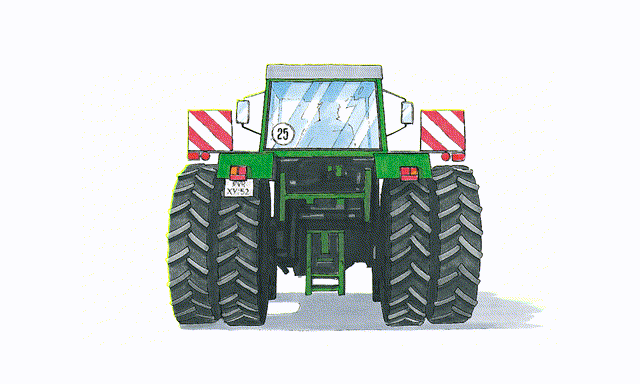
Explicación
As we need an A for (attention) the right warning sign is in place.
-
Pregunta 8 de 10
¿Qué ha de tenerse en cuenta a la hora de elegir el sistema de trincaje para sujetar la mercancía?
2.2.22-2233 puntosExplicación
Among other things, the face and shape of the load are decisive for the selection of suitable and necessary lashing equipment. Equally important are the requirements of the vehicle, such as the permissible payload and the attachment points.
-
Pregunta 9 de 10
Desea asegurar su carga firmemente con amarres. ¿Qué debería tener en cuenta también?
2.2.22-2243 puntosExplicación
When lashing down, the load is pressed onto the loading area using lashing devices to increase the friction force and prevent slipping. It is important to check the tension of the lashing devices, as the necessary contact force and thus the required friction can only be achieved with sufficient tension. In addition, this method is only suitable for dimensionally stable loads; flexible goods can deform under the tension, which means that the pre-tensioning force is lost and load securing is no longer guaranteed.
-
Pregunta 10 de 10
¿Cuándo hay que marcar con placas de aviso rojas-blancas un apero agrícola remolcado?
2.2.22-3033 puntosExplicación
A red and white warning board is then to mount when it protrudes rearward more than 1 m on the rear lamps of the tractor if it has traffic hazardous parts and also when it laterally by more than 40 cm beyond the boundary or rear lamps of the tractor protrudes. All three are correct.