
2.1.03 Condiciones de carretera y clima
Regla de oro ⭐
Mal tiempo = Menos agarre + Mayor distancia de frenado + Mala visibilidad.
👉 Reduzca siempre la velocidad, aumente la distancia y evite girar o frenar bruscamente.
🌧️ Lluvia y caminos mojados
- La primera lluvia después del tiempo seco crea una película de aceite resbaladiza.
- La distancia de frenado se hace más larga.
- La visibilidad empeora debido a las salpicaduras de agua y al visor empañado.
- Evite frenar o acelerar bruscamente.
- Incrementar la distancia de seguridad inmediatamente.
- Las marcas viales se vuelven muy resbaladizas cuando están mojadas.
La “primera lluvia después de la sequía” es especialmente peligrosa.
💧 aquaplaning
- Ocurre a alta velocidad en carreteras mojadas.
- Los neumáticos pierden contacto con la carretera.
- No puede girar ni frenar correctamente.
- El riesgo es mayor en los surcos de las ruedas y en el agua estancada.
- Quita el pie del acelerador lentamente.
- Mantenga el volante recto.
- NO frene repentinamente.
🌬️ Vientos cruzados
- El peligro aumenta cerca de puentes, túneles y camiones.
- Las motocicletas pueden virar repentinamente hacia los lados.
- La estela del camión cambia repentinamente la presión del viento.
- La alta velocidad hace que los vientos cruzados sean más peligrosos.
Reduzca la velocidad y contravire con cuidado.
⚠️ Superficies resbaladizas
- Marcas de carril
- parches de aceite
- Adoquines
- hojas y arena
- Alcantarillas y raíles de tranvía
- Carreteras mojadas y grava
Mayor riesgo de patinar y caer.
🌫️ Niebla y mala visibilidad
- Utilice luces bajas.
- Luz antiniebla trasera solo por debajo de 50 m de visibilidad.
- Velocidad máxima con luz antiniebla trasera = 50 km/h.
- No conduzca por la línea central.
- Oriéntate por el lado derecho de la carretera.
NO se permiten luces de estacionamiento solas en condiciones de niebla.
❄️ Nieve y hielo
- El camino se vuelve extremadamente resbaladizo.
- Los montones de nieve reducen la visibilidad.
- La distancia de frenado aumenta considerablemente.
- Evite adelantar en aguanieve.
- Conduzca suavemente y sin tirones.
Frene temprano y conduzca de manera predecible.
🏍️ Riesgos especiales de motocicletas
- El viento cruzado puede empujar la motocicleta hacia los lados.
- Las marcas de los carriles mojados son muy resbaladizas.
- Los raíles del tranvía deben cruzarse lo más perpendicularmente posible.
- Los adoquines reducen considerablemente el agarre.
- Las hojas, la arena y el aceite aumentan el riesgo de caídas en las curvas.
- Mantenga suficiente distancia al montar en grupo.
- Evite frenar bruscamente mientras está inclinado.
- La rueda trasera puede bloquearse más fácilmente en carreteras mojadas.
🧠 Fórmula de memoria rápida
🌧️ Lluvia = Resbaladizo + Mala visibilidad
💧 Aquaplaning = Sin dirección + Sin frenado
🌬️ Viento cruzado = contraviraje con cuidado
❄️ Nieve/Hielo = Frenar temprano + Conducir despacio
⚠️ Superficies resbaladizas = Evite movimientos bruscos
Preguntas de práctica (11)
-
Pregunta 1 de 11
¿Qué puede significar un repentino empeoramiento del estado de la calzada?
2.1.03-0253 puntosExplicación
As the road surface deteriorates, it always results in a change and deterioration of traction. As the wheels lose stiction, the vehicle is slipping and skidding faster. The tire noise also depends on the condition of the road surface and changes when, for example, the road turns from a paved road to a cobblestone track.
-
Pregunta 2 de 11
¿Por qué se recomienda frenar en este momento?
2.1.03-0293 puntosExplicación
Snow is a special danger for you as a car driver. Your lane is covered in snow. In addition, your view is restricted by a heap of snow. The upcoming green car does not respect the right of way. Therefore, you should brake early, because due to the slipperiness of the braking distance is extended. Probably the green car is also hampered by the snow pile.
-
Pregunta 3 de 11
¿Qué debe tener Ud. en cuenta especialmente si después de un período de sequía prolongado empieza a llover?
2.1.03-1034 puntosExplicación
If rain sets in after prolonged drought, a dangerous film of lubricant forms on the road, which is only washed away after a long period of rain. This film is more dangerous than rain alone. Brake very carefully. This lubricating film is also deposited on the windscreen. After turning on the windscreen wipers, it first worsens the view drastically. The braking distance is extended by the poorer traction.
-
Pregunta 4 de 11
Comienza a llover. ¿Por qué tiene que aumentar en seguida la distancia de seguridad?
2.1.03-1044 puntosExplicación
When it starts raining, you must immediately increase the safety distance for the following reasons: Under the influence of moisture, the dirt, dust and fine deposits from tire abrasion or pollen on the road turn into a dangerous film of grease. This reduces the traction and thereby extends the braking distance. This lubricating film also forms on the windscreen and on the brake drums. If you use the windscreen wipers, they will first worsen your view and smudge the window. On the brake drums, this lubricating film leads to a slower response of the brakes in wet conditions.
-
Pregunta 5 de 11
Ud. circula fuera de poblado con niebla densa en una carretera nacional. ¿Puede circular siempre en el centro de la calzada encima de la marca guía?
2.1.03-1054 puntosExplicación
Driving on the center line is not allowed even in dense fog, especially as drivers can always collide with oncoming traffic due to reduced visibility. If there's fog, slow down and orient yourself on the right side of the road for a safe ride.
-
Pregunta 6 de 11
¿Qué tiene que hacer durante el día si de repente le sorprende un banco de niebla?
2.1.03-1064 puntosExplicación
As a car driver you must turn on low beam during the day when there's fog, snowfall and other poor visibility. Because of the insufficient luminosity driving with parking light is not permitted. Adjust your speed to the visibility conditions and use the rear fog light when you can see less than 50 meters.
-
Pregunta 7 de 11
¿Cómo logra suficiente visibilidad por el parabrisas delantero?
2.1.03-1073 puntosExplicación
Turn your windscreen wipers to interval switching, during fog in order to remove fine water droplets from the mist. Turn on your windscreen wipers before overtaking or being overtaken so that obstructions caused by slush or spray water are immediately removed. Avoid fogged windows with the correct ventilation setting: Set ventilation to outside air supply and not to circulating air. Open the windows a gap to let the moisture escape. Briefly switching on the air conditioning dehumidifies the air very quickly.
-
Pregunta 8 de 11
¿Qué es lo correcto en esta situación?
2.1.03-1154 puntosExplicación
There are two lanes in your direction of travel. You drive on the right side of the two tracks. In oncoming traffic, a snow plow truck approaches. You see in the mirror that a vehicle in the left lane next to you wants to overtake. Snowdrifts hinder you while driving on the lane. You cannot turn left unless the overtaking is completed. Therefore, you must delay further and wait in front of the obstacle until you can dodge to the left.
-
Pregunta 9 de 11
¿Qué debería hacer en esta situación?
2.1.03-1164 puntos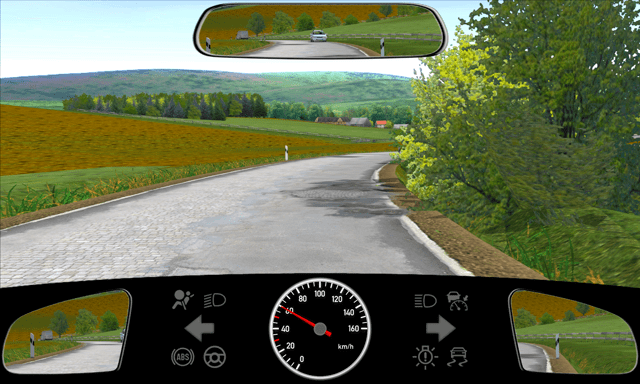
Explicación
In the event of lane damage before a turn, you should reduce your speed considerably to avoid damaging the vehicle. Due to the confusion of the curve, you should not drive past the lane damage on the left, but continue on the right on your lane.
-
Pregunta 10 de 11
Va circulando por una carretera estrecha con árboles a ambos lados. ¿Qué ha de tener en cuenta?
2.1.03-1204 puntosExplicación
The narrow width of the road and its often curved shape due to tree roots force you to take extra care when cornering and when facing oncoming traffic. Choose your speed in such a way that the vehicle can be brought to a halt within half the visible distance. Example: With a visibility of approx. 40 metres, you should choose your speed so that you come to a stop within approx. 20 metres. In purely mathematical terms, the stopping distance at 30 km/h is 18 metres.
-
Pregunta 11 de 11
¿Con qué tiene que contar en esta situación?
2.1.03-1224 puntos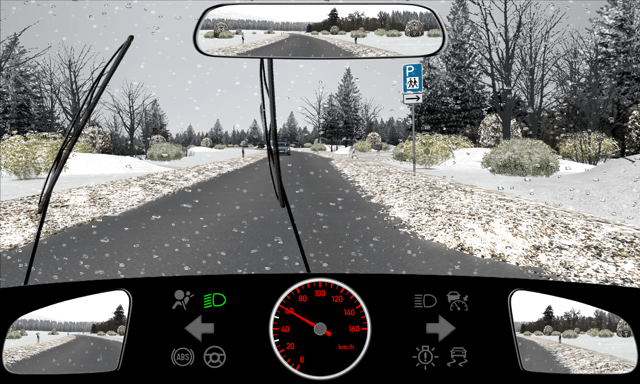
Explicación
The snow on the right and left sides of the road may limit the lane. Therefore, you must expect that the distance to oncoming traffic is reduced. In addition, you can see from the traffic sign that there is a parking area for walkers on the right-hand side. Therefore, you must expect that there are pedestrians on the roadway.