
2.1.03 Yol ve Hava Koşulları
Altın Kural ⭐
Kötü hava = Daha az kavrama + Daha uzun fren mesafesi + Zayıf görüş.
👉 Daima hızı azaltın, mesafeyi artırın ve ani direksiyon veya frenlemeden kaçının.
🌧️ Yağmur ve Islak Yollar
- Kuru havanın ardından yağan ilk yağmur, kaygan bir yağ filmi oluşturur.
- Fren mesafesi uzar.
- Su spreyi ve buğulanan vizör nedeniyle görüş mesafesi kötüleşiyor.
- Ani frenleme veya hızlanmalardan kaçının.
- Güvenlik mesafesini derhal artırın.
- Yol işaretleri ıslandığında çok kayganlaşır.
“Kuraklıktan sonraki ilk yağmur” özellikle tehlikelidir.
💧 Suda kızaklama
- Islak yollarda yüksek hızda meydana gelir.
- Lastikler yolla teması kaybeder.
- Düzgün bir şekilde yön veremez veya frenleyemezsiniz.
- Tekerlek izleri ve durgun sularda risk daha yüksektir.
- Ayağınızı gazdan yavaşça çekin.
- Direksiyonu düz tutun.
- Ani fren yapmayın.
🌬️ Yan rüzgarlar
- Köprülerin, tünellerin ve kamyonların yakınında tehlike artıyor.
- Motosikletler aniden yana doğru yön değiştirebilir.
- Kamyonun hava akımı rüzgar basıncını aniden değiştiriyor.
- Yüksek hız, yan rüzgarları daha tehlikeli hale getirir.
Hızınızı azaltın ve dikkatlice karşı yöne dönün.
⚠️ Kaygan Yüzeyler
- Şerit işaretleri
- Yağ yamaları
- Arnavut kaldırımı
- Yapraklar ve kum
- Menholler ve tramvay rayları
- Islak yollar ve çakıl
Kayma ve düşme riski artar.
🌫️ Sis ve Zayıf Görüş
- Kısa huzmeli farlar kullanın.
- Arka sis lambası yalnızca 50 metre görüş mesafesinin altında.
- Arka sis lambasıyla maksimum hız = 50 km/saat.
- Orta çizgide sürüş yapmayın.
- Kendinizi yolun sağ tarafına yönlendirin.
Sisli havalarda tek başına park lambalarına izin VERİLMEZ.
❄️Kar ve Buz
- Yol aşırı derecede kayganlaşıyor.
- Kar yığınları görüş mesafesini azaltıyor.
- Fren mesafesi büyük ölçüde artar.
- Sulu karda sollamaktan kaçının.
- Sarsıntılı direksiyon olmadan sorunsuz sürüş yapın.
Erken fren yapın ve öngörülebilir şekilde sürün.
🏍️ Motosiklete Özel Riskler
- Yan rüzgarlar motosikleti yana doğru itebilir.
- Islak şerit işaretleri çok kaygandır.
- Tramvay rayları mümkün olduğunca dik olarak geçilmelidir.
- Parke taşları tutuşu güçlü bir şekilde azaltır.
- Yapraklar, kum ve yağ virajlarda düşme riskini artırır.
- Grup sürüşünde yeterli mesafeyi koruyun.
- Eğilirken ani fren yapmaktan kaçının.
- Islak yollarda arka tekerlek daha kolay kilitlenebilir.
🧠 Hızlı Hafıza Formülü
🌧️ Yağmur = Kaygan + Kötü görüş
💧 Suda kızaklama = Direksiyon yok + Fren yok
🌬️ Yan Rüzgar = Dikkatli bir şekilde karşı yön verin
❄️ Kar/Buz = Erken fren yapın + Yavaş sürün
⚠️ Kaygan yüzeyler = Ani hareketlerden kaçının
Alıştırma soruları (11)
-
Soru 1 / 11
Araç yolunun aniden kötüleşmesi, hangi sonuçlara yol açabilir?
2.1.03-0253 puanAçıklama
As the road surface deteriorates, it always results in a change and deterioration of traction. As the wheels lose stiction, the vehicle is slipping and skidding faster. The tire noise also depends on the condition of the road surface and changes when, for example, the road turns from a paved road to a cobblestone track.
-
Soru 2 / 11
Şimdi neden fren yapmalısınız?
2.1.03-0293 puanAçıklama
Snow is a special danger for you as a car driver. Your lane is covered in snow. In addition, your view is restricted by a heap of snow. The upcoming green car does not respect the right of way. Therefore, you should brake early, because due to the slipperiness of the braking distance is extended. Probably the green car is also hampered by the snow pile.
-
Soru 3 / 11
Uzun bir kuraklık döneminden sonra, yağmur yağmaya başladığı zaman, neleri hesaba katmak zorundasınız?
2.1.03-1034 puanAçıklama
If rain sets in after prolonged drought, a dangerous film of lubricant forms on the road, which is only washed away after a long period of rain. This film is more dangerous than rain alone. Brake very carefully. This lubricating film is also deposited on the windscreen. After turning on the windscreen wipers, it first worsens the view drastically. The braking distance is extended by the poorer traction.
-
Soru 4 / 11
Yağmur yağmaya başlıyor. Öndeki araca bırakılacak emniyet mesafesini neden arttırmak zorundasınız?
2.1.03-1044 puanAçıklama
When it starts raining, you must immediately increase the safety distance for the following reasons: Under the influence of moisture, the dirt, dust and fine deposits from tire abrasion or pollen on the road turn into a dangerous film of grease. This reduces the traction and thereby extends the braking distance. This lubricating film also forms on the windscreen and on the brake drums. If you use the windscreen wipers, they will first worsen your view and smudge the window. On the brake drums, this lubricating film leads to a slower response of the brakes in wet conditions.
-
Soru 5 / 11
Yerleşim yerleri dışında, yoğun sisli bir havada, Federal Karayolunda gidiyorsunuz. Aracınızı yolun ortasındaki sevk çizgisinin üzerinde sürekli olarak sürmenize izin verilmiş midir?
2.1.03-1054 puanAçıklama
Driving on the center line is not allowed even in dense fog, especially as drivers can always collide with oncoming traffic due to reduced visibility. If there's fog, slow down and orient yourself on the right side of the road for a safe ride.
-
Soru 6 / 11
Gündüz ansızın yoğun sisle karşılaştığınızda, ne yapmak zorundasınız?
2.1.03-1064 puanAçıklama
As a car driver you must turn on low beam during the day when there's fog, snowfall and other poor visibility. Because of the insufficient luminosity driving with parking light is not permitted. Adjust your speed to the visibility conditions and use the rear fog light when you can see less than 50 meters.
-
Soru 7 / 11
Aracın siper camından yeterince görüş sağlayabilmek için neler yapabilirsiniz?
2.1.03-1073 puanAçıklama
Turn your windscreen wipers to interval switching, during fog in order to remove fine water droplets from the mist. Turn on your windscreen wipers before overtaking or being overtaken so that obstructions caused by slush or spray water are immediately removed. Avoid fogged windows with the correct ventilation setting: Set ventilation to outside air supply and not to circulating air. Open the windows a gap to let the moisture escape. Briefly switching on the air conditioning dehumidifies the air very quickly.
-
Soru 8 / 11
Buradaki doğru davranış nedir?
2.1.03-1154 puanAçıklama
There are two lanes in your direction of travel. You drive on the right side of the two tracks. In oncoming traffic, a snow plow truck approaches. You see in the mirror that a vehicle in the left lane next to you wants to overtake. Snowdrifts hinder you while driving on the lane. You cannot turn left unless the overtaking is completed. Therefore, you must delay further and wait in front of the obstacle until you can dodge to the left.
-
Soru 9 / 11
Burada nasıl davranmalısınız?
2.1.03-1164 puan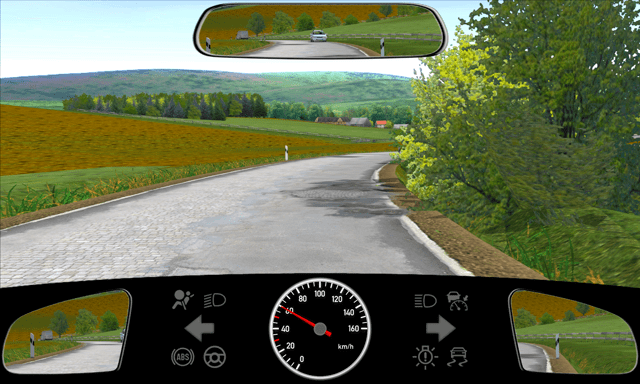
Açıklama
In the event of lane damage before a turn, you should reduce your speed considerably to avoid damaging the vehicle. Due to the confusion of the curve, you should not drive past the lane damage on the left, but continue on the right on your lane.
-
Soru 10 / 11
İki tarafı ağaçlı dar bir yoldan geçiyorsunuz. Nelere dikkat etmelisiniz?
2.1.03-1204 puanAçıklama
The narrow width of the road and its often curved shape due to tree roots force you to take extra care when cornering and when facing oncoming traffic. Choose your speed in such a way that the vehicle can be brought to a halt within half the visible distance. Example: With a visibility of approx. 40 metres, you should choose your speed so that you come to a stop within approx. 20 metres. In purely mathematical terms, the stopping distance at 30 km/h is 18 metres.
-
Soru 11 / 11
Burada hesaba katmanız gereken şey nedir?
2.1.03-1224 puan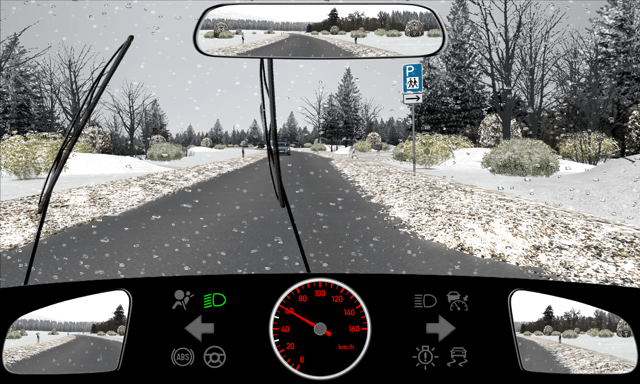
Açıklama
The snow on the right and left sides of the road may limit the lane. Therefore, you must expect that the distance to oncoming traffic is reduced. In addition, you can see from the traffic sign that there is a parking area for walkers on the right-hand side. Therefore, you must expect that there are pedestrians on the roadway.