
2.1.03 Warunki drogi i pogody
Złota zasada ⭐
Zła pogoda = mniejsza przyczepność + dłuższa droga hamowania + słaba widoczność.
👉Zawsze zmniejszaj prędkość, zwiększaj dystans i unikaj gwałtownego skręcania lub hamowania.
🌧️ Deszcz i mokre drogi
- Pierwszy deszcz po suchej pogodzie tworzy śliską warstwę oleju.
- Droga hamowania wydłuża się.
- Widoczność pogarsza się z powodu rozprysków wody i zaparowanego wizjera.
- Unikaj nagłego hamowania i przyspieszania.
- Natychmiast zwiększ bezpieczną odległość.
- Oznakowanie drogowe staje się bardzo śliskie, gdy jest mokre.
Szczególnie niebezpieczny jest „pierwszy deszcz po suszy”.
💧 Aquaplaning
- Występuje przy dużej prędkości na mokrej nawierzchni.
- Opony tracą kontakt z drogą.
- Nie możesz prawidłowo kierować ani hamować.
- Ryzyko jest większe w przypadku kolein pod kołami i stojącej wody.
- Powoli zdejmij nogę z gazu.
- Trzymaj kierownicę prosto.
- NIE hamuj nagle.
🌬️Boczny wiatr
- Zagrożenie wzrasta w pobliżu mostów, tuneli i ciężarówek.
- Motocykle mogą nagle skręcić w bok.
- Strumień powietrza w ciężarówce nagle zmienia ciśnienie wiatru.
- Duża prędkość sprawia, że boczny wiatr jest bardziej niebezpieczny.
Zmniejsz prędkość i ostrożnie kontruj.
⚠️ Śliskie nawierzchnie
- Oznaczenia pasów
- Plastry olejowe
- Kostka brukowa
- Liście i piasek
- Włazy i szyny tramwajowe
- Mokre drogi i żwir
Zwiększone ryzyko poślizgu i upadku.
🌫️ Mgła i słaba widoczność
- Używaj świateł mijania.
- Tylne światło przeciwmgielne tylko przy widoczności poniżej 50 m.
- Maksymalna prędkość z tylnym światłem przeciwmgłowym = 50 km/h.
- Nie jedź wzdłuż linii środkowej.
- Skieruj się na prawą stronę drogi.
Same światła postojowe NIE są dozwolone we mgle.
❄️Śnieg i lód
- Droga staje się wyjątkowo śliska.
- Zaspy śniegu ograniczają widoczność.
- Droga hamowania znacznie się wydłuża.
- Unikaj wyprzedzania na błocie pośniegowym.
- Jedź płynnie, bez szarpnięć kierownicą.
Hamuj wcześnie i jedź przewidywalnie.
🏍️ Specjalne ryzyko motocykla
- Boczny wiatr może zepchnąć motocykl na bok.
- Oznaczenia pasów na mokrej nawierzchni są bardzo śliskie.
- Szyny tramwajowe należy krzyżować możliwie prostopadle.
- Kostka brukowa mocno zmniejsza przyczepność.
- Liście, piasek i olej zwiększają ryzyko upadku na zakrętach.
- Zachowaj odpowiednią odległość podczas jazdy w grupie.
- Unikaj gwałtownego hamowania podczas pochylania się.
- Tylne koło może łatwiej blokować się na mokrych drogach.
🧠 Formuła szybkiej pamięci
🌧️ Deszcz = ślisko + słaba widoczność
💧 Aquaplaning = brak kierowania + brak hamowania
🌬️ Boczny wiatr = Ostrożnie kontratakuj
❄️ Śnieg/lód = Hamuj wcześniej + Jedź powoli
⚠️ Śliskie powierzchnie = Unikaj gwałtownych ruchów
Practice Questions (11)
-
Question 1 of 11
Do czego może prowadzić nagłe pogorszenie się stanu nawierzchni?
2.1.03-0253 PunktówWyjaśnienie
As the road surface deteriorates, it always results in a change and deterioration of traction. As the wheels lose stiction, the vehicle is slipping and skidding faster. The tire noise also depends on the condition of the road surface and changes when, for example, the road turns from a paved road to a cobblestone track.
-
Question 2 of 11
Dlaczego muszą Państwo zahamować?
2.1.03-0293 PunktówWyjaśnienie
Snow is a special danger for you as a car driver. Your lane is covered in snow. In addition, your view is restricted by a heap of snow. The upcoming green car does not respect the right of way. Therefore, you should brake early, because due to the slipperiness of the braking distance is extended. Probably the green car is also hampered by the snow pile.
-
Question 3 of 11
Na co należy się nastawić, jeżeli po dłuższym okresie suszy zacznie padać?
2.1.03-1034 PunktówWyjaśnienie
If rain sets in after prolonged drought, a dangerous film of lubricant forms on the road, which is only washed away after a long period of rain. This film is more dangerous than rain alone. Brake very carefully. This lubricating film is also deposited on the windscreen. After turning on the windscreen wipers, it first worsens the view drastically. The braking distance is extended by the poorer traction.
-
Question 4 of 11
Zaczyna padać. Dlaczego należy od razu zwiększyć odstęp bezpieczeństwa do poprzedzającego pojazdu?
2.1.03-1044 PunktówWyjaśnienie
When it starts raining, you must immediately increase the safety distance for the following reasons: Under the influence of moisture, the dirt, dust and fine deposits from tire abrasion or pollen on the road turn into a dangerous film of grease. This reduces the traction and thereby extends the braking distance. This lubricating film also forms on the windscreen and on the brake drums. If you use the windscreen wipers, they will first worsen your view and smudge the window. On the brake drums, this lubricating film leads to a slower response of the brakes in wet conditions.
-
Question 5 of 11
Jedzie Pani/Pan poza terenem zabudowanym drogą federalną w gęstej mgle. Czy można jechać środkiem jezdni wzdłuż linii środkowej?
2.1.03-1054 PunktówWyjaśnienie
Driving on the center line is not allowed even in dense fog, especially as drivers can always collide with oncoming traffic due to reduced visibility. If there's fog, slow down and orient yourself on the right side of the road for a safe ride.
-
Question 6 of 11
Co należy zrobić w ciągu dnia w przypadku nagle występującej ławy mgły?
2.1.03-1064 PunktówWyjaśnienie
As a car driver you must turn on low beam during the day when there's fog, snowfall and other poor visibility. Because of the insufficient luminosity driving with parking light is not permitted. Adjust your speed to the visibility conditions and use the rear fog light when you can see less than 50 meters.
-
Question 7 of 11
W jaki sposób można utrzymać wystarczającą widoczność przez szybę przednią?
2.1.03-1073 PunktówWyjaśnienie
Turn your windscreen wipers to interval switching, during fog in order to remove fine water droplets from the mist. Turn on your windscreen wipers before overtaking or being overtaken so that obstructions caused by slush or spray water are immediately removed. Avoid fogged windows with the correct ventilation setting: Set ventilation to outside air supply and not to circulating air. Open the windows a gap to let the moisture escape. Briefly switching on the air conditioning dehumidifies the air very quickly.
-
Question 8 of 11
Jak zachować się poprawnie?
2.1.03-1154 PunktówWyjaśnienie
There are two lanes in your direction of travel. You drive on the right side of the two tracks. In oncoming traffic, a snow plow truck approaches. You see in the mirror that a vehicle in the left lane next to you wants to overtake. Snowdrifts hinder you while driving on the lane. You cannot turn left unless the overtaking is completed. Therefore, you must delay further and wait in front of the obstacle until you can dodge to the left.
-
Question 9 of 11
Jak należy się tutaj zachować?
2.1.03-1164 Punktów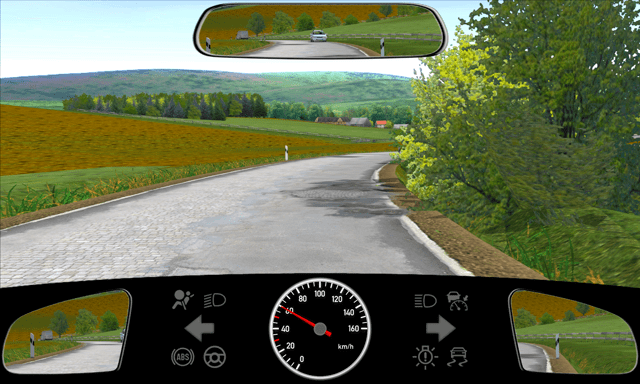
Wyjaśnienie
In the event of lane damage before a turn, you should reduce your speed considerably to avoid damaging the vehicle. Due to the confusion of the curve, you should not drive past the lane damage on the left, but continue on the right on your lane.
-
Question 10 of 11
Jadą Państwo wąską aleją. O czym muszą Państwo pamiętać?
2.1.03-1204 PunktówWyjaśnienie
The narrow width of the road and its often curved shape due to tree roots force you to take extra care when cornering and when facing oncoming traffic. Choose your speed in such a way that the vehicle can be brought to a halt within half the visible distance. Example: With a visibility of approx. 40 metres, you should choose your speed so that you come to a stop within approx. 20 metres. In purely mathematical terms, the stopping distance at 30 km/h is 18 metres.
-
Question 11 of 11
Z czym muszą się Państwo w tym przypadku liczyć?
2.1.03-1224 Punktów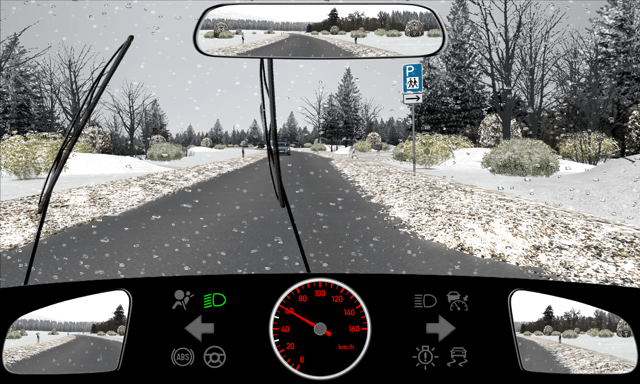
Wyjaśnienie
The snow on the right and left sides of the road may limit the lane. Therefore, you must expect that the distance to oncoming traffic is reduced. In addition, you can see from the traffic sign that there is a parking area for walkers on the right-hand side. Therefore, you must expect that there are pedestrians on the roadway.