
1.3.01 Priorytet
Z łatwością poznaj najważniejsze niemieckie zasady dotyczące priorytetów: Tuż przed lewą, drogi priorytetowe, zasady obracania, rondai wiele więcej.
NAJWAŻNIEJSZA ZASADA
Jeśli NIE ma znaków, NIE ma sygnalizacji świetlnej i NIE ma funkcjonariusza policji:
➡️ LEWY UKŁADA SIĘ W PRAWYM
Pierwszeństwo mają pojazdy jadące z PRAWEJ strony.
🏆 Hierarchia priorytetów
1. Policja
Instrukcje policji zawsze są najważniejsze.
2. Sygnalizacja świetlna
Sygnalizacja świetlna zastępuje znaki drogowe.
3. Znaki drogowe
Ustąp pierwszeństwa, zatrzymaj się, droga priorytetowa itp.
4. Tuż przed lewą
Podstawowa zasada, jeśli nic innego nie reguluje ruchu.
➡️ Tuż przed lewą (Rechts vor Links)
✅ Obowiązuje tutaj
- Skrzyżowania bez znaków
- Skrzyżowania typu T bez regulacji ruchu drogowego
- Ulice mieszkalne
- Małe miejskie skrzyżowanie
❌ NIE dotyczy
- Drogi priorytetowe
- Ronda ze znakami
- Ścieżki polne i leśne
- Podjazdy i obniżone krawężniki
⚠️ Ważne wyjątki
Ścieżki polne i leśne
Pojazdy wyjeżdżające z polnych lub leśnych ścieżek muszą zawsze ustąpić pierwszeństwa.
Opuszczenie nieruchomości
Opuszczając posesję lub podjazd, pierwszeństwo mają wszystkie pozostałe osoby.
Rondo
Pojazdy znajdujące się już na rondzie mają zazwyczaj pierwszeństwo.
🔄 Zmieniające się zasady
↩️ Skręcamy w lewo
- Ustąp pierwszeństwa nadjeżdżającym pojazdom
- Ustąp pierwszeństwa rowerzystom jadącym na wprost
- Ustąp pierwszeństwa tramwajom jadącym prosto
- Poczekaj, aż pas będzie wolny
↪️Skręt w prawo
- Uważaj na rowerzystów po prawej stronie
- Obserwuj przejście dla pieszych
- Sprawdź dokładnie lusterka
- Szanuj drogi priorytetowe
🛣 Przepisy drogowe z pierwszeństwem
Pozostając na drodze priorytetowej
W pierwszej kolejności jadą pojazdy pozostające na drodze priorytetowej.
Zjazd z drogi priorytetowej
Opuszczając go, być może będziesz musiał ustąpić pierwszeństwa pojazdom nadjeżdżającym z naprzeciwka.
Wjazd na drogę priorytetową
Kierowcy wjeżdżający muszą zawsze poczekać.
⭕ Regulamin ronda
✅ Poprawnie
- Ustąp przed wejściem
- Pojazdy znajdujące się wewnątrz mają pierwszeństwo
- Sygnał przy wyjściu
❌ Źle
- Wejście zbyt szybkie
- Zapominanie o kierunkowskazach
- Ignorowanie rowerzystów
🧠 Łatwe sztuczki zapamiętywania
Prawa strona = priorytet
Skręcający w lewo czekają
Droga priorytetowa przewyższa drogi boczne
Jeśli nie jesteś pewien: zwolnij i komunikuj się
📚 Tabela szybkich priorytetów
| Sytuacja | Kto ma pierwszeństwo? |
|---|---|
| Brak znaków na skrzyżowaniu | Pojazd od prawej |
| Skręcając w lewo | Nadjeżdżający ruch |
| Wjazd na rondo | Pojazdy już w środku |
| Wyjazd z podjazdu | Wszyscy pozostali użytkownicy dróg |
| Droga priorytetowa | Pojazdy na drodze priorytetowej |
🎯 Wskazówki dotyczące egzaminu
✅ Pamiętaj
- Tuż przed lewą jest podstawową zasadą
- Osoby skręcające w lewo zwykle czekają
- Drogi priorytetowe są bardzo ważne
- Uważaj na rowerzystów i tramwaje
❌ Typowe błędy
- Ignorowanie rowerzystów z prawej strony
- Zapominając o zasadach pierwszeństwa skrętu
- Mylenie dróg bocznych z drogami równymi
- Zbyt szybka jazda na niejasnych skrzyżowaniach
Practice Questions (47)
-
Question 1 of 47
W jakich miejscach bez znaków drogowych, regulujących pierwszeństwo przejazdu, obowiązuje zasada pierwszeństwa z prawej strony?
1.3.01-0015 PunktówWyjaśnienie
At intersections and T-junctions without a traffic-regulating traffic sign "left yields to right" applies. If a vehicle leaves a property or a restricted traffic area, all other road users, including pedestrians and children on the sidewalk, have priority.
-
Question 2 of 47
W jakich miejscach bez znaków drogowych, regulujących pierwszeństwo przejazdu, obowiązuje zasada pierwszeństwa z prawej strony?
1.3.01-0025 PunktówWyjaśnienie
At intersections and T-junctions without priority signs, the vehicles coming from the right have priority. The same applies to roads that are equally ranked according to their signage. Lanes with drop kerb, drives as well as field and forest trails are an exception. If you are on one of these roads, you must give priority to other road users.
-
Question 3 of 47
Zbliża się Pani/Pan do skrzyżowania, na którym sytuacja pierwszeństwa przejazdu nie jest od razu jednoznaczna dla Pani/Pana. Jak się Pani/Pan zachowa?
1.3.01-0035 PunktówWyjaśnienie
There are situations that are difficult to understand in terms of the right of way. If this happens to you wait and watch other car drivers. If the situation remains difficult, you can communicate with each other by clear hand signals. To simply continue straight ahead or act according to the rule "left yields to right" would be too risky and accident-prone.
-
Question 4 of 47
Jakie zachowanie jest prawidłowe?
1.3.01-0075 Punktów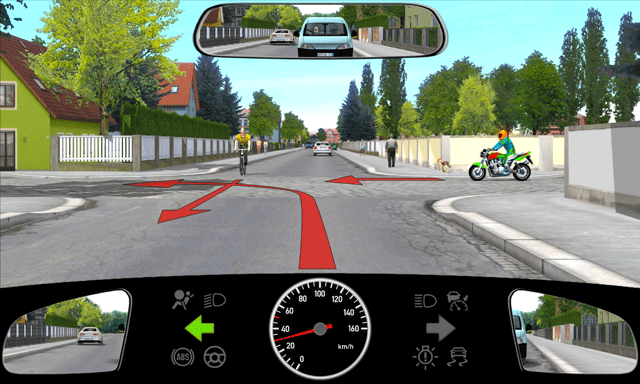
Wyjaśnienie
It is necessary to comply to the left yields to right rule. Grant the motorcyclist from the right the right of way before entering the intersection. Next, you as a left-turning driver, have to give priority to the oncoming cyclist. For the motorcyclist the cyclist comes from the right and thus has priority.
-
Question 5 of 47
Jakie zachowanie jest prawidłowe?
1.3.01-0135 Punktów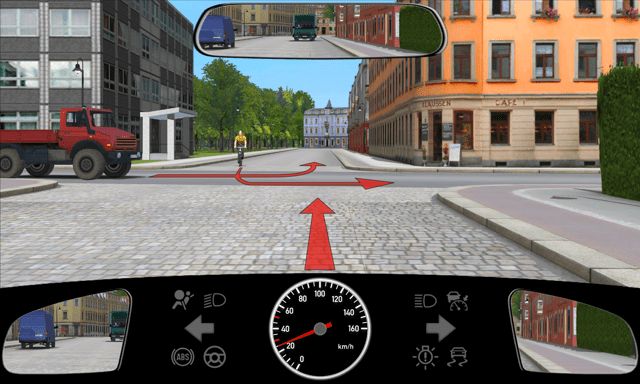
Wyjaśnienie
Left yields to right applies in intersections and T-junctions without a traffic sign. Since no vehicle comes from the right, you may first cross the intersection. After that the truck drives and finally the cyclist.
-
Question 6 of 47
Jakie zachowanie jest właściwe?
1.3.01-0165 Punktów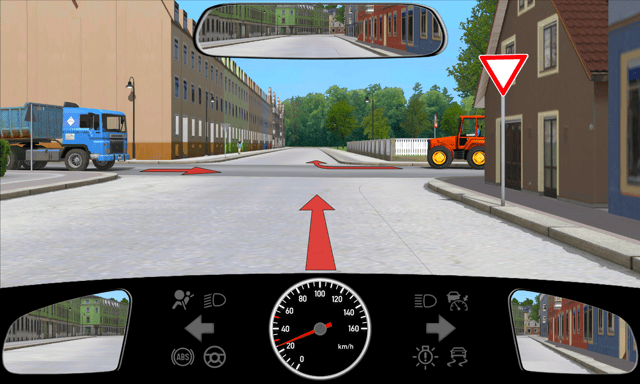
Wyjaśnienie
The traffic sign "Give way" regulates the right of way here. That means you have to wait and let both, the right and left vehicle, pass.
-
Question 7 of 47
Jakie zachowanie jest prawidłowe?
1.3.01-0175 Punktów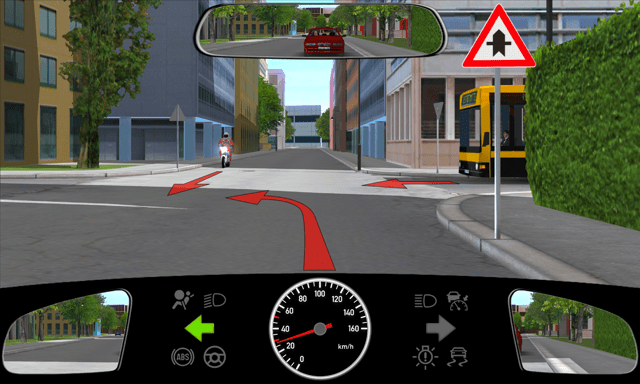
Wyjaśnienie
Here the traffic sign "right of way at the next intersection or T-junction" applies. Since you want to turn left you will have to let the oncoming vehicle pass. You may then turn in front of the vehicle coming from the right.
-
Question 8 of 47
Jakie zachowanie jest prawidłowe?
1.3.01-0185 Punktów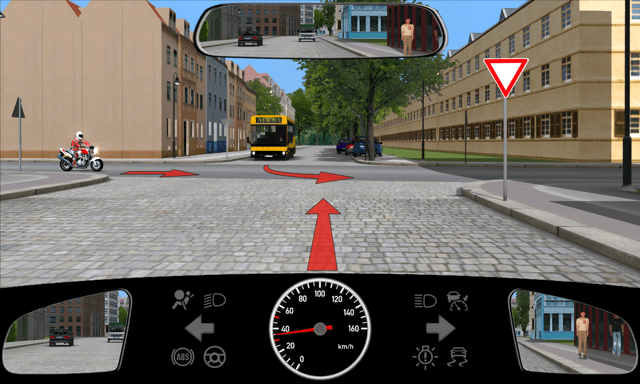
Wyjaśnienie
The traffic sign "Give way" suspends the left yields to right regulation. Thus, the motorcycle coming from the left has priority. You have to wait. Then the left-turning driver of the oncoming traffic must first let you cross the intersection before he can turn.
-
Question 9 of 47
Jakie zachowanie jest prawidłowe?
1.3.01-0215 Punktów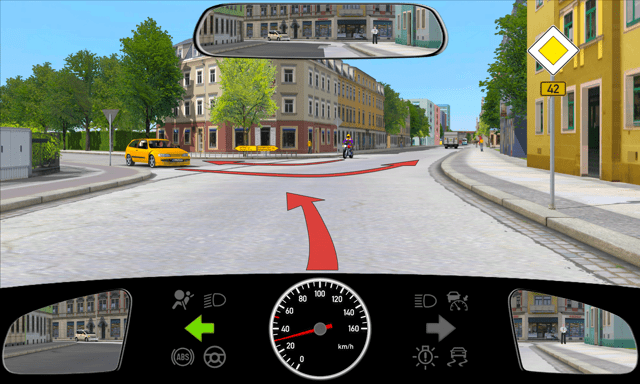
Wyjaśnienie
The traffic sign stands for a "priority road". You may therefore turn in front of the vehicle coming from the left. First, however, you must let the oncoming vehicle turn, because you have to wait as a left-turning driver.
-
Question 10 of 47
Jak powinni się Państwo tutaj właściwie zachować?
1.3.01-0345 Punktów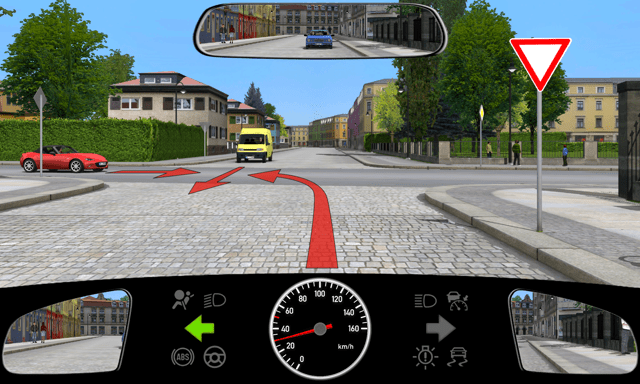
Wyjaśnienie
The right-of-way rule says that you have to let the yellow vehicle drive through.
-
Question 11 of 47
Jakie zachowanie jest prawidłowe?
1.3.01-0355 Punktów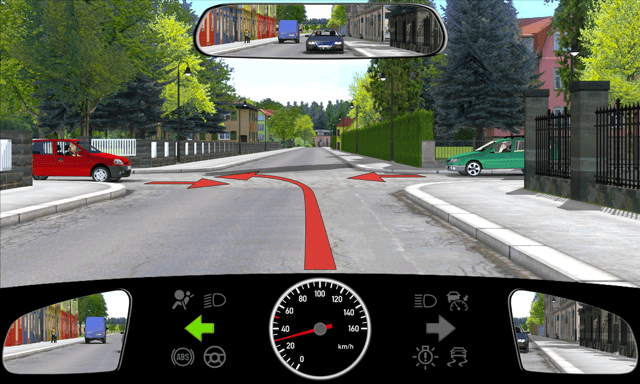
Wyjaśnienie
Since there are no signs at this intersection, which determine the priority of the drivers, the right of way "left yields to right" applies. For this reason, you need to let the car on your right pass first. Afterwards, the driver on the left has to give you the right of way.
-
Question 12 of 47
Jakie zachowanie jest prawidłowe?
1.3.01-0385 Punktów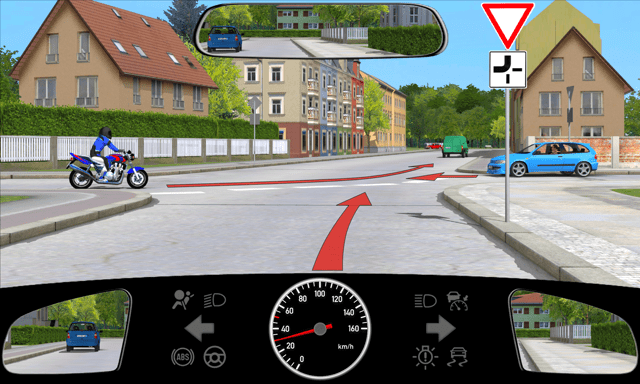
Wyjaśnienie
According to the signage, the motorcyclist is on the priority road and is therefore allowed to drive first. Both the driver of the blue car and you are on a lane with the "Give way" sign. As this does not clear up the situation, "left yields to right" applies. For this reason, you have to let the other vehicle drive through.
-
Question 13 of 47
Kto może jechać tutaj jako pierwszy?
1.3.01-0395 Punktów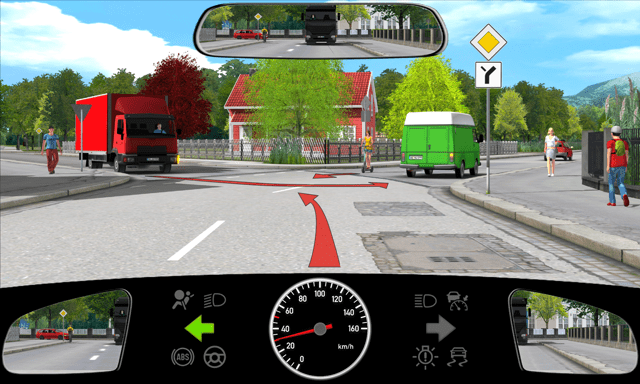
Wyjaśnienie
The electric scooter follows the priority road and therefore has the right of way.
-
Question 14 of 47
Które zachowanie jest tu prawidłowe?
1.3.01-0405 Punktów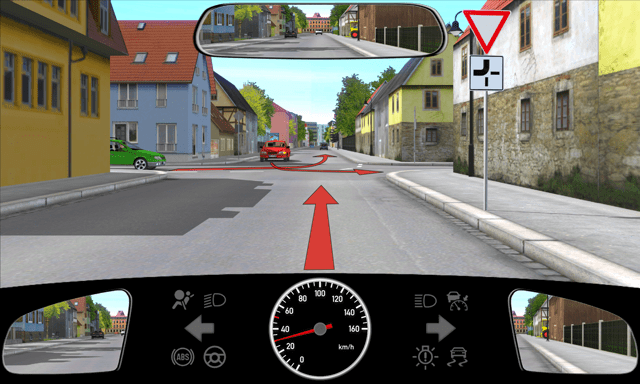
Wyjaśnienie
The green and red cars are on a turning main road. You are on the secondary road. The green car remains on the main road, which means that the green car is allowed to drive first, then the red car and you are allowed to drive last.
-
Question 15 of 47
Które zachowanie jest tu prawidłowe?
1.3.01-0415 Punktów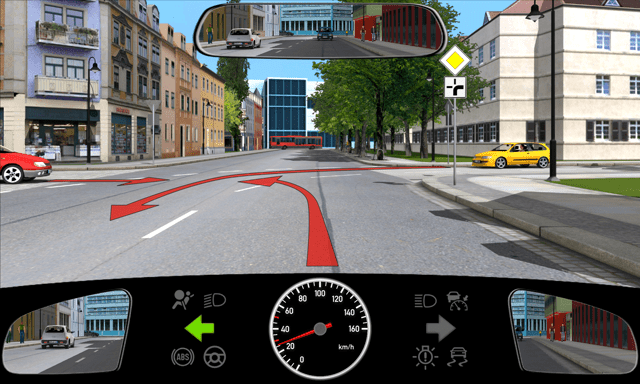
Wyjaśnienie
You and the yellow car are on a turning main road. The red car is on a secondary road. Because the yellow car remains on the main road, it is allowed to drive first. You may drive second and the red car can drive last.
-
Question 16 of 47
Które zachowanie jest prawidłowe?
1.3.01-0425 Punktów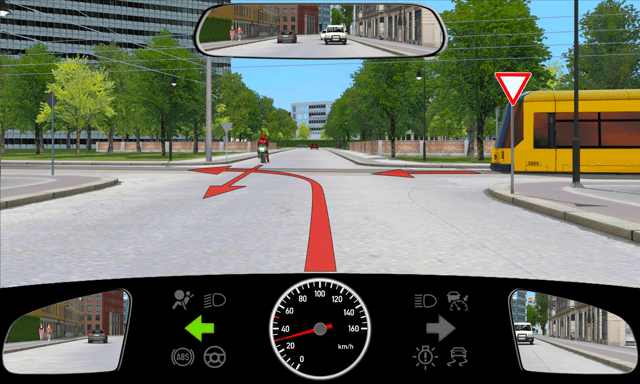
Wyjaśnienie
The sign at the intersection indicates that you must give way. Since you want to turn left, you must let the tram as well as the oncoming motorbike pass and enter the intersection last.
-
Question 17 of 47
Które zachowanie jest tu prawidłowe?
1.3.01-0435 Punktów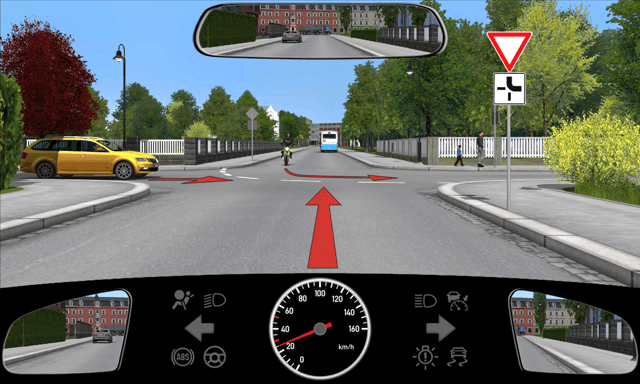
Wyjaśnienie
The motorbike is on a turning main road and is allowed to turn in front of the yellow car and you. According to the "right before left" rule at crossroads, you may drive in front of the yellow car.
-
Question 18 of 47
Jakie zachowanie jest tutaj prawidłowe?
1.3.01-0445 Punktów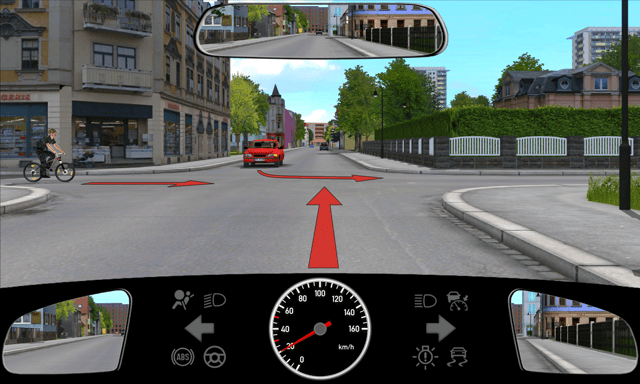
Wyjaśnienie
At this intersection applies to the right before left. So you can drive first. "Right before left" applies to intersections where the right of way is not regulated by signs, traffic lights or traffic police officers.
-
Question 19 of 47
Jakie zachowanie jest tutaj właściwe?
1.3.01-0455 Punktów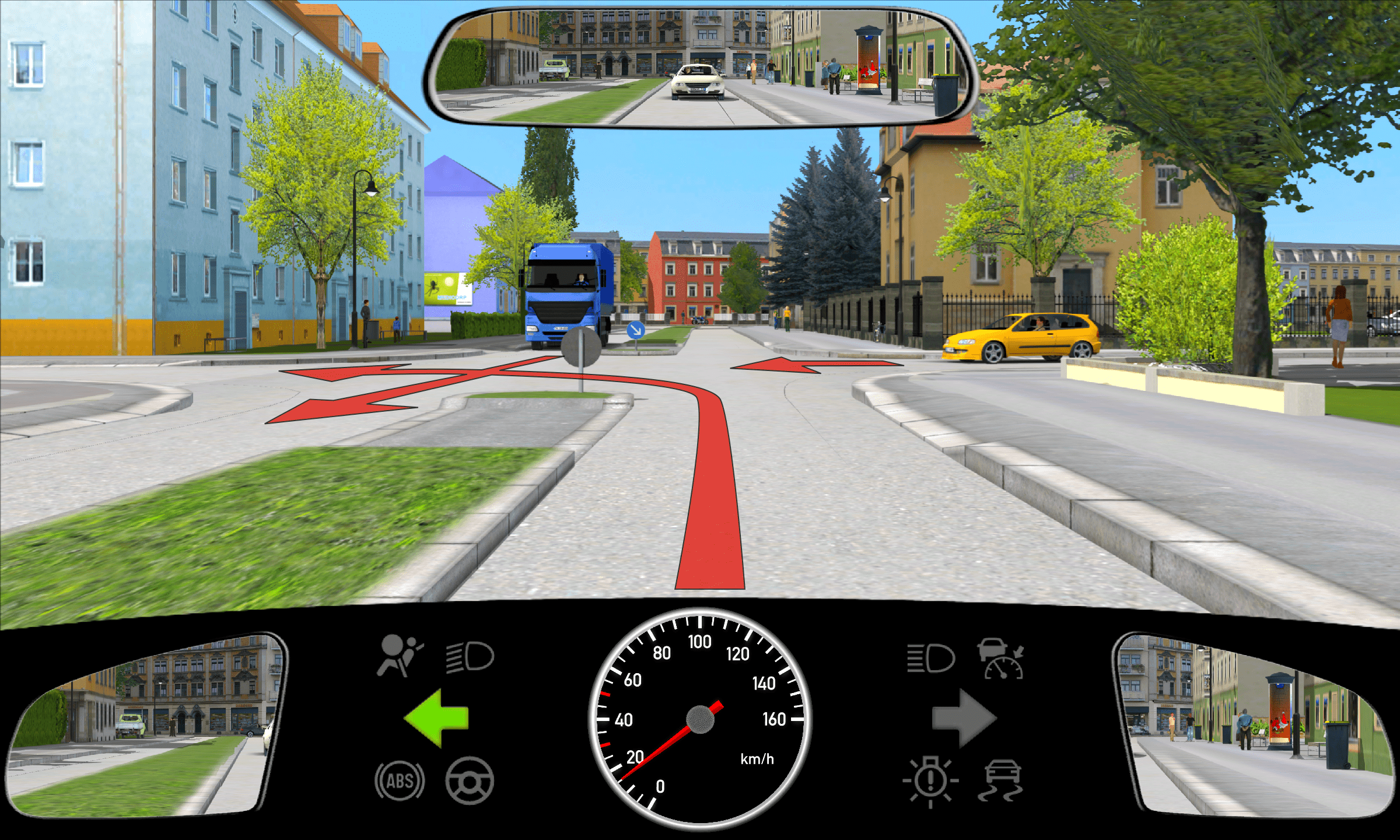
Wyjaśnienie
At this junction, the right before left rule applies, which means that you must let the yellow vehicle pass. You must also let the lorry through, as you want to turn left and the lorry wants to continue straight ahead in its lane.
-
Question 20 of 47
Które zachowanie jest prawidłowe?
1.3.01-0465 Punktów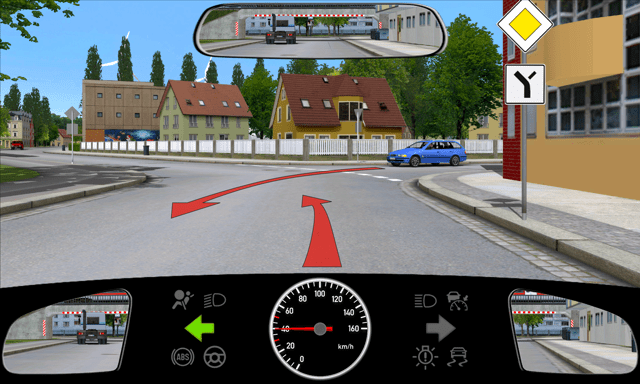
Wyjaśnienie
You are on the turning priority road and follow its course. Therefore, you must drive first and the other vehicle must wait.
-
Question 21 of 47
Jakie zachowanie jest tutaj właściwe?
1.3.01-0475 Punktów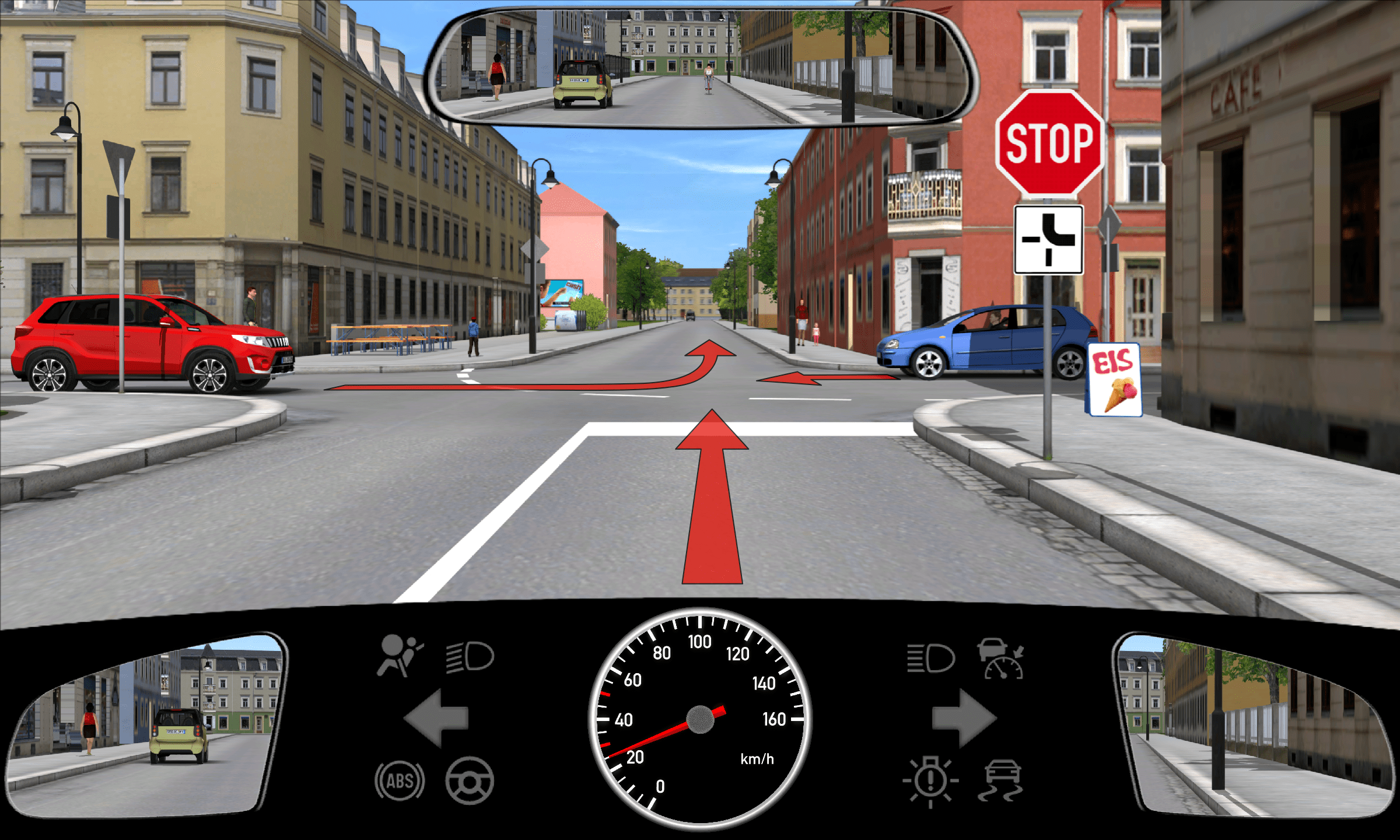
Wyjaśnienie
You are approaching a priority road that is about to turn. As you are coming from a side road, you must allow the blue car leaving the priority road to pass. You must also stop at a stop sign at the stop line before you are allowed to enter the junction.
-
Question 22 of 47
Jakie zachowanie jest prawidłowe?
1.3.01-0485 Punktów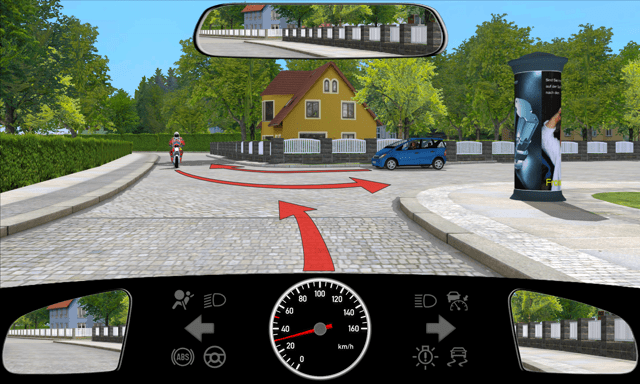
Wyjaśnienie
At an intersection, which has no traffic signs, "left yields to right" applies. If a car drives from the right wants to turn right, he is allowed to drive first and you have to wait. On the other hand, if a vehicle approaching you wants to turn left, you have the right of way, because if a driver wants to turn, must always give priority to oncoming traffic.
-
Question 23 of 47
Jakie zachowanie jest prawidłowe?
1.3.01-0495 Punktów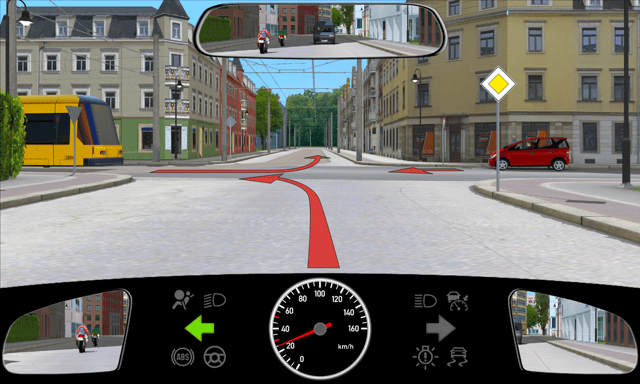
Wyjaśnienie
The traffic sign indicates that you are on a priority road. The tram and the driver of the red car, on the other hand, must follow the sign "Give way" and wait. You drive first.
-
Question 24 of 47
Jakie zachowanie jest prawidłowe?
1.3.01-0505 Punktów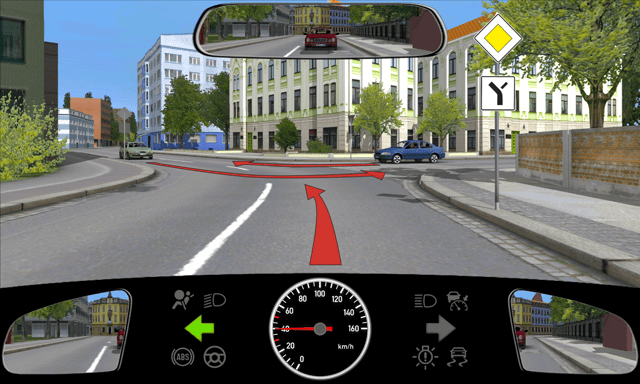
Wyjaśnienie
If you are traveling on a priority road, you are always allowed to drive first. A car that meets you and wants to turn left, however, has to wait. If a car driver wants to turn into your street from the right, he/she must also give you the right of way, since you are on a priority road.
-
Question 25 of 47
Które zachowanie jest prawidłowe?
1.3.01-0515 Punktów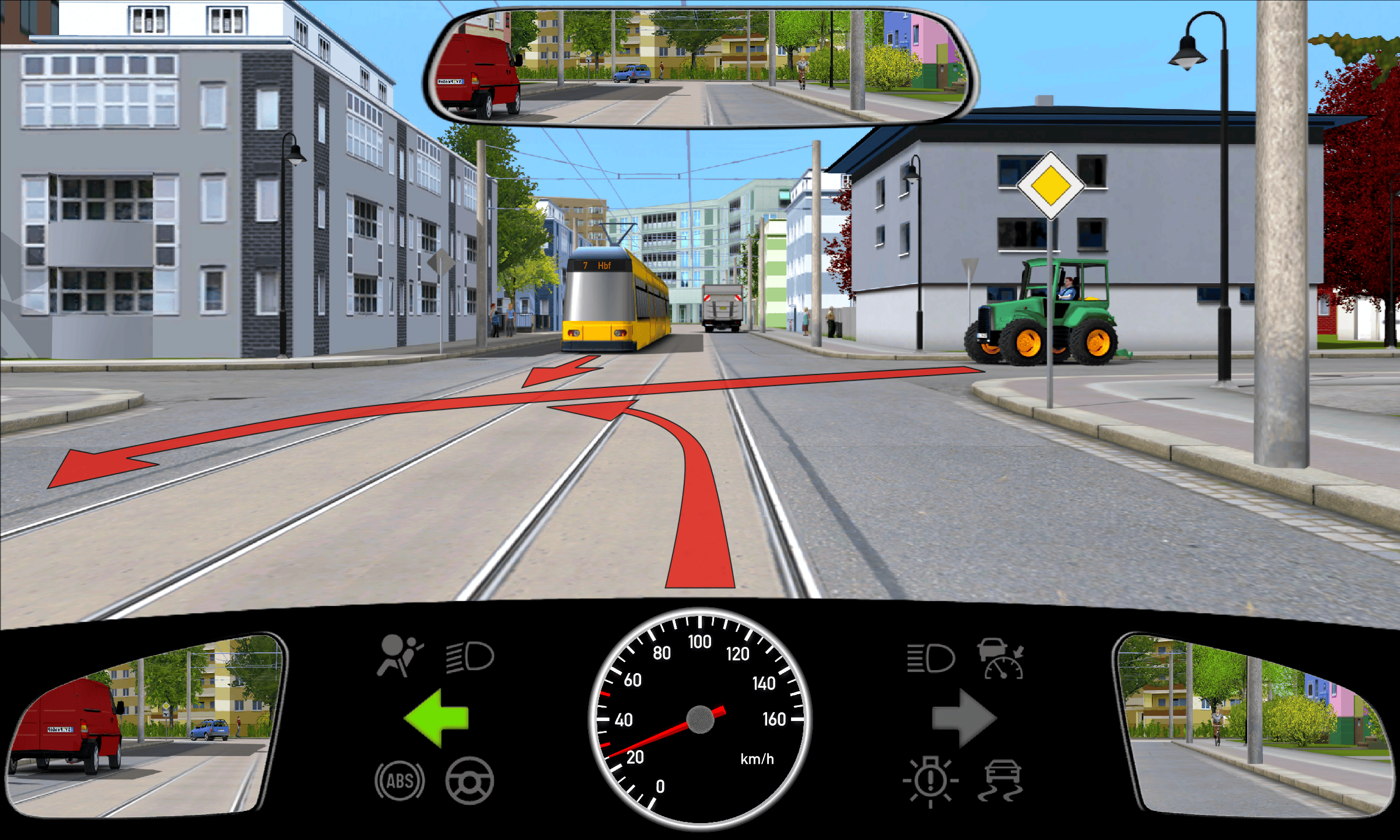
Wyjaśnienie
The following hierarchy applies on a priority road: In principle, vehicles on a priority road always have priority. However, when leaving a priority road, you must give priority to oncoming vehicles. However, vehicles that want to drive onto a priority road must give priority to other road users on the priority road. This means you have to give priority to the tram because it is traveling on a priority road, does not change direction and you want to turn left.
-
Question 26 of 47
Które zachowanie jest prawidłowe?
1.3.01-0525 Punktów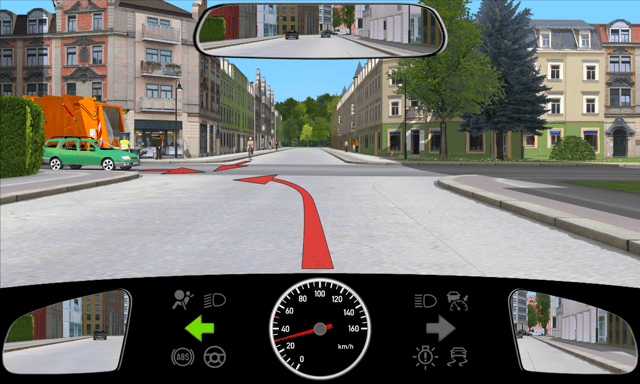
Wyjaśnienie
Due to the rule "left yields to right" you would have priority over the green car. However, you must give priority to the oncoming cyclist whose lane you would be crossing. To ensure the traffic flow, it is therefore advisable to let the driver of the green car first enter the intersection.
-
Question 27 of 47
Chcą Państwo skręcić w prawo w drogę z pierwszeństwem. Na co należy zwrócić uwagę?
1.3.01-0535 PunktówWyjaśnienie
If you turn right into a priority road, you must give priority to all road users. This applies both to vehicles that come from the right and those that pass from the left. In addition, be sure to take care of cyclists and pedestrians who are to your right or behind you.
-
Question 28 of 47
Jak zachować się poprawnie?
1.3.01-0565 Punktów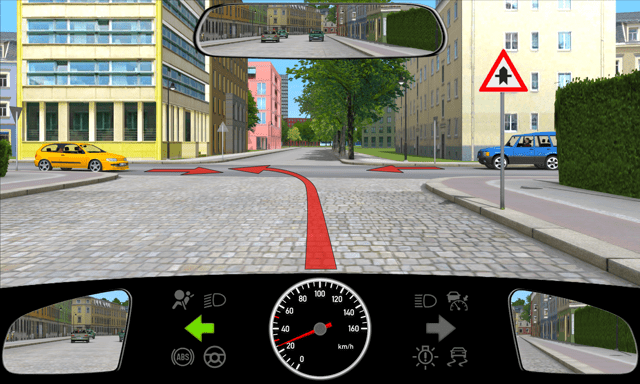
Wyjaśnienie
At this intersection you have right of way. This is indicated by the traffic sign. That's why the vehicles have to wait from the right and left and let you drive first.
-
Question 29 of 47
Jak należy zachować się prawidłowo?
1.3.01-0575 Punktów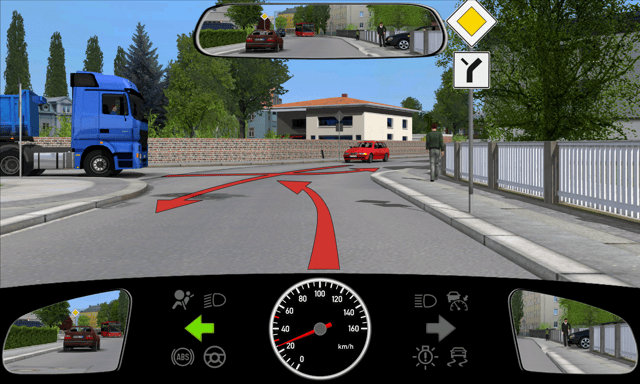
Wyjaśnienie
If you want to turn left from a priority road and another car is driving next to you, which remains on the priority road, you must give priority to this car driver. A vehicle that is not on the priority road, on the other hand, has to wait.
-
Question 30 of 47
Co obowiązuje w takiej sytuacji?
1.3.01-0585 Punktów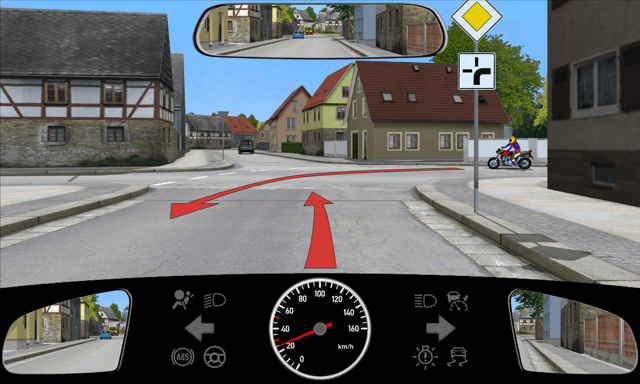
Wyjaśnienie
You are on a turning priority road, but you don't want to follow it to the right and instead continue straight ahead. From the right a motorcycle follows the course of the priority road. You have to wait and give priority to this vehicle.
-
Question 31 of 47
Kto powinien jechać pierwszy?
1.3.01-0595 Punktów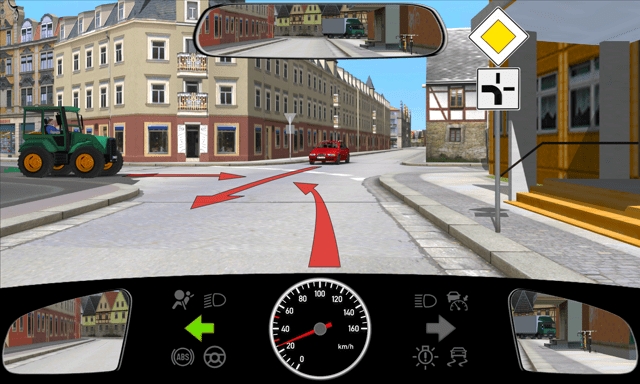
Wyjaśnienie
You follow a turning priority road. Therefore, you have priority over the driver of the car driving straight ahead. The driver of the tractor also has to wait because he/she leaves the priority road and the rule left yields to right applies to you.
-
Question 32 of 47
Jakie zachowanie jest właściwe?
1.3.01-0605 Punktów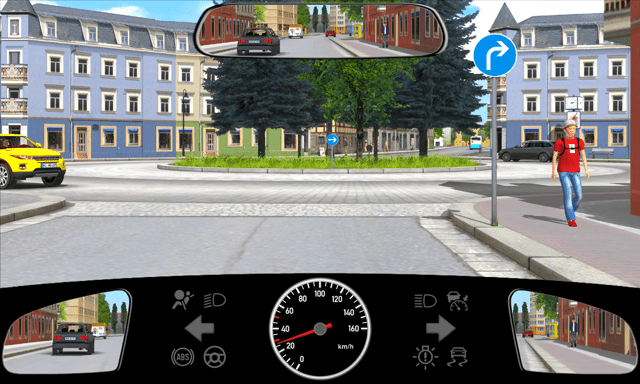
Wyjaśnienie
If no traffic signs have been erected to regulate the right of way, this is so-called circular traffic. Here, the basic rule of right before left applies. As you are turning into circular traffic, you must signal.
-
Question 33 of 47
Które zachowanie jest prawidłowe?
1.3.01-1035 Punktów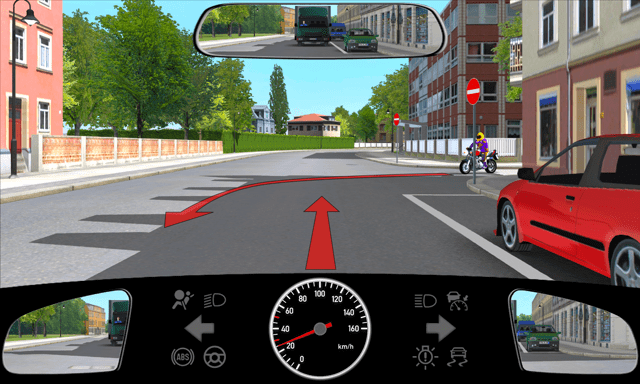
Wyjaśnienie
Who comes from the right, has right of way at intersections and T-junctions. Because if there is no priority-controlling traffic sign, "left yields to right" applies. No matter the size and type of the vehicle.
-
Question 34 of 47
Chcesz skręcić w lewo. Kto musi zaczekać?
1.3.01-1125 Punktów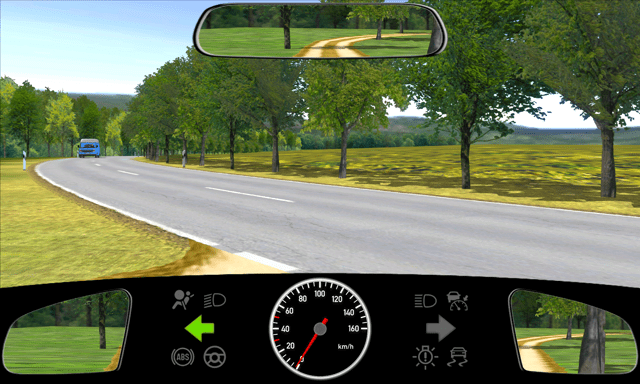
Wyjaśnienie
At intersections and T-junctions without a traffic-regulating traffic sign, the rule "left yields to right" applies. Field and forest paths, however, are subordinate traffic routes. If you want to turn from a field or forest path onto a road, you have to wait.
-
Question 35 of 47
Które zachowanie jest prawidłowe?
1.3.01-1135 Punktów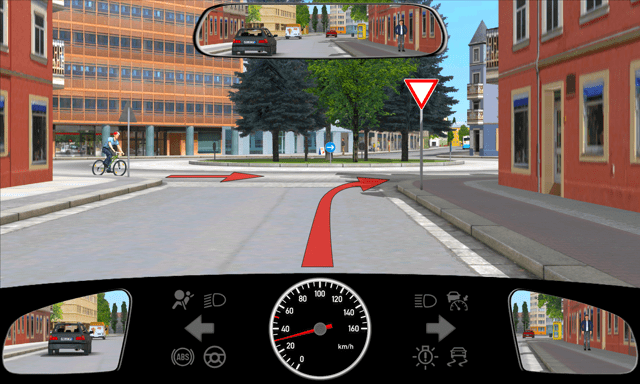
Wyjaśnienie
If you want to turn into a roundabout, you will be asked to wait by the "Give way" traffic sign. The drivers driving in a circle have priority here.
-
Question 36 of 47
Które zachowanie jest prawidłowe?
1.3.01-1145 Punktów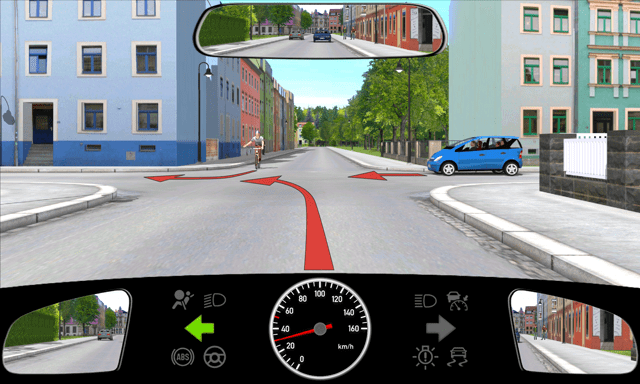
Wyjaśnienie
Here, "left yields to right" applies as well as the rules for left turns. The car coming from the right may drive first. Since you want to turn left, the oncoming cyclist has right of way.
-
Question 37 of 47
Które zachowanie jest prawidłowe?
1.3.01-1165 Punktów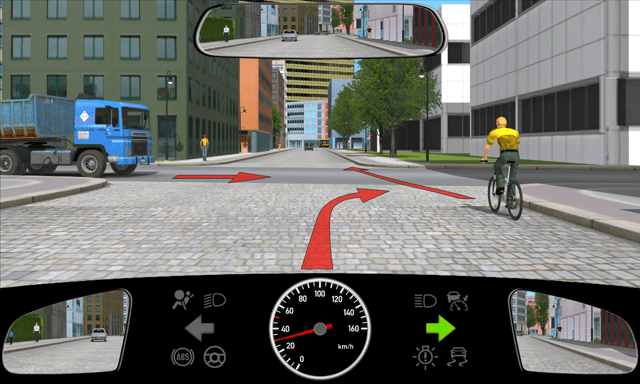
Wyjaśnienie
At this spot, the right of way is not regulated by traffic signs. Therefore, at this intersection left yields to right applies. Here the straight driving cyclist has priority over you as you want to turn. The truck coming from the left may drive last.
-
Question 38 of 47
Które zachowanie jest prawidłowe?
1.3.01-1175 Punktów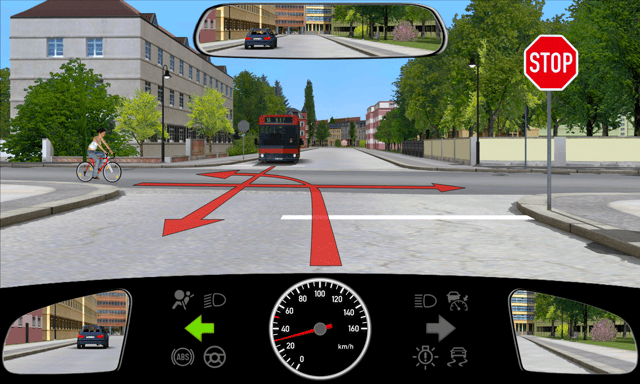
Wyjaśnienie
A vehicle coming from the left is already on the priority road. Therefore, it is allowed to drive first. If you turn left, you will have to let oncoming vehicles drive past first. Due to the traffic sign, you have to stop at the stop line ("Give way") or stop completely and are not even allowed to trundle ("Stop sign").
-
Question 39 of 47
Które zachowanie jest prawidłowe?
1.3.01-1185 Punktów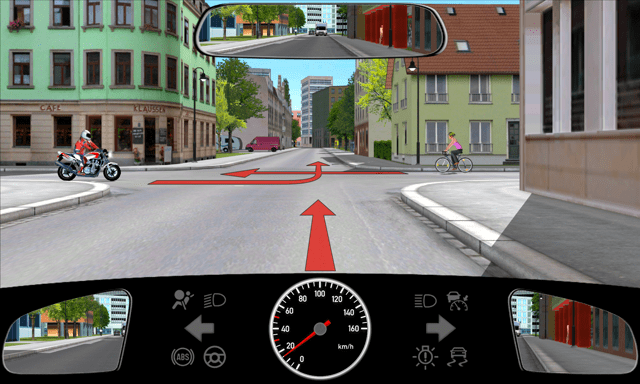
Wyjaśnienie
Since the right of way here is not regulated by traffic signs, left yields to right applies. This means: you must stop and grant access to vehicles from the right. The bike coming from the left has to let you in.
-
Question 40 of 47
Chcesz przeciąć drogę z pierwszeństwem przejazdu. Widoczność po obu stronach jest mocno ograniczona z powodu zaparkowanych pojazdów. Jak się zachowasz?
1.3.01-1195 PunktówWyjaśnienie
If visibility is limited you should only proceed with caution. Slowly get into the intersection until you can see the priority road. This is how you act responsibly.
-
Question 41 of 47
Które zachowanie jest prawidłowe?
1.3.01-1205 Punktów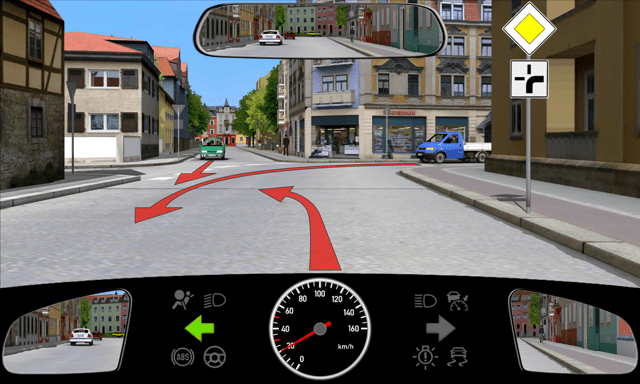
Wyjaśnienie
If you are on a priority road and you want to turn left, you will have to let oncoming cars drive by. If a vehicle drives next to you, which contrary to you remains on the priority road, then this car driver has priority. However, if a vehicle from another street with the traffic sign "Give way" wishes to turn into your priority road, he/she may only drive last.
-
Question 42 of 47
Jakie zachowanie jest prawidłowe?
1.3.01-1255 Punktów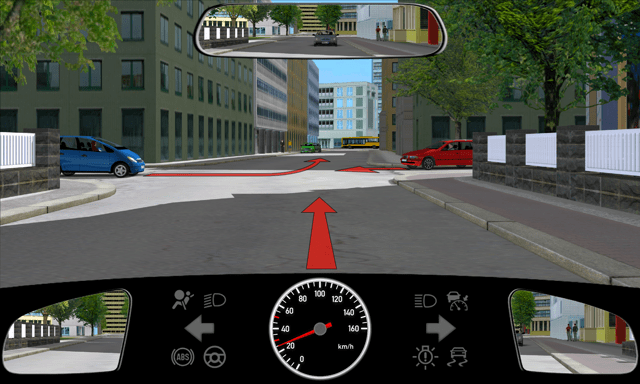
Wyjaśnienie
Without additional priority-regulating traffic signs or traffic lights, the general "left yields to right" rule applies. The car coming from the right must be given priority. You have priority over the car coming from the left.
-
Question 43 of 47
Jakie zachowanie jest prawidłowe?
1.3.01-1265 Punktów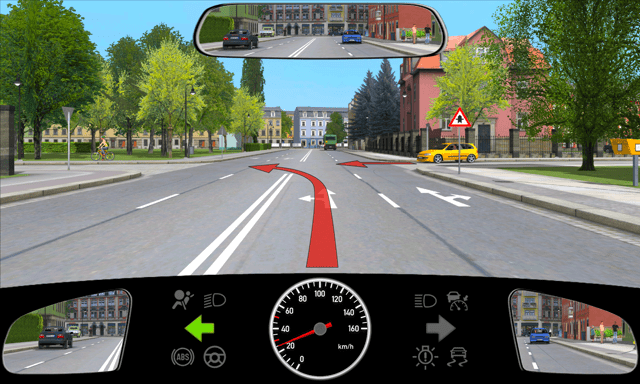
Wyjaśnienie
At the traffic sign "right of way at the next intersection or T-junction", you may drive first at the next intersection. A vehicle coming from the left must wait.
-
Question 44 of 47
W jakiej kolejności pojazdy muszą tutaj jechać dalej?
1.3.01-1275 Punktów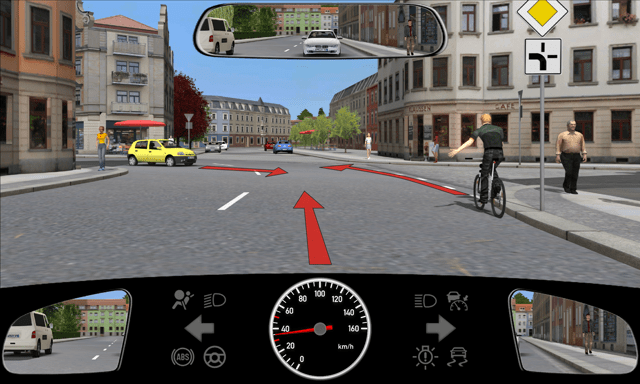
Wyjaśnienie
You are on a turning priority road and you want to leave straight ahead. The cyclist follows the course of the priority road and therefore has priority over you. The car from the left must grant you right of way according to the rule "left yields to right".
-
Question 45 of 47
Kto w tej sytuacji może jechać pierwszy?
1.3.01-1285 Punktów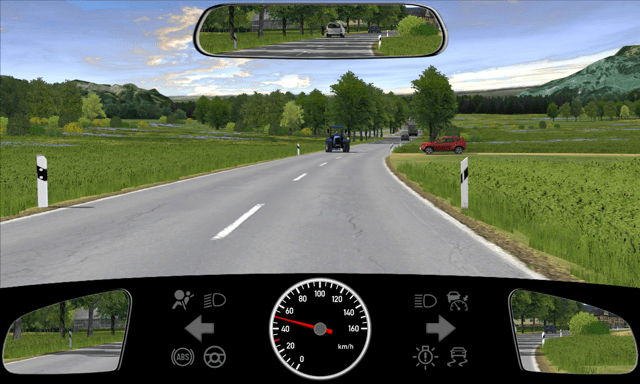
Wyjaśnienie
The basic rule "right before left" does not apply to vehicles driving out of a field or forest path onto another road.
-
Question 46 of 47
Jak zachowają się Państwo tutaj właściwie?
1.3.01-1295 Punktów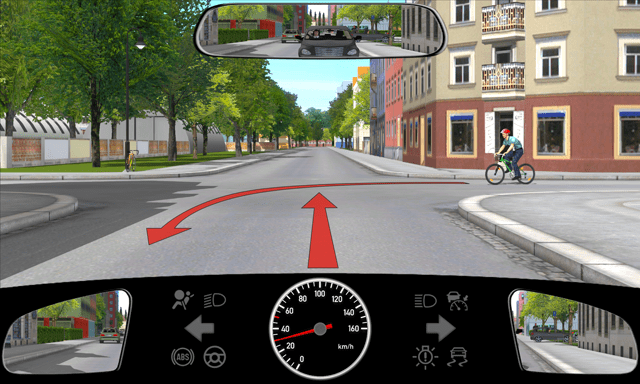
Wyjaśnienie
At intersections and junctions, whoever is coming from the right has the right of way.
-
Question 47 of 47
Co jest w tej sytuacji właściwe?
1.3.01-1305 PunktówWyjaśnienie
You can see from the signs that this is not a roundabout. Therefore, right before left applies.