
2.1.03 Cestovni i vremenski uvjeti
Zlatno pravilo ⭐
Loše vrijeme = Loše prianjanje + Dulji put kočenja + Slaba vidljivost.
👉 Uvijek smanjite brzinu, povećajte udaljenost i izbjegavajte naglo upravljanje ili kočenje.
🌧️ Kiša i mokri putevi
- Prva kiša nakon suhog vremena stvara sklizak uljni film.
- Put kočenja postaje duži.
- Vidljivost postaje lošija zbog prskanja vode i zamagljenog vizira.
- Izbjegavajte naglo kočenje ili ubrzavanje.
- Odmah povećajte sigurnosni razmak.
- Oznake na cesti postaju vrlo skliske kada su mokre.
Posebno je opasna “Prva kiša nakon suše”.
💧 Akvaplaning
- Javlja se pri velikim brzinama na mokrim cestama.
- Gume gube kontakt s cestom.
- Ne možete pravilno upravljati ili kočiti.
- Rizik je veći u kolotrazima i stajaćoj vodi.
- Polako skinite nogu s gasa.
- Držite upravljač ravno.
- NEMOJTE naglo kočiti.
🌬️ Bočni vjetar
- Opasnost raste u blizini mostova, tunela i kamiona.
- Motocikli mogu iznenada skrenuti bočno.
- Pogonski tok kamiona iznenada mijenja tlak vjetra.
- Velika brzina čini bočni vjetar opasnijim.
Smanjite brzinu i pažljivo upravljajte.
⚠️ Skliske površine
- Oznake traka
- Uljne zakrpe
- Kaldrma
- Lišće i pijesak
- Šahtovi i tramvajske tračnice
- Mokri kolnici i makadam
Povećana opasnost od klizanja i pada.
🌫️ Magla i slaba vidljivost
- Koristite kratka svjetla.
- Stražnje svjetlo za maglu samo ispod 50m vidljivosti.
- Najveća brzina sa stražnjim svjetlom za maglu = 50 km/h.
- Nemojte voziti po središnjoj liniji.
- Orijentirajte se na desnu stranu ceste.
Samo parkirna svjetla NISU dopuštena u magli.
❄️ Snijeg i led
- Cesta postaje izuzetno skliska.
- Snježne gomile smanjuju vidljivost.
- Put kočenja se znatno povećava.
- Izbjegavajte pretjecanja po bljuzgavici.
- Vozite glatko bez trzaja u upravljanju.
Zakočite rano i vozite predvidljivo.
🏍️ Posebni rizici za motocikle
- Bočni vjetar može gurnuti motocikl bočno.
- Oznake mokrih traka su vrlo skliske.
- Tramvajske tračnice moraju se prelaziti što okomitije.
- Kaldrma snažno smanjuje prianjanje.
- Lišće, pijesak i ulje povećavaju rizik od pada u zavojima.
- Održavajte dovoljan razmak u grupnoj vožnji.
- Izbjegavajte naglo kočenje tijekom naginjanja.
- Stražnji kotač može se lakše blokirati na mokrim cestama.
🧠 Formula brzog pamćenja
🌧️ Kiša = sklisko + slaba vidljivost
💧 Akvaplaning = Nema upravljanja + Nema kočenja
🌬️ Bočni vjetar = Pažljivo protuupravljanje
❄️ Snijeg/led = Kočite ranije + Vozite polako
⚠️ Skliske površine = Izbjegavajte nagle pokrete
Pitanja za vježbu (26)
-
Pitanje 1 od 26
What can cause in aquaplaning (sliding on wet roads) on wet road surfaces?
2.1.03-0155 BodoviObjašnjenje
Aquaplaning - also known as hydroplaning - occurs when the tread depth of the tires is too low to displace the accumulated amount of water or when the amount of water to be discharged is too large due to a high speed (from 60 km/h). In addition, wheel ruts in the road, in which water accumulates, favor this effect.
-
Pitanje 2 od 26
What can be caused if the road surface suddenly becomes worse?
2.1.03-0253 BodoviObjašnjenje
As the road surface deteriorates, it always results in a change and deterioration of traction. As the wheels lose stiction, the vehicle is slipping and skidding faster. The tire noise also depends on the condition of the road surface and changes when, for example, the road turns from a paved road to a cobblestone track.
-
Pitanje 3 od 26
What is the right course of action?
2.1.03-0285 BodoviObjašnjenje
While overtaking a cyclist, the oncoming truck also partly gets on your lane. Brake and drive as far to the right as possible.
-
Pitanje 4 od 26
Why should you brake now?
2.1.03-0293 BodoviObjašnjenje
Snow is a special danger for you as a car driver. Your lane is covered in snow. In addition, your view is restricted by a heap of snow. The upcoming green car does not respect the right of way. Therefore, you should brake early, because due to the slipperiness of the braking distance is extended. Probably the green car is also hampered by the snow pile.
-
Pitanje 5 od 26
What is the right course of action now?
2.1.03-0334 BodoviObjašnjenje
Due to the bad weather conditions, you should reduce your speed and avoid jerky steering movements (see danger sign) as you could otherwise skid.
-
Pitanje 6 od 26
What can be the effect of aquaplaning?
2.1.03-0344 BodoviObjašnjenje
In the event of aquaplaning, your vehicle has no direct contact with the road surface, so the steering command and the braking command cannot be implemented.
-
Pitanje 7 od 26
What is the correct course of action in this situation?
2.1.03-0363 Bodovi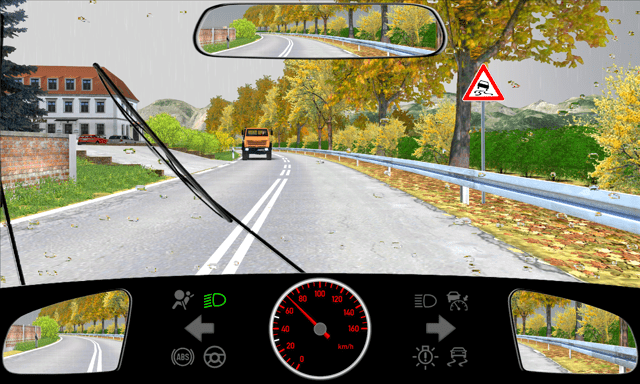
Objašnjenje
The traffic sign indicates a risk of skidding and sliding. To avoid skidding, you should reduce your speed, especially when it is raining and leaves are falling on the road, as is the case here. Braking hard, accelerating hard or steering jerkily can cause the tyres to lose their grip and you could skid or slide.
-
Pitanje 8 od 26
What should you be prepared for here?
2.1.03-0374 Bodovi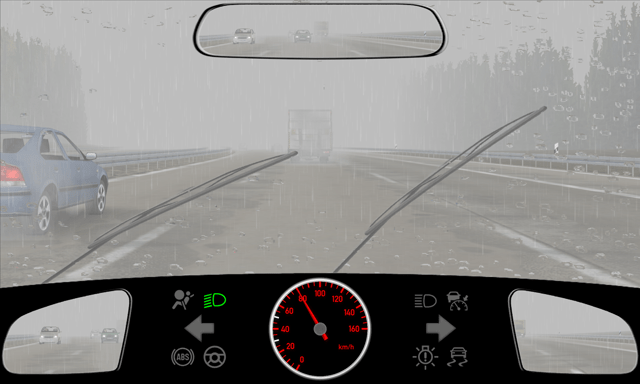
Objašnjenje
Because of the rain, you should be prepared for the fact that other vehicles will not be able to see your vehicle and that your braking distance will be longer due to the reduced grip.
-
Pitanje 9 od 26
Where are you particularly at risk during an overtaking manoeuvre here?
2.1.03-0384 Bodovi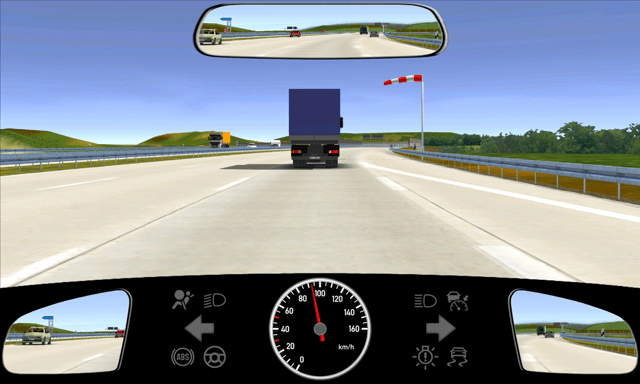
Objašnjenje
If there is a strong side wind from the right, you as a motorist are particularly at risk if, when driving off-road, you overtake in the slipstream of a truck. This hazard arises from the fact that strong cross winds from the right push your vehicle to the left, whereupon you automatically countersteer. As you overtake a truck, you slipstream into it; the crosswind is gone instantly and you have to adjust the steering. As soon as you pull out of the slipstream, the pressure starts up again with the crosswind; You have to countersteer again.
-
Pitanje 10 od 26
What must you anticipate in this situation?
2.1.03-0444 Bodovi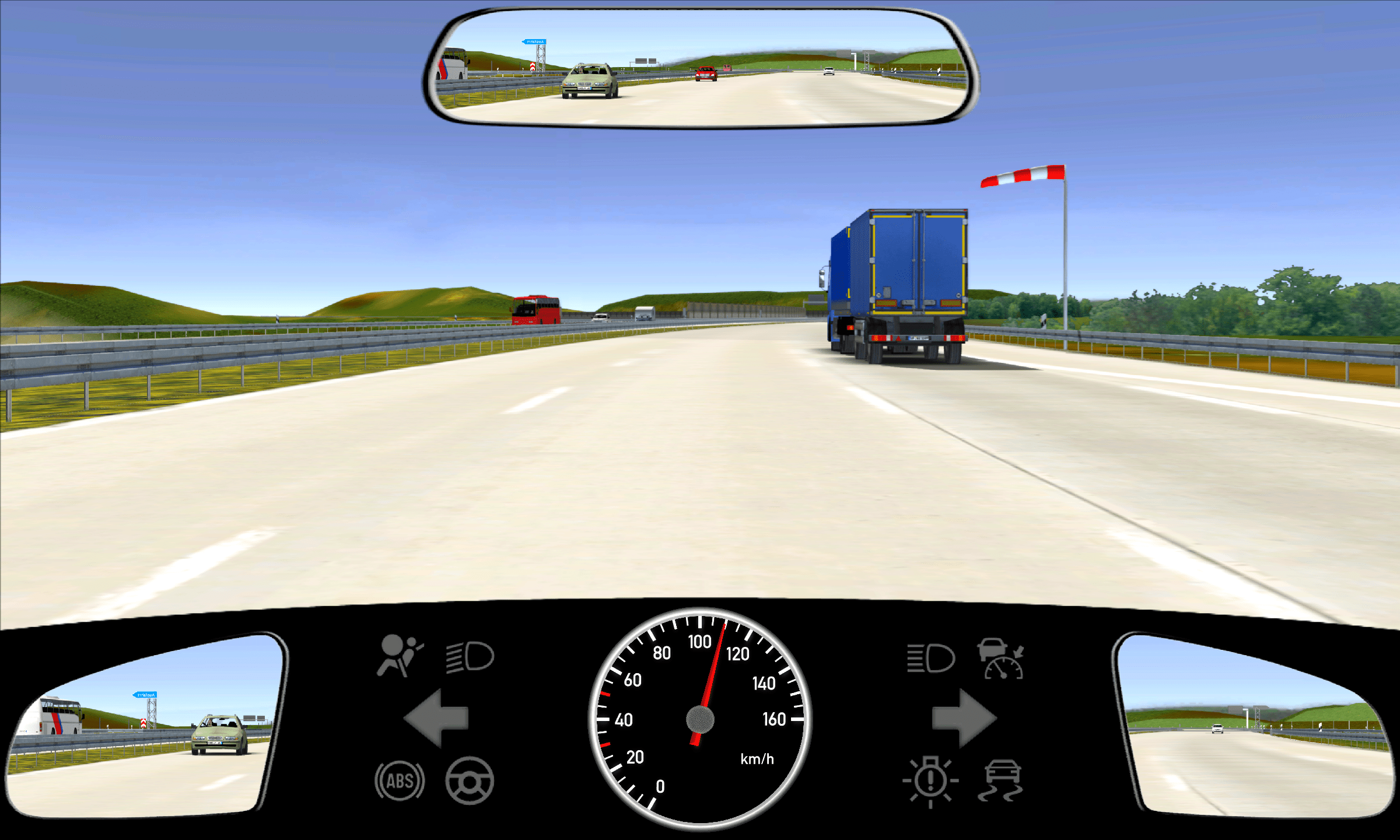
Objašnjenje
You can see from the windsock that a strong wind is blowing from the right. The strong wind could move your vehicle to the left. Be prepared to steer to the right. In addition, when entering the slipstream of the truck, you must be prepared for your vehicle to be moved to the right because its large surface area will keep out the crosswind. Be prepared to steer to the left to avoid colliding with the truck.
-
Pitanje 11 od 26
Where does aquaplaning (sliding on wet roads) occur particularly often?
2.1.03-1015 BodoviObjašnjenje
If the speed is too high and/or there is more water than can be drained from the tire profiles, aquaplaning occurs. A water film prevents contact between tires and the road. The vehicle is no longer controllable. The risk of aquaplaning exists in particular in ruts and road subsidence. Level crossings usually have no increased risk for aquaplaning, since water can usually run well here.
-
Pitanje 12 od 26
What must you reckon with when it starts raining after a long period of dry weather?
2.1.03-1034 BodoviObjašnjenje
If rain sets in after prolonged drought, a dangerous film of lubricant forms on the road, which is only washed away after a long period of rain. This film is more dangerous than rain alone. Brake very carefully. This lubricating film is also deposited on the windscreen. After turning on the windscreen wipers, it first worsens the view drastically. The braking distance is extended by the poorer traction.
-
Pitanje 13 od 26
It starts raining. Why must you immediately increase the safe distance?
2.1.03-1044 BodoviObjašnjenje
When it starts raining, you must immediately increase the safety distance for the following reasons: Under the influence of moisture, the dirt, dust and fine deposits from tire abrasion or pollen on the road turn into a dangerous film of grease. This reduces the traction and thereby extends the braking distance. This lubricating film also forms on the windscreen and on the brake drums. If you use the windscreen wipers, they will first worsen your view and smudge the window. On the brake drums, this lubricating film leads to a slower response of the brakes in wet conditions.
-
Pitanje 14 od 26
You are driving in dense fog on a federal road (Bundesstraße) outside a built-up area. Are you allowed to drive in the middle of the road continuously straddling the broken white line?
2.1.03-1054 BodoviObjašnjenje
Driving on the center line is not allowed even in dense fog, especially as drivers can always collide with oncoming traffic due to reduced visibility. If there's fog, slow down and orient yourself on the right side of the road for a safe ride.
-
Pitanje 15 od 26
What must you do on encountering sudden dense fog driving at daytime?
2.1.03-1064 BodoviObjašnjenje
As a car driver you must turn on low beam during the day when there's fog, snowfall and other poor visibility. Because of the insufficient luminosity driving with parking light is not permitted. Adjust your speed to the visibility conditions and use the rear fog light when you can see less than 50 meters.
-
Pitanje 16 od 26
How can you achieve sufficient visibility through the windscreen?
2.1.03-1073 BodoviObjašnjenje
Turn your windscreen wipers to interval switching, during fog in order to remove fine water droplets from the mist. Turn on your windscreen wipers before overtaking or being overtaken so that obstructions caused by slush or spray water are immediately removed. Avoid fogged windows with the correct ventilation setting: Set ventilation to outside air supply and not to circulating air. Open the windows a gap to let the moisture escape. Briefly switching on the air conditioning dehumidifies the air very quickly.
-
Pitanje 17 od 26
When overtaking several trucks, you are faced with this situation. What should you do now?
2.1.03-1114 Bodovi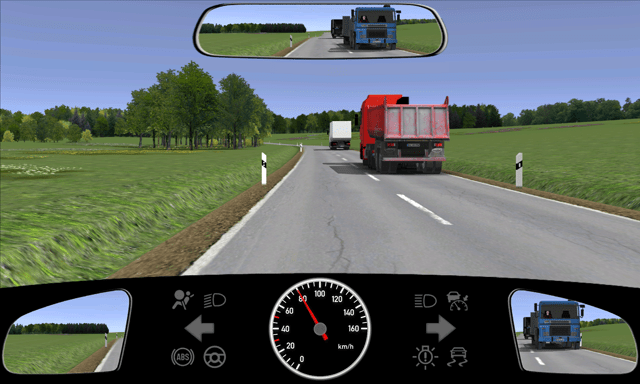
Objašnjenje
The visibility is very poor due to the weather and the road is not sufficiently visible. In order not to endanger anyone, you should stop the overtaking process as quickly as possible and ensure that you are at a safe distance from the vehicle in front of you when you go back into lane.
-
Pitanje 18 od 26
What is the right course of action?
2.1.03-1154 BodoviObjašnjenje
There are two lanes in your direction of travel. You drive on the right side of the two tracks. In oncoming traffic, a snow plow truck approaches. You see in the mirror that a vehicle in the left lane next to you wants to overtake. Snowdrifts hinder you while driving on the lane. You cannot turn left unless the overtaking is completed. Therefore, you must delay further and wait in front of the obstacle until you can dodge to the left.
-
Pitanje 19 od 26
What should you do here?
2.1.03-1164 Bodovi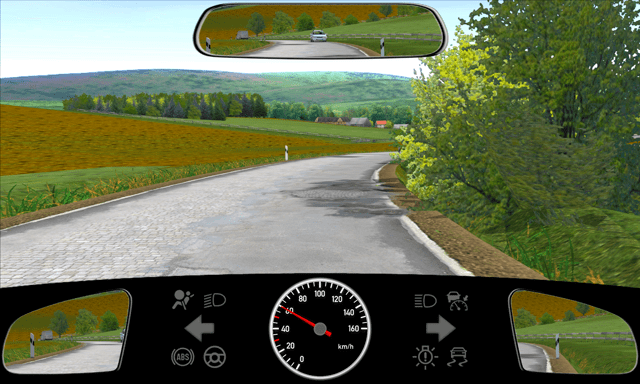
Objašnjenje
In the event of lane damage before a turn, you should reduce your speed considerably to avoid damaging the vehicle. Due to the confusion of the curve, you should not drive past the lane damage on the left, but continue on the right on your lane.
-
Pitanje 20 od 26
You are driving on the autobahn. What is the correct thing to do in this situation?
2.1.03-1175 BodoviObjašnjenje
Due to the severely restricted view on the motorway, you can switch on your rear fog light and drive a maximum of 50 km / h.
-
Pitanje 21 od 26
While driving, you use your vehicle’s adaptive cruise control (ACC) system. What must you anticipate in these weather conditions?
2.1.03-1193 Bodovi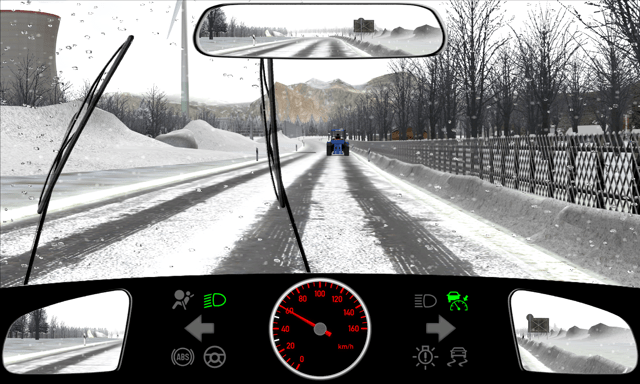
Objašnjenje
The adaptive cruise control system (ASC) independently estimates the distance and speed of the vehicle in front. This can be limited in bad weather, e.g. due to snow and dirt. Therefore, you must regulate the distance and speed yourself.
-
Pitanje 22 od 26
You are driving along a narrow avenue. What must you be aware of?
2.1.03-1204 BodoviObjašnjenje
The narrow width of the road and its often curved shape due to tree roots force you to take extra care when cornering and when facing oncoming traffic. Choose your speed in such a way that the vehicle can be brought to a halt within half the visible distance. Example: With a visibility of approx. 40 metres, you should choose your speed so that you come to a stop within approx. 20 metres. In purely mathematical terms, the stopping distance at 30 km/h is 18 metres.
-
Pitanje 23 od 26
The electronic stability control (ESC) display light has flashed several times. What is the correct course of action in this situation?
2.1.03-1213 BodoviObjašnjenje
You have to reduce your speed. Due to the slippery road surface and the obviously too high speed in the curves for the road conditions, the wheels lose grip and the car could skid.
-
Pitanje 24 od 26
What must you anticipate here?
2.1.03-1224 Bodovi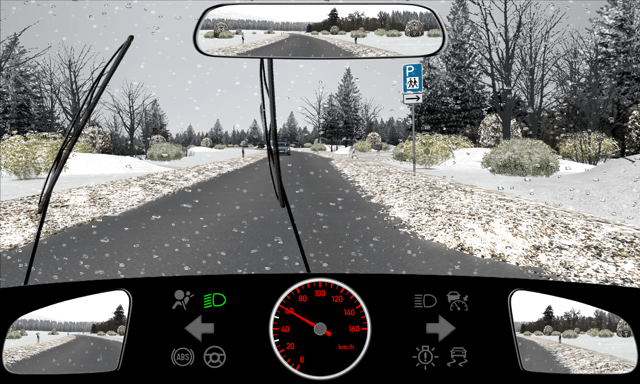
Objašnjenje
The snow on the right and left sides of the road may limit the lane. Therefore, you must expect that the distance to oncoming traffic is reduced. In addition, you can see from the traffic sign that there is a parking area for walkers on the right-hand side. Therefore, you must expect that there are pedestrians on the roadway.
-
Pitanje 25 od 26
While driving straight ahead, you lose control of your vehicle due to aquaplaning. What is the proper response now?
2.1.03-1234 BodoviObjašnjenje
During aquaplaning, you cannot turn or change the direction of your car. You should also not accelerate or brake. So just carefully take your foot off the gas pedal and try to keep the wheel straight until your wheels touch the road again.
-
Pitanje 26 od 26
Why is it dangerous to overtake on this snow-covered carriageway?
2.1.03-1244 Bodovi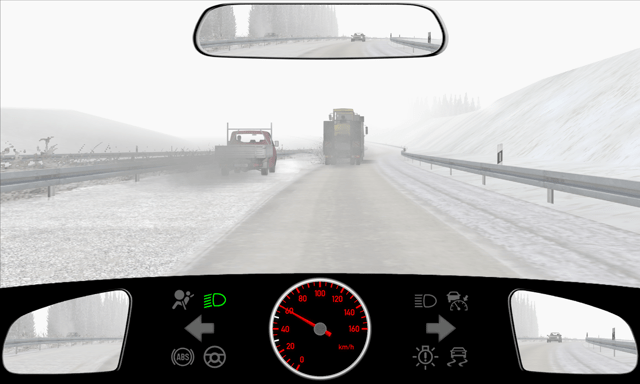
Objašnjenje
In the event of sneaky, icy road, the tires have less liability and can slip. You should avoid sudden braking through slow, forward -looking driving so as not to skid. In addition, the in front can also be thrown on the left lane due to the clearing/ stray vehicle in front and your view also deteriorates.