
2.1.03 Conditions routières et météorologiques
Règle d'or ⭐
Mauvais temps = Moins d’adhérence + Distance de freinage plus longue + Mauvaise visibilité.
👉 Réduisez toujours la vitesse, augmentez la distance et évitez les virages ou les freinages brusques.
🌧️ Pluie et routes mouillées
- La première pluie après un temps sec crée un film d'huile glissant.
- La distance de freinage devient plus longue.
- La visibilité devient pire à cause des projections d'eau et de la visière embuée.
- Évitez les freinages ou les accélérations brusques.
- Augmentez immédiatement la distance de sécurité.
- Les marquages routiers deviennent très glissants lorsqu'ils sont mouillés.
La « première pluie après la sécheresse » est particulièrement dangereuse.
💧Aquaplaning
- Se produit à grande vitesse sur routes mouillées.
- Les pneus perdent le contact avec la route.
- Vous ne pouvez pas diriger ou freiner correctement.
- Le risque est plus élevé dans les ornières de roue et dans l’eau stagnante.
- Relâchez lentement les gaz.
- Gardez le volant droit.
- Ne freinez PAS brusquement.
🌬️ Vents latéraux
- Le danger augmente à proximité des ponts, des tunnels et des camions.
- Les motos peuvent soudainement dévier de côté.
- Le sillage des camions modifie soudainement la pression du vent.
- La vitesse élevée rend les vents latéraux plus dangereux.
Réduisez la vitesse et contre-braquez prudemment.
⚠️ Surfaces glissantes
- Marquage des voies
- Plaques de pétrole
- Pavés
- Feuilles et sable
- Regards et rails de tramway
- Routes mouillées et gravier
Risque accru de dérapage et de chute.
🌫️ Brouillard et mauvaise visibilité
- Utilisez des feux de croisement.
- Feu antibrouillard arrière uniquement en dessous de 50 m de visibilité.
- Vitesse maximale avec feu antibrouillard arrière = 50 km/h.
- Ne conduisez pas sur la ligne médiane.
- Orientez-vous du côté droit de la route.
Les feux de stationnement seuls ne sont PAS autorisés en cas de brouillard.
❄️ Neige et glace
- La route devient extrêmement glissante.
- Les amas de neige réduisent la visibilité.
- La distance de freinage augmente considérablement.
- Évitez les dépassements dans la neige fondante.
- Conduisez en douceur sans direction saccadée.
Freinez tôt et conduisez de manière prévisible.
🏍️ Risques particuliers moto
- Les vents latéraux peuvent pousser la moto sur le côté.
- Le marquage des voies mouillées est très glissant.
- Les rails du tramway doivent être traversés le plus perpendiculairement possible.
- Les pavés réduisent fortement l'adhérence.
- Les feuilles, le sable et l’huile augmentent le risque de chute dans les virages.
- Gardez suffisamment de distance lorsque vous roulez en groupe.
- Évitez les freinages brusques en vous penchant.
- La roue arrière peut se bloquer plus facilement sur route mouillée.
🧠 Formule de mémoire rapide
🌧️ Pluie = Glissant + Mauvaise visibilité
💧 Aquaplaning = Pas de direction + Pas de freinage
🌬️ Vent de travers = Contre-braquez prudemment
❄️ Neige/Glace = Freiner tôt + Conduire lentement
⚠️ Surfaces glissantes = Évitez les mouvements brusques
Questions d’entraînement (26)
-
Question 1 sur 26
Qu'est-ce qui favorise l'aquaplaning (glissement sur l'eau)?
2.1.03-0155 pointsExplication
Aquaplaning - also known as hydroplaning - occurs when the tread depth of the tires is too low to displace the accumulated amount of water or when the amount of water to be discharged is too large due to a high speed (from 60 km/h). In addition, wheel ruts in the road, in which water accumulates, favor this effect.
-
Question 2 sur 26
Quelles peuvent être les conséquences d'une détérioration subite de l'état de la chaussée?
2.1.03-0253 pointsExplication
As the road surface deteriorates, it always results in a change and deterioration of traction. As the wheels lose stiction, the vehicle is slipping and skidding faster. The tire noise also depends on the condition of the road surface and changes when, for example, the road turns from a paved road to a cobblestone track.
-
Question 3 sur 26
Quel est le comportement correct?
2.1.03-0285 pointsExplication
While overtaking a cyclist, the oncoming truck also partly gets on your lane. Brake and drive as far to the right as possible.
-
Question 4 sur 26
Pourquoi devez-vous freiner maintenant?
2.1.03-0293 pointsExplication
Snow is a special danger for you as a car driver. Your lane is covered in snow. In addition, your view is restricted by a heap of snow. The upcoming green car does not respect the right of way. Therefore, you should brake early, because due to the slipperiness of the braking distance is extended. Probably the green car is also hampered by the snow pile.
-
Question 5 sur 26
Quelle est la bonne conduite à adopter maintenant?
2.1.03-0334 pointsExplication
Due to the bad weather conditions, you should reduce your speed and avoid jerky steering movements (see danger sign) as you could otherwise skid.
-
Question 6 sur 26
Quelles conséquences peut avoir un aquaplaning (aquaplanage)?
2.1.03-0344 pointsExplication
In the event of aquaplaning, your vehicle has no direct contact with the road surface, so the steering command and the braking command cannot be implemented.
-
Question 7 sur 26
Quel est le bon comportement à adopter dans cette situation?
2.1.03-0363 points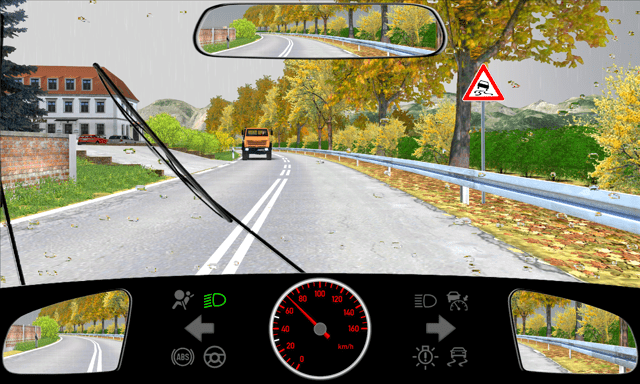
Explication
The traffic sign indicates a risk of skidding and sliding. To avoid skidding, you should reduce your speed, especially when it is raining and leaves are falling on the road, as is the case here. Braking hard, accelerating hard or steering jerkily can cause the tyres to lose their grip and you could skid or slide.
-
Question 8 sur 26
À quoi devez-vous vous attendre dans cette situation?
2.1.03-0374 points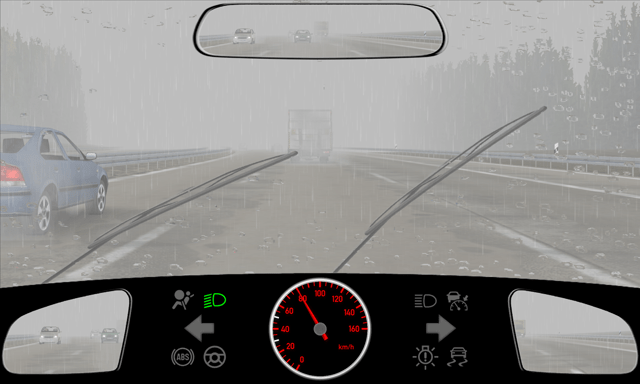
Explication
Because of the rain, you should be prepared for the fact that other vehicles will not be able to see your vehicle and that your braking distance will be longer due to the reduced grip.
-
Question 9 sur 26
Quand vous mettez-vous particulièrement en danger lorsque vous doublez?
2.1.03-0384 points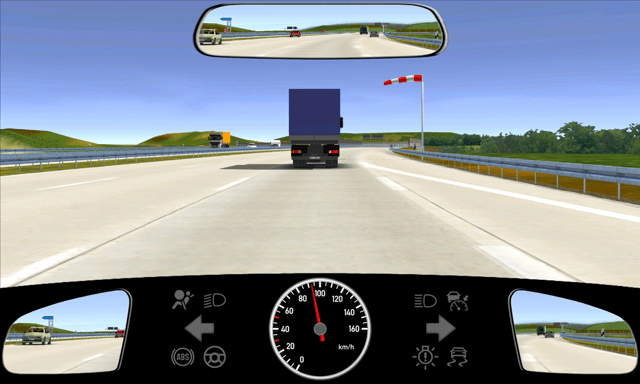
Explication
If there is a strong side wind from the right, you as a motorist are particularly at risk if, when driving off-road, you overtake in the slipstream of a truck. This hazard arises from the fact that strong cross winds from the right push your vehicle to the left, whereupon you automatically countersteer. As you overtake a truck, you slipstream into it; the crosswind is gone instantly and you have to adjust the steering. As soon as you pull out of the slipstream, the pressure starts up again with the crosswind; You have to countersteer again.
-
Question 10 sur 26
À quoi devez-vous vous attendre dans cette situation?
2.1.03-0444 points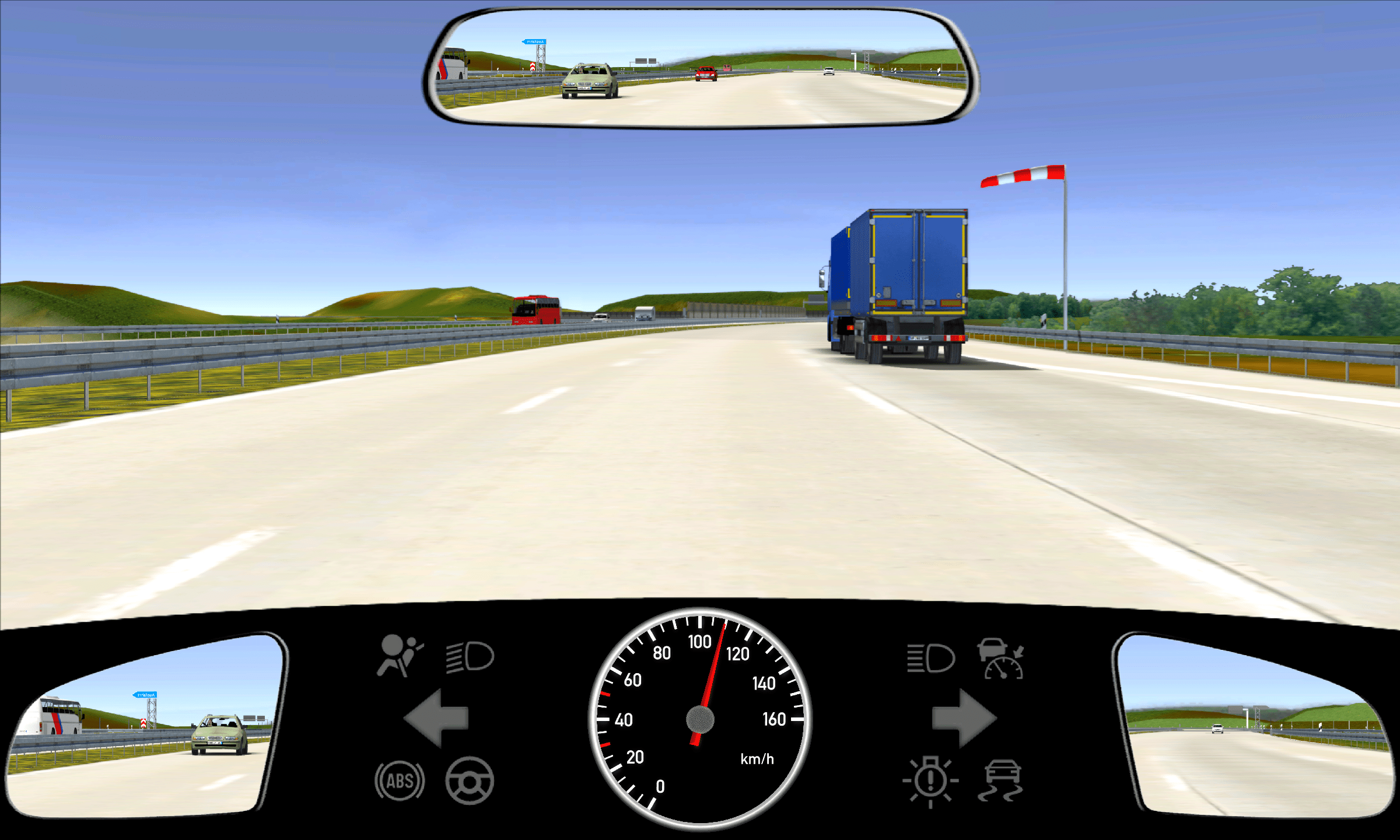
Explication
You can see from the windsock that a strong wind is blowing from the right. The strong wind could move your vehicle to the left. Be prepared to steer to the right. In addition, when entering the slipstream of the truck, you must be prepared for your vehicle to be moved to the right because its large surface area will keep out the crosswind. Be prepared to steer to the left to avoid colliding with the truck.
-
Question 11 sur 26
Où doit-on s'attendre particulièrement à l'aquaplaning (glissement sur l'eau)?
2.1.03-1015 pointsExplication
If the speed is too high and/or there is more water than can be drained from the tire profiles, aquaplaning occurs. A water film prevents contact between tires and the road. The vehicle is no longer controllable. The risk of aquaplaning exists in particular in ruts and road subsidence. Level crossings usually have no increased risk for aquaplaning, since water can usually run well here.
-
Question 12 sur 26
A quoi devez-vous vous attendre lorsqu'il commence à pleuvoir après une longue période de sécheresse?
2.1.03-1034 pointsExplication
If rain sets in after prolonged drought, a dangerous film of lubricant forms on the road, which is only washed away after a long period of rain. This film is more dangerous than rain alone. Brake very carefully. This lubricating film is also deposited on the windscreen. After turning on the windscreen wipers, it first worsens the view drastically. The braking distance is extended by the poorer traction.
-
Question 13 sur 26
Il commence à pleuvoir. Pourquoi devez-vous augmenter la distance de sécurité?
2.1.03-1044 pointsExplication
When it starts raining, you must immediately increase the safety distance for the following reasons: Under the influence of moisture, the dirt, dust and fine deposits from tire abrasion or pollen on the road turn into a dangerous film of grease. This reduces the traction and thereby extends the braking distance. This lubricating film also forms on the windscreen and on the brake drums. If you use the windscreen wipers, they will first worsen your view and smudge the window. On the brake drums, this lubricating film leads to a slower response of the brakes in wet conditions.
-
Question 14 sur 26
Vous roulez par brouillard dense sur une route nationale (Bundesstrasse) en dehors d'une agglomération. Etes-vous autorisé à rouler au milieu de la chaussée en chevauchant la ligne blanche?
2.1.03-1054 pointsExplication
Driving on the center line is not allowed even in dense fog, especially as drivers can always collide with oncoming traffic due to reduced visibility. If there's fog, slow down and orient yourself on the right side of the road for a safe ride.
-
Question 15 sur 26
Que devez-vous faire pendant la journée quand vous rencontrez brusquement un brouillard épais?
2.1.03-1064 pointsExplication
As a car driver you must turn on low beam during the day when there's fog, snowfall and other poor visibility. Because of the insufficient luminosity driving with parking light is not permitted. Adjust your speed to the visibility conditions and use the rear fog light when you can see less than 50 meters.
-
Question 16 sur 26
Comment pouvez-vous assurer une visibilité suffisante à travers le pare-brise?
2.1.03-1073 pointsExplication
Turn your windscreen wipers to interval switching, during fog in order to remove fine water droplets from the mist. Turn on your windscreen wipers before overtaking or being overtaken so that obstructions caused by slush or spray water are immediately removed. Avoid fogged windows with the correct ventilation setting: Set ventilation to outside air supply and not to circulating air. Open the windows a gap to let the moisture escape. Briefly switching on the air conditioning dehumidifies the air very quickly.
-
Question 17 sur 26
Vous vous retrouvez dans cette situation en doublant plusieurs camions. Comment vous comportez-vous maintenant?
2.1.03-1114 points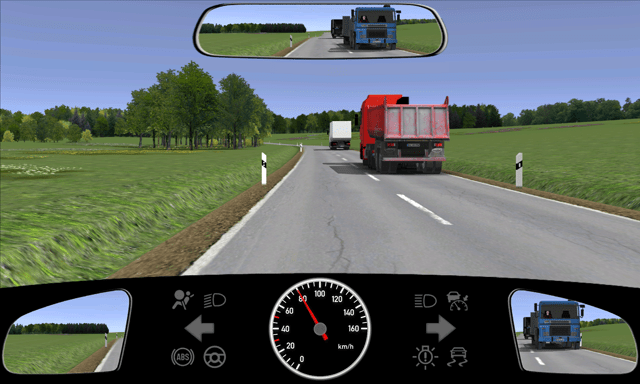
Explication
The visibility is very poor due to the weather and the road is not sufficiently visible. In order not to endanger anyone, you should stop the overtaking process as quickly as possible and ensure that you are at a safe distance from the vehicle in front of you when you go back into lane.
-
Question 18 sur 26
Quel est le bon comportement à adopter?
2.1.03-1154 pointsExplication
There are two lanes in your direction of travel. You drive on the right side of the two tracks. In oncoming traffic, a snow plow truck approaches. You see in the mirror that a vehicle in the left lane next to you wants to overtake. Snowdrifts hinder you while driving on the lane. You cannot turn left unless the overtaking is completed. Therefore, you must delay further and wait in front of the obstacle until you can dodge to the left.
-
Question 19 sur 26
Comment devriez-vous vous comporter dans cette situation?
2.1.03-1164 points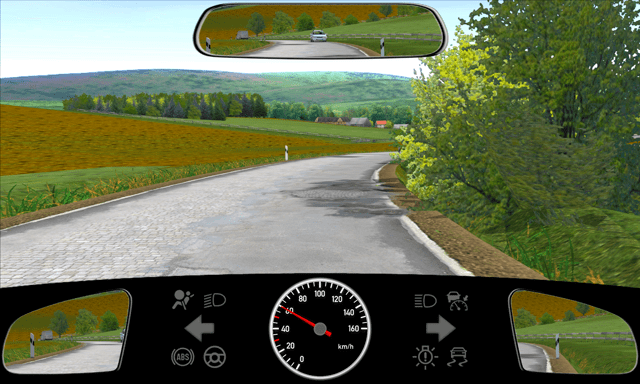
Explication
In the event of lane damage before a turn, you should reduce your speed considerably to avoid damaging the vehicle. Due to the confusion of the curve, you should not drive past the lane damage on the left, but continue on the right on your lane.
-
Question 20 sur 26
Vous roulez sur l'autoroute. Que faire dans cette situation?
2.1.03-1175 pointsExplication
Due to the severely restricted view on the motorway, you can switch on your rear fog light and drive a maximum of 50 km / h.
-
Question 21 sur 26
Vous utilisez le régulateur de vitesse adaptatif (ACC) de votre véhicule. À quoi devez-vous vous attendre avec ces conditions météorologiques?
2.1.03-1193 points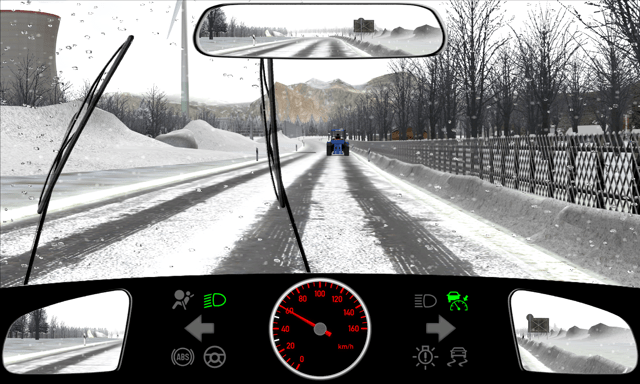
Explication
The adaptive cruise control system (ASC) independently estimates the distance and speed of the vehicle in front. This can be limited in bad weather, e.g. due to snow and dirt. Therefore, you must regulate the distance and speed yourself.
-
Question 22 sur 26
Vous roulez dans une allée étroite. À quoi devez-vous faire attention?
2.1.03-1204 pointsExplication
The narrow width of the road and its often curved shape due to tree roots force you to take extra care when cornering and when facing oncoming traffic. Choose your speed in such a way that the vehicle can be brought to a halt within half the visible distance. Example: With a visibility of approx. 40 metres, you should choose your speed so that you come to a stop within approx. 20 metres. In purely mathematical terms, the stopping distance at 30 km/h is 18 metres.
-
Question 23 sur 26
Le voyant de l'électrostabilisateur programmé (ESC) s'est allumé plusieurs fois. Comment vous comportez-vous dans cette situation?
2.1.03-1213 pointsExplication
You have to reduce your speed. Due to the slippery road surface and the obviously too high speed in the curves for the road conditions, the wheels lose grip and the car could skid.
-
Question 24 sur 26
À quoi devez-vous vous attendre dans cette situation?
2.1.03-1224 points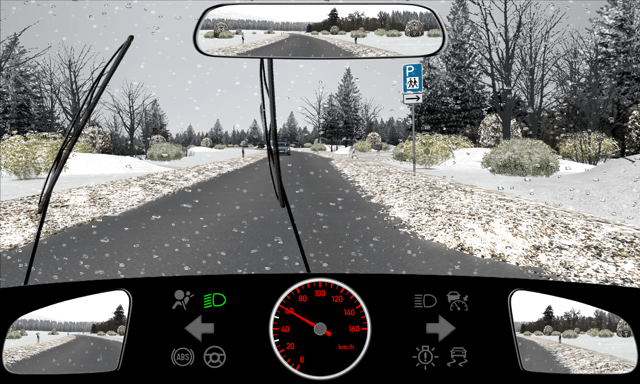
Explication
The snow on the right and left sides of the road may limit the lane. Therefore, you must expect that the distance to oncoming traffic is reduced. In addition, you can see from the traffic sign that there is a parking area for walkers on the right-hand side. Therefore, you must expect that there are pedestrians on the roadway.
-
Question 25 sur 26
En roulant tout droit votre véhicule fait l'objet d'un aquaplanage et vous en perdez le contrôle. Quel est le bon comportement à adopter maintenant?
2.1.03-1234 pointsExplication
During aquaplaning, you cannot turn or change the direction of your car. You should also not accelerate or brake. So just carefully take your foot off the gas pedal and try to keep the wheel straight until your wheels touch the road again.
-
Question 26 sur 26
Pourquoi est-il dangereux de doubler sur cette chaussée enneigée?
2.1.03-1244 points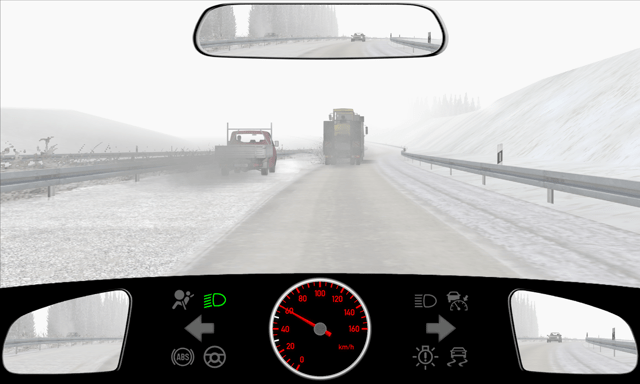
Explication
In the event of sneaky, icy road, the tires have less liability and can slip. You should avoid sudden braking through slow, forward -looking driving so as not to skid. In addition, the in front can also be thrown on the left lane due to the clearing/ stray vehicle in front and your view also deteriorates.