
1.1.07 Situations de circulation spéciales
Trafic spécial Situations
La circulation n’est pas toujours fluide. Vous devez maîtriser les tunnels, les passages à niveau, les véhicules d'urgence et les usagers de la route vulnérables. La règle fondamentale : Conduite défensive et anticipation.
Environnements difficiles
Des règles spécifiques s'appliquent dans ces zones pour assurer la sécurité.
Tunnels
Les yeux s'adaptent lentement à l'obscurité.
- ● Feux de croisement allumés
- ● Retirer les lunettes de soleil
- ● NE JAMAIS faire demi-tour ou reculer
Passages à niveau
Les trains ont la priorité absolue.
- ● Attendez à la Croix de Saint-André
- ● Pas de zone de dépassement
- ● Ne vous arrêtez pas sur les rails
Zones forestières (faune)
Risque élevé de croisement d'animaux ("Wildwechsel").
- ● Tremper les lumières si un animal apparaît
- ● Freinez fermement, maintenez la direction droite
- ● Ne faites PAS un écart dangereux
Chantiers de construction
Tracé de voie complexe et dangers.
- ● Les lignes jaunes remplacent le blanc
- ● Des limites de vitesse strictes s'appliquent
- ● Évitez la conduite décalée
Dépasser les cyclistes
Les cyclistes vacillent ou font souvent un écart pour éviter les nids-de-poule. Donnez-leur de l'espace.
Évaluer et vérifier
La circulation venant en sens inverse est-elle dégagée ? Vérifiez les rétroviseurs et l'épaule (angle mort).
Distance latérale
Gardez au moins 1,5 m distance latéralement. Si vous ne pouvez pas, NE dépassez PAS.
Refusionnez en toute sécurité
N'intervenez pas trop tôt. Assurez-vous de bien voir le cycliste dans votre rétroviseur.
Urgence et accidents : correct
Former un couloir d'urgence
Sur les autoroutes/autoroutes : la voie de gauche se déplace à GAUCHE, toutes les autres voies se déplacent à DROITE.
Arriver à un accident
1. Feux de détresse allumés. 2. Gilet de sécurité ON. 3. Scène sécurisée (Triangle). 4. Premiers secours.
Urgence : erreurs dangereuses
"Gaffing" (Rubbernecking)
Ralentir pour observer un accident ou prendre des photos est illégal et immoral.
Suivre une ambulance
N’utilisez jamais le couloir de secours pour éviter la circulation. Cela bloque les véhicules de secours.
Usagers de la route vulnérables
Le « principe de confiance » (Vertrauensgrundsatz) dit que vous pouvez supposer que les autres suivent les règles. Exception: Enfants, personnes âgées et personnes handicapées. Vous devez anticiper leurs erreurs.
- check Âgé: Peut ne pas vous entendre/voir ou juger correctement la vitesse.
- check Enfants: Impulsif. Si une balle roule dans la rue, un enfant la suit.
- check Fauteuils roulants : Gardez une distance latérale de sécurité. Sois patient.
Le contact visuel est la clé
Si un piéton ou un cycliste ne vous regarde pas, supposez qu'il ne vous a pas vu. Freinez et soyez prêt à vous arrêter.
Pièges typiques des examens
Piège n°1 : Lumière bleue UNIQUEMENT contre Lumière bleue + Sirène expand_more
Lumière bleue uniquement : Avertissement d'un accident ou d'un convoi. Conduisez prudemment, faites de la place.
Lumière bleue + Sirène : Priorité immédiate ! Dégagez la route instantanément. Arrêtez-vous si nécessaire.
Piège n°2 : Priorité de passage ou prévention des accidents expand_more
Même si vous avez la priorité (par exemple, feu vert ou route prioritaire), si un autre conducteur force le passage, vous DOIT FREINER. Insister sur votre droite crée un accident, et vous serez en partie fautif.
Piège n°3 : Dépasser un bus à l’approche d’un arrêt. expand_more
Si un bus se dirige vers un arrêt avec des feux de détresse clignotants, vous êtes INTERDIT de le dépasser. Vous devez attendre derrière lui jusqu'à ce qu'il s'arrête. Ce n'est qu'alors que vous pourrez passer au pas.
Questions d’entraînement (63)
-
Question 1 sur 63
À quoi devez-vous vous attendre quand vous suivez un train routier (véhicule à moteur auquel est attelée une remorque, plusieurs ou une semi-remorque) lorsque celui-ci veut tourner à droite dans une route étroite?
1.1.07-0013 pointsExplication
Keep a large distance from the lorry and under no circumstances overtake on the right-hand side, even if you would have the opportunity to do so as a two-wheeler driver. The road train must first reduce its speed considerably to turn. For reasons of space, the truck driver may then have to steer the towing vehicle far to the left so that the trailer or semi-trailer does not roll over the kerb when turning.
-
Question 2 sur 63
A quoi devez-vous vous attendre dans une agglomération aux intersections et aux débouchés?
1.1.07-0023 pointsExplication
By driving on a wide and well-developed road, you don't automatically have the right of way. The rule "right before left" does not apply always and everywhere. Instead, signs or traffic lights regulate who has priority. Therefore, pay attention to the signposted right-of-way regulation or the traffic lights at each individual intersection and junction.
-
Question 3 sur 63
Pourquoi devez-vous être ici particulièrement prudent?
1.1.07-0063 points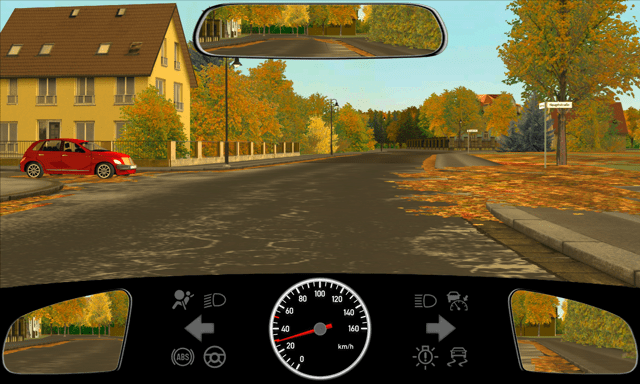
Explication
The wet leaves on the road result in a longer braking distance and a high risk of slipping. Therefore, reduce your speed and drive carefully before reaching the intersection. A vehicle could be coming from the right and you should give it the right of way. Since there are no signs at the intersection that give you the right of way, the rule here is "right before left".
-
Question 4 sur 63
Vous vous approchez d'une école que des enfants quittent. A quoi devez-vous vous attendre?
1.1.07-0095 pointsExplication
In the vicinity of schools, you must always be prepared for children crossing the road abruptly. Children are not yet able to assess themselves and other road users very well and often react impulsively and in a way that is not appropriate for traffic. As a car driver, you must adapt your driving style accordingly in order to exclude any danger to children. In addition to driving at a low speed, you must be particularly attentive and ready to brake at all times.
-
Question 5 sur 63
Que peuvent signifier des feux de détresse allumés?
1.1.07-0104 pointsExplication
The use of the hazard warning lights is subject to strict rules. You may only switch on the hazard warning lights to secure your broken-down vehicle or to indicate a traffic jam or a school bus. A school bus with its hazard warning lights on may only be overtaken at walking speed.
-
Question 6 sur 63
Devant vous, une moissonneuse veut tourner à droite. Qu'est-ce qui est correct?
1.1.07-0114 pointsExplication
The combine harvester needs to gain amplitude to turn because the turn is very narrow. To do this, it will greatly reduce his speed. Keep your distance and also drive slowly and be prepared to brake. Especially for cyclists: Never overtake on the right!
-
Question 7 sur 63
Vous roulez derrière un véhicule agricole avec une remorque très chargée. A quoi devez-vous vous attendre?
1.1.07-0134 pointsExplication
If you are riding behind an agricultural vehicle with a heavily loaded trailer, you must expect the following: Part of the load could fall onto the roadway when turning or braking. The indicator could be dirty or covered by the load. The braking distance of the vehicle is increased by the weight of the load.
-
Question 8 sur 63
À quoi devez-vous vous attendre?
1.1.07-0143 points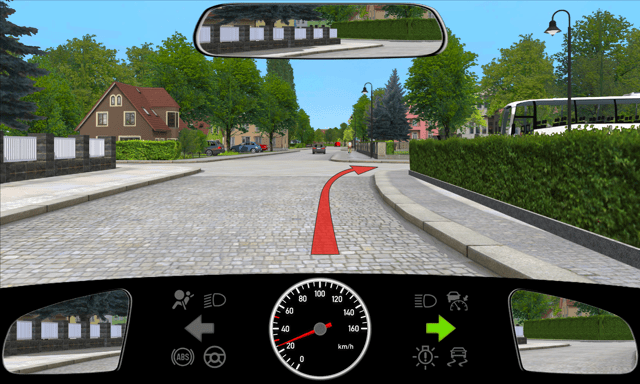
Explication
You must expect to have to stop before the intersection when turning. For one thing, the view of the bus coming from the right is obstructed. In addition, other vehicles could pass it. In addition, pedestrians may also want to cross the road. You must always show special consideration for them.
-
Question 9 sur 63
Quel comportement adoptez-vous dans cette situation?
1.1.07-0154 points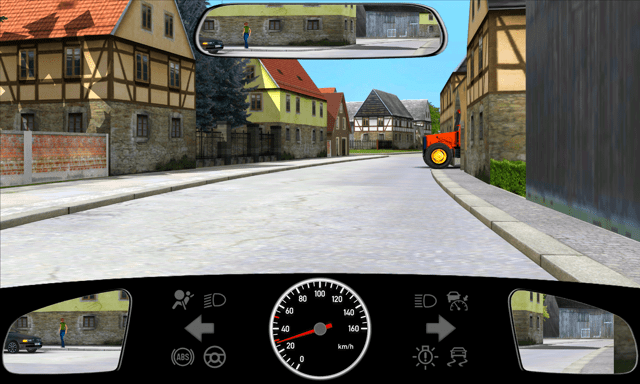
Explication
The driver of the vehicle coming out of the exit cannot see the cross traffic. He would have to be directed into the traffic. He could drive further ahead and prevent you from continuing your journey. You should reduce your speed, be ready to brake, even stop if necessary.
-
Question 10 sur 63
A quoi vous préparez-vous dans cette situation?
1.1.07-0175 pointsExplication
Because the oncoming vehicle is being slowed down by a bicycle, you should expect the vehicle to overtake the bicycle. If this happens, the vehicle could cross into your lane. In the event that the driver does not brake, you should keep as far to the right on the road as possible. Also, be prepared to brake so that you can react to any situation as quickly as possible.
-
Question 11 sur 63
Vous voulez tourner à droite au croisement. Quel est le bon comportement à adopter?
1.1.07-0194 points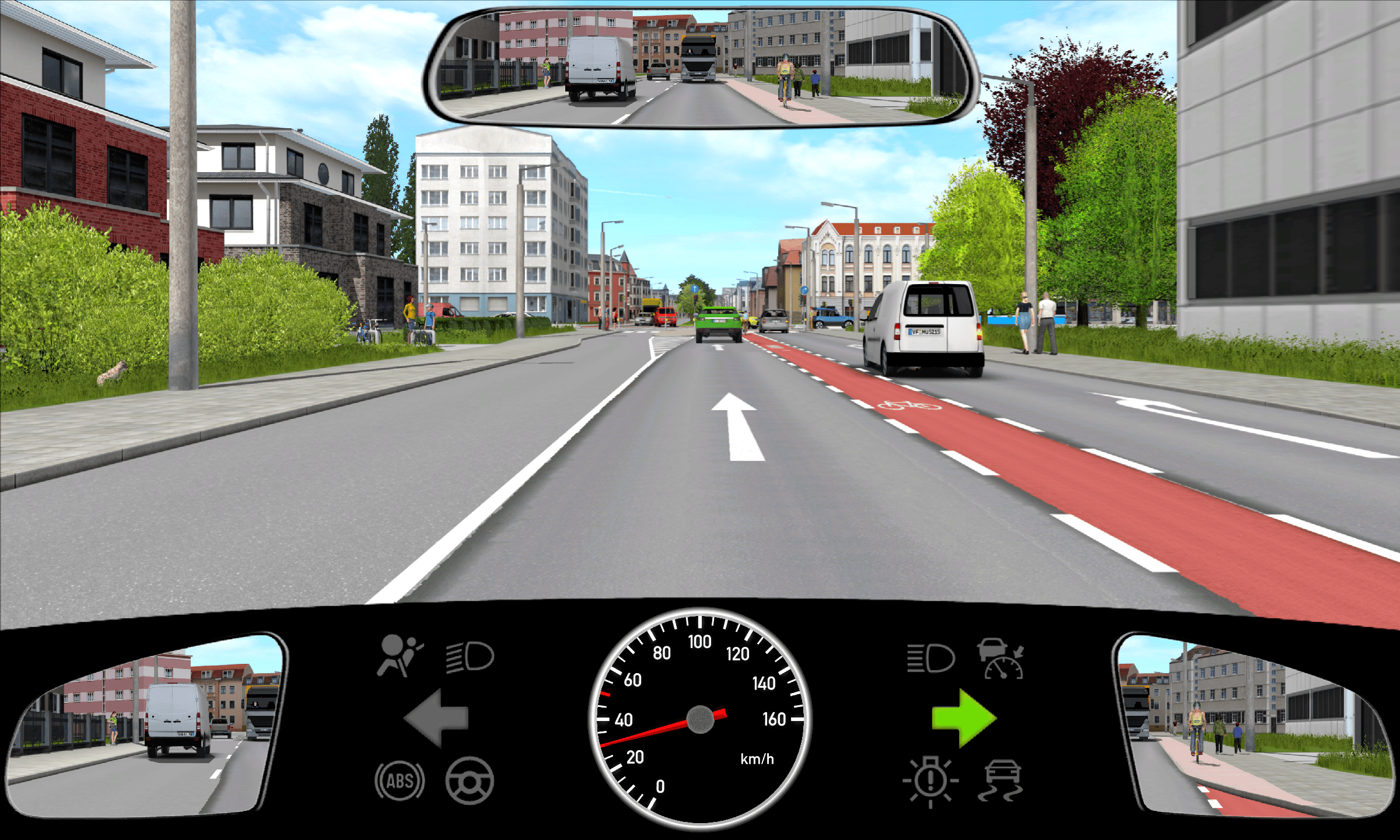
Explication
There is a protective lane for cyclists between your lane and the turning lane. It is part of the carriageway and is separated by a broken line. You may only use the protective lane to change lanes, swerve or turn. If you use it, you are not allowed to obstruct cyclists or come to a standstill in the protective lane. You should therefore change lanes as early as possible.
-
Question 12 sur 63
Dans quels cas cette situation peut-elle devenir dangereuse?
1.1.07-0204 points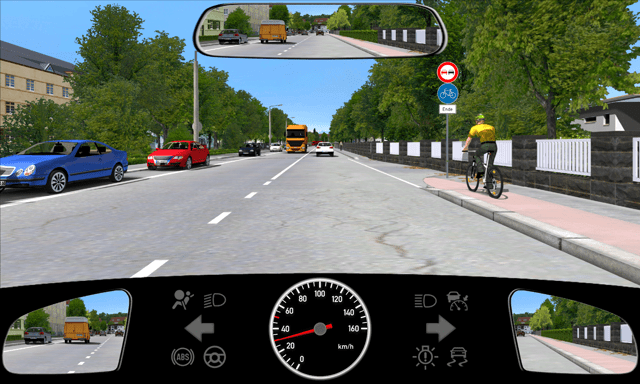
Explication
You can see that the cycle path ends immediately in front of you. The cyclist would have to stop and wait until she can safely merge into the flowing traffic. However, rather than stopping, expect her to swing into the lane in front of you.
-
Question 13 sur 63
À quoi devez-vous faire attention avec des vélos électriques (E-Bikes) dans la circulation?
1.1.07-0233 pointsExplication
E-bikes are just as quiet as classic bikes and are therefore often perceived late. However, they often achieve significantly higher speeds than bicycles without an engine. This is underestimated by many road users, so dangerous situations can occur surprisingly. In general, expect cyclists to gain speed and perform speedy maneuvers.
-
Question 14 sur 63
Quel est le comportement correct à adopter maintenant?
1.1.07-0254 points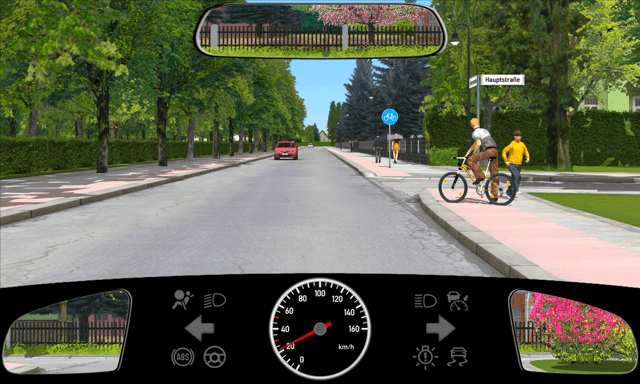
Explication
You should be ready to brake and watch the cyclist carefully, because the cyclist can suddenly ride onto the road.
-
Question 15 sur 63
Vous voulez dépasser un tracteur agricole comportant un outil porté dépassant vers l'arrière. A quoi devez-vous faire attention?
1.1.07-1014 pointsExplication
You should always refrain from an overtaking maneuver when the tractor wants to turn. The reason for this is that the tractor has a large turning circle and is likely to veer, blocking the road. Also keep in mind that the turn signals of such a vehicle are not always visible and that they could be covered by dirt due to the agricultural use.
-
Question 16 sur 63
A quoi devez-vous vous attendre après cette courbure de la route?
1.1.07-1033 points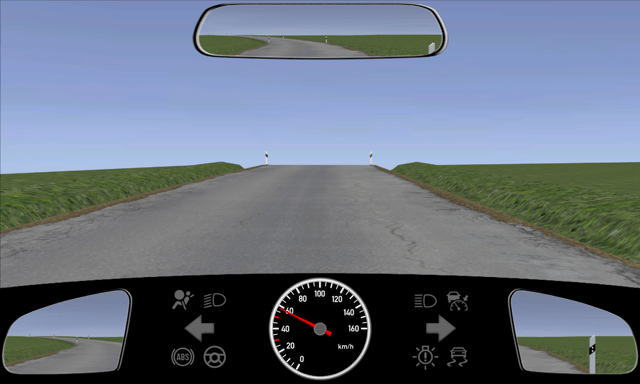
Explication
Due to the height of the crest, it is not possible to see what is behind it. Expect to encounter obstacles there, such as broken-down or slow-moving motor vehicles. Also be prepared for oncoming trucks sharing your lane. To be able to react to such dangers in time, you should reduce your speed accordingly.
-
Question 17 sur 63
A quoi devez-vous vous attendre ici?
1.1.07-1073 points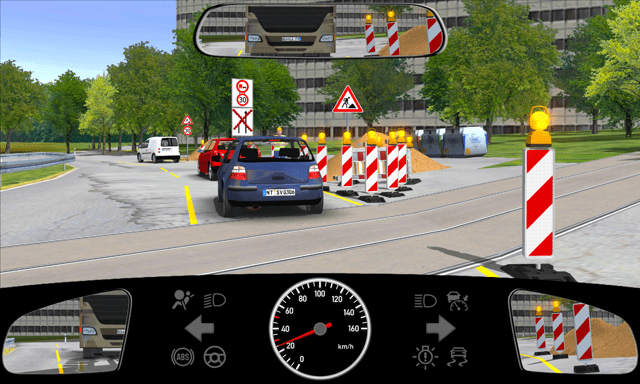
Explication
In the area of a construction site you have to drive carefully and reduce the speed. For one, the road can be dirty. But it there can also be workers, construction equipment or construction vehicles on the road and obstruct the traffic.
-
Question 18 sur 63
Vous roulez sur une route nouvellement aménagée dans une zone forestière. A quoi devez-vous vous attendre?
1.1.07-1133 pointsExplication
When roads are newly constructed in forested areas, they often pass through the natural habitat of various wild animals. Therefore, it is possible that their habitual paths cross your roadway. For this reason, you must expect wildlife crossings and obstacles due to frequent wildlife accidents on forest roads.
-
Question 19 sur 63
A quel moment de la journée faut-il s'attendre éventuellement à nombreux passages de gibier?
1.1.07-1173 pointsExplication
Expect more deer crossings during the morning and evening twilight. This transitional period between day and night is characterized by diffuse light conditions.
-
Question 20 sur 63
A quels dangers devez-vous vous attendre tout particulièrement dans les régions rurales?
1.1.07-1184 pointsExplication
Where farming is practised, tractors and other agricultural vehicles travel at slow speeds and/or over width. Often the roadway is also dirty with soil or manure.
-
Question 21 sur 63
Au crépuscule, un tracteur agricole vient en sens inverse tout éclairé. A quoi devez-vous vous attendre?
1.1.07-1194 pointsExplication
In agricultural vehicles, the lights are sometimes broken. They can also be covered up by dirt or tarpaulins. The width of the vehicles is not easy to assess. In addition, these vehicles can have up to two trailers.
-
Question 22 sur 63
Que devez-vous respecter avant d’entrer dans un tunnel?
1.1.07-1204 pointsExplication
Before entering a tunnel, you must note the following: there is a light obligation in a tunnel. Therefore, turn on the dipped beam to see and be seen better. If you have sunglasses, take them off. You must not switch on the fog lamp in the tunnel.
-
Question 23 sur 63
Comment devez-vous vous comporter en cas d’embouteillage dans un tunnel?
1.1.07-1214 pointsExplication
If there is a traffic jam in a tunnel, stop and turn off the engine. By keeping a safe distance of about five metres, you reduce the risk of poisoning, preserve a manoeuvring option and allow rescue vehicles to pass. Switch on the hazard warning lights to warn following drivers. Only leave your vehicle after an appropriate loudspeaker announcement.
-
Question 24 sur 63
Qu’est-ce qui peut entraver l’attention en traversant un tunnel?
1.1.07-1224 pointsExplication
When passing through a tunnel, the following factors may interfere with your attention: the lack of visual stimulus and the monotony of speed, as well as the lights of oncoming traffic. In this case, an orientation on the right side of the road is helpful; avoid looking directly into the light of oncoming traffic.
-
Question 25 sur 63
Quelles sont les règles de comportement fondamentales que vous devez suivre dans le tunnel?
1.1.07-1254 pointsExplication
The following rules of conduct are mandatory in all tunnels: on the entire route no U-turns are allowed. Regardless of the lighting situation, the dim light must always be switched on. The instructions of the tunnel staff must always be followed. Personal protection antecedes the protection of vehicles and their security.
-
Question 26 sur 63
Quel comportement adoptez-vous maintenant?
1.1.07-1365 pointsExplication
The white reversing lights of the vehicle that turned in front of you indicate that it would probably turn back to its original lane in reverse. Since you cannot tell if you have been noticed by the driver, you should reduce your driving speed and be ready to brake. Refrain from an evasive maneuver due to oncoming traffic.
-
Question 27 sur 63
Vous voulez tourner à droite. Comment devriez-vous vous comporter?
1.1.07-1374 points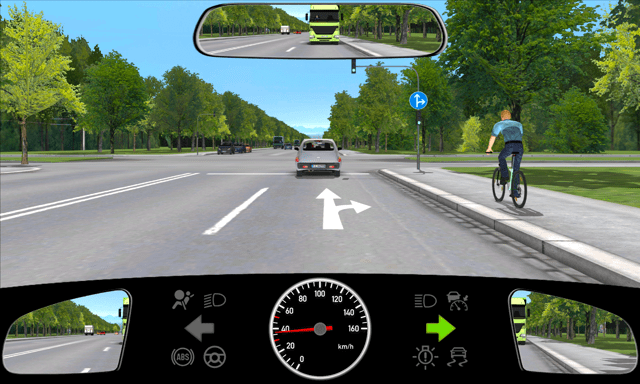
Explication
Before you can turn, you have to check in the rear-view mirror if the road is clear. It is also advisable to look over your shoulder: this is the only way to be aware of dangerous situations located in the blind spot of the mirror. Keep in mind that other road users - cyclists or pedestrians - whose way you cross, always have priority.
-
Question 28 sur 63
À quoi devez-vous vous attendre?
1.1.07-1384 points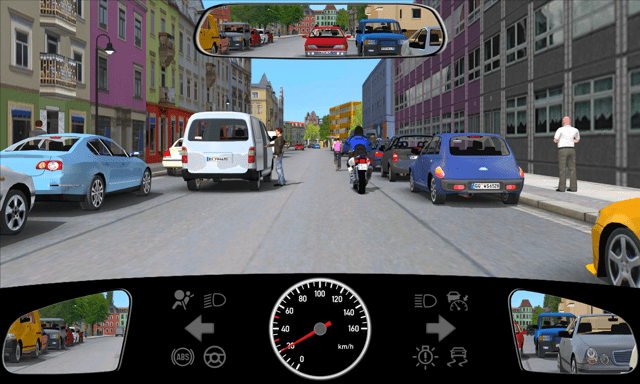
Explication
The other road users can react to this situation with all the different scenarios described. All are equally dangerous. Therefore, extreme caution and slow driving is required.
-
Question 29 sur 63
Une voiture souhaite reculer sur la chaussée devant la moto. À quoi devez-vous vous attendre?
1.1.07-1393 points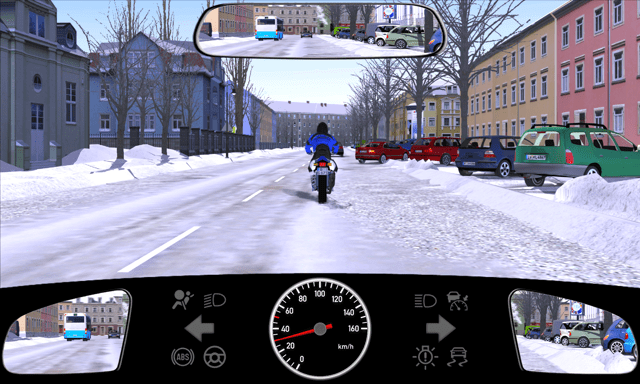
Explication
Car drivers often underestimate the speed of approaching motorcyclists; the same happens to the driver here while he's pulling out of a parking space. The action alternatives of the motorcyclist - braking or dodging - are both dangerous for him on a snow-slicked road surface. He could fall. Also consider the longer braking distance in this weather.
-
Question 30 sur 63
Pourquoi êtes-vous particulièrement exposé à des dangers lorsque vous conduisez un deux-roues?
1.1.07-1414 pointsExplication
Especially in restrictive visibility conditions such as fog and darkness, the small silhouette of the two-wheeled driver leads to the fact that he is recognized late or not at all. In addition, the small design makes it difficult to estimate its speed. In the event of a collision, two-wheelers generally offer less protection than most other motor vehicles.
-
Question 31 sur 63
Sur une route fortement fréquentée, à plusieurs voies, vous vous êtes rangé pour tourner à gauche. Vous changez toutefois d'avis et souhaitez tourner maintenant à droite. Comment vous comportez-vous?
1.1.07-1423 pointsExplication
A lane change or turning right could endanger other road users due to the heavy traffic. You must therefore turn left and take a small detour. Watch out for lane markings that prohibit you from changing lanes.
-
Question 32 sur 63
Un tunnel se trouve sur mon itinéraire. Que dois-je savoir?
1.1.07-1434 pointsExplication
If there is a tunnel on your route, you should know the appropriate traffic signs and behavioral measures in the event of a breakdown or an accident: in this case, alert the tunnel monitoring center and follow the next escape route. First, turn off the engine of your vehicle and leave the ignition key in the lock for rescue operations.
-
Question 33 sur 63
Pendant que vous rouliez dans un tunnel, vous avez dû stationner votre véhicule, en raison d'un feu, dans le tunnel. Comment vous comportez-vous maintenant?
1.1.07-1454 pointsExplication
If you have to park your vehicle in a tunnel due to a fire, you should: stop the engine, leave the key in the ignition switch and quickly trigger the fire alarm at the emergency call station. Leave the tunnel as fast as possible on the next escape route.
-
Question 34 sur 63
À quoi devez-vous vous attendre?
1.1.07-1465 pointsExplication
You see that the truck wants to turn in front of you. The vehicle obscures the view of the traffic, so you need to adjust your speed. The truck probably swings out to take the curve. He might stop abruptly to let pedestrians or other road users pass.
-
Question 35 sur 63
À quoi devez-vous faire attention maintenant?
1.1.07-1474 pointsExplication
You want to turn right, so does the car driver in front of you. The pedestrian traffic light of the cross street into which you want to turn shows green, and the pedestrian has priority. It is possible that your car in front will pull up and stop soon after to let the pedestrian pass. On the right you can also see a cyclist. The cyclist could drive past your vehicle on the right and circle your turning vehicle on the left. Avoid this danger.
-
Question 36 sur 63
Pourquoi devez-vous attendre ici?
1.1.07-1485 pointsExplication
The cyclist must be given priority because she is on the right-of-way. Wait until the cyclist has passed the vehicles and driven through.
-
Question 37 sur 63
Pourquoi devez-vous attendre ici?
1.1.07-1495 pointsExplication
The traffic on the main road is jammed. The red car drives around the parked vehicles to turn left. You have to wait and let this car pass as it has priority.
-
Question 38 sur 63
À quoi faut-il prêter attention lorsque le feu rouge passe au "vert"?
1.1.07-1525 pointsExplication
While you wait at the red light, a motorcyclist pushes past the waiting vehicles. When the traffic light switches to green you should pay attention to the motorcyclist and let him pass before he initiates a risky overtaking maneuver. But you should also let the pedestrian cross the road, which is still on the road despite it being green.
-
Question 39 sur 63
A quelle situation devez-vous vous préparer ici?
1.1.07-1533 points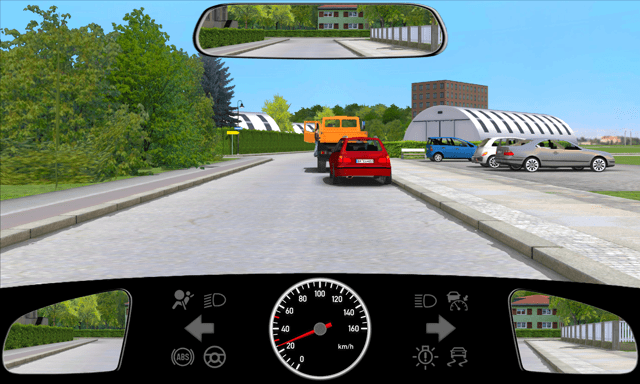
Explication
The truck blocks your view. You can therefore recognize neither the oncoming traffic nor traffic signs behind the truck. Approach the vehicle at low speed. Look for oncoming traffic (they have priority) and keep your distance to the open driver's door when driving around. The driver of the truck could suddenly get out and jump onto the road.
-
Question 40 sur 63
Quel est le comportement correct pour traverser un tunnel?
1.1.07-1544 pointsExplication
When driving through a tunnel, proceed as follows: Make sure to pay attention to the safety distance and orient yourself on the right-hand side of the road in order to avoid glare from oncoming traffic. Get an overview of safety devices so you know where the nearest emergency exit and emergency telephone are located.
-
Question 41 sur 63
À quoi devez-vous faire attention maintenant?
1.1.07-1554 pointsExplication
You intend to turn left. Two cyclists move in the same direction. You must pay particular attention to these, as they could also turn into the street without notice.
-
Question 42 sur 63
Quelle attitude adopter maintenant?
1.1.07-1563 pointsExplication
Since the dog (from the right) seems to be walking into the street, please perform emergency braking and keep the steering wheel straight and steady.
-
Question 43 sur 63
A quoi devez-vous vous attendre dans cette situation?
1.1.07-1574 pointsExplication
Please be prepared for people behind the bus to enter the lane and for the bus to swerve and briefly enter your lane.
-
Question 44 sur 63
Quel peut-être le comportement des cyclistes?
1.1.07-1584 pointsExplication
All 3 answers are correct. Cyclists use one-way streets in both directions, they may not have lights in the dark or they may ride on the wrong side of cycle paths.
-
Question 45 sur 63
À quoi devez-vous vous préparer ici?
1.1.07-1594 points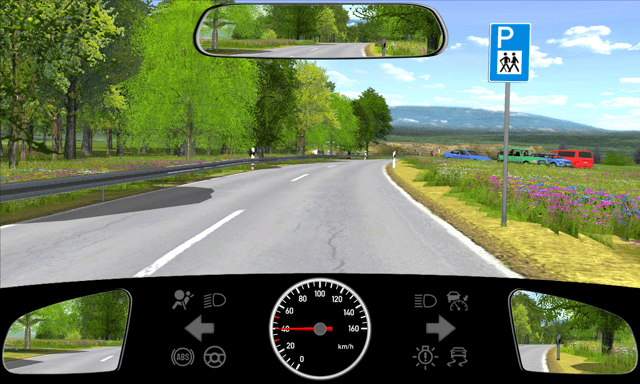
Explication
The traffic sign indicates a rambler parking area, which means that people can walk across the roadway and vehicles can drive off or onto the parking area at any time.
-
Question 46 sur 63
Pourquoi devez-vous vous arrêter maintenant?
1.1.07-1605 pointsExplication
As you do not have a full view of the traffic situation and must give the cyclist the right of way, you must stop and carefully feel your way in.
-
Question 47 sur 63
Vous voulez continuer à rouler tout droit. Quel est le bon comportement à adopter dans cette situation?
1.1.07-1615 pointsExplication
You are coming from a priority road first. As there are no other traffic signs, right is before left. The red car is driving on your right and therefore has the right of way. The electric scooter does not have right of way, so to avoid an accident you should let it cross anyway.
-
Question 48 sur 63
Vous voulez quitter votre stationnement. Comment bien évaluer la situation?
1.1.07-1623 points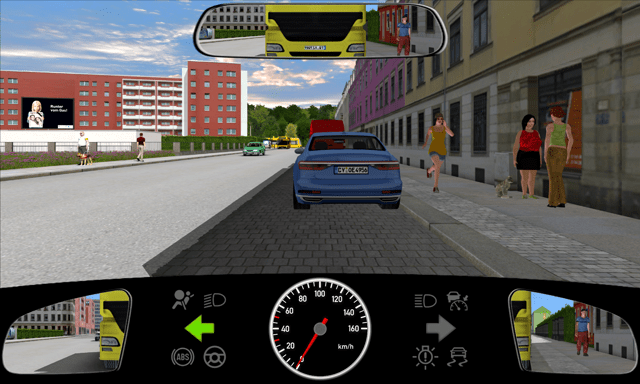
Explication
As the vehicle parked behind you is very large, you will only see vehicles coming from behind at a late stage and you yourself will only be recognised by other drivers at a late stage.
-
Question 49 sur 63
Pourquoi le fait de passer à côté de cet accident est-il dangereux?
1.1.07-1633 points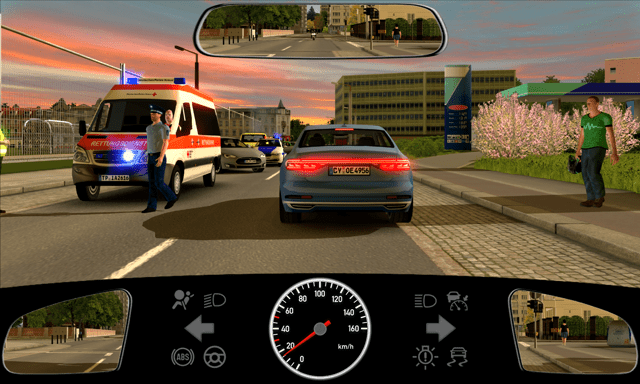
Explication
The traffic situation is unclear, sudden braking manoeuvres by gawpers and pedestrians crossing the road must be expected.
-
Question 50 sur 63
À quoi devez vous faire attention lorsque vous tournez à droite?
1.1.07-1645 pointsExplication
The cyclist has the right of way. When turning right, you must always pay attention to whether pedestrians or cyclists are approaching. They are allowed to cross the street in front of you. Use the rearview mirror and also look over your shoulder to be able to see the blind spot.
-
Question 51 sur 63
Quel doit être maintenant le bon comportement?
1.1.07-1655 pointsExplication
The scooter does not seem to see you coming and takes the right of way. To avoid an accident, you must immediately perform emergency braking.
-
Question 52 sur 63
À quoi devez vous vous attendre dans cette situation?
1.1.07-1664 points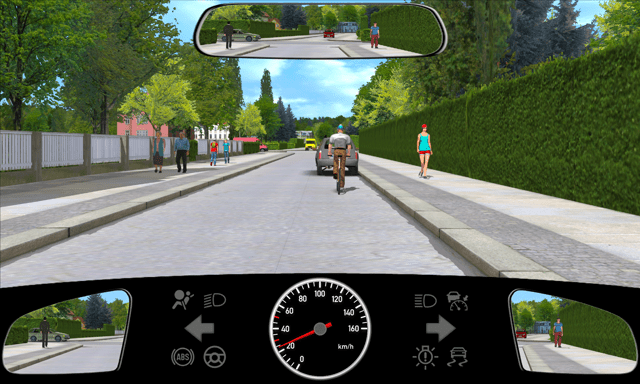
Explication
Since the obstacle is on your side, you must wait in this case. In addition, the cyclist will overtake the parked car and therefore swerve to the left.
-
Question 53 sur 63
Vous traversez un tunnel. Quelle est la particularité de cette traversée?
1.1.07-1674 pointsExplication
In a tunnel, the emergency exits and SOS emergency telephones are clearly signposted and illuminated. In an emergency, you should use the facilities. You can easily be distracted by the different lighting, the lights of other road users and the much louder noises in the tunnel.
-
Question 54 sur 63
Quel est le bon comportement à adopter maintenant?
1.1.07-1684 pointsExplication
The vehicle that is still parked wants to enter the road and has obviously overlooked you. You should slow down to avoid an accident.
-
Question 55 sur 63
À quoi devez-vous vous attendre maintenant?
1.1.07-1694 pointsExplication
The [yellow] vehicle will stop, so you must be ready for the driver to open the door. The cyclist will probably move to the left to overtake the yellow vehicle. You must also expect the truck to drive off.
-
Question 56 sur 63
Vous roulez sur un tronçon de route sur lequel on annonce un embouteillage. Quel est le bon comportement à adopter?
1.1.07-1704 pointsExplication
You should be extra attentive on curves and before hilltops, because the traffic situation is difficult to see. You should also continue to follow the traffic reports.
-
Question 57 sur 63
Pourquoi devez-vous vous arrêter maintenant?
1.1.07-1714 pointsExplication
The "Give way" sign in combination with the additional bicycle sign shows you that you must pay attention to possible cyclists and give them the right of way. Therefore, you must now stop and let the cyclist pass.
-
Question 58 sur 63
Quel est le bon comportement à adopter dans cette situation?
1.1.07-1724 pointsExplication
If a cyclist suddenly comes from the left, you must do an emergency stop.
-
Question 59 sur 63
Un chevreuil traverse la chaussée devant votre véhicule. À quoi devez-vous faire attention?
1.1.07-1733 pointsExplication
A deer is very unpredictable, maybe it runs back into the forest, maybe it will stop in the middle of the street. You should therefore reduce your speed and follow what is happening, as other animals can also step on the road.
-
Question 60 sur 63
Quel est le bon comportement à adopter dans cette situation?
1.1.07-1743 pointsExplication
As the lorry in front of you is parking in reverse, you must continue to slow down. You can only change lanes when the lane to your left is free. Stay in your lane for the time being and continue braking.
-
Question 61 sur 63
À quoi vous préparez-vous dans cette situation?
1.1.07-1754 pointsExplication
You are driving on a turning priority road. Anyone leaving a priority road must give way to vehicles following the priority road. The yellow car flashes and turns left. Although it does not have right of way, at its high speed it will not be able to stop without coming into your lane. You should therefore brake and give up your right of way to avoid a collision. The obligation to avoid accidents takes precedence over all right of way rules.
-
Question 62 sur 63
Comment devez-vous vous comporter dans ce cas?
1.1.07-1764 pointsExplication
In the left side mirror you can see that a car behind you is about to overtake. At the same time, the person on the bike on the right in front of you could move onto the road. A truck is also coming towards you on the opposite lane. All three factors lead to a narrow roadway and thus increase the risk of accidents. In this situation you have to brake to avoid a collision with the overtaking car and the cyclist.
-
Question 63 sur 63
Why do you have to be particularly attentive now?
2.2.11-0014 points