
1.1.07 Special traffic situations
Special Traffic Situations
Traffic isn't always smooth sailing. You must master tunnels, level crossings, emergency vehicles, and vulnerable road users. The core rule: Defensive Driving & Anticipation.
Challenging Environments
Specific rules apply in these zones to ensure safety.
Tunnels
Eyes adjust slowly to darkness.
- ● Low beam lights ON
- ● Remove sunglasses
- ● NEVER U-turn or reverse
Level Crossings
Trains have absolute priority.
- ● Wait at St. Andrew's Cross
- ● No overtaking area
- ● Don't stop on tracks
Forest Areas (Wildlife)
High risk of animals crossing ("Wildwechsel").
- ● Dip lights if animal appears
- ● Brake firmly, hold steering straight
- ● Do NOT swerve dangerously
Construction Sites
Complex lane routing and hazards.
- ● Yellow lines override white
- ● Strict speed limits apply
- ● Avoid staggered driving
Overtaking Cyclists
Cyclists often sway or swerve to avoid potholes. Give them space.
Assess & Check
Is oncoming traffic clear? Check mirrors and shoulder (Blind Spot).
Lateral Distance
Keep at least 1.5m distance sideways. If you can't, DO NOT overtake.
Re-merge Safely
Do not cut in too early. Ensure you see the cyclist fully in your rear mirror.
Emergency & Accidents: Correct
Forming an Emergency Corridor
On Autobahns/Highways: Left lane moves LEFT, all other lanes move RIGHT.
Arriving at an Accident
1. Hazard lights ON. 2. Safety Vest ON. 3. Secure scene (Triangle). 4. First Aid.
Emergency: Dangerous Errors
"Gaffing" (Rubbernecking)
Slowing down to look at an accident or taking photos is illegal and immoral.
Following an Ambulance
Never use the emergency corridor to skip traffic. This blocks rescue vehicles.
Vulnerable Road Users
The "Trust Principle" (Vertrauensgrundsatz) says you can assume others follow rules. Exception: Children, elderly, and disabled persons. You must anticipate their mistakes.
- check Elderly: May not hear/see you or judge speed correctly.
- check Children: Impulsive. If a ball rolls on the street, a child follows.
- check Wheelchairs: Keep safe lateral distance. Be patient.
Eye Contact is Key
If a pedestrian or cyclist is not looking at you, assume they haven't seen you. Brake and be ready to stop.
Typical Exam Traps
Trap #1: Blue Light ONLY vs. Blue Light + Siren expand_more
Blue light only: Warning of an accident or convoy. Drive carefully, make space.
Blue light + Siren: Immediate right of way! Clear the road instantly. Stop if necessary.
Trap #2: Right of Way vs. Accident Prevention expand_more
Even if you have the right of way (e.g., green light or priority road), if another driver forces their way in, you MUST BRAKE. Insisting on your right creates an accident, and you will be partially at fault.
Trap #3: Overtaking a Bus approaching a stop. expand_more
If a bus is moving towards a stop with hazard lights flashing, you are FORBIDDEN from overtaking it. You must wait behind it until it stops. Only then can you pass at walking speed.
Practice Questions (63)
-
Question 1 of 63
What must you be prepared for when a truck in front of you wishes to turn right into a narrow street?
1.1.07-0013 PointsExplanation
Keep a large distance from the lorry and under no circumstances overtake on the right-hand side, even if you would have the opportunity to do so as a two-wheeler driver. The road train must first reduce its speed considerably to turn. For reasons of space, the truck driver may then have to steer the towing vehicle far to the left so that the trailer or semi-trailer does not roll over the kerb when turning.
-
Question 2 of 63
What do you have to particularly remember at crossroads and junctions in a built-up area?
1.1.07-0023 PointsExplanation
By driving on a wide and well-developed road, you don't automatically have the right of way. The rule "right before left" does not apply always and everywhere. Instead, signs or traffic lights regulate who has priority. Therefore, pay attention to the signposted right-of-way regulation or the traffic lights at each individual intersection and junction.
-
Question 3 of 63
Why must you be particularly careful here?
1.1.07-0063 Points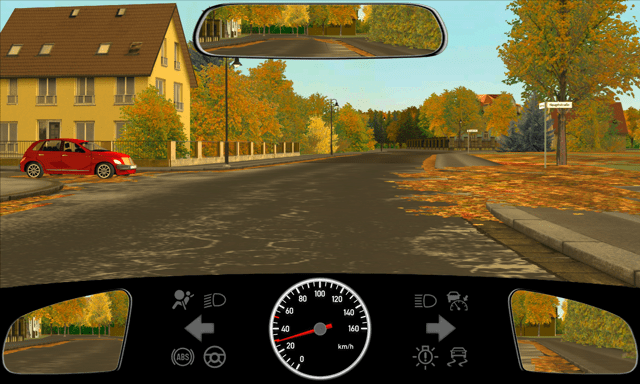
Explanation
The wet leaves on the road result in a longer braking distance and a high risk of slipping. Therefore, reduce your speed and drive carefully before reaching the intersection. A vehicle could be coming from the right and you should give it the right of way. Since there are no signs at the intersection that give you the right of way, the rule here is "right before left".
-
Question 4 of 63
You are approaching a school. Children are leaving the school grounds. What must you reckon with?
1.1.07-0095 PointsExplanation
In the vicinity of schools, you must always be prepared for children crossing the road abruptly. Children are not yet able to assess themselves and other road users very well and often react impulsively and in a way that is not appropriate for traffic. As a car driver, you must adapt your driving style accordingly in order to exclude any danger to children. In addition to driving at a low speed, you must be particularly attentive and ready to brake at all times.
-
Question 5 of 63
What do hazard warning lights draw your attention to?
1.1.07-0104 PointsExplanation
The use of the hazard warning lights is subject to strict rules. You may only switch on the hazard warning lights to secure your broken-down vehicle or to indicate a traffic jam or a school bus. A school bus with its hazard warning lights on may only be overtaken at walking speed.
-
Question 6 of 63
A big combine harvester in front of you wishes to turn right. What is correct?
1.1.07-0114 PointsExplanation
The combine harvester needs to gain amplitude to turn because the turn is very narrow. To do this, it will greatly reduce his speed. Keep your distance and also drive slowly and be prepared to brake. Especially for cyclists: Never overtake on the right!
-
Question 7 of 63
You are driving behind a farm vehicle with a trailer carrying a high load. What must you reckon with?
1.1.07-0134 PointsExplanation
If you are riding behind an agricultural vehicle with a heavily loaded trailer, you must expect the following: Part of the load could fall onto the roadway when turning or braking. The indicator could be dirty or covered by the load. The braking distance of the vehicle is increased by the weight of the load.
-
Question 8 of 63
What should you anticipate?
1.1.07-0143 Points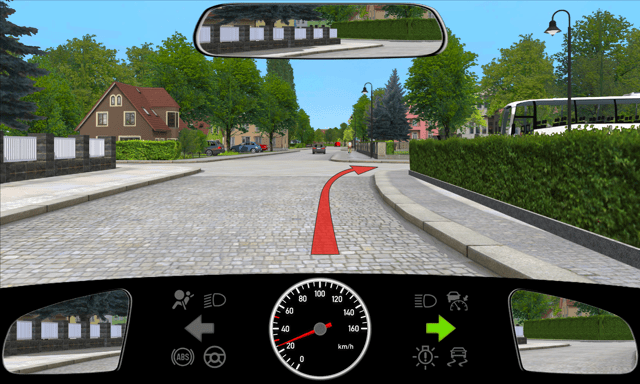
Explanation
You must expect to have to stop before the intersection when turning. For one thing, the view of the bus coming from the right is obstructed. In addition, other vehicles could pass it. In addition, pedestrians may also want to cross the road. You must always show special consideration for them.
-
Question 9 of 63
What should you do in this situation?
1.1.07-0154 Points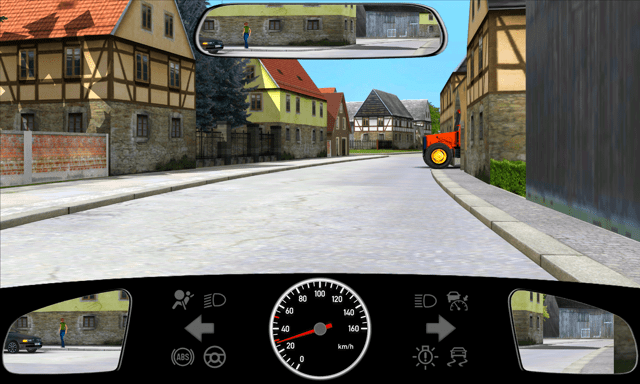
Explanation
The driver of the vehicle coming out of the exit cannot see the cross traffic. He would have to be directed into the traffic. He could drive further ahead and prevent you from continuing your journey. You should reduce your speed, be ready to brake, even stop if necessary.
-
Question 10 of 63
What should you anticipate in this situation?
1.1.07-0175 PointsExplanation
Because the oncoming vehicle is being slowed down by a bicycle, you should expect the vehicle to overtake the bicycle. If this happens, the vehicle could cross into your lane. In the event that the driver does not brake, you should keep as far to the right on the road as possible. Also, be prepared to brake so that you can react to any situation as quickly as possible.
-
Question 11 of 63
You want to turn right at the junction. What is the right thing to do?
1.1.07-0194 Points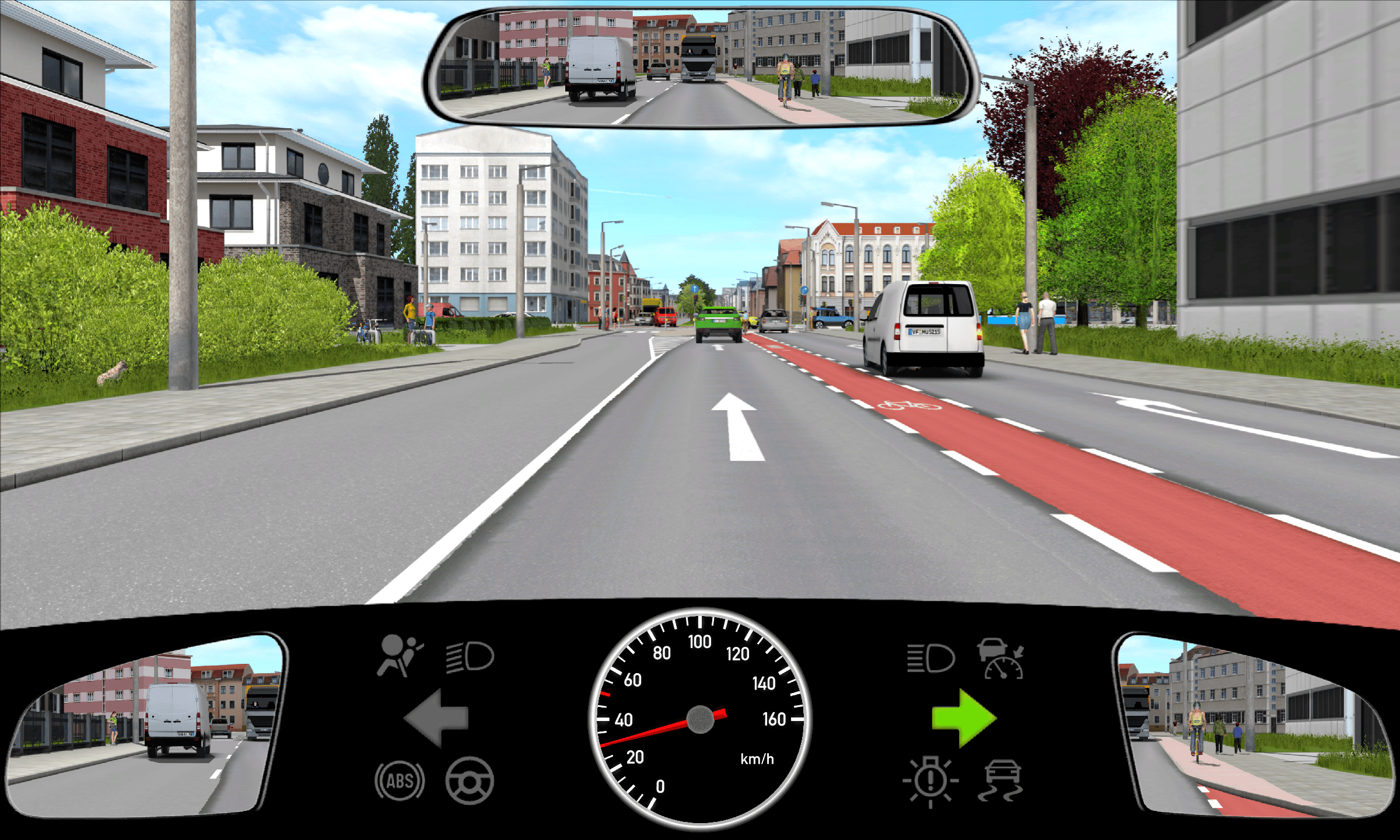
Explanation
There is a protective lane for cyclists between your lane and the turning lane. It is part of the carriageway and is separated by a broken line. You may only use the protective lane to change lanes, swerve or turn. If you use it, you are not allowed to obstruct cyclists or come to a standstill in the protective lane. You should therefore change lanes as early as possible.
-
Question 12 of 63
When could a dangerous situation arise here?
1.1.07-0204 Points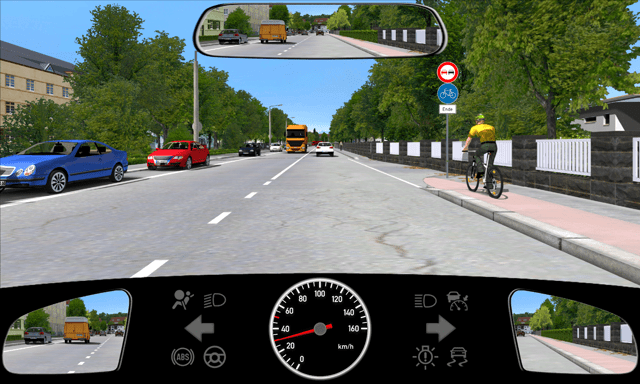
Explanation
You can see that the cycle path ends immediately in front of you. The cyclist would have to stop and wait until she can safely merge into the flowing traffic. However, rather than stopping, expect her to swing into the lane in front of you.
-
Question 13 of 63
What should you note about electric bicycles (e-bikes) participating in road traffic?
1.1.07-0233 PointsExplanation
E-bikes are just as quiet as classic bikes and are therefore often perceived late. However, they often achieve significantly higher speeds than bicycles without an engine. This is underestimated by many road users, so dangerous situations can occur surprisingly. In general, expect cyclists to gain speed and perform speedy maneuvers.
-
Question 14 of 63
What is the right course of action now?
1.1.07-0254 Points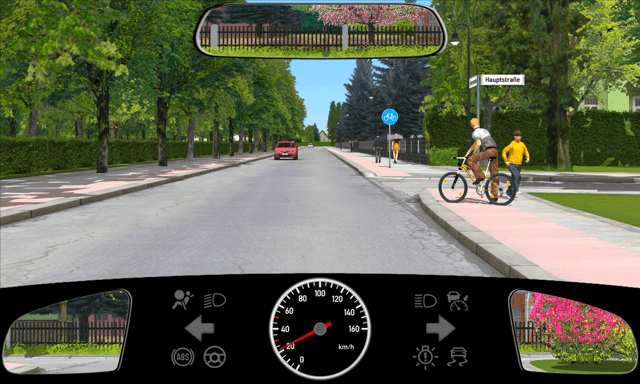
Explanation
You should be ready to brake and watch the cyclist carefully, because the cyclist can suddenly ride onto the road.
-
Question 15 of 63
You wish to overtake a farm tractor with a mounted implement extending beyond its back. What must you remember?
1.1.07-1014 PointsExplanation
You should always refrain from an overtaking maneuver when the tractor wants to turn. The reason for this is that the tractor has a large turning circle and is likely to veer, blocking the road. Also keep in mind that the turn signals of such a vehicle are not always visible and that they could be covered by dirt due to the agricultural use.
-
Question 16 of 63
What must you anticipate on the other side of this crest in the road?
1.1.07-1033 Points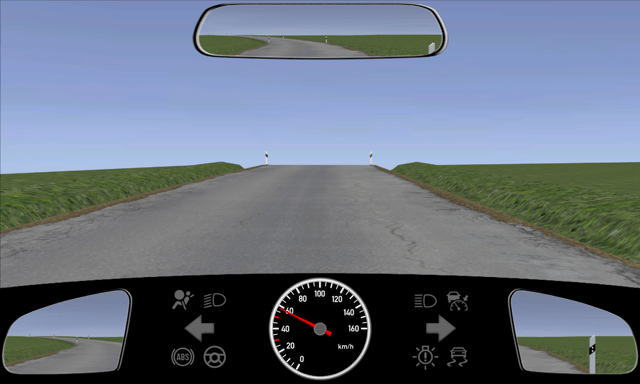
Explanation
Due to the height of the crest, it is not possible to see what is behind it. Expect to encounter obstacles there, such as broken-down or slow-moving motor vehicles. Also be prepared for oncoming trucks sharing your lane. To be able to react to such dangers in time, you should reduce your speed accordingly.
-
Question 17 of 63
What must you be prepared for in this situation?
1.1.07-1073 Points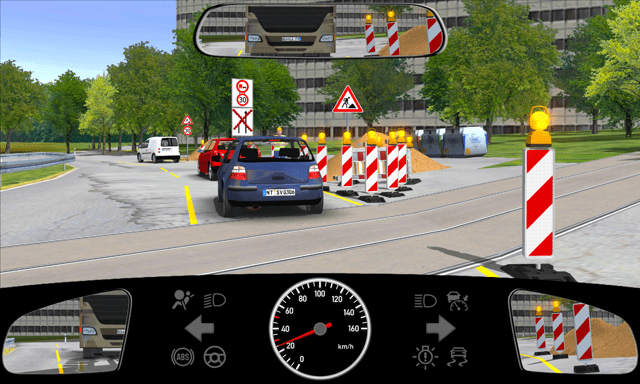
Explanation
In the area of a construction site you have to drive carefully and reduce the speed. For one, the road can be dirty. But it there can also be workers, construction equipment or construction vehicles on the road and obstruct the traffic.
-
Question 18 of 63
You are driving on a new road through a woodland area. What must you reckon with?
1.1.07-1133 PointsExplanation
When roads are newly constructed in forested areas, they often pass through the natural habitat of various wild animals. Therefore, it is possible that their habitual paths cross your roadway. For this reason, you must expect wildlife crossings and obstacles due to frequent wildlife accidents on forest roads.
-
Question 19 of 63
At which time of the day do you have to reckon with increased wild animals crossing?
1.1.07-1173 PointsExplanation
Expect more deer crossings during the morning and evening twilight. This transitional period between day and night is characterized by diffuse light conditions.
-
Question 20 of 63
Which dangers must you reckon with above all in rural areas?
1.1.07-1184 PointsExplanation
Where farming is practised, tractors and other agricultural vehicles travel at slow speeds and/or over width. Often the roadway is also dirty with soil or manure.
-
Question 21 of 63
A farm tractor is approaching you at dawn with its headlights switched on. What must you reckon with?
1.1.07-1194 PointsExplanation
In agricultural vehicles, the lights are sometimes broken. They can also be covered up by dirt or tarpaulins. The width of the vehicles is not easy to assess. In addition, these vehicles can have up to two trailers.
-
Question 22 of 63
What must you observe when you enter a tunnel?
1.1.07-1204 PointsExplanation
Before entering a tunnel, you must note the following: there is a light obligation in a tunnel. Therefore, turn on the dipped beam to see and be seen better. If you have sunglasses, take them off. You must not switch on the fog lamp in the tunnel.
-
Question 23 of 63
What must you do in case of a traffic jam in a tunnel?
1.1.07-1214 PointsExplanation
If there is a traffic jam in a tunnel, stop and turn off the engine. By keeping a safe distance of about five metres, you reduce the risk of poisoning, preserve a manoeuvring option and allow rescue vehicles to pass. Switch on the hazard warning lights to warn following drivers. Only leave your vehicle after an appropriate loudspeaker announcement.
-
Question 24 of 63
What can impair your attention when driving through a tunnel?
1.1.07-1224 PointsExplanation
When passing through a tunnel, the following factors may interfere with your attention: the lack of visual stimulus and the monotony of speed, as well as the lights of oncoming traffic. In this case, an orientation on the right side of the road is helpful; avoid looking directly into the light of oncoming traffic.
-
Question 25 of 63
Which basic code of conduct must you observe in a tunnel?
1.1.07-1254 PointsExplanation
The following rules of conduct are mandatory in all tunnels: on the entire route no U-turns are allowed. Regardless of the lighting situation, the dim light must always be switched on. The instructions of the tunnel staff must always be followed. Personal protection antecedes the protection of vehicles and their security.
-
Question 26 of 63
What should you do now?
1.1.07-1365 PointsExplanation
The white reversing lights of the vehicle that turned in front of you indicate that it would probably turn back to its original lane in reverse. Since you cannot tell if you have been noticed by the driver, you should reduce your driving speed and be ready to brake. Refrain from an evasive maneuver due to oncoming traffic.
-
Question 27 of 63
You want to turn right. What should you do?
1.1.07-1374 Points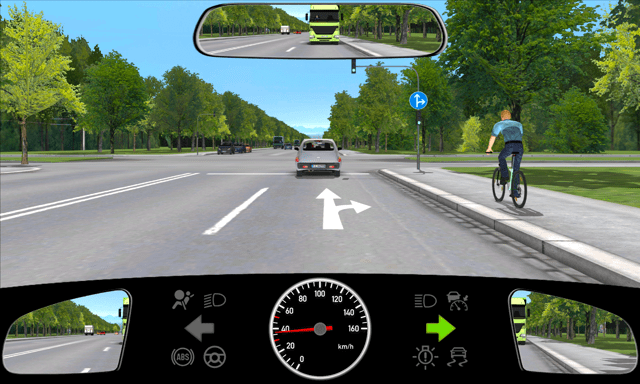
Explanation
Before you can turn, you have to check in the rear-view mirror if the road is clear. It is also advisable to look over your shoulder: this is the only way to be aware of dangerous situations located in the blind spot of the mirror. Keep in mind that other road users - cyclists or pedestrians - whose way you cross, always have priority.
-
Question 28 of 63
What should you anticipate?
1.1.07-1384 Points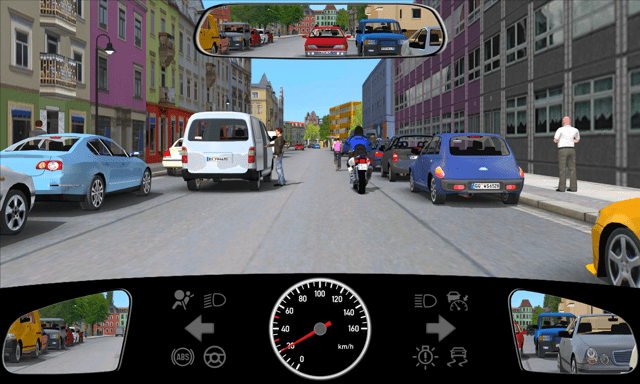
Explanation
The other road users can react to this situation with all the different scenarios described. All are equally dangerous. Therefore, extreme caution and slow driving is required.
-
Question 29 of 63
Ahead of the motorbike a car is seeking to reverse on the road. What should you anticipate?
1.1.07-1393 Points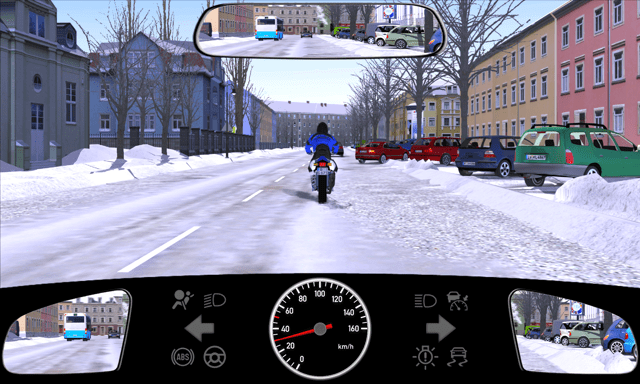
Explanation
Car drivers often underestimate the speed of approaching motorcyclists; the same happens to the driver here while he's pulling out of a parking space. The action alternatives of the motorcyclist - braking or dodging - are both dangerous for him on a snow-slicked road surface. He could fall. Also consider the longer braking distance in this weather.
-
Question 30 of 63
Why are you particularly at risk, if you are riding a two-wheeler?
1.1.07-1414 PointsExplanation
Especially in restrictive visibility conditions such as fog and darkness, the small silhouette of the two-wheeled driver leads to the fact that he is recognized late or not at all. In addition, the small design makes it difficult to estimate its speed. In the event of a collision, two-wheelers generally offer less protection than most other motor vehicles.
-
Question 31 of 63
Driving on a very busy road with several lanes, you have manoeuvred yourself into the lane for taking a left turn. Now instead of turning left, you want to turn right. What should you do?
1.1.07-1423 PointsExplanation
A lane change or turning right could endanger other road users due to the heavy traffic. You must therefore turn left and take a small detour. Watch out for lane markings that prohibit you from changing lanes.
-
Question 32 of 63
There is a tunnel on my route. What should I know?
1.1.07-1434 PointsExplanation
If there is a tunnel on your route, you should know the appropriate traffic signs and behavioral measures in the event of a breakdown or an accident: in this case, alert the tunnel monitoring center and follow the next escape route. First, turn off the engine of your vehicle and leave the ignition key in the lock for rescue operations.
-
Question 33 of 63
While driving in a tunnel you were forced to bring your vehicle to a halt due to a fire. What should you do now?
1.1.07-1454 PointsExplanation
If you have to park your vehicle in a tunnel due to a fire, you should: stop the engine, leave the key in the ignition switch and quickly trigger the fire alarm at the emergency call station. Leave the tunnel as fast as possible on the next escape route.
-
Question 34 of 63
What should you anticipate?
1.1.07-1465 PointsExplanation
You see that the truck wants to turn in front of you. The vehicle obscures the view of the traffic, so you need to adjust your speed. The truck probably swings out to take the curve. He might stop abruptly to let pedestrians or other road users pass.
-
Question 35 of 63
What must you watch out for now?
1.1.07-1474 PointsExplanation
You want to turn right, so does the car driver in front of you. The pedestrian traffic light of the cross street into which you want to turn shows green, and the pedestrian has priority. It is possible that your car in front will pull up and stop soon after to let the pedestrian pass. On the right you can also see a cyclist. The cyclist could drive past your vehicle on the right and circle your turning vehicle on the left. Avoid this danger.
-
Question 36 of 63
Why are you required to stop here?
1.1.07-1485 PointsExplanation
The cyclist must be given priority because she is on the right-of-way. Wait until the cyclist has passed the vehicles and driven through.
-
Question 37 of 63
Why are you required to stop here?
1.1.07-1495 PointsExplanation
The traffic on the main road is jammed. The red car drives around the parked vehicles to turn left. You have to wait and let this car pass as it has priority.
-
Question 38 of 63
What must you look out for when the traffic lights turn green?
1.1.07-1525 PointsExplanation
While you wait at the red light, a motorcyclist pushes past the waiting vehicles. When the traffic light switches to green you should pay attention to the motorcyclist and let him pass before he initiates a risky overtaking maneuver. But you should also let the pedestrian cross the road, which is still on the road despite it being green.
-
Question 39 of 63
What must you be prepared for in this situation?
1.1.07-1533 Points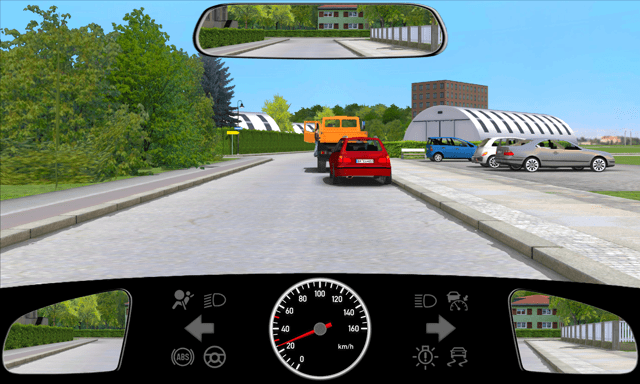
Explanation
The truck blocks your view. You can therefore recognize neither the oncoming traffic nor traffic signs behind the truck. Approach the vehicle at low speed. Look for oncoming traffic (they have priority) and keep your distance to the open driver's door when driving around. The driver of the truck could suddenly get out and jump onto the road.
-
Question 40 of 63
What should you do when driving through a tunnel?
1.1.07-1544 PointsExplanation
When driving through a tunnel, proceed as follows: Make sure to pay attention to the safety distance and orient yourself on the right-hand side of the road in order to avoid glare from oncoming traffic. Get an overview of safety devices so you know where the nearest emergency exit and emergency telephone are located.
-
Question 41 of 63
What must you watch out for now?
1.1.07-1554 PointsExplanation
You intend to turn left. Two cyclists move in the same direction. You must pay particular attention to these, as they could also turn into the street without notice.
-
Question 42 of 63
What should you do now?
1.1.07-1563 PointsExplanation
Since the dog (from the right) seems to be walking into the street, please perform emergency braking and keep the steering wheel straight and steady.
-
Question 43 of 63
For what should your prepare yourself in this situation?
1.1.07-1574 PointsExplanation
Please be prepared for people behind the bus to enter the lane and for the bus to swerve and briefly enter your lane.
-
Question 44 of 63
What kind of behaviour must you anticipate from cyclists?
1.1.07-1584 PointsExplanation
All 3 answers are correct. Cyclists use one-way streets in both directions, they may not have lights in the dark or they may ride on the wrong side of cycle paths.
-
Question 45 of 63
What must you be prepared for here?
1.1.07-1594 Points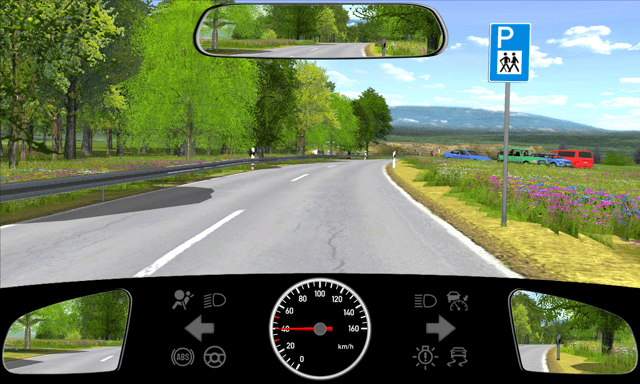
Explanation
The traffic sign indicates a rambler parking area, which means that people can walk across the roadway and vehicles can drive off or onto the parking area at any time.
-
Question 46 of 63
Why are you required to stop now?
1.1.07-1605 PointsExplanation
As you do not have a full view of the traffic situation and must give the cyclist the right of way, you must stop and carefully feel your way in.
-
Question 47 of 63
You want to continue driving straight ahead. What is the correct course of action in this situation?
1.1.07-1615 PointsExplanation
You are coming from a priority road first. As there are no other traffic signs, right is before left. The red car is driving on your right and therefore has the right of way. The electric scooter does not have right of way, so to avoid an accident you should let it cross anyway.
-
Question 48 of 63
I want to re-join the road. What is the correct assessment of this situation?
1.1.07-1623 Points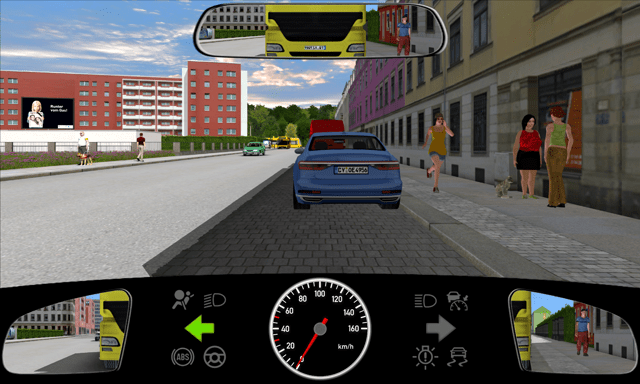
Explanation
As the vehicle parked behind you is very large, you will only see vehicles coming from behind at a late stage and you yourself will only be recognised by other drivers at a late stage.
-
Question 49 of 63
Why is it dangerous to carry on driving past this accident scene?
1.1.07-1633 Points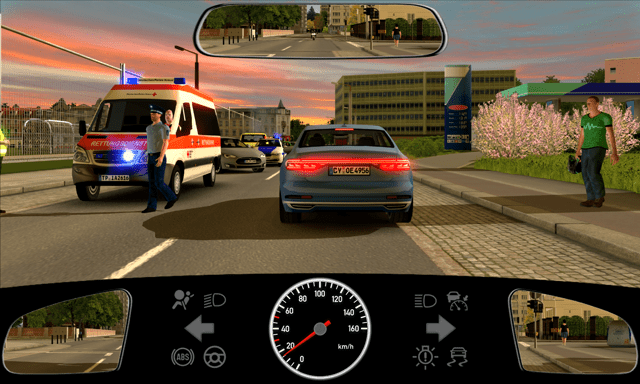
Explanation
The traffic situation is unclear, sudden braking manoeuvres by gawpers and pedestrians crossing the road must be expected.
-
Question 50 of 63
What must you watch out for when turning right here?
1.1.07-1645 PointsExplanation
The cyclist has the right of way. When turning right, you must always pay attention to whether pedestrians or cyclists are approaching. They are allowed to cross the street in front of you. Use the rearview mirror and also look over your shoulder to be able to see the blind spot.
-
Question 51 of 63
What is the right course of action now?
1.1.07-1655 PointsExplanation
The scooter does not seem to see you coming and takes the right of way. To avoid an accident, you must immediately perform emergency braking.
-
Question 52 of 63
What must you anticipate in this situation?
1.1.07-1664 Points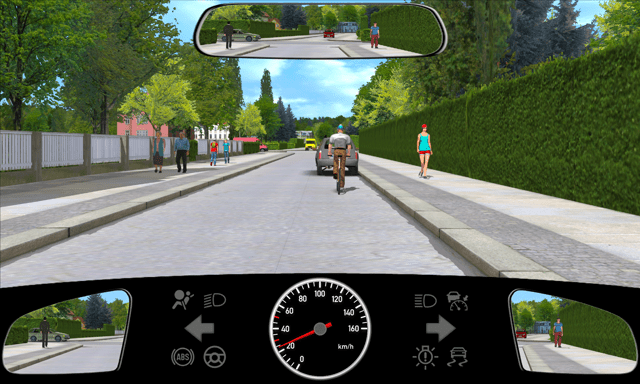
Explanation
Since the obstacle is on your side, you must wait in this case. In addition, the cyclist will overtake the parked car and therefore swerve to the left.
-
Question 53 of 63
You are driving through a tunnel. What special aspect applies here?
1.1.07-1674 PointsExplanation
In a tunnel, the emergency exits and SOS emergency telephones are clearly signposted and illuminated. In an emergency, you should use the facilities. You can easily be distracted by the different lighting, the lights of other road users and the much louder noises in the tunnel.
-
Question 54 of 63
What is the right course of action now?
1.1.07-1684 PointsExplanation
The vehicle that is still parked wants to enter the road and has obviously overlooked you. You should slow down to avoid an accident.
-
Question 55 of 63
What should you anticipate now?
1.1.07-1694 PointsExplanation
The [yellow] vehicle will stop, so you must be ready for the driver to open the door. The cyclist will probably move to the left to overtake the yellow vehicle. You must also expect the truck to drive off.
-
Question 56 of 63
You are driving on a section of road where a traffic jam has been reported. What is the right course of action?
1.1.07-1704 PointsExplanation
You should be extra attentive on curves and before hilltops, because the traffic situation is difficult to see. You should also continue to follow the traffic reports.
-
Question 57 of 63
Why are you required to stop now?
1.1.07-1714 PointsExplanation
The "Give way" sign in combination with the additional bicycle sign shows you that you must pay attention to possible cyclists and give them the right of way. Therefore, you must now stop and let the cyclist pass.
-
Question 58 of 63
What is the correct course of action in this situation?
1.1.07-1724 PointsExplanation
If a cyclist suddenly comes from the left, you must do an emergency stop.
-
Question 59 of 63
While driving, a deer crosses the road in front of your vehicle. What should you be aware of?
1.1.07-1733 PointsExplanation
A deer is very unpredictable, maybe it runs back into the forest, maybe it will stop in the middle of the street. You should therefore reduce your speed and follow what is happening, as other animals can also step on the road.
-
Question 60 of 63
What is the right course of action?
1.1.07-1743 PointsExplanation
As the lorry in front of you is parking in reverse, you must continue to slow down. You can only change lanes when the lane to your left is free. Stay in your lane for the time being and continue braking.
-
Question 61 of 63
What should you anticipate in this situation?
1.1.07-1754 PointsExplanation
You are driving on a turning priority road. Anyone leaving a priority road must give way to vehicles following the priority road. The yellow car flashes and turns left. Although it does not have right of way, at its high speed it will not be able to stop without coming into your lane. You should therefore brake and give up your right of way to avoid a collision. The obligation to avoid accidents takes precedence over all right of way rules.
-
Question 62 of 63
What is the right behaviour now?
1.1.07-1764 PointsExplanation
In the left side mirror you can see that a car behind you is about to overtake. At the same time, the person on the bike on the right in front of you could move onto the road. A truck is also coming towards you on the opposite lane. All three factors lead to a narrow roadway and thus increase the risk of accidents. In this situation you have to brake to avoid a collision with the overtaking car and the cyclist.
-
Question 63 of 63
Why do you have to be particularly attentive now?
2.2.11-0014 Points