
1.2.19 Level crossings
Here are the most important rules about level crossings, railway barriers, flashing lights, St. Andrew’s crosses, and train priority in an easy and memorable way.
🧠 Quick Memory Rules
🚦 Red Flashing Light
Stop immediately before the St. Andrew’s Cross.
🚧 Lowering Barrier
Never drive through when barriers start lowering.
🚂 Train Priority
Rail vehicles always have priority.
⚠ Traffic Jam Danger
Never enter the crossing if you may stop on the rails.
🛑 When You MUST Stop
🚫 Stop Immediately
- Red flashing lights appear
- Barriers start lowering
- Barriers are closed
- Railway employee waves a flag
- Railway employee shows red light
⚠ Why This Is Important
- Trains travel very fast
- Trains need long braking distance
- Barriers close quickly
- Vehicles may get trapped
✖ St. Andrew’s Cross Rules
| Sign / Situation | Meaning | What You Must Do |
|---|---|---|
| St. Andrew’s Cross | Train has priority | Wait if train approaches |
| Red flashing light | Crossing blocked | Stop immediately |
| Arrow flashing light | Applies to turning traffic | Turning vehicles must stop |
| Lightning symbol | Electric overhead line | Important for tall vehicles |
✅ How To Cross Safely
🚗 Safe Driving Behavior
- Reduce speed before crossing
- Look carefully both ways
- Listen for approaching trains
- Cross quickly and safely
- Stay alert even with open barriers
❌ Dangerous Behavior
- Driving around barriers
- Stopping on rails
- Following other cars blindly
- Ignoring flashing lights
- Crossing during traffic jams
⭐ Special Situations
🚛 Trucks Over 7.5t
Outside built-up areas, heavy vehicles and vehicles with trailers must often wait behind the 80-meter marker.
🏭 Industrial & Forest Areas
Expect unprotected railway crossings without barriers or flashing lights.
🚨 Broken Barrier System
Never cross if the barrier system seems defective. Inform the police immediately.
🚩 Railway Staff Signals
🚩 White-Red-White Flag
The crossing is blocked. You must stop and wait at a safe distance.
🔴 Red Light By Railway Staff
Tracks are inaccessible and trains have priority. Do not cross.
🎯 Easy Exam Tips
- Train always has priority
- Stop at red flashing lights
- Never stop on rails
- Open barrier does NOT mean safe automatically
- Crossing during traffic jams
- Driving around barriers
- Ignoring railway staff
- Following other vehicles too early
Practice Questions (19)
-
Question 1 of 19
When must you wait at a level crossing?
1.2.19-0023 PointsExplanation
All road users are required to stop and wait immediately before a level crossing in the following situations: when the signal system's red flashing light comes on, when the barriers start to lower, when the barriers are closed, when a staff member waves a white-red-white flag , You must wait until the blockage is released again.
-
Question 2 of 19
A railway employee is waving a red lamp at a level crossing. What does this mean?
1.2.19-0043 PointsExplanation
All car drivers and other road users must wait at a safe distance before the crossing if a member of the railway staff secures a low-traffic level crossing with a red light. Waving the red light means that the tracks are inaccessible and trains have priority.
-
Question 3 of 19
At the entrance to an industrial estate, there is a St. Andrew's Cross with the supplementary sign "Industrial estate, rail vehicles have precedence". What must you remember?
1.2.19-0083 PointsExplanation
Even if there are no barriers and no diagonal crosses at the level crossings in the entire industrial area, motor vehicle drivers must give priority to all rail vehicles. Always expect a train to come, observe the railway lines accurately and approach the tracks only with moderate speed.
-
Question 4 of 19
These level crossing barriers have not moved for some time now. What is the right course of action?
1.2.19-0094 Points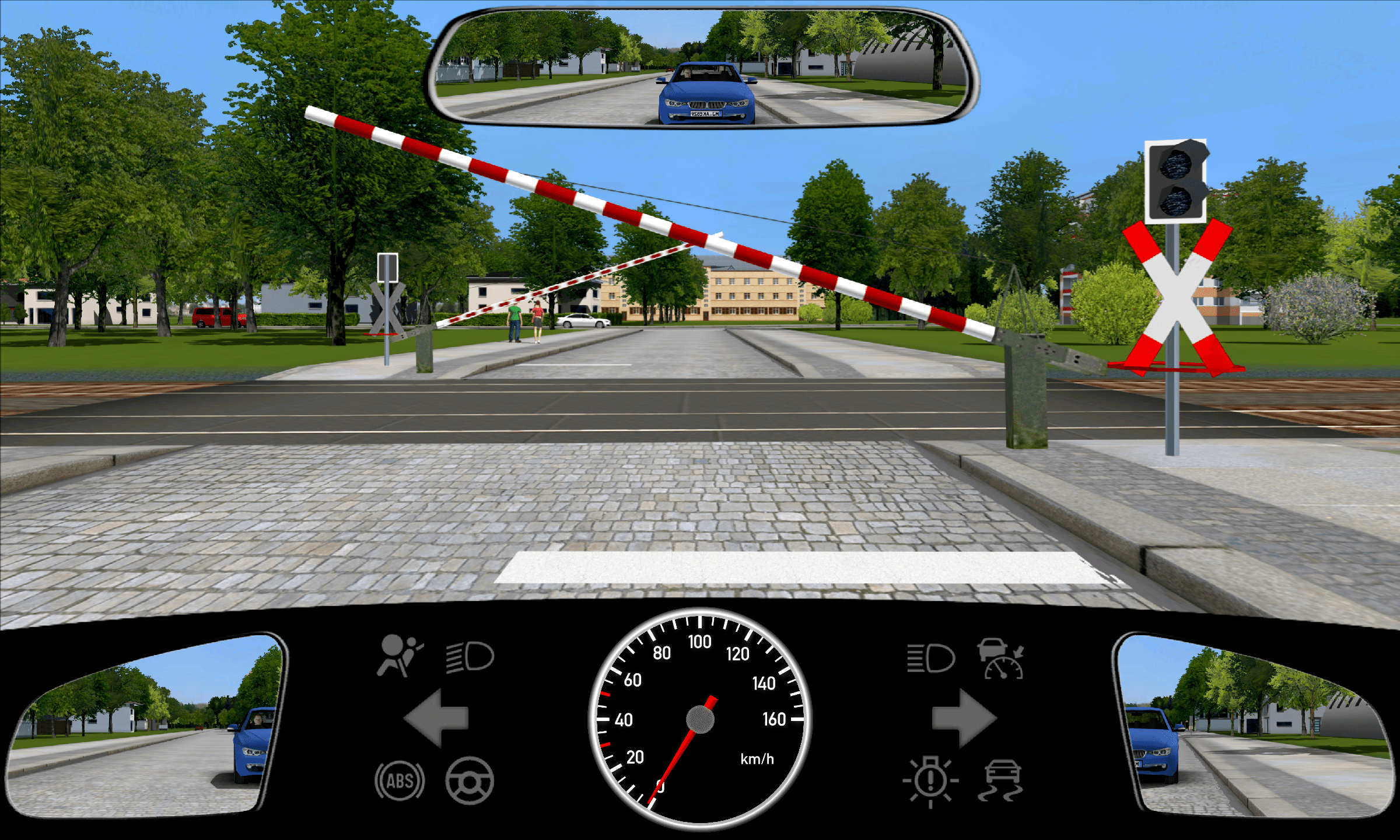
Explanation
Apparently there is a fault with the railway barrier. It is therefore not safe to use the railway crossing. Do not cross the railway crossing under any circumstances; if a train is approaching, there is an acute danger to your life and there is also a risk that you will not be able to get through under the barriers and get stuck. Inform the police about the fault at the railway crossing so that the problem can be fixed.
-
Question 5 of 19
You are driving along a forest track and approach a level crossing without St. Andrew's Cross. What do you do?
1.2.19-1013 PointsExplanation
Even without the diagonal cross, a car driver must always give priority to a rail vehicle on field and forest paths. Approach the railroad crossing at moderate speed and listen for a train approaching. Observe the track and stop, if necessary, to let the rail vehicle pass.
-
Question 6 of 19
What do you do at a level crossing when the barriers are closed?
1.2.19-1023 PointsExplanation
At a level crossing with closed gates, all car drivers have to wait in front of the diagonal cross. If there is no traffic sign, a safe distance to the rails must be observed. Be careful not to block intersections or T-junctions when waiting. In the dark, lighting must be switched on, parking light is sufficient.
-
Question 7 of 19
When are you allowed to cross a level crossing with flashing lights but no barriers after a train has passed?
1.2.19-1043 PointsExplanation
You may only cross the level crossing after the red flashing light turns off, as another train could follow. Do not be fooled by oncoming traffic to drive on if the car driver waiting on the opposite site already starts driving too early after the train has passed through.
-
Question 8 of 19
You are approaching a level crossing with barriers. Where must you wait if you would have to stop on the rails in case of traffic congestion?
1.2.19-1053 PointsExplanation
If you are unable to pass the railroad crossing quickly due to slow traffic, then stop in front of the diagonal cross. Waiting directly in front of the rails or at the level of the barriers is prohibited, because at these positions you may be hit by the dynamic pressure of the train, by the train itself or trapped by the barriers.
-
Question 9 of 19
The barrier of a level crossing inside a built-up area is closed. Where must you wait?
1.2.19-1073 PointsExplanation
Trucks and vehicles with trailers (vehicles over 7.5 t permissible total mass) are only required to wait outside of built-up areas behind the level crossing (80 m) ahead marker. Inside a built-up area they have to wait in front of the diagonal crosses.
-
Question 10 of 19
What does this traffic sign mean?
1.2.19-1093 Points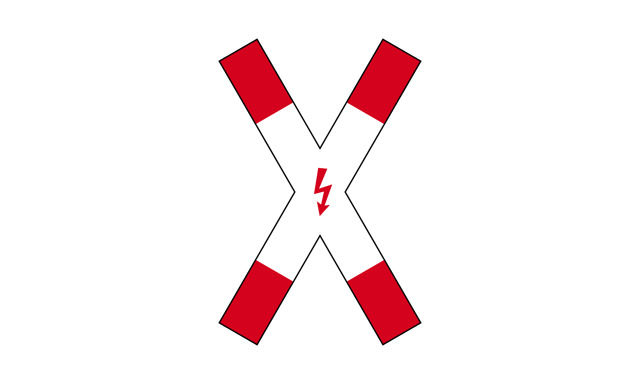
Explanation
The diagonal crosses indicate that rail transport has priority here. As a car driver you need to wait when a rail vehicle is approaching. A lightning bolt in the diagonal cross is an indication of an electrical overhead line, which is important for special transports with a big height.
-
Question 11 of 19
A light signal with no level crossing sign is positioned before a level crossing, and in front of a junction with a road to the right. The red light is illuminated. Where must you wait?
1.2.19-1103 Points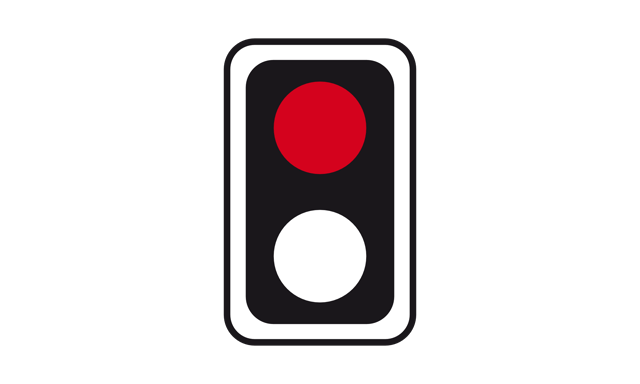
Explanation
In the event of a red light, the car driver must stop in any case. In order not to block the traffic from the road going to the right, the red light is located several meters from the actual railroad crossing. Wait at the stop line or at the light sign if no line is available.
-
Question 12 of 19
What must you do in this situation?
1.2.19-1113 Points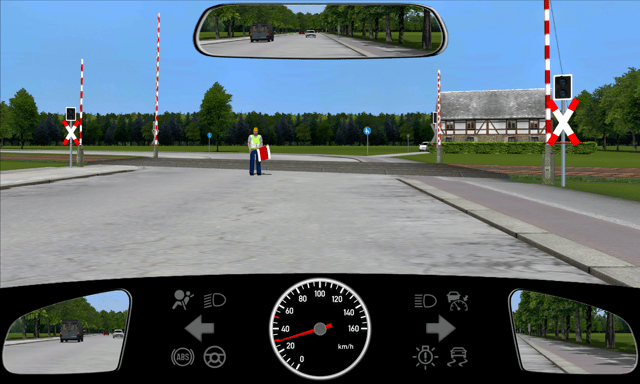
Explanation
The railway employee secures the level crossing and therefore you should stop before the St. Andrew's cross.
-
Question 13 of 19
Who is required to stop at a level crossing with a red flashing light in the form of an arrow point to the right?
1.2.19-1123 PointsExplanation
A diagonal cross with a red flashing light in the form of an arrow to the right can be found behind an intersection or T-junction after a railroad crossing. The right arrow indicates that the car drivers who turn right must wait.
-
Question 14 of 19
What does this traffic sign combination indicate?
1.2.19-1134 Points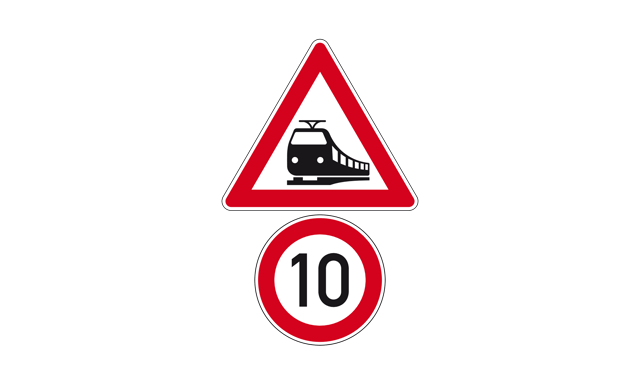
Explanation
The traffic sign combination shows you a level crossing. The car driver may approach the level crossing only at 10 km/h and cross it at that speed.
-
Question 15 of 19
What is the right course of action now?
1.2.19-1144 PointsExplanation
If there is a risk that you might come to a stop on the rails due to a traffic jam situation or stagnant traffic, stop in front of the diagonal cross and wait until you can safely and quickly cross the level crossing. Fatal accidents occur when a car standing on the rails cannot avoid the approaching train.
-
Question 16 of 19
You are approaching a rail crossing. The barrier begins to lower. What should you do?
1.2.19-1153 PointsExplanation
When a driver approaches a gate that lowers, he/she must wait in front of the level crossing. This also applies if no rail vehicle is yet to be seen. Switching on the hazard light is not required.
-
Question 17 of 19
Where do you have to anticipate encountering rail crossings with no technical safeguards?
1.2.19-1163 PointsExplanation
In industrial and port areas, on field and forest paths, as well as on roads with little traffic, you should expect a railway crossing without a barrier or traffic light (technically unprotected).
-
Question 18 of 19
You want to cross a level crossing with the barriers open. What is correct?
1.2.19-1173 PointsExplanation
Even when the barriers are open, you must always approach level crossings with caution and at a moderate speed. This gives you enough time to react to possible bumps and dangerous situations. Moderate speed in this context does not mean walking speed, because you can also drive faster than walking speed. In this way you can prevent possible dangerous situations with approaching trains or lowering barriers.
-
Question 19 of 19
What should you do now?
1.2.19-1183 PointsExplanation
Level crossings may not be crossed when the flashing lights above the St. Andrew's Cross are on or the barriers are lowered.