
2.2.04 Distance
Keep enough distance so you can react and brake safely if the vehicle ahead suddenly slows down. In good conditions, remember the simple rule: outside towns keep about half your speed in meters.
Two-second rule
2 sec
Choose a fixed point. When the vehicle ahead passes it, you should pass it at least two seconds later.
Half-speed rule
100 → 50 m
Outside built-up areas, distance should be at least half your speed in meters.
Bad weather
×2
Rain, snow, ice, darkness, or poor visibility mean you need much more distance.
Core Rules to Memorize
Normal safe distance
Keep enough distance to stop safely if the vehicle in front brakes suddenly.
Outside towns
Use the half-speed rule: at 80 km/h keep about 40 m; at 100 km/h keep about 50 m.
In town
In urban traffic, shorter distances can be acceptable when driving attentively and road conditions are good.
Bad conditions
On wet, snowy, or icy roads, increase the distance clearly — often at least double.
Easy Distance Examples
| Speed | Rule | Distance |
|---|---|---|
| 50 km/h | City, about 1 second | ≈ 15 m |
| 80 km/h | Half-speed rule | ≈ 40 m |
| 100 km/h | Half-speed rule | ≈ 50 m |
| Bad weather | Increase safety margin | Often ×2 |
Memory trick
Outside towns: divide your speed by 2 and use that number as meters. Example: 80 km/h ÷ 2 = 40 m.
Special Rule: Long Vehicles, Trucks, and Trailers
Vehicles longer than 7 m
Outside built-up areas, long vehicle combinations must keep enough distance so overtaking vehicles can safely pull back into the lane.
Trucks over 3.5 t
They must leave an insertion distance, called Einscherabstand, so another vehicle can move back in after overtaking.
Car with trailer
Outside towns, cars with trailers are usually limited to 80 km/h, so the half-speed distance is about 40 m.
Heavy truck on motorway
For a truck around 12 t at 80 km/h on the Autobahn, remember the exam value: at least 50 m distance.
Why Distance Matters
Reaction time: More distance gives you more time to notice danger and react.
Braking distance: Extra weight, trailers, wet roads, and high speed increase the distance needed to stop.
Overtaking safety: Long vehicles must create space so overtaking vehicles can safely return to the lane.
Collision prevention: Distance is not a goal by itself; it exists to prevent rear-end crashes.
Exam Checklist
- ✓Can I stop safely if the vehicle ahead brakes?
- ✓Outside town: is my distance at least half my speed in meters?
- ✓Is the road wet, icy, snowy, or dark? Then increase distance.
- ✓Am I driving a long vehicle or trailer? Leave space for overtaking vehicles.
Mini Quiz
At 100 km/h outside town, how much distance?
About 50 meters.
At 80 km/h with a trailer, what distance?
About 40 meters using the half-speed rule.
What should you do on icy roads?
Increase the distance greatly, often at least double.
Practice Questions (8)
-
Question 1 of 8
You are driving at 80 km/h behind a motor vehicle. What is the minimum safe distance you must observe?
2.2.04-0014 PointsExplanation
When driving behind another vehicle, you need to maintain the so-called "two-second distance" to be able to stop in time. At a speed of 80 km/h, this corresponds to about 40 meters.
-
Question 2 of 8
You are driving in urban traffic on a dry roadway in a stream of traffic travelling at a speed of 50 km/h. What is the minimum safe distance you must keep from the vehicle in front?
2.2.04-0024 PointsExplanation
In urban areas, as well as in city traffic, shorter distances are justified according to jurisdiction than out of town. The general "two-second distance" may be reduced to one second with attentive driving and favorable road conditions. At 50 km/h, this is about 15 meters. That's about three car lengths.
-
Question 3 of 8
What is the minimum safety distance you should maintain from the vehicle ahead when driving at a speed of 100 km/h?
2.2.04-0043 PointsCorrect: 50
Explanation
In order to be able to brake in time, you should keep the safety distance equal to the half of the speed in meters.
-
Question 4 of 8
When driving outside of a built-up area, what minimum safety distance should you maintain between you and the vehicle ahead?
2.2.04-0054 PointsExplanation
Outside of closed towns, the StVO prescribes a safety distance of 2 seconds. This then corresponds again to the "half speedometer" rule of thumb. Attention: These rules only apply to dry roads. In the case of rain, snow and black ice, the safety distance should be at least twice as large.
-
Question 5 of 8
When must a car with trailer driving outside built-up areas on roads with only one lane for each direction keep a sufficient distance from the car in front so that an overtaking vehicle may pull in?
2.2.04-1023 PointsCorrect: 7
Explanation
StVO § 4 Abs.2: "Motor vehicles subject to a special speed restriction and vehicules longer than 7 meters must keep a fixed distance from other vehicles in front of them so they can be overtaken by other passing vehicles. ..) "
-
Question 6 of 8
You are driving a car with a caravan in tow. What is true regarding your distance to the vehicle ahead?
2.2.04-1054 Points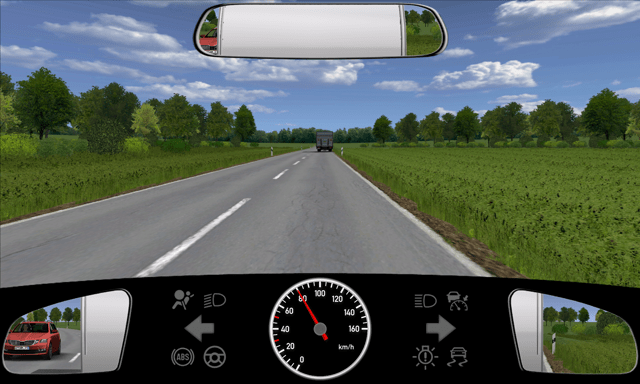
Explanation
As a rule, the distance to the vehicle in front must be large enough for the overtaking vehicle to be able to overtake. After the overtaking, the distance to the vehicle in front should be adjusted again, as the distance should not be bigger than your vehicle length.
-
Question 7 of 8
You are driving a heavily loaded car. Why should you maintain a greater safety distance to the vehicle ahead?
2.2.04-1063 PointsExplanation
The additional weight changes the driving characteristics of the car. The brakes are under more load. This can reduce the braking power, which increases the braking distance.
-
Question 8 of 8
From what length of a vehicle combination must you keep a sufficient distance from the vehicle in front outside the built-up area to allow an overtaking vehicle to file in?
2.2.04-1073 PointsCorrect: 7
Explanation
If the length of the vehicle combination is more than 7 meters, you must keep a longer distance from the vehicle in front outside built-up areas. This gives overtaking vehicles the opportunity to pull in in front of you.