
1.1.05 Speed
Speed = Risk Multiplier
Driving too fast is the #1 cause of fatal accidents on German roads. Speed limits are maximum values, not recommendations. You must always adapt your speed to the road, traffic, visibility, and weather conditions.
Where Does Fast Driving Lead to Accidents?
Statistical hotspots you must memorize for the exam.
Rural Roads (Landstraßen)
Unexpected curves, narrow lanes, and trees close to the road edge create high risk.
Intersections
Misjudging the speed of cross-traffic or approaching too fast to yield properly.
Changing Conditions
Sudden patches of ice, wet leaves in autumn, or aquaplaning.
School Zones
Children are unpredictable. Even 30km/h can be too fast if visibility is blocked.
How to Take Tight Bends
The "Slow In, Fast Out" technique prevents centrifugal force accidents.
Before the Curve
Reduce speed significantly. Downshift if necessary to have traction.
In the Curve
Maintain a steady, slow speed. Do not brake hard or accelerate abruptly.
Exiting
Once the road straightens, accelerate gently back to cruising speed.
Buses: Correct Behavior
Bus at stop with hazard lights ON
You may pass at walking speed (4-7 km/h). This applies to oncoming traffic too!
Passengers boarding/alighting
If passengers are on the road, you must stop. Ensure no one is endangered.
Buses: Deadly Mistakes
Bus approaching stop with hazards flashing
DO NOT OVERTAKE. You must wait behind the bus until it stops.
Passing at 30 km/h
Too fast! If a child runs out from behind the bus, you cannot stop in time.
Residential Areas & Schools
In residential areas, assume children are playing on the road. They act impulsively and ignore traffic rules. Your reaction time is the only safety net.
- check Always drive ready to brake immediately.
- check Maintain large lateral distance from cyclists.
- check Respect the 30 km/h zones strictly—noise reduction helps focus.
Anticipation is Key
If you see a ball roll onto the street, brake immediately. A child usually follows the ball.
High Probability Event
Typical Exam Traps
Trap #1: "The speed limit is 50 km/h, so I drive 50 km/h." expand_more
WRONG. 50 km/h is the maximum allowed. If it's raining, traffic is heavy, or visibility is poor, you MUST drive slower. The correct answer in exams often involves "adapting speed" rather than "driving the limit."
Trap #2: Braking distance calculation formula. expand_more
Remember: (Speed ÷ 10) × (Speed ÷ 10).
At 50km/h = 25m. At 100km/h = 100m.
Doubling speed quadruples braking distance! This is a guaranteed exam question.
Trap #3: Narrow roads with no center line. expand_more
On narrow roads, you must drive at a speed that allows you to stop within half of the visible distance, because an oncoming vehicle needs the other half to stop.
Practice Questions (4)
-
Question 1 of 4
Where does driving fast often lead to accidents?
1.1.05-0014 PointsExplanation
Excessive speed is one of the main causes of accidents. The faster you drive, the longer your braking distance and the less time you have to react to other road users. At too high a speed, you can be carried out of the bend by centrifugal force. On slippery and wet roads, you lose traction and control of the car at high speed.
-
Question 2 of 4
Where is fast driving particularly dangerous?
1.1.05-0024 PointsExplanation
In blind bends, fast driving is particularly dangerous because suddenly appearing obstacles are seen too late. High speed can also be dangerous at road narrowings, as there is not always enough braking distance available. Also, do not underestimate the risk of skidding due to uneven road surfaces at level crossings.
-
Question 3 of 4
How do you take tight bends?
1.1.05-0034 PointsExplanation
You should reduce your speed before entering a tight bend and only accelerate again when entering the straight, if visibility permits. Be aware that abrupt braking in a bend can cause your vehicle to skid.
-
Question 4 of 4
What must you be aware of here?
1.1.05-1074 Points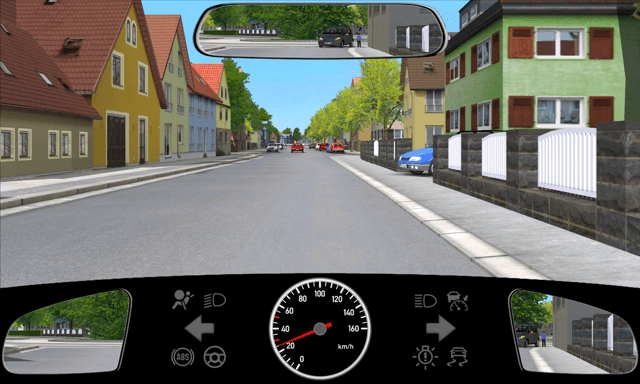
Explanation
They are crossing a residential area. The road is wide and tempts them to drive fast. But be careful: playing children can suddenly jump onto the road. If you drive too fast, you will not be able to react and brake in time. You may also overlook crossroads or junctions. In residential areas, "right before left" often applies: you must give way to vehicles coming from the right.