
1.2.09 Turning, turning and reversing
1. Tangent Turning
When two oncoming vehicles both want to turn left, you must turn in front of each other (tangentially).
2. Yielding (Right of Way)
- 🛑 Oncoming Traffic: Always has priority over left-turners.
- 🛑 Pedestrians: Have priority when you turn into their street.
- 🛑 Cyclists/Scooters: Have priority if they are going straight next to you.
- 🛑 Trams: Always give way to trams when turning.
3. Indicating Rules
You must always indicate when changing direction.
- Indicate when following a priority turning road.
- Indicate when turning into a property/T-junction.
- Roundabouts: Indicate ONLY when leaving, NEVER when entering!
4. Positioning
The Routine: 1. Look (Mirror & Shoulder) ➔ 2. Indicate ➔ 3. Arrange vehicle.
One-Way Streets: Move to the far left lane to turn left.
Multi-Lane Turns: Stay in your lane! Do not drift into parallel lanes. If turning right immediately after, use the right-most left-turn lane.
⚠️ Exam Trap Warning
Even if you are on a priority road, if you are turning across straight-moving traffic (like a tram), you must stop and yield.
Practice Questions (34)
-
Question 1 of 34
You want to turn left. When must you pay attention to the traffic following behind you?
1.2.09-0164 PointsExplanation
When turning left, you should be aware of following traffic before turning and before merging.
-
Question 2 of 34
Two vehicles approach one another at an intersection. Both vehicles want to turn left. In what exceptional case do they have to turn one after the other?
1.2.09-0173 PointsExplanation
Always turn in front of each other. If the traffic situation or the design of the intersection, e.g. lane markings, requires it, you must turn one behind the other.
-
Question 3 of 34
Two vehicles approach one another at an intersection. Both vehicles want to turn left. What must both drivers do in the normal case?
1.2.09-0183 PointsExplanation
If two left-turning vehicles come towards each other, they turn in front of each other (tangentially).
-
Question 4 of 34
You want to turn left. What driving line should you maintain?
1.2.09-0194 Points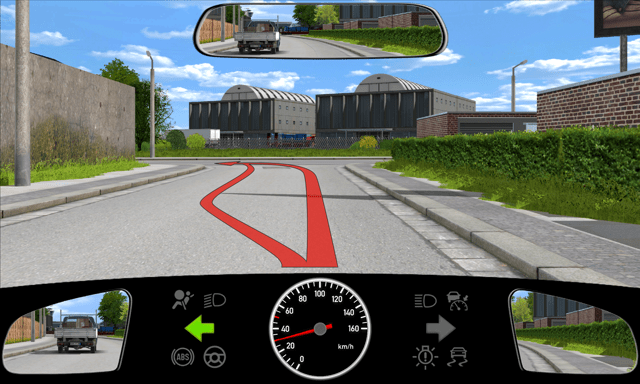
Explanation
Use the right-hand driving line. The left-hand driving line is intended for oncoming traffic.
-
Question 5 of 34
To which road user must you give way here?
1.2.09-0205 PointsExplanation
When turning, you must give priority to oncoming traffic and cross traffic - in this case cyclists and pedestrians. Although your traffic lights are green, you must wait until the pedestrian has crossed the road. Pedestrians have priority over turning vehicles.
-
Question 6 of 34
You want to leave the roundabout at this exit. What is the right thing to do?
1.2.09-0214 Points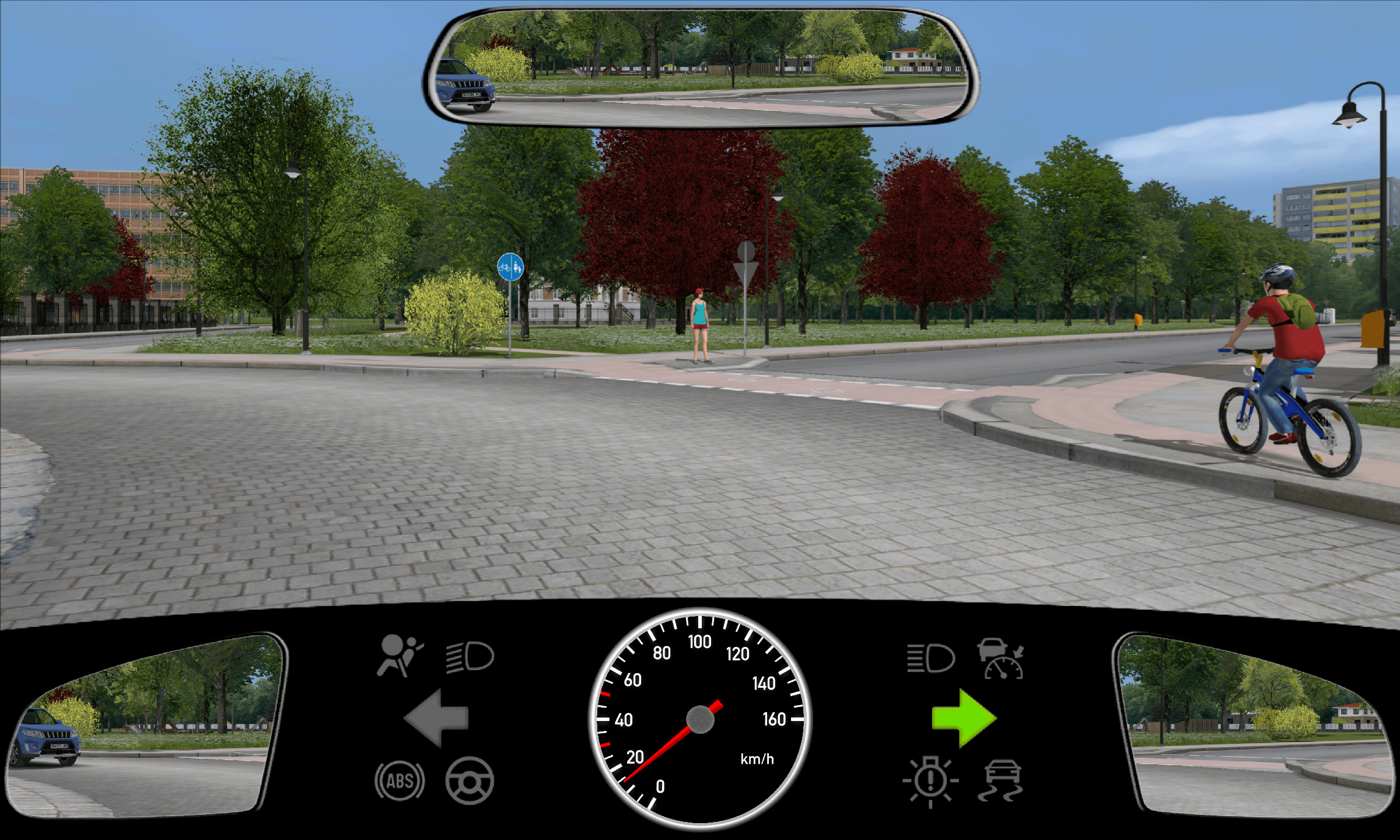
-
Question 7 of 34
You want to turn right here. What is correct?
1.2.09-0224 Points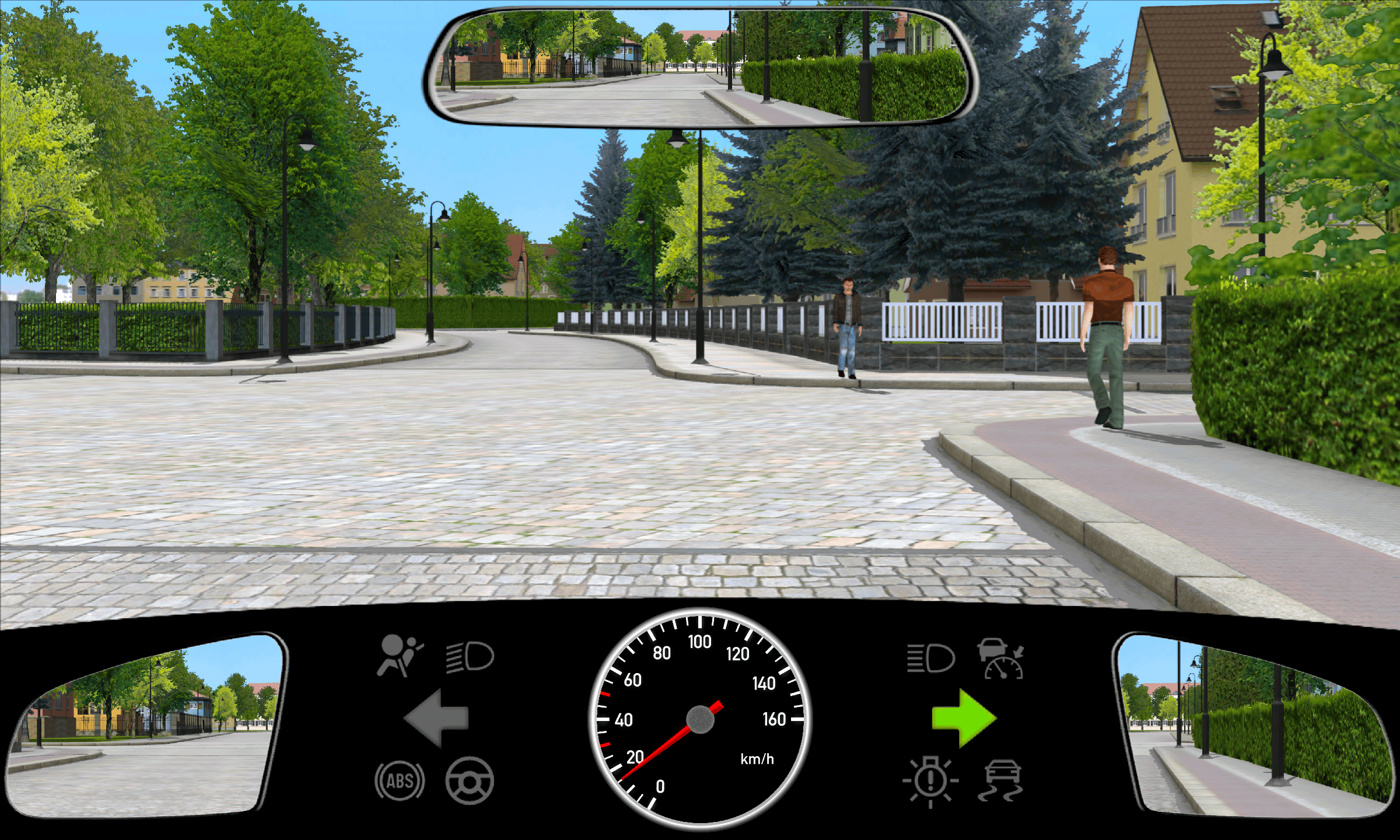
Explanation
You must let both pedestrians cross the road. They do not change their direction of movement and therefore have priority over you.
-
Question 8 of 34
What can give rise to particularly dangerous situations where several lanes turn off?
1.2.09-1014 PointsExplanation
Drive at moderate speed into multi-lane turns. At too fast a pace you could get out of your lane and get into the lane of parallel driving vehicles. Avoid a lane change within this turning situation. There is a risk that a vehicle is directly behind you in your blind spot.
-
Question 9 of 34
All three vehicles want to turn left. Which is in the correct lane?
1.2.09-1033 Points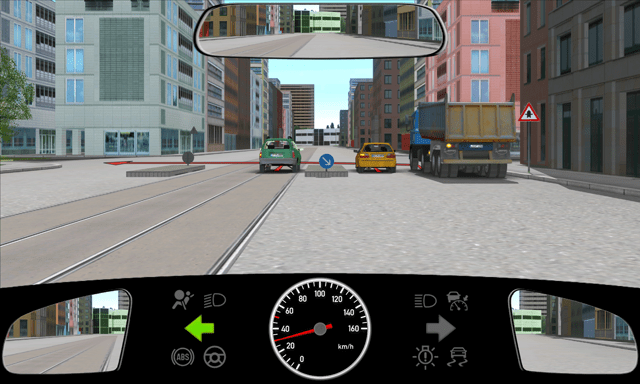
Explanation
Only the yellow car merged into the lane correctly. He passed right, as it says on the road sign on the safety island, in order to then get in proper lane as left as possible to prepare his turn to the left. The green car is completely wrong on the rails; In this situation, the truck may only drive straight ahead or turn right.
-
Question 10 of 34
After turning left, you want to turn immediately right. How should you position your vehicle?
1.2.09-1043 Points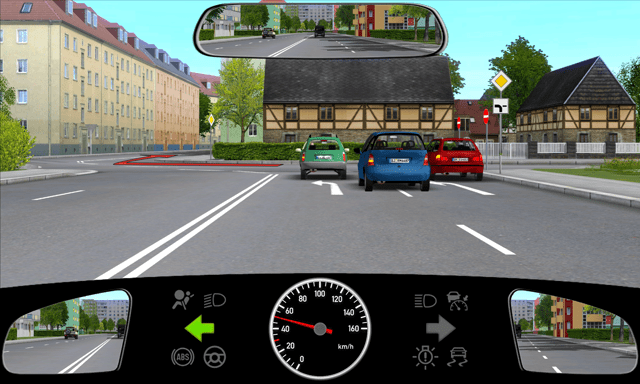
Explanation
If you want to turn right again immediately after turning left, you get in proper lane on the right, if there are two lanes for turning left. Otherwise, keep as far to the right as possible. This is the only way you can turn right after a left turn without hindering other road users.
-
Question 11 of 34
Who must signal a change of direction here?
1.2.09-1073 Points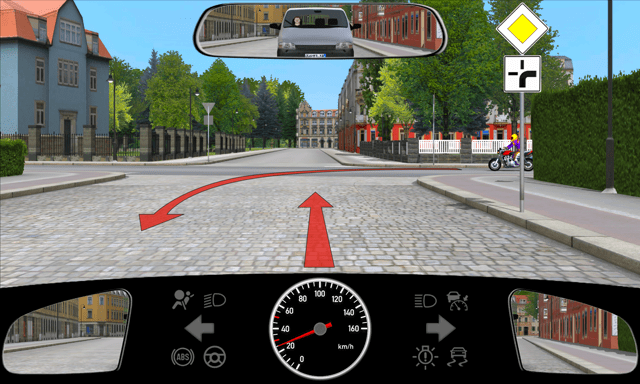
-
Question 12 of 34
You are on a roundabout. What should you remember?
1.2.09-1093 PointsExplanation
In a roundabout you may only stop if this is unavoidable due to traffic, for example due to a traffic jam. Indicate when leaving the roundabout. You can only drive over paved or asphalted central islands if it is unavoidable due to the size of the vehicle. Always give priority to cyclists traveling on your right side and remaining in the roundabout.
-
Question 13 of 34
In what situation is it especially dangerous to perform a turn?
1.2.09-1114 PointsExplanation
When turning in poor visibility (fog), dangerous situations can arise. The same applies when turning in curves and before crests.
-
Question 14 of 34
Who is required to indicate?
1.2.09-1123 Points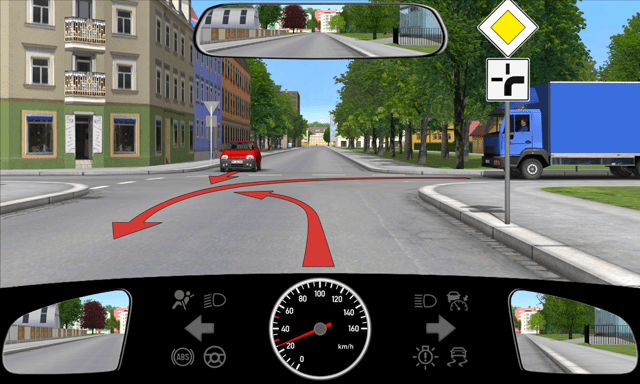
Explanation
Changing the direction of travel must always be indicated by pressing the indicator. If you stay on a turning priority road you should also indicate that. Therefore, the blue truck must indicate. You, who's turning left, must also indicate.
-
Question 15 of 34
Who is required to indicate a change of driving direction here?
1.2.09-1133 Points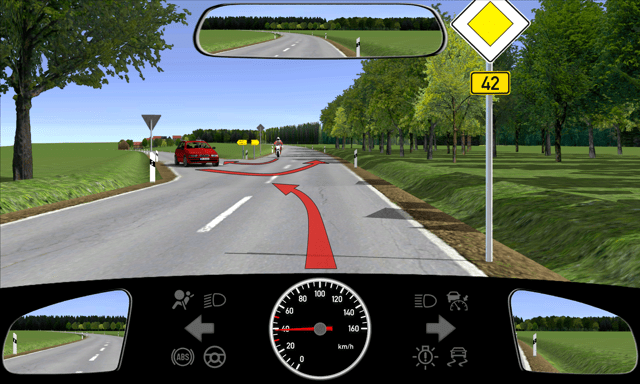
Explanation
The change of the direction of travel must always be indicated early enough. All three drivers intend to turn. Therefore, all three vehicles must indicate.
-
Question 16 of 34
When do have you to indicate a change in direction?
1.2.09-1174 PointsExplanation
If you want to turn into a T-junction or a property, you have to indicate. The same applies if you follow a turning priority road - here, too, the change of the direction of travel must be indicated.
-
Question 17 of 34
Why are you required to stop now?
1.2.09-1194 PointsExplanation
Drivers who turn need to wait for vehicles from the opposite direction, even for cyclists. The red car has to wait until the green car and the cyclist are gone.
-
Question 18 of 34
You want to turn left. In what sequence do you prepare to take the left turn?
1.2.09-1204 PointsExplanation
If you want to turn left, prepare the turn in the following order: 1. look, 2. indicate, 3. arrange. Looking means that you are observing follow-up traffic in the mirror and over your shoulder. Then press the indicator to the left side. Only if you can rule out danger for other road users, you may merge left in order to turn.
-
Question 19 of 34
What is the right course of action?
1.2.09-1215 Points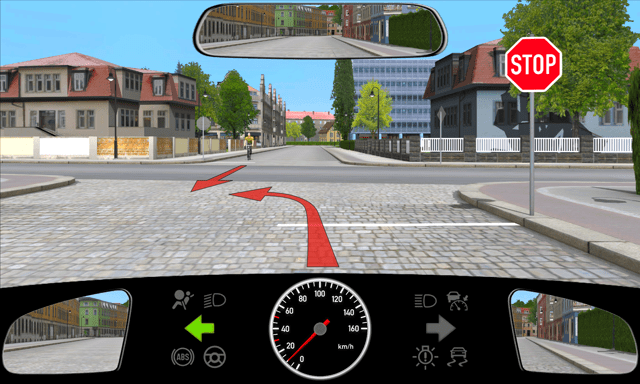
Explanation
In front of the traffic sign "Stop! Give way!", colloquially also called stop sign, you must always stop. Mostly there is a stop line. The wheels must be stationary for at least a short amount of time. The cross traffic has right of way - then the cyclists on the opposite side. As a driver turning left, you have to grant him the right of way.
-
Question 20 of 34
You want to turn left. To whom must you give priority?
1.2.09-1234 PointsExplanation
The oncoming traffic when turning left, has always right of way. This also applies to cyclists; they are granted priority. If pedestrians cross the street you want to turn into, the pedestrians have priority too.
-
Question 21 of 34
You want to turn left. What difficulties could arise here?
1.2.09-1243 PointsExplanation
When turning left, vehicles approaching each other have to turn in front of each other (tangent turning). This can lead to poor visibility of the straight-ahead traffic. Especially left-turning trucks can lead to massive obstructions and make it safer to turn in a wide arc (turning behind each other). There may be misunderstandings between drivers when one wants to turn behind and the other in front.
-
Question 22 of 34
Why are you required to stop now?
1.2.09-1254 PointsExplanation
You are on a priority road and therefore you're allowed to drive before the white car coming from the right. However, as a driver who wants to turn, you have a subordinate position to traffic driving straight-ahead, in this case the tram. You have to stop.
-
Question 23 of 34
What is the right course of action here?
1.2.09-1264 PointsExplanation
You must not overtake the moped before the level crossing. In general, no vehicles may be overtaken at level crossings from signs 151, 156 to the rails.
-
Question 24 of 34
Why are you required to brake now?
1.2.09-1275 PointsExplanation
The motorcyclist comes from the left at high speed. He probably did not see you because of the oncoming vehicle. Although you have the right of way, you have to slow down, as otherwise an accident will occur.
-
Question 25 of 34
Why do you have to wait before turning right?
1.2.09-1285 PointsExplanation
If you want to turn, you must give priority to road users traveling straight ahead. In this case, you have lower priority to the pedestrian and the cyclist and must allow them a safe crossing.
-
Question 26 of 34
What must you be aware of here?
1.2.09-1293 PointsExplanation
Since the blue car is already in the roundabout, you have to slow down. Only when leaving the roundabout, you must indicate.
-
Question 27 of 34
[The cyclist] wants to continue straight ahead. What is the right course of action here?
1.2.09-1314 Points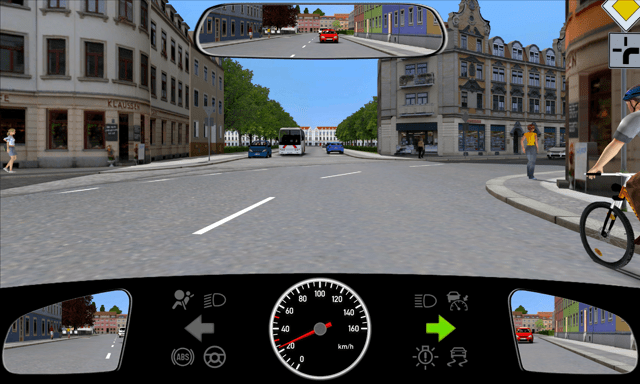
Explanation
Vehicles that want to turn need to let bicycles pass that drive in their direction on or next to the road, before turning. It does not matter if their wheels are motorized or not.
-
Question 28 of 34
Why must you wait before taking a turn in this situation?
1.2.09-1325 PointsExplanation
Because of the truck and the motorcycle. Here you have to pay attention to the turning rules. Wait for the vehicles to complete the maneuver and then continue turning.
-
Question 29 of 34
Who has to indicate in this situation?
1.2.09-1333 Points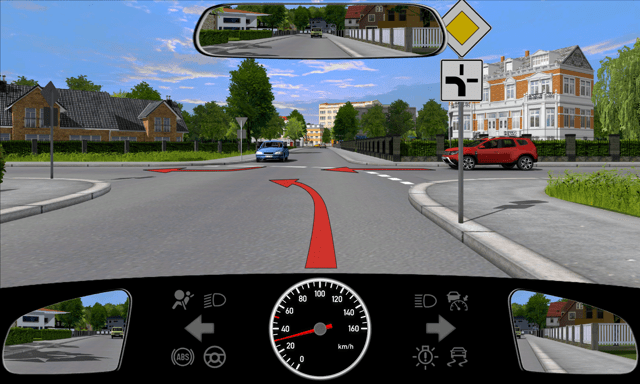
Explanation
You and the blue car are changing direction for this reason you must indicate the change of direction.
-
Question 30 of 34
What is the right course of action now?
1.2.09-1344 PointsExplanation
The motorbike behind you has already changed to the left lane and will overtake you on the left. In order to merge into the left-turning lane in time, you must slow down.
-
Question 31 of 34
Why are you not allowed to take the turn now?
1.2.09-1355 PointsExplanation
At an intersection, drivers going straight ahead have the right of way. You must wait to turn until the yellow car has crossed the intersection.
-
Question 32 of 34
What must you anticipate in this situation?
1.2.09-1365 PointsExplanation
The blue car drives past the stopping bus and may want to continue straight on, even though it is in the turning lane. Since you turn left, he has right of way.
-
Question 33 of 34
Why are you required to stop now?
1.2.09-1375 PointsExplanation
There is an electric scooter in the blind spot, so you must stop to avoid endangering it.
-
Question 34 of 34
What is the right course of action now?
1.2.09-1384 PointsExplanation
The straight ahead traffic always has priority, whether the cyclist is riding on the road or on a cycle path. To make sure that no other cyclist is approaching, you must look over your shoulder to the right.