
1.1.02 Behavior towards pedestrians
Pedestrians are the most vulnerable participants in road traffic. As a driver, you must always anticipate their behavior, especially children and elderly people who may not follow the rules strictly. Defensive driving and partner-like behavior are key.
verified Core Exam Principles
Defensive Driving
Always drive with the expectation that pedestrians might make mistakes. Reduce your speed in areas with heavy foot traffic or limited visibility.
Partner-like Behavior
Do not insist on your right of way if a pedestrian is already on the road or clearly confused. Prioritize safety over strict rule adherence.
child_care Children in Traffic
High RiskCorrect Behavior
- check Reduce speed significantly when seeing children playing near the road.
- check Be ready to brake immediately; reaction distance matters.
- check Maintain a safe lateral distance when passing.
Wrong Ideas
- close Assuming children will stop at the curb and look both ways.
- close Honking to warn children (this may startle them into running onto the road).
- close Accelerating to pass them quickly.
Exam Note
In exam questions, if you see a ball rolling onto the street, ALWAYS assume a child will run after it immediately without looking. The correct answer is always to brake.
horizontal_rule Zebra Crossings (Pedestrian Crossings)

Approaching a Zebra Crossing
Key Rule: Moderate speed and readiness to brake.
Approaching
Approach at moderate speed. If a pedestrian is waiting or stepping onto the crossing, you must stop.
No Overtaking
Overtaking on a zebra crossing is strictly prohibited to ensure visibility of pedestrians.
Stopping
Do not stop or park directly on the crossing or up to 5 meters before it.
Traffic Jams
Keep the crossing clear if traffic is backed up. Do not block the path for pedestrians.
directions_bus Buses, Trams & Stops
1
Bus approaching a stop with hazard lights ON
expand_more
You must NOT overtake the bus while it is moving. Stay behind until it stops. This indicates a dangerous situation where children might be crossing.
2
Bus stationary at stop with hazard lights ON
expand_more
You may pass the bus at walking pace (4-7 km/h). This applies to traffic in BOTH directions (unless there is a physical barrier like a median). You must be able to stop immediately if a passenger steps onto the road.
3
Passing Trams
expand_more
Normally, pass trams on the right. If passengers are boarding or alighting and there is no safety island, you must stop and wait until the way is clear. Drive carefully past stopped trams.
warning Typical Exam Traps
The "Waving" Trap
Scenario: A pedestrian is waiting to cross but hesitates. You stop.
Trap Answer: "I wave my hand to signal the pedestrian to cross."
Incorrect! Do not wave. You might signal them into danger (e.g., a car overtaking you). Just wait patiently.
Parked Vehicles & Limited Visibility
Scenario: Driving down a narrow street with cars parked on both sides.
Exam Focus: You must anticipate pedestrians stepping out from behind vehicles. The correct behavior is always to reduce speed and keep a large lateral distance if possible.
Practice Questions (33)
-
Question 1 of 33
What conduct must you expect of children at zebra crossings?
1.1.02-0055 PointsExplanation
Children generally do not have the necessary training to always behave according to the rules in road traffic. Therefore, it is quite conceivable that they do not know the meaning of a zebra crossing and enter the road despite approaching vehicles or suddenly run back after crossing.
-
Question 2 of 33
What do you have to reckon with when children are waiting at traffic lights?
1.1.02-0224 PointsExplanation
Due to a lack of life experience as well as insufficient education, children do not always behave according to the rules in road traffic and, for example, get into the lane during a scuffle. Furthermore, you must expect children to suddenly run across the road, even if the traffic lights are still red or the lights of the cross-traffic are just changing.
-
Question 3 of 33
What do you have to reckon with when elderly persons using walking frames cross the road?
1.1.02-0274 PointsExplanation
When elderly people with walking aids cross the road, you have a higher duty of care. The principle of trust is suspended. You must expect these people to stop suddenly or turn around unexpectedly. Older people also take a comparatively long time to cross the road.
-
Question 4 of 33
A person in a wheelchair is travelling along the road although there is a pavement on the right. What do you do?
1.1.02-0284 PointsExplanation
Disabled and elderly people sometimes do not behave in a roadworthy manner due to physical limitations. Therefore, please be especially careful and be sure to show consideration. Expect the wheelchair user to suddenly and unexpectedly swerve and drive even further into the lane. In such situations, it is not permitted to use the horn or drive around the person at high speed.
-
Question 5 of 33
Having crossed the road, a person in a wheelchair cannot get up the curb and onto the pavement. What do you do?
1.1.02-0294 PointsExplanation
You should help the person. To do this, you may stop and switch on the hazard warning lights to warn other road users of possible dangers. It is not permitted to honk your horn and drive around the person in this situation. This would frighten and unsettle the wheelchair user.
-
Question 6 of 33
Who has a severe visual handicap?
1.1.02-0324 Points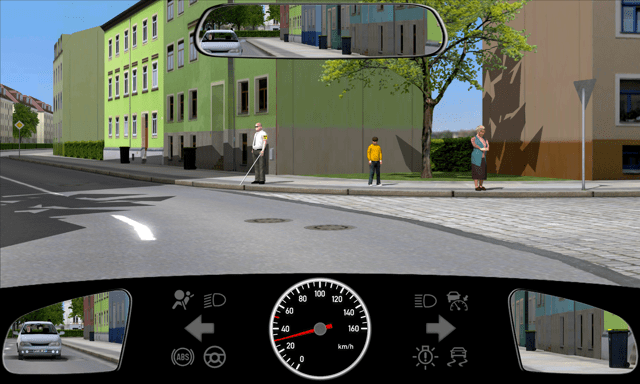
Explanation
You must expect a severe visual impairment in the case of persons with the following markings: If a person is wearing a yellow armband with three black dots and/or a white blind person's cane extended diagonally.
-
Question 7 of 33
How do you behave?
1.1.02-0394 Points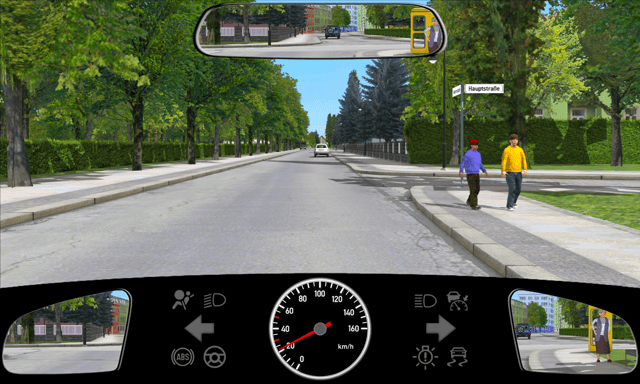
Explanation
Reduce speed and watch the two children very closely. Be careful and ready to brake. Stop if the children's behaviour makes this necessary.
-
Question 8 of 33
What risks must you be aware of?
1.1.02-0415 Points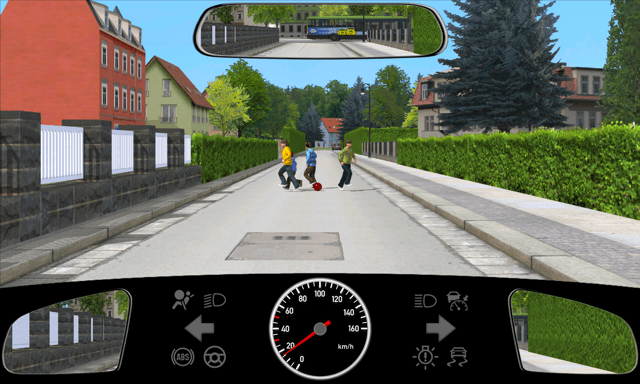
Explanation
If a ball is lying on the road, it can be assumed that a child will come and fetch it. For you as a driver, this means: stop immediately so that the child can fetch the ball safely. With children, you have to expect that they will behave in a way that is contrary to traffic regulations and that they will not be able to assess dangers correctly.
-
Question 9 of 33
How should you behave?
1.1.02-0425 Points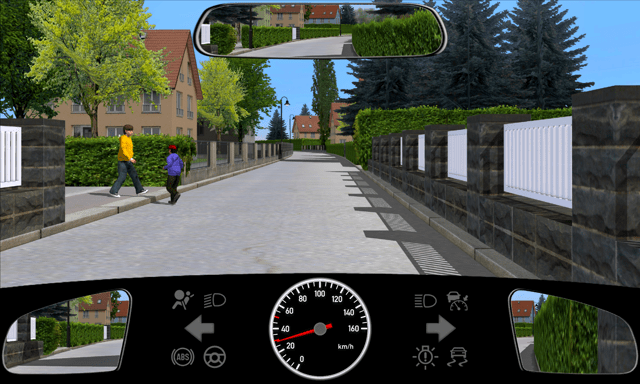
Explanation
The rule here is: reduce speed immediately, be ready to brake and drive slowly past the situation. It can be assumed that children who are playing are not paying attention to the traffic and are not behaving in a way that is appropriate for the traffic.
-
Question 10 of 33
How must you behave?
1.1.02-0435 Points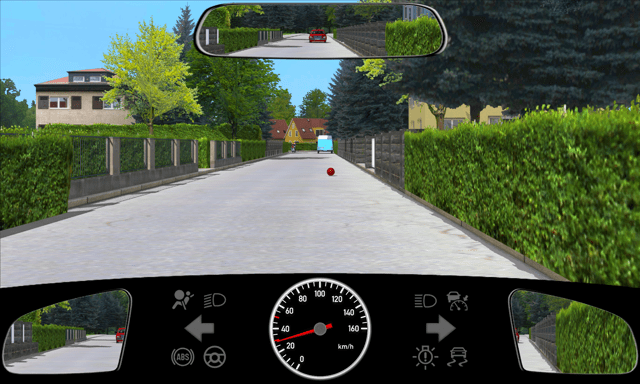
Explanation
Most likely, a child will come running into the road after the ball without paying attention to the traffic. Immediately slow your vehicle down to walking speed. Be especially alert and ready to brake!
-
Question 11 of 33
What should you do now?
1.1.02-0485 Points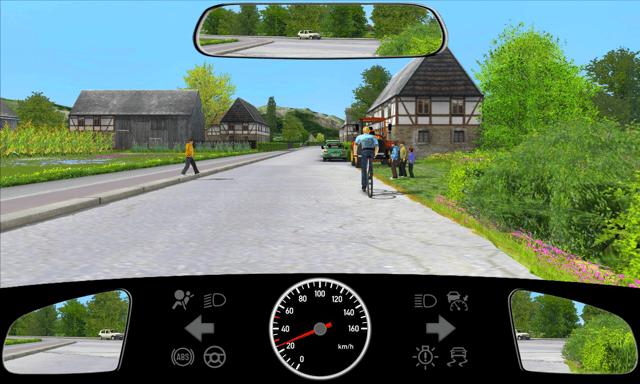
Explanation
Since there are children both on the left and right on the street, you should brake to walking pace and remain ready to brake.
-
Question 12 of 33
Why must you drive slowly here and be ready to brake?
1.1.02-0505 PointsExplanation
The child behind the van on the left runs towards the roadway. You cannot see whether it will stop. Therefore, be especially attentive and careful in this unclear traffic situation. Drive slowly and be ready to brake.
-
Question 13 of 33
What is the correct course of action in this situation?
1.1.02-0514 Points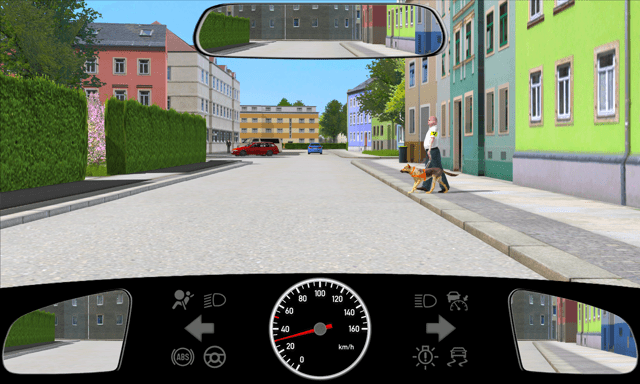
Explanation
The man is wearing a yellow armband and has a guide dog with him. He is blind or visually impaired and cannot see the traffic situation. Special care must be taken for blind people. Therefore, you must let him cross the road in front of you.
-
Question 14 of 33
Why must you anticipate that children might behave unpredictably in road traffic situations?
1.1.02-0524 PointsExplanation
Children often behave unpredictably, which is why other road users always have to count on the unexpected. Due to external stimuli in the environment, small children are constantly distracted from the road and traffic. They continuously let their eyes hike in the area and get stuck with interesting events or objects. The noise perception also only develops in the course of life and is only available to a limited extent in children. That is why children can usually not assign the many noises in road traffic to a certain direction and it is more difficult for them to assess them purely acoustically from which direction a vehicle approaches. In addition to the perception of the direction, the perception of distances, speeds and braking distance in childhood is not yet fully pronounced. Therefore, children can often only overlook the traffic situation incompletely.
-
Question 15 of 33
What must you heed in this situation?
1.1.02-1084 Points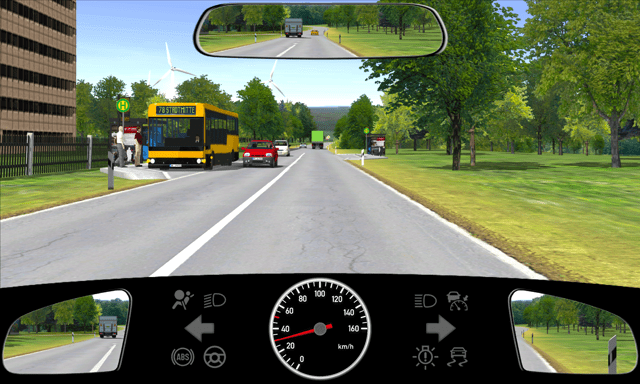
Explanation
When public transport and school buses are at a stop and their hazard warning lights are switched on, the following applies: Vehicles may only pass them at walking speed and at a sufficient distance. This applies to oncoming traffic as well as to vehicles travelling in the same direction as the bus. Any danger to passengers must be ruled out by you as the driver of the vehicle.
-
Question 16 of 33
The tram has just become stationary at the stop. What is the right course of action?
1.1.02-1164 Points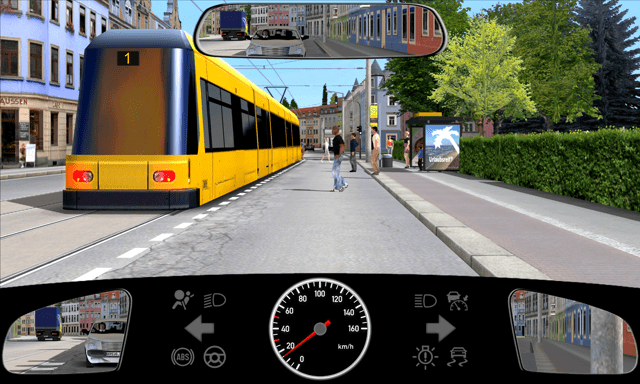
Explanation
You may carefully pass a stopping tram at walking speed - but only if this does not endanger or obstruct any passengers.
-
Question 17 of 33
What should you do?
1.1.02-1195 Points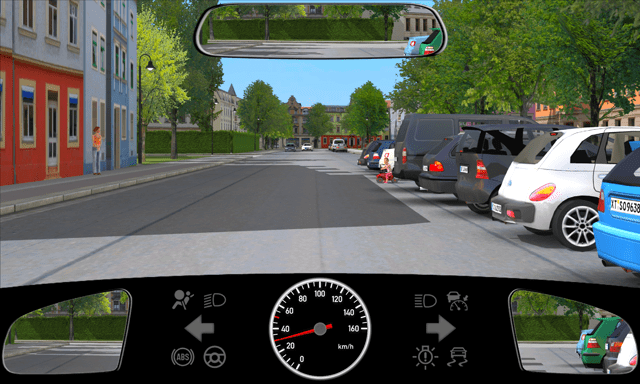
Explanation
Special caution is always required towards children in road traffic. In this situation, you must expect that the small child will continue to drive onto the road behind the van. Slow down to walking speed and remain alert and ready to brake at all times. Stop if necessary if you are not sure how the child will behave. It would be grossly negligent to just honk your horn and drive on.
-
Question 18 of 33
What should you do?
1.1.02-1214 Points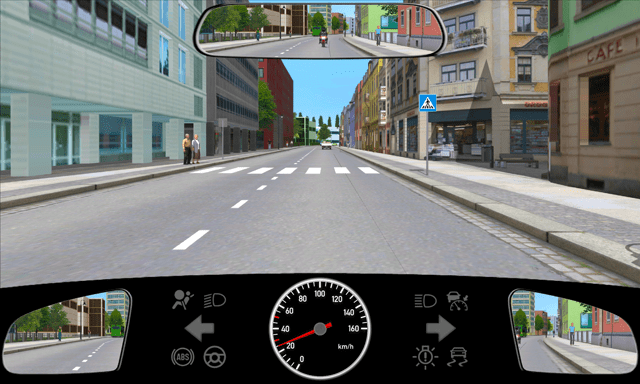
Explanation
When pedestrians wait at a zebra crossing to cross the road, they have priority. This also applies if they are on the left-hand side of the road. You should therefore brake in good time. Pedestrians must be able to see that you are complying with your obligation to stop. Even if the pedestrians stop first and wait, you must give them the right of way in a clearly visible manner.
-
Question 19 of 33
What actions should you anticipate at such stops?
1.1.02-1224 Points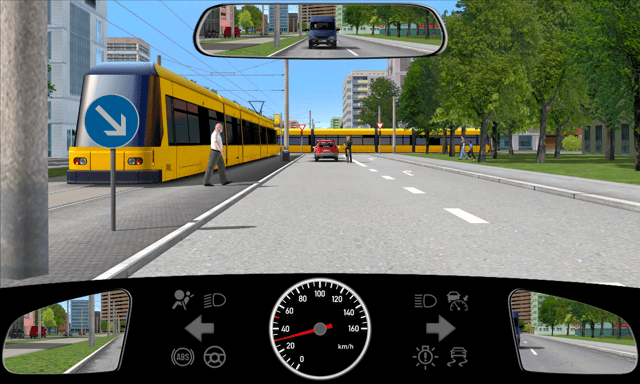
Explanation
Pedestrians are required to wait at such traffic islands. You are therefore allowed to pass the tram even if the tram doors are still open. But because people often behave carelessly when getting on and off the tram, dangerous situations arise time and again. For example, without paying attention to the traffic, passengers simply run across the carriageway to reach the tram.
-
Question 20 of 33
You want to turn right. What must you be prepared for?
1.1.02-1234 Points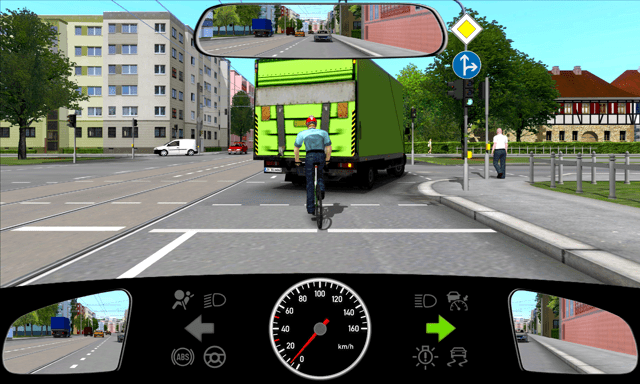
Explanation
If you want to turn right, road users travelling in a straight line here have priority. These may be pedestrians or cyclists who want to cross the road. If a truck turns right in front of you, it is also possible that a pedestrian will let it pass. In that case, the lorry would block your view of the other side of the road and thus of the road users travelling from there.
-
Question 21 of 33
What must you be prepared for?
1.1.02-1244 Points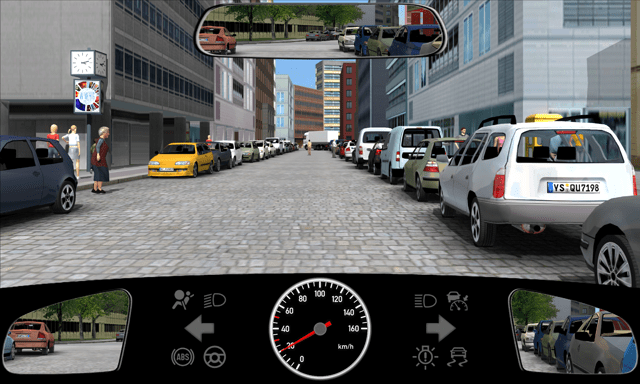
Explanation
Where there are many parked cars, you should always drive carefully and considerately. On the one hand, your view is obstructed by the parked vehicles. Secondly, you must always be aware that car doors may be carelessly opened. Other road users may also want to cross the lane between the parked cars.
-
Question 22 of 33
What should you anticipate?
1.1.02-1254 Points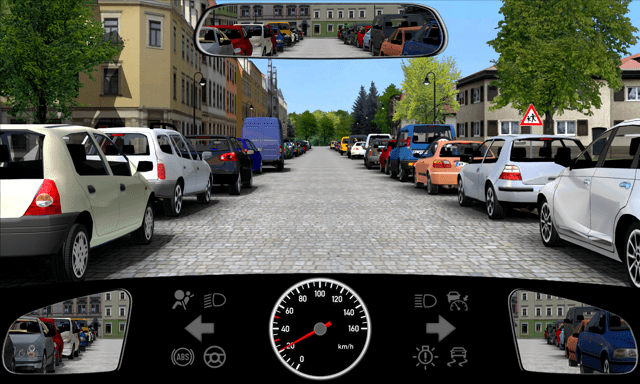
Explanation
The "Children" danger sign on the right makes it clear that increased attention and a special degree of caution are necessary at this point. In addition to children, adults can of course also suddenly step onto the roadway between parked vehicles here, requiring heavy braking.
-
Question 23 of 33
Why are older pedestrians at more risk than younger ones from road traffic?
1.1.02-1264 PointsExplanation
Older road users see less well, hear less well, react more slowly and misjudge the speed of vehicles. Be prepared for these people to recognise dangers too late and react too late or not at all.
-
Question 24 of 33
What actions should you anticipate from persons at the pedestrian crossing?
1.1.02-1284 PointsExplanation
Zebra crossings have a protective function for pedestrians. They give them priority over other road users. Some pedestrians thoughtlessly trust this protection and cross the roadway without paying attention to the traffic. At zebra crossings, be aware that pedestrians and especially elderly or vulnerable people may enter the roadway without looking left and right. It is also possible that pedestrians will turn halfway around when the traffic lights turn red.
-
Question 25 of 33
A pedestrian with a white stick wants to cross the road in front of you. What should you do?
1.1.02-1294 PointsExplanation
The white cane shows you that this road user is blind or at least severely visually impaired. The stick is also the sign that the person is allowed to participate in road traffic without an escort. You must always treat blind and visually impaired people with increased consideration. Reduce your speed and stop if necessary. Do not honk: you would frighten and unsettle the person.
-
Question 26 of 33
What should you anticipate?
1.1.02-1304 Points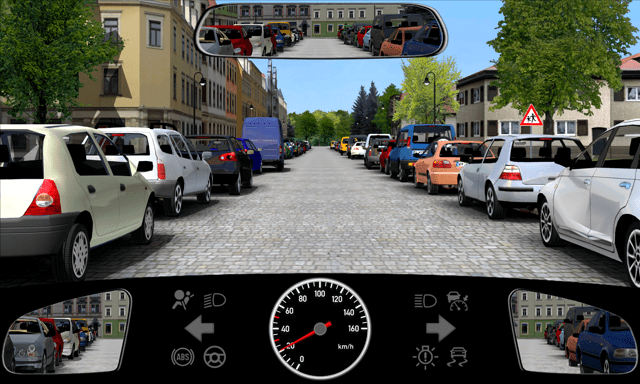
Explanation
The "Children" danger sign on the right warns you to take extra care. With many parked vehicles, however, you must always assume that people will step onto the carriageway unexpectedly. Of course, in addition to children, adults can also fail to behave in a roadworthy manner and suddenly appear between the vehicles.
-
Question 27 of 33
What should you anticipate?
1.1.02-1313 Points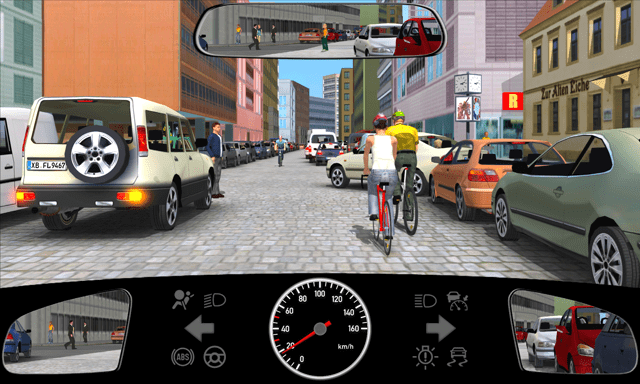
Explanation
In a traffic situation with several parked vehicles and different road users, the parked vehicles impair your visibility. Pedestrians can be expected to emerge between cars to cross the road. It is also possible for people to get out of vehicles or for vehicles to drive off without paying attention to the current traffic situation.
-
Question 28 of 33
What is your assessment of this situation?
1.1.02-1324 Points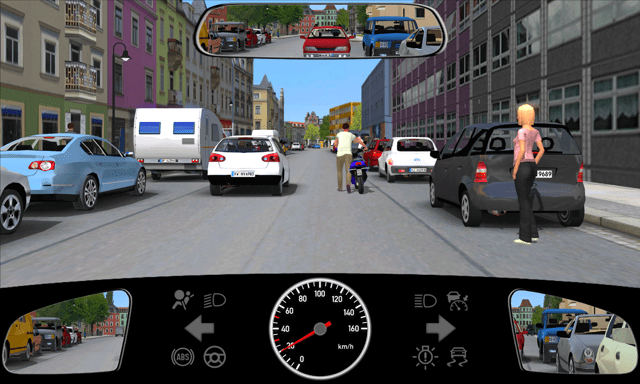
Explanation
You should only pass the waiting pedestrian at the side of the road with an appropriate safe distance and very carefully. The same applies to a moped rider who is properly pushing his moped on the right-hand side of the road. If necessary, you can also change to the left lane.
-
Question 29 of 33
A person at the side of the road is wearing a yellow armband with three black spots. What does this armband indicate?
1.1.02-1334 PointsExplanation
If you see a person at the side of the road wearing a yellow armband with three black dots, this means for you: the principle of trust has been suspended. You now have an increased duty of care. This is because the armband indicates a physical limitation in the form of a severe visual impairment. If visually impaired persons wear this armband and/or a white stick, they are allowed to move in traffic without an escort.
-
Question 30 of 33
What should you anticipate when pedestrians are crossing the road?
1.1.02-1354 PointsExplanation
When a pedestrian crosses the roadway, it is not certain that he will continue this action to the opposite side of the road. It is also quite possible that he will stop, turn around or continue with a delay.
-
Question 31 of 33
Why must you drive slowly now, and be ready to brake?
1.1.02-1365 PointsExplanation
You must drive slowly and be ready to brake because passengers can cross the road in front of the bus.
-
Question 32 of 33
Why are you required to brake here?
1.1.02-1375 PointsExplanation
A child is behind the parked vehicle and will probably cross the road in the next moment.
-
Question 33 of 33
What is the right course of action now?
1.1.02-1384 PointsExplanation
Since the dog, most likely, will run onto the street from the left, you have to reduce your speed and prepare for a braking for danger.