
1.1.04 Darkness and poor visibility
Light → Dark Transitions
The human eye requires significantly more time to adapt from bright light to darkness than vice versa. This phenomenon is called dark adaptation.
mode Tunnel Entries
When entering a tunnel on a sunny day, you are effectively driving "blind" for the first few seconds. Reduce speed before entering.
garage_home Underground Car Parks
Pedestrians in dark clothing are nearly invisible immediately after entry. Turn on low beams (Abblendlicht) immediately.
Core Exam Principle
Your eyes are the limiting factor.
You must adjust your speed so that you can stop within the distance you can see. If visibility is 50 meters, your stopping distance cannot exceed 50 meters.
Glare & Dazzling
Sources of Glare
- light Oncoming Traffic: High beams from other cars or misaligned headlights.
- water_drop Wet Roads: Water reflects light from street lamps and oncoming cars, doubling the glare effect.
- dirty_lens Dirty Windshield: Dirt scatters light, turning small points of light into blinding sheets of glare.
Correct Behavior
Look towards the right edge of the road (guideline/marker) instead of the oncoming lights.
Reduce speed immediately if dazzled.
Do not switch on your own high beams "to see better" (this blinds the other driver too).
Environmental Traps
Neon Signs & Advertising
Brightly colored advertisements can overpower traffic lights or be mistaken for them. A red neon sign might mask a red traffic light.
Tree Avenues (Alleen)
Driving through tree avenues on sunny days creates a strobe-like effect (flickering). This tires the eyes quickly and makes estimating speed of oncoming traffic difficult.
Typical Exam Traps
Never accelerate when visibility decreases. This is a guaranteed failure in the exam.
In the dark, an intersection might look like a continuous priority road because side streets are unlit. Always verify priority signs if you cannot see the side road clearly.
Using high beams in fog creates a "white wall" effect due to reflection. Use low beams or fog lights instead.
Practice Questions (5)
-
Question 1 of 5
What must you do in this situation when you are dazzled?
1.1.04-1034 Points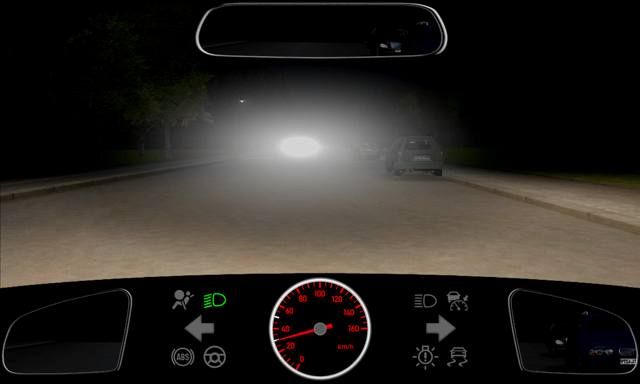
Explanation
If you are dazzled by a high beam or incorrectly adjusted headlights, do not look into the cone of light but to the right edge of the road. As a precaution, reduce your speed so that you can still brake in time for pedestrians or cyclists.
-
Question 2 of 5
What must you be aware of here?
1.1.04-1074 Points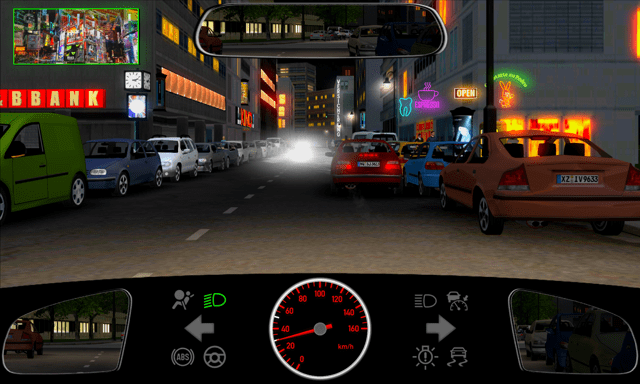
Explanation
The numerous neon signs distract from traffic and in particular from traffic lights. Due to the distraction other road users might see you too late and you might not see them in time as well. Hazardous situations can arise. Other road users might behave incorrectly because they do not recognize the traffic signs or recognize them when it's too late. Drive carefully and at an appropriate speed.
-
Question 3 of 5
Why might driving along this road become dangerous?
1.1.04-1084 Points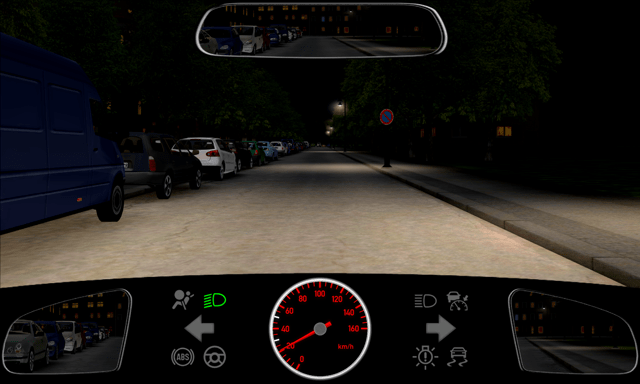
Explanation
If you are on a lighted roadway with dark sections, you must pay particular attention to pedestrians who might cross the road. Parked vehicles in the aforementioned dark sections are also often not seen in time. Therefore, drive slowly and carefully. Oncoming vehicles, on the other hand, are usually easy to spot.
-
Question 4 of 5
What must you watch out for when you drive into an underground car park?
1.1.04-1104 PointsExplanation
When entering an underground car park, drivers are bothered by the change from daylight to moderate lighting in the interior. The pupils do not respond quickly enough to the lighting condition changes and therefore might not be able to detect obstacles or people in time. In addition, the entrances and exits are narrow and confusing. Drive slowly, with low beam and always ready for braking in an underground car park.
-
Question 5 of 5
What should you do in this kind of visibility?
1.1.04-1113 Points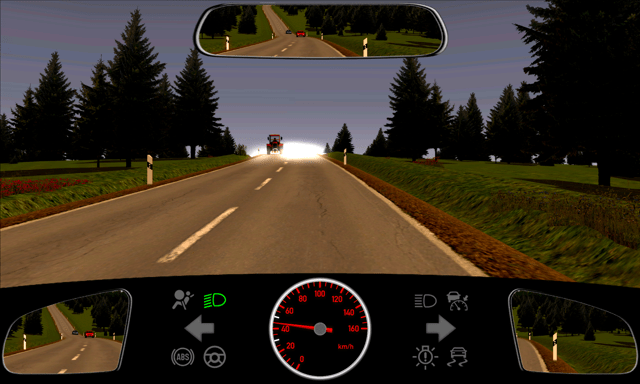
Explanation
In poor visibility conditions, you must first reduce your speed. If you are blinded by an oncoming vehicle, you should look to the right-hand side of the road so that you do not leave the road. You must not switch on your high beams here.