
2.5.01 Environmental protection
Drive smoothly, avoid unnecessary noise, reduce fuel consumption, and use your vehicle responsibly to protect the environment. Eco-friendly driving saves fuel, lowers emissions, reduces wear, and improves road safety.
🔊 Avoid Noise Pollution
- Avoid high engine revolutions.
- Do not modify intake or exhaust systems.
- Drive in high gears at low RPM.
- Avoid racing starts and squealing tires.
- Turn off the engine during long waits.
- Do not “play” with the gas pedal while standing.
- Honking is only acceptable to avoid danger.
- Too loud music reduces concentration and reaction time.
Easy Memory Tip:
Quiet driving = eco driving.
⛽ Save Fuel
- Shift early into higher gears.
- Drive smoothly and avoid hard acceleration.
- Use Eco Mode if available.
- Avoid kick-down unless necessary.
- Turn off air conditioning when possible.
- Remove roof racks when not needed.
- Keep correct tire pressure.
- Do not warm up the engine while standing.
Remember:
Fast driving = much higher fuel consumption.
🛞 Tire Protection
- Use winter tires only in winter.
- Low tire pressure increases wear.
- Fast starts damage tires quickly.
- Correct tire use lowers fuel consumption.
- Greater speed = greater air resistance.
Important Formula:
Double speed = 4× air resistance.
🌍 Environmental Zones
- You need a valid emission sticker.
- The sticker must be visible on the windshield.
- Motorcycles are generally exempt.
- Historic and special vehicles may be exempt.
- Without a valid badge, entry is forbidden.
Quick Tip:
Always check the environmental zone sign before entering.
🚗 Eco-Friendly Driving Habits
Before Driving
- Plan trips carefully.
- Avoid unnecessary trips.
- Use carpools or public transport.
- Store luggage in the trunk.
While Driving
- Drive with foresight.
- Brake gently and early.
- Maintain low engine speed.
- Use engine braking downhill.
Electric Vehicles
- Recuperation recovers energy.
- Start-stop systems reduce emissions.
- Electric driving lowers pollution.
- Charging regularly improves efficiency.
📚 Important Exam Facts
| Topic | Key Fact |
|---|---|
| 160 km/h | Fuel consumption may increase up to 35% |
| Start-Stop System | Can save up to 15% fuel |
| Cold Engine | Consumes more fuel and causes more wear |
| Roof Rack | Increases aerodynamic drag and fuel use |
| Eco Driving | Gentle acceleration and early braking save energy |
Practice Questions (27)
-
Question 1 of 27
Why should you avoid driving off at a rapid pace?
2.5.01-0073 PointsExplanation
Making a racing start is an additional noise pollution for other road users. You as a car driver damage your vehicle as well as the tires due to high wear and abrasion with a racing start. The environment is additionally burdened. On the other hand, the rear-wheel brake is no longer and not any less loaded when starting.
-
Question 2 of 27
What is caused by driving with winter tyres during the summer months?
2.5.01-0113 PointsExplanation
Every car driver should know that winter tires are designed for use in cold and snowy streets. By using them in summer months, the driving stability decreases. Greater rubber abrasion and tire wear lead to increased fuel consumption.
-
Question 3 of 27
What motor vehicles may enter an environment zone that has this sign?
2.5.01-0123 Points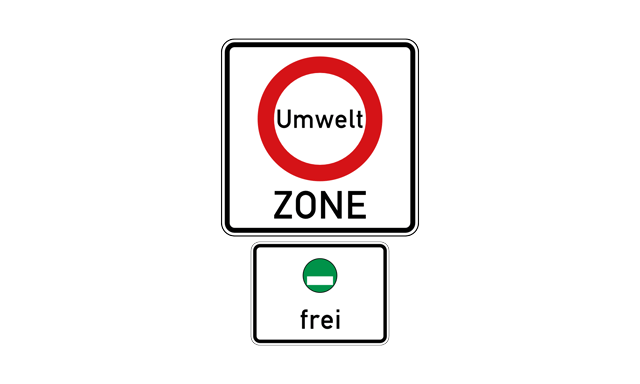
Explanation
The additional sign shows which motor vehicles with which sticker may enter. Motorbikes may enter in any case.
-
Question 4 of 27
You want to wash your car. Where should you do this in the interests of environmental protection?
2.5.01-0133 PointsExplanation
You should always wash your vehicle in a car wash. There, the wastewater is disposed of by the operators in an environmentally friendly manner. On the other hand, if you wash your vehicle on the road or in a parking lot, the water gets into the ground untreated.
-
Question 5 of 27
What increases the fuel consumption of your vehicle considerably?
2.5.01-0143 PointsExplanation
Turning on the seat heating or air conditioning of your vehicle consumes a lot of energy and increases the fuel consumption of your car significantly. Navigation devices require relatively little power compared to these devices.
-
Question 6 of 27
What are the effects of driving at high speed in motor vehicles with combustion engines?
2.5.01-0163 PointsExplanation
Be aware that fast, high-speed driving results in high fuel consumption and high exhaust emissions. This also leads to more noise and to a not lower noise level.
-
Question 7 of 27
Why is an environmentally considerate driving style also beneficial for road safety?
2.5.01-0183 PointsExplanation
Alternative fuels can also be used to drive fast. However, you will be driving in an environmentally friendly way if you avoid high speeds, if you drive with foresight and thus avoid, for example, braking hard and starting again.
-
Question 8 of 27
What results in increased fuel consumption of your car?
2.5.01-1063 PointsExplanation
Increased fuel consumption can be expected if, for example, you install roof or ski racks or if you load your vehicle with unnecessary objects. Increased tire pressure, on the other hand, does not matter for fuel consumption, even if it should be avoided altogether.
-
Question 9 of 27
How can you save fuel?
2.5.01-1073 PointsExplanation
Additional load and additional attachments such as roof racks or ski holders increase fuel consumption: when not in use, remove them. You save fuel when driving low-speed: shift up the gear early. Turning off the air conditioning system saves fuel, as does maintaining tire pressure according to the manufacturer's specifications. Because too little tire pressure increases the rolling resistance.
-
Question 10 of 27
How can you reduce noise?
2.5.01-1113 PointsExplanation
Driving in the high-speed range causes more noise than a low-speed driving style. In built-up areas you should drive in the highest possible gear, so that the engine causes the least possible noise. Avoid a high-speed start with squeaky tires.
-
Question 11 of 27
Where do you have to place the emissions sticker for identifying lowemission vehicles?
2.5.01-1174 PointsExplanation
As a car driver, you must ensure that the carbon emission sticker is affixed to the inside of the windshield of your vehicle so that it clearly identifies your low-emission vehicle.
-
Question 12 of 27
Where can you stow your baggage so that you do not increase your fuel consumption unnecessarily?
2.5.01-1193 PointsExplanation
If possible, you should only store the luggage in the trunk of your vehicle. The use of a roof rack to carry luggage results in greatly increased aerodynamic drag, often resulting in a significant increase in fuel consumption.
-
Question 13 of 27
What can contribute to environmentally-friendly driving?
2.5.01-1213 PointsExplanation
If possible, carpool to reduce the number of vehicles on the road. Training can help you to adopt a fuel-efficient driving style. Electric vehicles do not emit any pollutants, so they are particularly environmentally friendly when driving.
-
Question 14 of 27
How can you save fuel if you drive a car with an automatic gearbox?
2.5.01-1223 PointsExplanation
Unnecessary acceleration leads to high fuel consumption. Drive in eco mode if available. The car adapts its acceleration behaviour to reduce fuel consumption.
-
Question 15 of 27
What cars that are driven within designated environmental zones must display a particulate matter sticker?
2.5.01-1233 PointsExplanation
In principle, all cars in a designated environmental zone are subject to the obligation to display a fine dust sticker. Work machines, ambulances, etc. are exempt.
-
Question 16 of 27
What can result from listening to very loud music while driving a car?
2.5.01-1243 PointsExplanation
Too loud music can cause warning signals and the like of other road users to be overheard. Too loud music can also annoy, disturb and thus endanger other road users. The driver's ability to react deteriorates due to the loud music and the resulting reduced ability to concentrate.
-
Question 17 of 27
Air resistance affects the fuel consumption of a vehicle. What affects air resistance the most?
2.5.01-1253 PointsExplanation
The faster you drive, the greater the air resistance acting on your vehicle. Doubling your speed results in 4 times the air resistance. The tread depth of the tyres has a major effect on the rolling resistance of the tyres. The number of passengers does not directly affect the air resistance.
-
Question 18 of 27
You have to wait because a rail-crossing barrier is lowered. How can you now help protect the environment at this point?
2.5.01-1263 PointsExplanation
By using the automatic start-stop system, the vehicle can be switched off while waiting and immediately switched on again with little effort. This minimises the emission of pollutants. Applying the handbrake has no effect on the vehicle's pollutant emissions.
-
Question 19 of 27
What increases the range of an electric vehicle?
2.5.01-1273 PointsExplanation
If you only brake slightly, the electric motor brakes and the kinetic energy is recovered. If you brake harder, you will be mechanically braked and the kinetic energy will not be recovered. Due to a high recuperation level, an electric car behaves like a combustion engine, so you may have to brake less strongly, i.e. mechanically. The heating in the electric car is fed directly from the battery and thus consumes energy that could also be used for driving.
-
Question 20 of 27
What is the benefit of recuperation in an electric vehicle?
2.5.01-1283 PointsExplanation
Recuperation means "recovery". Just as electrical energy was converted into kinetic energy, braking converts the kinetic energy back into electrical energy, which is then fed back into the battery. This increases the range of the electric vehicle.
-
Question 21 of 27
Your car is equipped with an automatic start-stop system. What is the environmental protection benefit from using this vehicle system?
2.5.01-1293 PointsExplanation
The automatic start-stop system automatically switches off the engine when you come to a standstill and restarts it as soon as you press one of the pedals. By switching off the engine, for example at traffic lights, the automatic start-stop system can reduce noise pollution and also save up to 15% fuel.
-
Question 22 of 27
You are driving a car with a plug-in hybrid drive system. How can you optimise fuel consumption?
2.5.01-1303 PointsExplanation
By driving proactively - with gentle acceleration and timely braking - you can reduce your vehicle's fuel consumption. The electric motor is often used in this driving style. You can also reduce fuel consumption by regularly charging the battery of your plug-in hybrid on the power grid or minimize it by driving purely electrically.
-
Question 23 of 27
When planning your journeys, how can you make them environmentally-friendlier?
2.5.01-2073 PointsExplanation
For the sake of the environment, motorists should refrain from all trips that are not absolutely necessary. Therefore, plan your trips well and make carpools as often as possible to avoid unnecessary trips. Another positive contribution to active environmental protection is the use of public transport.
-
Question 24 of 27
How do you drive down a descending gradient safely?
2.5.01-2083 PointsExplanation
On a down grade, use the engine brake by shifting down to a lower gear. This relieves the service brakes. Under no circumstances change to idle! Because idling puts the engine brake out of action, thus the service brakes could overheat. In addition, the brake booster cannot work when the ignition is switched off. This considerably lengthens the braking distance.
-
Question 25 of 27
What motor vehicles are permitted to enter an environment zone without a fine-particle badge?
2.5.01-2093 PointsExplanation
All two- and three-wheeled motor vehicles and agricultural and forestry tractors may enter an environmental zone without the carbon emission sticker. They are exempt from the restrictions of the environmental zone. The installation of a catalytic converter does not exempt you as a car driver from the obligation to obtain an environmental badge.
-
Question 26 of 27
Why are short journeys performed with a cold engine especially damaging to the environment?
2.5.01-2113 PointsExplanation
Short trips with a cold engine usually consume more fuel than driving with a motor in operating temperature. That's why they are particularly harmful to the environment. In addition, the friction is greater in short-distance driving with a cold engine. This leads to a higher material wear.
-
Question 27 of 27
What causes avoidable noise?
2.5.01-2123 PointsExplanation
All noise disturbances arising during normal operation of a vehicle are considered unavoidable. As a car driver, you should avoid any excess noise, for example, honking as a greeting or closing the doors very loudly. A roof rack will not cause you any avoidable noise.