
2.1.11 Affective-emotional behaviour in road traffic
Stay calm, drive defensively, avoid aggression, and always prioritize safety over emotions or time pressure.
😌 Stay Calm & Avoid Aggression
✔ Good Behaviour
- Keep a safe distance.
- Wait patiently for safe overtaking.
- Let aggressive drivers pass.
- Drive calmly even when annoyed.
- Expect mistakes from others.
❌ Dangerous Behaviour
- Tailgating
- Using flash lights aggressively
- Honking in anger
- Road racing
- Risky overtaking
🧠 Emotions Affect Driving
Anger, stress, fear, sadness or excitement can distract you and lead to risky driving.
If you are emotionally upset, stop somewhere safe, calm down, and continue later.
Never drive immediately after an argument or emotional situation.
😴 Fatigue & Microsleep
Signs of Fatigue
- Yawning often
- Heavy eyes
- Lane drifting
Risks
Tired drivers react slower and make more mistakes.
What To Do
Stop, rest, walk a little, and continue only when refreshed.
🚗 Safe Overtaking
Never overtake when visibility is limited (bends, unclear opposite lane).
Only overtake when it is completely safe and you can clearly see the road ahead.
Do not pressure slower vehicles with headlights or tailgating.
🧑 Young Drivers & Risks
Common Problems
- Showing off
- Driving too fast
- Overestimating skills
- Night driving accidents
Best Solution
Drive defensively and avoid unnecessary risks.
🚘 Handling Tailgaters
Stay calm and maintain your speed safely.
Move to the right lane when possible and let the aggressive driver pass.
Do NOT brake suddenly, honk aggressively, or try to “teach them a lesson.”
⚡ Speed & Time Pressure
Time pressure increases risk-taking and causes speeding.
Always obey speed limits and drive anticipatorily.
↔ Lane Changes
Frequent lane changes increase the chance of mistakes and accidents.
Changing lanes usually saves very little time.
📝 Easy Memory Rules
Practice Questions (25)
-
Question 1 of 25
Travelling on a main road after a lengthy period of time of following behind, you are finally able to overtake a very slow-moving car. What should you do?
2.1.11-0084 PointsExplanation
You should stay calm in this situation and overtake with a sufficient safety distance without endangering other road users. Harassing others by tightly cutting them should be avoided. Otherwise an accident could occur.
-
Question 2 of 25
The vehicle ahead has prevented you from overtaking for some time now. What is the right course of action?
2.1.11-0094 Points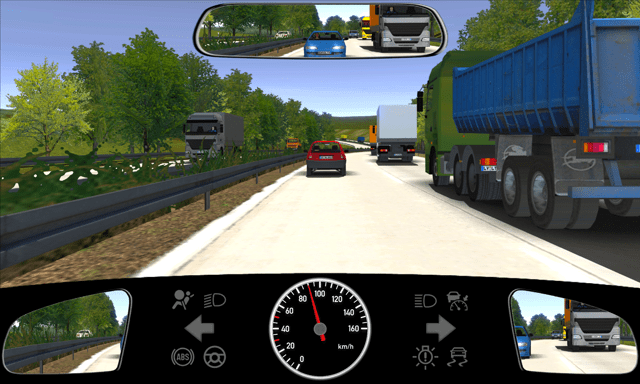
Explanation
The car driver has to wait until overtaking is possible without danger and always maintain the necessary safety distance to the vehicle in front. Stay calm, because tailgating, turning the headlights on full beam for a long time or honking is considered coercion and will be punished with fines or even a withdrawal of your driving license.
-
Question 3 of 25
What should you be aware of when driving a car after a long day's work?
2.1.11-0123 PointsExplanation
After a long day at work, you are usually not fully productive and get tired faster. That's why mistakes while driving can increase and your concentration decreases.
-
Question 4 of 25
How can you recognise a good driver?
2.1.11-0134 PointsExplanation
A good driver always takes care to act in partnership and also knows that people can make mistakes.
-
Question 5 of 25
The [red] car in front of you has been driving slowly for some time now. What is the correct course of action in this situation?
2.1.11-0144 PointsExplanation
You maintain your speed so as not to tailgate and keep the required safe distance. It is forbidden to tailgate, tailgate too closely or honk your horn in traffic. The road is clear, but you can only see as far as the next bend. The visible distance is too short for an overtaking manoeuvre.
-
Question 6 of 25
What frequently causes young people to have “disco accidents”?
2.1.11-0154 PointsExplanation
Young drivers in particular have less driving experience and a higher willingness to take risks through showing off. Dangerous situations are assessed more poorly and accidents occur more frequently. A defensive driving style can prevent accidents.
-
Question 7 of 25
Why can driving under pressure of time be dangerous?
2.1.11-0164 PointsExplanation
When you are under time pressure, you may underestimate dangers because your willingness to take risks increases and people often drive too fast. You should still drive defensively and stick to the speed limits to avoid endangering yourself and others.
-
Question 8 of 25
You are on a road outside of a built-up area, and a car in front of you is driving much slower than is permitted to and has the capacity to. What is the right course of action?
2.1.11-0174 PointsExplanation
Even if you don't like it, you must adapt your speed to that of the car and not get too close to it. Only overtake at a suitable place and not in front of it. Do not endanger yourself or others.
-
Question 9 of 25
Why is it not advisable to change lanes frequently?
2.1.11-0183 PointsExplanation
Every lane change requires certain activities: observing traffic, flashing, changing the lane yourself. In this case, other road users can be overlooked and endangered. Changing lanes often doesn't save you much time, but the more often you change lanes, the more likely you are to make mistakes.
-
Question 10 of 25
You have narrowly avoided a road traffic accident through emergency braking. Your hands and knees are shaking. What is the right course of action?
2.1.11-0193 PointsExplanation
Stop at the next opportunity and take a break until you have calmed down. Maybe you can get out, walk a few metres and take a deep breath. You should also go through the situation again in your head later, as you may realise what didn't go perfectly. That way you can adjust your driving behaviour in the future.
-
Question 11 of 25
While driving, you become very annoyed at the behaviour of another road user. What is the right course of action now?
2.1.11-0203 PointsExplanation
It is important that you are not distracted by the traffic if you are annoyed by the behaviour of other drivers, because road safety is paramount. Concentrate on the traffic and continue driving calmly; if you are emotionally agitated while driving, you could overlook dangers. If necessary, take a break and only continue driving when you have calmed down.
-
Question 12 of 25
After overtaking you, a car pulls back into lane without leaving sufficient space in front of you. What should you do?
2.1.11-1184 PointsExplanation
The car driver in the overtaking vehicle shows a misconduct that should not disturb you. Stay calm, do not honk and do not turn on the flash light. Decelerate slightly and restore the required safety distance between the vehicles.
-
Question 13 of 25
The risk of causing an accident when driving a vehicle is significantly higher for drivers aged between 18 and 24. What reasons are frequently relevant here?
2.1.11-1194 PointsExplanation
Young car drivers often have too little experience to be able to correctly assess road traffic risks. They often drive carelessly and riskily, overestimate their abilities and rely on the safety of the vehicles they control. By testing their car and their own driving skills, they sometimes get into unmanageable situations.
-
Question 14 of 25
While you are in a traffic jam, looking in your rear-view mirror you see a motorcyclist "snaking" past the stationary line of vehicles. What should you do?
2.1.11-1204 PointsExplanation
Under no circumstances should you act illegally just because another road user violates applicable rules. It is forbidden for you as a car driver to honk in this situation, to stop the motorcyclist or to let him pass.
-
Question 15 of 25
You are driving on a main road and a car following behind is "tailgating" you. How should you react?
2.1.11-1214 PointsExplanation
When driving on a highway and being harassed by the car behind you, you should keep calm and control your speed at an appropriate pace. You should avoid slow driving so as not to hinder the flow of traffic. However, you should also not be tempted to drive faster. It's best to let the pushy driver pass at the next opportunity.
-
Question 16 of 25
Five young friends are driving in a car to a recreational event. The mood is exuberant. To what risks can this give rise?
2.1.11-1234 PointsExplanation
For the car driver, there is a risk of getting carried away by the mood. He/She can be distracted by the others and overlook traffic hazards and make driving mistakes. It is recommended to set up rules of conduct for the passengers before starting the journey. So, the car driver is not a spoilsport or tempted in any way.
-
Question 17 of 25
You want to overtake. Why should you not do so?
2.1.11-1254 PointsExplanation
A car driver may only overtake if he/she can see that the opposite lane is free. In this situation, the oncoming traffic cannot be seen, so you must not overtake.
-
Question 18 of 25
You were in a bad mood prior to commencing your journey. What consequences should you avoid when driving?
2.1.11-1264 PointsExplanation
Anything that could negatively affect your safe driving should be avoided. Besides distractions, this also includes aggressiveness. If you're upset, do not get behind the wheel immediately afterwards.
-
Question 19 of 25
Which is the stamp of a responsible driver?
2.1.11-1273 PointsExplanation
A responsible car driver expects mistakes from other road users and does not sit behind the wheel while he/she is very tired or cannot control his/her feelings. Furthermore, he/she does not always insist on his right and cannot be distracted.
-
Question 20 of 25
What emotions can influence driving behaviour?
2.1.11-1284 PointsExplanation
Strong emotions such as anger, fear and sadness as well as joy and exuberance usually influence the driving behavior. They distract the car driver from the road and often lead to risky, aggressive or over-cautious driving. Only when you're calm and balanced you should participate in traffic.
-
Question 21 of 25
What indications mean you should interrupt your journey?
2.1.11-1294 PointsExplanation
Brief microsleep often causes devastating accidents. If you have to yawn frequently, can barely keep your eyes open, or have trouble keeping your lane, you should stop your journey and take a rest.
-
Question 22 of 25
Your passenger wants to discuss something with you during the journey. What should you do?
2.1.11-1304 Points -
Question 23 of 25
During the journey your passenger informs you that you are repeatedly tailgating. What should you do?
2.1.11-1314 PointsExplanation
You should take the safety advice of passengers seriously. Keep a larger distance. Within built-up areas, the distance to the vehicle in front should be at least three car lengths or approx. 15 m. Outside built-up areas, you should follow the "two-second rule of thumb".
-
Question 24 of 25
At a red light in a built-up area, another driver apparently wants to provoke you into a street race. What should you do?
2.1.11-1324 PointsExplanation
Don't be provoked and stay calm. Since road races are strictly prohibited, you should not pay attention to this behavior.
-
Question 25 of 25
What frequently causes young people to have “disco accidents”?
2.1.11-1334 PointsExplanation
Young drivers in particular have less experience driving at night with crowded vehicles. In addition, the risk of accidents increases due to distracting passengers.