
2.7.01 Driving operation, driving physics, driving technique
Learn the most important driving physics, braking techniques, cornering behavior, loading rules and safety systems for motorcycles, cars, trailers and modern vehicles.
1. Braking Basics
Golden Rules
- Use both brakes for the shortest stopping distance.
- The front brake provides more braking power.
- The rear wheel locks more easily during braking.
- ABS prevents wheel lock during emergency braking.
- Wet roads reduce brake effectiveness.
Remember
During braking, weight shifts forward. This increases grip on the front wheel and reduces grip on the rear wheel.
Easy Memory Trick:
“Front wheel grips harder, rear wheel slips easier.”
2. Curves & Centrifugal Force
Danger
- Driving too fast in curves increases centrifugal force.
- Braking hard in a curve can make the motorcycle stand upright.
- Accelerating in curves increases the turning radius.
- You may drift into oncoming traffic.
Correct Technique
- Slow down before entering the bend.
- Accelerate only near the curve exit.
- Lean more if the bend becomes tighter.
- Keep distance from the center line downhill.
Important Physics
3. Motorcycle Safety
Before Riding
- Check mirrors and brakes.
- Check tire condition and pressure.
- Check visor for scratches or damage.
- Distribute luggage evenly.
Wheelie Risks
- Sudden acceleration can lift the front wheel.
- Low gear acceleration increases risk.
- Passengers increase rear weight shift.
- Loss of steering control may occur.
Downhill Riding
- Use engine braking in low gears.
- Avoid speeding up between bends.
- Continuous braking overheats brakes.
- Higher engine RPM = stronger engine brake.
If Motorcycle Wobbles
- Reduce speed immediately.
- Disengage clutch carefully.
- Brake smoothly.
- Never accelerate.
4. Tires & Road Grip
Increase Tire Pressure When
- Driving with passengers
- Carrying heavy luggage
- Driving long distances
- Driving at high speed
Slippery Surfaces
- Wet roads
- Leaves & dirt
- Sand & gravel
- Tram tracks
- Manhole covers
Best Stability
- Correct tire pressure
- Balanced loading
- Good suspension
- Equal wheel contact with road
5. Trailers & Caravans
Effects of a Trailer
- Longer braking distance
- Slower acceleration
- More space needed in turns
- Higher skidding risk
Important Checks
- Electrical connection works
- Breakaway cable attached
- Support wheel raised
- Mirrors provide rear visibility
6. Driver Assistance Systems
| System | Function |
|---|---|
| ABS | Prevents wheel locking during braking |
| TCS | Prevents wheel spin during acceleration |
| Lane Keeping Assist | Warns or steers if leaving the lane unintentionally |
| Emergency Brake Assist | Automatically brakes in dangerous situations |
| Hill Assist | Prevents rolling backward on hills |
Important:
Assistance systems improve safety but cannot replace an attentive and capable driver.
7. Electric Vehicles
Characteristics
- Almost silent
- No direct exhaust emissions
- Need charging stations
Planning Long Trips
- Lower driving range
- Battery affected by temperature
- More charging stops needed
Recuperation
The electric motor generates electricity while braking and recharges the battery.
Quick Revision Tips
Brake BEFORE curves
Use both brakes
Lower gear = more engine braking
Speed ×2 = force ×4
Practice Questions (59)
-
Question 1 of 59
What must you take into consideration when checking tyre pressure?
2.7.01-0453 PointsExplanation
When checking tire pressure, you must also take into account the temperature and load of the vehicle. These can influence the tire pressure. By contrast, the material of the wheel rim doesn't matter.
-
Question 2 of 59
What increases the effect of centrifugal force on the vehicle when driving round bends?
2.7.01-0473 PointsExplanation
The speed has an immediate effect on the level of centrifugal force. Your braking distance quadruples when you drive at twice the speed. The centrifugal force increases the smaller the curve radius. The tire pressure has no effect on the centrifugal force.
-
Question 3 of 59
You are driving in the wet in a car with trailer on a narrow rural road and are approaching a clearly visible but tight left-hand bend. What should you do?
2.7.01-0584 PointsExplanation
Decrease your speed before the turn. Take the weather conditions into account. Keep in mind that the centrifugal force grows twice as fast as the speed. You should only accelerate again in the curve vertex.
-
Question 4 of 59
What must you be aware of when driving a quad?
2.7.01-0654 PointsExplanation
Reduce speed when turning, as quads tend to tip over due to their high centre of gravity.
-
Question 5 of 59
What should be observed when driving a quad?
2.7.01-0664 PointsExplanation
The quad has no steering assistance, so steering may be more difficult than driving a car.
-
Question 6 of 59
In bends with poor road conditions, what increases the risk of skidding?
2.7.01-0723 PointsExplanation
Ideally, all wheels should press on the road with the same force to ensure optimum grip and handling. If this is not the case, it can increase the risk of skidding in poor road conditions. The suspension, for example, has the task of keeping all tyres on the road with the same force. If the suspension is damaged, it can no longer do this. The risk of skidding also increases if the tyre pressure is incorrect or if the vehicle is incorrectly or unevenly loaded. This is because the tyres cannot apply the same force to the road and you lose grip more quickly.
-
Question 7 of 59
What changes when a caravan trailer is towed?
2.7.01-1024 PointsExplanation
If you drive with a caravan, not only does it increase the risk of skidding, the overtaking and braking distances will be longer as well. This is due to the additional load to be pulled and the pulling motion of the trailer.
-
Question 8 of 59
You are in your car towing a trailer on a road with oncoming traffic and want to turn left. What must you particularly remember when you set off again?
2.7.01-1044 PointsExplanation
With a trailer you have a lower accelerating ability, changed mass and a greater total length. This must be taken into consideration when you're starting your car again. Oncoming traffic must not be warned in this case by using the flash light.
-
Question 9 of 59
You are in your car towing a trailer which has no brakes and you approach a long steep downhill slope. What is correct?
2.7.01-1054 PointsExplanation
Reduce your speed on time. Us a gear as low as possible. The thus activated engine brake supports the braking action of the pedal braking. By no means you should put your car in idling. This would make the vehicle faster.
-
Question 10 of 59
What must you check on a car with a caravan trailer before setting out on a journey?
2.7.01-1073 PointsExplanation
Caravans restrict the view to the back. Therefore, you must check before the start of the journey, if the mirrors provide sufficient visibility to the back. You also need to make sure that the illuminating devices are working.
-
Question 11 of 59
You are in your car towing a fully loaded trailer which has no brakes. What is correct?
2.7.01-1083 PointsExplanation
Note that a fully loaded trailer without its own brake extends the braking distance and thus the stopping distance by the respective trailer load. The thinking distance does not change in this case.
-
Question 12 of 59
You want to tow a singe-axle caravan trailer behind your car. What must you check?
2.7.01-1093 PointsExplanation
The caravan reduces the view to the back. You as a car driver have to check whether the rear view through the existing mirrors is sufficient. You may need to attach extra mirrors to your car. Towing vehicle and trailer must always be coordinated.
-
Question 13 of 59
You want to set off in an automatic car (hydraulic converter). What must you know?
2.7.01-1103 PointsExplanation
If you give a "go" with an engaged gear as a car driver in a vehicle with automatic transmission it will try to start driving. This can only be prevented by operating the service brake. The selector lever can and may be operated with the engine stationary and running.
-
Question 14 of 59
What must you remember with regard to tyre pressure?
2.7.01-1113 PointsExplanation
By regularly checking the air pressure of the tires, tire damage can be avoided, but fuel can also be saved. If you put your vehicle under a greater burden, you need to adjust the tire pressure.
-
Question 15 of 59
You had a tyre failure and must mount the emergency wheel. What is prohibited when you continue to drive?
2.7.01-1123 PointsExplanation
Emergency wheels have a different design than conventional wheels and are only allowed up to a speed of 80 km/h. They have worse operating characteristics. You should only drive with them as far as necessary. Taking other people with you is allowed.
-
Question 16 of 59
What does a rear-wheel drive car tend to do if you accelerate too much on a bend?
2.7.01-1153 PointsExplanation
You should always expect your vehicle with rear wheel drive to swing off to the back if you over-accelerate on a turn. It is more likely to oversteer than understeer.
-
Question 17 of 59
What are the advantages of an anti-slip device (ASR)?
2.7.01-1183 PointsExplanation
The traction control system (TCS) of a car prevents the wheels of the vehicle from spinning, especially when accelerating faster. Slipping away to the side when starting to drive on slippery roads is thereby largely prevented.
-
Question 18 of 59
You want to couple up a trailer with ball coupling. What is correct?
2.7.01-1204 PointsExplanation
In a trailer with ball clutch, the clutch dog must firmly enclose the spherical head. The fuse must engage. Make sure the electrical connection works. The support wheel must not run while driving. It must be locked in high position.
-
Question 19 of 59
What must you do after coupling up a single-axle trailer with overrun brakes?
2.7.01-1214 PointsExplanation
The breakaway cable must be hung on the coupling device of the towing vehicle. With an overrun brake, the trailer brakes automatically when the connection to the towing vehicle breaks off. The function of the brake must be checked. The support wheel must not run while driving, so it should be brought to the upper position.
-
Question 20 of 59
What must you bear in mind when loading a single-axle trailer?
2.7.01-1223 PointsExplanation
When loading a single-axle trailer, you must ensure to comply with the total mass and that your load does not exceed the permissible axial load and bearing load.
-
Question 21 of 59
You want to park your single-axle trailer (overrun brakes, 1000 kg permissible total mass) on a slope. What must you do?
2.7.01-1233 PointsExplanation
You must always secure your trailer against possibly rolling away. To do this, you must use the parking brake and place the wheel chocks in front of the wheels. Usually such trailers have no reverse lockout.
-
Question 22 of 59
Which dangerous defects can have occurred on a trailer with overrun brakes which has been parked for some time?
2.7.01-1244 PointsExplanation
If you leave a trailer standing somewhere for a long time, the weather can cause damage: electrical connections can be damaged, rust can form on the brakes. Sun exposure does not increase the tire pressure too much, so that no dangerous defects occur.
-
Question 23 of 59
What must you remember when loading a trailer?
2.7.01-1253 PointsExplanation
Always pay attention to the proper securing of your cargo. In order not to endanger yourself and other road users, you must always have a clear view and full control over your vehicle. The cargo must be marked at the rear and may not protrude more than 50 cm at the front.
-
Question 24 of 59
Why should you not apply the clutch when driving on a long, steep downhill slope?
2.7.01-1273 PointsExplanation
If you step down the clutch, the engine brake will not work and you will have to use the service brake more. As a result, overheating and increased brake wear can occur.
-
Question 25 of 59
You suddenly have to brake when cornering on a wet carriageway. What special aspects exist with a vehicle equipped with an anti-lock braking system (ABS)?
2.7.01-1304 PointsExplanation
On wet roads, the antilocking system prevents the wheels from locking and shortens the braking distance. In addition, the vehicle remains more steerable when braking. On gravel or snow, the braking distance can certainly be much longer.
-
Question 26 of 59
What is the effect of the cornering characteristics of a combination vehicle (car towing a caravan) when taking a turn?
2.7.01-1313 PointsExplanation
Despite careful driving, it is possible that the trailer cuts the curve or even swings out. The car driver must therefore proceed with caution in order to exclude hazards to others.
-
Question 27 of 59
What can restrict the functionality of a lane departure warning system?
2.7.01-1332 PointsExplanation
The function of the lane departure warning system may be limited if the system cannot properly pick up lane signals. This is, because the computer-controlled system works on the basis of different optical systems. There are no signals from the guardrails. Another name for the lane departure warning system is: Lane Keeping Assist (active lane departure warning system with steering assistance).
-
Question 28 of 59
What information should you obtain before undertaking a journey with a purely electric vehicle?
2.7.01-1343 PointsExplanation
The car driver should inform himself about the range of the electric vehicle before starting the journey. This differs significantly from the range of conventional vehicles and more frequent stops to recharge the batteries are necessary. You should also take into account that there is more technology in an electric vehicle. Although it is generally true that electric vehicles are just as safe as conventional cars. But in their bodies usually run cables that are designed for enormously high voltages.
-
Question 29 of 59
You are planning a longer journey with a purely electric vehicle. What should you be aware of?
2.7.01-1352 PointsExplanation
If you are planning a longer journey with a purely electric vehicle, you should consider that your car has a much lower range compared to conventional vehicles. In addition, the capacity of the batteries is influenced by the outside temperature.
-
Question 30 of 59
What should you be aware of when charging purely electric vehicles?
2.7.01-1363 PointsExplanation
When charging pure electric vehicles, you must be aware that they cannot be recharged at every gas station. Only use the charging cables approved by the manufacturer. Depending on the power connection, the charging time varies.
-
Question 31 of 59
How is a purely electric vehicle different from a vehicle with a combustion engine?
2.7.01-1373 PointsExplanation
Pure electric vehicles are almost noiseless. These vehicles also have no direct exhaust emissions. The aerodynamic drag depends on the volume of the body and not on the type of drive.
-
Question 32 of 59
You are driving a purely electric vehicle in a residential area. What should you be aware of due to your lower engine noise?
2.7.01-1383 PointsExplanation
With a pure electric vehicle, you are almost noiseless on the road and you can acoustically be hardly perceived by other road users. Especially cyclists are at risk if they hear no engine noise. Without looking back, they often turn.
-
Question 33 of 59
You are driving a motor vehicle fitted with anti-lock braking system (ABS). How do you achieve the shortest possible braking distance?
2.7.01-1394 PointsExplanation
If you drive a car with an automatic anti-lock braking system, you achieve the shortest braking distance by braking abruptly and with maximum pedal force. The ABS prevents the wheels from locking during braking.
-
Question 34 of 59
You are driving at high speed into a bend. What could happen if you had to brake suddenly?
2.7.01-1414 PointsExplanation
If you drive fast into a tight curve, you lose road grip when you brake hard and slide out of the curve. (Centrifugal force)
-
Question 35 of 59
What can result in your motor vehicle skidding while driving round a bend?
2.7.01-1423 PointsExplanation
If you turn sharply, your vehicle may start to skid on bends. This can also happen if you drive too fast. Adjust your speed when cornering.
-
Question 36 of 59
The lane keeping assist system warns you with acoustic, haptic or optical signals. What might be the cause of this?
2.7.01-1433 PointsExplanation
If you drift out of your lane, the lane departure warning system detects this by recognising that you are approaching the lane marking. The permissible total mass must not be exceeded.
-
Question 37 of 59
In what situation can the lane keep assist system with steering override help you?
2.7.01-1443 PointsExplanation
On motorways and country roads, steering intervention by the lane departure warning system can be helpful, as the markings are clearly visible there. Due to poor markings and narrow lanes in roadworks, steering intervention by the lane departure warning system is not possible as it will most likely not be detected correctly.
-
Question 38 of 59
With which driving task can the lane keep assist system with steering override help the driver?
2.7.01-1453 PointsExplanation
If the lane markings are good, Lane Keeping Assist with steering intervention can help you to keep the vehicle on the lane when driving straight ahead. When turning, you cross lanes and markings; the lane departure warning system cannot intervene to support you here. When overtaking, you signal to the lane departure warning system by flashing that you are crossing the lane markings intentionally. Thus, it does not intervene during the overtaking process.
-
Question 39 of 59
What can negatively affect the functioning of the lane keep assist system?
2.7.01-1463 PointsExplanation
If the lane markings are in a poor condition, the lane keeping assistant cannot recognise where the lane to be maintained is. Due to additional lane markings in construction areas, it is not obvious which is the lane to be kept to. Weather conditions can affect the sensors of the lane departure warning system. In addition, water or snow can distort the markings.
-
Question 40 of 59
Under what conditions will the lane keep assist system with steering override function optimally?
2.7.01-1473 PointsExplanation
The lane keeping assistant works best with clear lane markings. Poor or additional markings in roadworks will not allow the lane departure warning system to intervene, as it will most likely not be detected correctly. Weather conditions can affect the sensors of the lane departure warning system. In addition, snow can distort the markings.
-
Question 41 of 59
How can driver assistance systems help you?
2.7.01-1493 PointsExplanation
In critical traffic situations, driver assistance systems can react quickly and intervene automatically by steering or braking etc.. If danger is imminent, they can warn you with light, sound and haptic signals. Driver assistance systems can also help you with driving tasks, such as keeping in lane.
-
Question 42 of 59
What can result if you accelerate too hard when driving a front-wheel drive car through a road bend?
2.7.01-1503 PointsExplanation
If you give a front-wheel drive car too much gas in a bend, it can swerve over the front axle. The front tyres lose their grip on the road and your vehicle can no longer be steered, but continues straight ahead and breaks away.
-
Question 43 of 59
Under what conditions can an active lane change assist system perform a lane change?
2.7.01-1513 PointsExplanation
The Active Lane Change Assistant only performs a lane change when it cannot detect any vehicle in the relevant safety zone. For an active lane change, the assistant must first detect a marked lane with several lanes.
-
Question 44 of 59
Your motor vehicle is equipped with an active lane keep assist system. What information can be indicated by the status display of this system?
2.7.01-1523 PointsExplanation
The system must be able to display when it is switched on, switched off or has a malfunction, as this is important for the driver.
-
Question 45 of 59
Your motor vehicle is equipped with a lane keep assist system. In what situation can this system help you?
2.7.01-1533 PointsExplanation
Lane Keeping Assist helps you stay in lane. It warns you if you unintentionally leave the lane.
-
Question 46 of 59
You have the lane keep assist system activated in your motor vehicle. It emits a warning signal while you are driving. What could be the cause of this?
2.7.01-1543 PointsExplanation
Lane Keeping Assist warns you if you unintentionally leave your lane. If you forget to indicate when changing lanes, Lane Keeping Assist recognizes this as unintentionally leaving your lane and warns you.
-
Question 47 of 59
You are using your motor vehicle’s lane keep assist system while driving. The system does not respond when you depart from the lane. What could be the cause of this?
2.7.01-1553 PointsExplanation
Due to missing lane markings, insufficient road illumination and heavy precipitation, the sensors of the lane departure warning system are impaired, which means that the lane is not reliably detected.
-
Question 48 of 59
Your motor vehicle is equipped with a lane change assist system without steering intervention. While driving, the warning light flashes on the left-hand exterior rear-view mirror. What is this warning light indicating?
2.7.01-1563 PointsExplanation
If there is a vehicle in the monitoring area, this is signaled by the warning lamp lighting up on the exterior mirror.
-
Question 49 of 59
While driving, you are using your motor vehicle’s active lane keep assist system. How can you manually override this driver assist system in the event that it intervenes?
2.7.01-1573 PointsExplanation
Countersteering and activating the indicator overrides the intervention of Lane Keeping Assist.
-
Question 50 of 59
In which situation is it purposeful to use an active lane change assist system?
2.7.01-1583 PointsExplanation
On motorways or motorway-like roads, the lane markings are clearly visible and the lanes are usually straight. This is where Active Lane Change Assist comes in handy.
-
Question 51 of 59
You want to overtake and you have initiated a lane change using the active lane change assist system. What is correct?
2.7.01-1593 PointsExplanation
The Active Lane Change Assistant can change lanes automatically after initiation. However, you must always monitor this, as e.g. safety distances are not always maintained automatically.
-
Question 52 of 59
Which driver assistance systems do you have to manually activate to assist you in specific situations?
2.7.01-1603 PointsExplanation
The active parking assistant and the adaptive cruise control system do not count as safety-relevant assistants. Therefore, you can activate them manually.
-
Question 53 of 59
You want to transport furniture in the van shown here (up to 3.5 t). Compared to driving a car, what do you have to be aware of?
2.7.01-1613 Points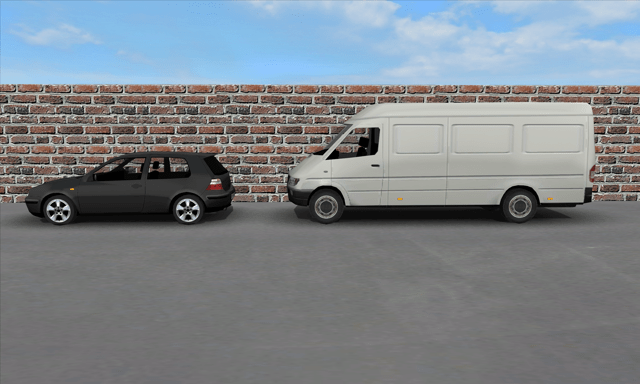
Explanation
A van is much higher, longer and wider than a normal car. Therefore, you should always pay attention to the signage of the passage height. You should also make sure that you adjust your speed in curves, as vans could overturn more easily. In addition, the side wind attacks an even larger area, which significantly increases the risk of being pressed out of the lane.
-
Question 54 of 59
How does the active park assist help you when parking?
2.7.01-1623 PointsExplanation
The active park assistant must be activated manually by you. After activating the assistant, the system supports you in finding a suitable parking space.
-
Question 55 of 59
Why might a turn assist system not always detect that a cyclist is present?
2.7.01-1633 PointsExplanation
A turning assistant can work incorrectly due to various circumstances. So it is possible that a cyclist or a pedestrian is not recognized by the system if there are obstacles between you and the cyclist. For example, such can be parked vehicles or trees on the side of the road. Likewise, the pollution or damage to the sensor can easily be the reason for an incorrect function.
-
Question 56 of 59
What must you note when using the active park assist?
2.7.01-1642 PointsExplanation
After activating the active park assistant, the system supports you in finding and parking a suitable parking space. Nevertheless, you still have to observe the traffic and intervene manually when the dangers arise.
-
Question 57 of 59
You are driving an electric vehicle. When can recuperation inhibit the braking action?
2.7.01-1653 PointsExplanation
By recuperation, the engine of the electric vehicle works like a generator when braking. The braking therefore generates electricity and automatically loads the car battery. So if the battery of the electric vehicle is already fully charged, the vehicle cannot regain the energy and the braking effect through recuperation may not be available. Instead, the vehicle has to fall back on conventional brakes. The recuperation can also be reduced or deactivated if the battery is too cold. This can reduce the braking effect through recuperation.
-
Question 58 of 59
Your vehicle is equipped with a hill-start assist. What benefit does this assist system provide?
2.7.01-1663 PointsExplanation
The hill assist can make it easier for you to start off on a hill by releasing the brakes, thus preventing unintentional rolling back.
-
Question 59 of 59
What applies when using driver assistance systems for longitudinal and lateral control of your vehicle?
2.7.01-1673 PointsExplanation
Before using the driver assistance system, you should understand the system's limitations. This way you know exactly which dangerous situations and malfunctions you need to pay more attention to. If you notice a driver assistance system malfunction, you should oversteer as quickly as possible. Through targeted oversteering, any errors in the driver assistance system during longitudinal and lateral guidance can be responded to manually. Oversteering can usually be triggered by gently pressing the accelerator and brake or by carefully counter-steering.