
2.7.01 Operación de manejo, física de conducción, técnica de manejo
Aprenda la física de conducción más importante, técnicas de frenado, comportamiento en curvas, reglas de carga y sistemas de seguridad para motocicletas, automóviles, remolques y vehículos modernos.
1. Conceptos básicos de frenado
Reglas de oro
- Utilice ambos frenos para lograr la distancia de frenado más corta.
- El freno delantero proporciona más potencia de frenado.
- La rueda trasera se bloquea más fácilmente al frenar.
- El ABS evita el bloqueo de las ruedas durante una frenada de emergencia.
- Las carreteras mojadas reducen la eficacia de los frenos.
Recordar
Durante el frenado, el peso se desplaza hacia adelante. Esto aumenta el agarre en la rueda delantera y reduce el agarre en la rueda trasera.
Truco de memoria fácil:
"La rueda delantera se agarra con más fuerza, la rueda trasera patina más fácilmente".
2. Curvas y fuerza centrífuga
Peligro
- Conducir demasiado rápido en las curvas aumenta la fuerza centrífuga.
- Frenar con fuerza en una curva puede hacer que la motocicleta se mantenga erguida.
- Acelerar en curvas aumenta el radio de giro.
- Es posible que se desvíe hacia el tráfico que viene en sentido contrario.
Técnica correcta
- Reduzca la velocidad antes de entrar en la curva.
- Acelere sólo cerca de la salida de la curva.
- Inclínese más si la curva se vuelve más cerrada.
- Manténgase alejado de la línea central cuesta abajo.
Física importante
3. Seguridad en motocicletas
Antes de montar
- Revisa espejos y frenos.
- Verifique el estado y la presión de los neumáticos.
- Revise la visera en busca de rayones o daños.
- Distribuya el equipaje de manera uniforme.
Riesgos de caballito
- Una aceleración repentina puede levantar la rueda delantera.
- La aceleración de marcha baja aumenta el riesgo.
- Los pasajeros aumentan el desplazamiento de peso hacia atrás.
- Puede ocurrir pérdida del control de la dirección.
Montar cuesta abajo
- Utilice el freno motor en marchas bajas.
- Evite acelerar entre curvas.
- El frenado continuo sobrecalienta los frenos.
- Mayores RPM del motor = freno motor más fuerte.
Si la motocicleta se tambalea
- Reduzca la velocidad inmediatamente.
- Desenganche el embrague con cuidado.
- Frene suavemente.
- Nunca aceleres.
4. Neumáticos y agarre en carretera
Aumente la presión de los neumáticos cuando
- Conducir con pasajeros
- Llevar equipaje pesado
- Conducir largas distancias
- Conducir a alta velocidad
Superficies resbaladizas
- Carreteras mojadas
- Hojas y tierra
- Arena y grava
- Vías de tranvía
- Tapas de registro
Mejor estabilidad
- Presión correcta de los neumáticos
- Carga equilibrada
- buena suspensión
- Contacto igual de las ruedas con la carretera.
5. Remolques y caravanas
Efectos de un tráiler
- Mayor distancia de frenado
- Aceleración más lenta
- Se necesita más espacio por turnos
- Mayor riesgo de derrape
Comprobaciones importantes
- trabajos de conexion electrica
- Cable de separación adjunto
- Rueda de apoyo levantada
- Los espejos proporcionan visibilidad trasera
6. Sistemas de asistencia al conductor
| Sistema | Función |
|---|---|
| ABS | Evita el bloqueo de las ruedas durante el frenado |
| TCS | Evita que las ruedas patinen durante la aceleración. |
| Asistente para mantenerse en el carril | Advierte o gira si se sale del carril involuntariamente |
| Asistencia de frenado de emergencia | Frena automáticamente en situaciones peligrosas. |
| Asistencia en pendientes | Evita rodar hacia atrás en pendientes |
Importante:
Los sistemas de asistencia mejoran la seguridad, pero no pueden sustituir a un conductor atento y capaz.
7. Vehículos eléctricos
Características
- Casi en silencio
- Sin emisiones de escape directas
- Necesita estaciones de carga
Planificación de viajes largos
- Rango de conducción más bajo
- Batería afectada por la temperatura
- Se necesitan más paradas de carga
Recuperación
El motor eléctrico genera electricidad mientras frena y recarga la batería.
Consejos de revisión rápida
Frenar ANTES de las curvas
Usa ambos frenos
Marcha más baja = más frenado motor
Velocidad ×2 = fuerza ×4
Preguntas de práctica (59)
-
Pregunta 1 de 59
¿Qué debe tener en cuenta durante el control de la presión de los neumáticos?
2.7.01-0453 puntosExplicación
When checking tire pressure, you must also take into account the temperature and load of the vehicle. These can influence the tire pressure. By contrast, the material of the wheel rim doesn't matter.
-
Pregunta 2 de 59
¿Qué aumenta la fuerza centrífuga que actúa sobre el vehículo en las curvas?
2.7.01-0473 puntosExplicación
The speed has an immediate effect on the level of centrifugal force. Your braking distance quadruples when you drive at twice the speed. The centrifugal force increases the smaller the curve radius. The tire pressure has no effect on the centrifugal force.
-
Pregunta 3 de 59
Va circulando sobre firme mojado con un turismo y un remolque por una carretera secundaria estrecha y se aproxima a una curva a la izquierda con visibilidad, pero estrecha. ¿Qué hace?
2.7.01-0584 puntosExplicación
Decrease your speed before the turn. Take the weather conditions into account. Keep in mind that the centrifugal force grows twice as fast as the speed. You should only accelerate again in the curve vertex.
-
Pregunta 4 de 59
¿Qué tiene que tener en cuenta al circular en quad?
2.7.01-0654 puntosExplicación
Reduce speed when turning, as quads tend to tip over due to their high centre of gravity.
-
Pregunta 5 de 59
¿Qué ha de tener en cuenta al circular en quad?
2.7.01-0664 puntosExplicación
The quad has no steering assistance, so steering may be more difficult than driving a car.
-
Pregunta 6 de 59
En aquellas curvas en las que la calzada está en malas condiciones, ¿qué hace aumentar el riesgo de derrapar?
2.7.01-0723 puntosExplicación
Ideally, all wheels should press on the road with the same force to ensure optimum grip and handling. If this is not the case, it can increase the risk of skidding in poor road conditions. The suspension, for example, has the task of keeping all tyres on the road with the same force. If the suspension is damaged, it can no longer do this. The risk of skidding also increases if the tyre pressure is incorrect or if the vehicle is incorrectly or unevenly loaded. This is because the tyres cannot apply the same force to the road and you lose grip more quickly.
-
Pregunta 7 de 59
¿Qué cambia al llevar un remolque caravana?
2.7.01-1024 puntosExplicación
If you drive with a caravan, not only does it increase the risk of skidding, the overtaking and braking distances will be longer as well. This is due to the additional load to be pulled and the pulling motion of the trailer.
-
Pregunta 8 de 59
Ud. circula en su turismo con remolque por una vía con tráfico en sentido contrario y quiere girar hacia la izquierda. ¿Qué es de especial importancia cuando vuelve a arrancar?
2.7.01-1044 puntosExplicación
With a trailer you have a lower accelerating ability, changed mass and a greater total length. This must be taken into consideration when you're starting your car again. Oncoming traffic must not be warned in this case by using the flash light.
-
Pregunta 9 de 59
Ud. circula en un turismo con un remolque sin freno. Se encuentra ante una fuerte pendiente de bajada. ¿Qué comportamiento es correcto?
2.7.01-1054 puntosExplicación
Reduce your speed on time. Us a gear as low as possible. The thus activated engine brake supports the braking action of the pedal braking. By no means you should put your car in idling. This would make the vehicle faster.
-
Pregunta 10 de 59
¿Qué tiene que comprobar en un turismo con remolque caravana antes de emprender la marcha?
2.7.01-1073 puntosExplicación
Caravans restrict the view to the back. Therefore, you must check before the start of the journey, if the mirrors provide sufficient visibility to the back. You also need to make sure that the illuminating devices are working.
-
Pregunta 11 de 59
Ud. conduce un turismo con remolque plenamente cargado y sin freno propio. ¿Qué es correcto?
2.7.01-1083 puntosExplicación
Note that a fully loaded trailer without its own brake extends the braking distance and thus the stopping distance by the respective trailer load. The thinking distance does not change in this case.
-
Pregunta 12 de 59
Ud. quiere acoplar a su turismo un remolque caravana de un eje. ¿Qué tiene que comprobar en su turismo?
2.7.01-1093 puntosExplicación
The caravan reduces the view to the back. You as a car driver have to check whether the rear view through the existing mirrors is sufficient. You may need to attach extra mirrors to your car. Towing vehicle and trailer must always be coordinated.
-
Pregunta 13 de 59
Ud. quiere emprender la marcha con un turismo automático (variador hidráulico). ¿Qué debe saber Ud.?
2.7.01-1103 puntosExplicación
If you give a "go" with an engaged gear as a car driver in a vehicle with automatic transmission it will try to start driving. This can only be prevented by operating the service brake. The selector lever can and may be operated with the engine stationary and running.
-
Pregunta 14 de 59
¿Qué debe tener en cuenta con respecto a la presión de los neumáticos?
2.7.01-1113 puntosExplicación
By regularly checking the air pressure of the tires, tire damage can be avoided, but fuel can also be saved. If you put your vehicle under a greater burden, you need to adjust the tire pressure.
-
Pregunta 15 de 59
Después de una avería ha tenido que montar la rueda de repuesto. ¿Qué está prohibido?
2.7.01-1123 puntosExplicación
Emergency wheels have a different design than conventional wheels and are only allowed up to a speed of 80 km/h. They have worse operating characteristics. You should only drive with them as far as necessary. Taking other people with you is allowed.
-
Pregunta 16 de 59
¿A qué tiende un turismo con tracción trasera si en la curva se acelera demasiado?
2.7.01-1153 puntosExplicación
You should always expect your vehicle with rear wheel drive to swing off to the back if you over-accelerate on a turn. It is more likely to oversteer than understeer.
-
Pregunta 17 de 59
¿Qué ventajas ofrece una regulación del resbalamiento de impulsión (ASR)?
2.7.01-1183 puntosExplicación
The traction control system (TCS) of a car prevents the wheels of the vehicle from spinning, especially when accelerating faster. Slipping away to the side when starting to drive on slippery roads is thereby largely prevented.
-
Pregunta 18 de 59
Ud. quiere acoplar un remolque mediante un empalme esférico. ¿Qué es correcto?
2.7.01-1204 puntosExplicación
In a trailer with ball clutch, the clutch dog must firmly enclose the spherical head. The fuse must engage. Make sure the electrical connection works. The support wheel must not run while driving. It must be locked in high position.
-
Pregunta 19 de 59
¿Qué tiene que hacer después de acoplar un remolque de eje simple con freno automático de retención?
2.7.01-1214 puntosExplicación
The breakaway cable must be hung on the coupling device of the towing vehicle. With an overrun brake, the trailer brakes automatically when the connection to the towing vehicle breaks off. The function of the brake must be checked. The support wheel must not run while driving, so it should be brought to the upper position.
-
Pregunta 20 de 59
¿Qué debe tener en cuenta cuando carga un remolque de un eje?
2.7.01-1223 puntosExplicación
When loading a single-axle trailer, you must ensure to comply with the total mass and that your load does not exceed the permissible axial load and bearing load.
-
Pregunta 21 de 59
Ud. quiere estacionar su remolque de eje simple (freno de inercia, 1000 kg peso máximo autorizado) en una pendiente de bajada. ¿Qué tiene que hacer?
2.7.01-1233 puntosExplicación
You must always secure your trailer against possibly rolling away. To do this, you must use the parking brake and place the wheel chocks in front of the wheels. Usually such trailers have no reverse lockout.
-
Pregunta 22 de 59
¿Qué defectos peligrosos pueden existir en un remolque con freno automático de retención después de una parada prolongada?
2.7.01-1244 puntosExplicación
If you leave a trailer standing somewhere for a long time, the weather can cause damage: electrical connections can be damaged, rust can form on the brakes. Sun exposure does not increase the tire pressure too much, so that no dangerous defects occur.
-
Pregunta 23 de 59
¿Qué debe tener en cuenta cuando carga un remolque?
2.7.01-1253 puntosExplicación
Always pay attention to the proper securing of your cargo. In order not to endanger yourself and other road users, you must always have a clear view and full control over your vehicle. The cargo must be marked at the rear and may not protrude more than 50 cm at the front.
-
Pregunta 24 de 59
¿Por qué no se debe circular con el embrague pisado en una pendiente de bajada pronunciada y larga?
2.7.01-1273 puntosExplicación
If you step down the clutch, the engine brake will not work and you will have to use the service brake more. As a result, overheating and increased brake wear can occur.
-
Pregunta 25 de 59
La calzada está mojada y tiene que frenar de repente en una curva. ¿Qué particularidades se dan en los vehículos con sistema antibloqueo (ABS)?
2.7.01-1304 puntosExplicación
On wet roads, the antilocking system prevents the wheels from locking and shortens the braking distance. In addition, the vehicle remains more steerable when braking. On gravel or snow, the braking distance can certainly be much longer.
-
Pregunta 26 de 59
¿Cómo afectan las características de viraje de una combinación de vehículos (coche con caravana) al girar?
2.7.01-1313 puntosExplicación
Despite careful driving, it is possible that the trailer cuts the curve or even swings out. The car driver must therefore proceed with caution in order to exclude hazards to others.
-
Pregunta 27 de 59
¿Qué puede restringir el funcionamiento de un sistema de aviso de salida de carril?
2.7.01-1332 puntosExplicación
The function of the lane departure warning system may be limited if the system cannot properly pick up lane signals. This is, because the computer-controlled system works on the basis of different optical systems. There are no signals from the guardrails. Another name for the lane departure warning system is: Lane Keeping Assist (active lane departure warning system with steering assistance).
-
Pregunta 28 de 59
¿Qué debe comprobar antes de realizar un viaje con un vehículo totalmente eléctrico?
2.7.01-1343 puntosExplicación
The car driver should inform himself about the range of the electric vehicle before starting the journey. This differs significantly from the range of conventional vehicles and more frequent stops to recharge the batteries are necessary. You should also take into account that there is more technology in an electric vehicle. Although it is generally true that electric vehicles are just as safe as conventional cars. But in their bodies usually run cables that are designed for enormously high voltages.
-
Pregunta 29 de 59
Usted quiere hacer un viaje prolongado con un vehículo totalmente eléctrico. ¿Qué debería tener en cuenta?
2.7.01-1352 puntosExplicación
If you are planning a longer journey with a purely electric vehicle, you should consider that your car has a much lower range compared to conventional vehicles. In addition, the capacity of the batteries is influenced by the outside temperature.
-
Pregunta 30 de 59
¿Qué debe tener en cuenta al cargar vehículos totalmente eléctricos?
2.7.01-1363 puntosExplicación
When charging pure electric vehicles, you must be aware that they cannot be recharged at every gas station. Only use the charging cables approved by the manufacturer. Depending on the power connection, the charging time varies.
-
Pregunta 31 de 59
¿Qué distingue a los vehículos eléctricos puros de los vehículos con motor de combustión interna?
2.7.01-1373 puntosExplicación
Pure electric vehicles are almost noiseless. These vehicles also have no direct exhaust emissions. The aerodynamic drag depends on the volume of the body and not on the type of drive.
-
Pregunta 32 de 59
Está conduciendo un vehículo totalmente eléctrico en una zona residencial. ¿Para qué debe estar preparado, debido a su bajo nivel de ruido al conducir?
2.7.01-1383 puntosExplicación
With a pure electric vehicle, you are almost noiseless on the road and you can acoustically be hardly perceived by other road users. Especially cyclists are at risk if they hear no engine noise. Without looking back, they often turn.
-
Pregunta 33 de 59
Usted conduce un vehículo de motor con un sistema automático de antibloqueo. ¿Cómo logra la distancia de frenado más corta posible?
2.7.01-1394 puntosExplicación
If you drive a car with an automatic anti-lock braking system, you achieve the shortest braking distance by braking abruptly and with maximum pedal force. The ABS prevents the wheels from locking during braking.
-
Pregunta 34 de 59
Va a tomar una curva cerrada a gran velocidad. ¿Qué puede ocurrir si se ve obligado a frenar bruscamente de forma repentina?
2.7.01-1414 puntosExplicación
If you drive fast into a tight curve, you lose road grip when you brake hard and slide out of the curve. (Centrifugal force)
-
Pregunta 35 de 59
En una curva, ¿qué puede hacer que su vehículo de motor derrape?
2.7.01-1423 puntosExplicación
If you turn sharply, your vehicle may start to skid on bends. This can also happen if you drive too fast. Adjust your speed when cornering.
-
Pregunta 36 de 59
El sistema de mantenimiento de carril le avisa mediante señales de percepción acústica, física o visual. ¿Cuál puede ser la causa de ello?
2.7.01-1433 puntosExplicación
If you drift out of your lane, the lane departure warning system detects this by recognising that you are approaching the lane marking. The permissible total mass must not be exceeded.
-
Pregunta 37 de 59
¿En qué situación le puede ser de ayuda el asistente de mantenimiento de carril con corrección de la dirección?
2.7.01-1443 puntosExplicación
On motorways and country roads, steering intervention by the lane departure warning system can be helpful, as the markings are clearly visible there. Due to poor markings and narrow lanes in roadworks, steering intervention by the lane departure warning system is not possible as it will most likely not be detected correctly.
-
Pregunta 38 de 59
¿A qué puede ayudar al conductor el asistente de mantenimiento de carril con corrección de la dirección?
2.7.01-1453 puntosExplicación
If the lane markings are good, Lane Keeping Assist with steering intervention can help you to keep the vehicle on the lane when driving straight ahead. When turning, you cross lanes and markings; the lane departure warning system cannot intervene to support you here. When overtaking, you signal to the lane departure warning system by flashing that you are crossing the lane markings intentionally. Thus, it does not intervene during the overtaking process.
-
Pregunta 39 de 59
¿Qué puede afectar al funcionamiento del asistente de mantenimiento de carril con corrección de la dirección?
2.7.01-1463 puntosExplicación
If the lane markings are in a poor condition, the lane keeping assistant cannot recognise where the lane to be maintained is. Due to additional lane markings in construction areas, it is not obvious which is the lane to be kept to. Weather conditions can affect the sensors of the lane departure warning system. In addition, water or snow can distort the markings.
-
Pregunta 40 de 59
¿En qué condiciones funciona mejor el asistente de mantenimiento de carril con corrección de la dirección?
2.7.01-1473 puntosExplicación
The lane keeping assistant works best with clear lane markings. Poor or additional markings in roadworks will not allow the lane departure warning system to intervene, as it will most likely not be detected correctly. Weather conditions can affect the sensors of the lane departure warning system. In addition, snow can distort the markings.
-
Pregunta 41 de 59
¿En qué pueden ayudarle los sistemas de asistencia a la conducción?
2.7.01-1493 puntosExplicación
In critical traffic situations, driver assistance systems can react quickly and intervene automatically by steering or braking etc.. If danger is imminent, they can warn you with light, sound and haptic signals. Driver assistance systems can also help you with driving tasks, such as keeping in lane.
-
Pregunta 42 de 59
En un turismo con tracción delantera, ¿qué consecuencia puede tener el acelerar demasiado en una curva?
2.7.01-1503 puntosExplicación
If you give a front-wheel drive car too much gas in a bend, it can swerve over the front axle. The front tyres lose their grip on the road and your vehicle can no longer be steered, but continues straight ahead and breaks away.
-
Pregunta 43 de 59
¿Bajo qué condiciones puede realizar un cambio de carril el asistente activo de cambio de carril?
2.7.01-1513 puntosExplicación
The Active Lane Change Assistant only performs a lane change when it cannot detect any vehicle in the relevant safety zone. For an active lane change, the assistant must first detect a marked lane with several lanes.
-
Pregunta 44 de 59
Su vehículo de motor está equipado con un asistente activo de mantenimiento de carril. ¿Qué información puede mostrar el indicador de estado de este sistema?
2.7.01-1523 puntosExplicación
The system must be able to display when it is switched on, switched off or has a malfunction, as this is important for the driver.
-
Pregunta 45 de 59
Su vehículo de motor está equipado con un asistente de mantenimiento de carril. ¿En qué situación le puede servir de ayuda este sistema?
2.7.01-1533 puntosExplicación
Lane Keeping Assist helps you stay in lane. It warns you if you unintentionally leave the lane.
-
Pregunta 46 de 59
Está utilizando el asistente de mantenimiento de carril de su vehículo de motor. Mientras va conduciendo, le avisa con una señal. ¿Cuál puede ser la causa de ello?
2.7.01-1543 puntosExplicación
Lane Keeping Assist warns you if you unintentionally leave your lane. If you forget to indicate when changing lanes, Lane Keeping Assist recognizes this as unintentionally leaving your lane and warns you.
-
Pregunta 47 de 59
Está utilizando el asistente de mantenimiento de carril de su vehículo de motor mientras va conduciendo. Al abandonar el carril, el sistema no reacciona. ¿Cuál puede ser la causa de ello?
2.7.01-1553 puntosExplicación
Due to missing lane markings, insufficient road illumination and heavy precipitation, the sensors of the lane departure warning system are impaired, which means that the lane is not reliably detected.
-
Pregunta 48 de 59
Su vehículo de motor está equipado con un asistente de cambio de carril sin corrección de la dirección. Mientras va conduciendo, se enciende el piloto de aviso en la zona del retrovisor izquierdo. ¿Qué indica este piloto de aviso?
2.7.01-1563 puntosExplicación
If there is a vehicle in the monitoring area, this is signaled by the warning lamp lighting up on the exterior mirror.
-
Pregunta 49 de 59
Está utilizando el asistente activo de mantenimiento de carril mientras va conduciendo. ¿Cómo puede anular manualmente este sistema de asistencia a la conducción en caso de intervención del sistema?
2.7.01-1573 puntosExplicación
Countersteering and activating the indicator overrides the intervention of Lane Keeping Assist.
-
Pregunta 50 de 59
¿En que situación le puede servir de ayuda usar un asistente activo de cambio de carril?
2.7.01-1583 puntosExplicación
On motorways or motorway-like roads, the lane markings are clearly visible and the lanes are usually straight. This is where Active Lane Change Assist comes in handy.
-
Pregunta 51 de 59
Quiere adelantar y ha iniciado un cambio de carril mediante el asistente activo de cambio de carril. ¿Qué es correcto?
2.7.01-1593 puntosExplicación
The Active Lane Change Assistant can change lanes automatically after initiation. However, you must always monitor this, as e.g. safety distances are not always maintained automatically.
-
Pregunta 52 de 59
¿Qué sistema de asistencia a la conducción tiene que activar a mano para que le sirva de apoyo en determinadas situaciones?
2.7.01-1603 puntosExplicación
The active parking assistant and the adaptive cruise control system do not count as safety-relevant assistants. Therefore, you can activate them manually.
-
Pregunta 53 de 59
Quiere transportar muebles con la furgoneta compacta mostrada en la imagen (hasta 3,5 t). En comparación con la conducción de un turismo, ¿qué ha de tener en cuenta?
2.7.01-1613 puntos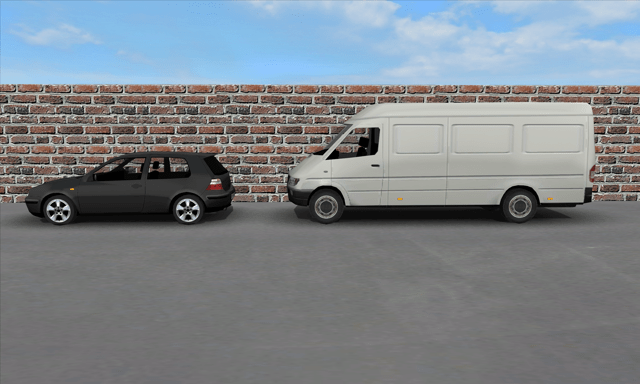
Explicación
A van is much higher, longer and wider than a normal car. Therefore, you should always pay attention to the signage of the passage height. You should also make sure that you adjust your speed in curves, as vans could overturn more easily. In addition, the side wind attacks an even larger area, which significantly increases the risk of being pressed out of the lane.
-
Pregunta 54 de 59
¿Cómo le puede ayudar el asistente activo de aparcamiento a la hora de estacionar?
2.7.01-1623 puntosExplicación
The active park assistant must be activated manually by you. After activating the assistant, the system supports you in finding a suitable parking space.
-
Pregunta 55 de 59
Si un asistente de giro no detecta a un ciclista de forma fiable, ¿cuál puede ser el motivo?
2.7.01-1633 puntosExplicación
A turning assistant can work incorrectly due to various circumstances. So it is possible that a cyclist or a pedestrian is not recognized by the system if there are obstacles between you and the cyclist. For example, such can be parked vehicles or trees on the side of the road. Likewise, the pollution or damage to the sensor can easily be the reason for an incorrect function.
-
Pregunta 56 de 59
¿Qué ha de tener en cuenta al utilizar el asistente activo de aparcamiento?
2.7.01-1642 puntosExplicación
After activating the active park assistant, the system supports you in finding and parking a suitable parking space. Nevertheless, you still have to observe the traffic and intervene manually when the dangers arise.
-
Pregunta 57 de 59
Va conduciendo un vehículo eléctrico. ¿En qué caso puede verse limitada la eficacia de frenado por recuperación?
2.7.01-1653 puntosExplicación
By recuperation, the engine of the electric vehicle works like a generator when braking. The braking therefore generates electricity and automatically loads the car battery. So if the battery of the electric vehicle is already fully charged, the vehicle cannot regain the energy and the braking effect through recuperation may not be available. Instead, the vehicle has to fall back on conventional brakes. The recuperation can also be reduced or deactivated if the battery is too cold. This can reduce the braking effect through recuperation.
-
Pregunta 58 de 59
Su vehículo viene equipado con un asistente de arranque en pendiente. ¿Qué ventaja le ofrece este asistente?
2.7.01-1663 puntosExplicación
The hill assist can make it easier for you to start off on a hill by releasing the brakes, thus preventing unintentional rolling back.
-
Pregunta 59 de 59
¿Qué se aplica al guiado longitudinal y lateral de su vehículo cuando utiliza sistemas de asistencia al conductor?
2.7.01-1673 puntosExplicación
Before using the driver assistance system, you should understand the system's limitations. This way you know exactly which dangerous situations and malfunctions you need to pay more attention to. If you notice a driver assistance system malfunction, you should oversteer as quickly as possible. Through targeted oversteering, any errors in the driver assistance system during longitudinal and lateral guidance can be responded to manually. Oversteering can usually be triggered by gently pressing the accelerator and brake or by carefully counter-steering.