
2.2.18 Autopistas y autopistas
Aprenda las normas de autopistas más importantes de forma rápida y sencilla para su examen teórico de conducción en alemán. Concéntrese en la seguridad, la disciplina de carril, el comportamiento de emergencia y las normas de peaje.
🚗 Reglas de carril y adelantamientos
Adelantamiento seguro
- Mantenga una distancia segura cuando otro vehículo cambie de carril.
- Esté preparado para vehículos más lentos incluso si aceleran.
- Reduzca la velocidad si es necesario.
- Nunca se acerque demasiado al vehículo, no toque la bocina ni encienda las luces de manera agresiva.
Uso del carril izquierdo
- El carril izquierdo está destinado principalmente a adelantamientos.
- Manténgase a la derecha siempre que sea posible.
- Si un coche adelanta, el coche que va detrás también podrá adelantar.
🛣️ Entrar y salir de la autopista
Carril de aceleración
- Puede conducir más rápido en el carril de aceleración.
- Acelere adecuadamente antes de incorporarse.
- El tráfico principal tiene prioridad.
- Mantenga una distancia segura.
Salir de la autopista
- Señalice al menos 300 m antes de la salida.
- Utilice el carril de salida para reducir la velocidad.
- Si la salida está bloqueada, continúe hasta la siguiente salida.
- Nunca te detengas ni retrocedas.
⛔ Estrictamente prohibido en la autopista
- invertir
- Dando la vuelta
- Parando en la carretera
- Conducir hacia atrás hasta una salida perdida
- Conducir por el arcén sin emergencia
Recordar
En la autopista sólo se puede circular en una dirección. Violar estas reglas es extremadamente peligroso.
🚑 Calle de rescate (Rettungsgasse)
Cuando el tráfico se detiene o avanza lentamente:
- Crear un carril de rescate para policías y vehículos de emergencia.
- Con 2 carriles → formarlo entre carril izquierdo y derecho.
- Con 3 carriles → formarlo entre el carril izquierdo y el carril central.
- NO utilice el arcén.
Motocicletas en atascos:
- Deben comportarse como coches.
- No se puede conducir entre vehículos.
- No se puede utilizar el arcén.
⚠️ Luces de advertencia de peligro
- Úsalos cuando te acerques a un atasco.
- Avise al tráfico que sigue con antelación.
- Úsalos durante el remolque.
- Útil durante accidentes o situaciones peligrosas.
Regla de remolque
Sólo se permite remolcar en la autopista hasta la siguiente salida. Ambos vehículos deben utilizar luces de emergencia.
🏎️ Reglas de velocidad
Velocidad mínima
Sólo podrán circular por la autopista vehículos con una velocidad superior a 60 km/h.
Velocidad recomendada
La velocidad recomendada en las autopistas alemanas es de 130 km/h.
Conducción nocturna
Nunca conduzca más rápido de lo que permiten las luces bajas.
🚨 Conductor en sentido contrario
- Conduzca lo más a la derecha posible.
- Advertir a otros usuarios de la vía.
- Informe a la policía inmediatamente.
💶 Reglas de peaje (peaje LKW)
- El peaje se aplica a camiones y combinados de más de 7,5 t.
- Tanto el conductor como el propietario son responsables.
- La clase de peso y los ejes deben introducirse correctamente.
Importante
Antes de circular por carreteras de peaje, compruebe siempre los ajustes del OBU y el número de ejes.
📚 Datos breves del examen
Las motocicletas deben seguir las mismas normas de autopista que los coches.
Las noticias de tráfico ayudan a evitar atascos, accidentes y conductores en sentido contrario.
El asistente de cambio de carril solo avisa, no gira automáticamente.
No bloquee los vehículos que ingresan desde vías de acceso si puede ayudar de manera segura.
Se permite conducir por el carril central cuando el tráfico del carril derecho esté obstruido.
Las luces de emergencia de los camiones a menudo advierten de atascos.
🧠 Consejos fáciles para recordar
Izquierda = adelantar → de lo contrario, manténgase en la derecha.
Sin marcha atrás. Sin parar. Sin turno.
Atasco = Carril de rescate.
¿Salida perdida? → Toma el siguiente.
Luces de peligro = Peligro por delante.
Preguntas de práctica (21)
-
Pregunta 1 de 21
¿Qué velocidad se aconseja para turismos y motocicletas en autopistas?
2.2.18-0032 puntosCorrecto: 130
Explicación
On motorways cars and motorcycles have to keep an advisory speed limit of 130 km/h. In addition, driving on a freeway is only permitted to vehicles exceeding 60 km/h.
-
Pregunta 2 de 21
Ud. circula por el izquierdo de dos carriles y se acerca a un vehículo que comienza a salir para adelantar. ¿Cómo debe ser su comportamiento?
2.2.18-0064 puntosExplicación
You allow this vehicle to overtake by maintaining a safety distance. As the vehicle changes from the right, be prepared that its speed is lower than yours despite acceleration. Slow your pace down, if necessary. Never tailgate, honk or flash.
-
Pregunta 3 de 21
Ud. circula por una autopista con poca densidad de tráfico. ¿Cuánto tiempo puede utilizar el carril izquierdo?
2.2.18-0073 puntosExplicación
The left lane may generally only be used for the purpose of overtaking. If the preceding vehicle overtakes, it can be assumed that the following car driver will also overtake. Therefore, it is allowed here to use the left lane. In all other cases, you have to drive on the right.
-
Pregunta 4 de 21
¿Qué es correcto en calzadas para automóviles?
2.2.18-0094 puntosExplicación
You may only enter at intersections or T-junctions on motorways. Turning on motorways is prohibited. The regulations regarding speed differ from those that apply on the freeway. On highways you must not drive faster than the range of the low beam allows.
-
Pregunta 5 de 21
En una autopista con 3 carriles se ha formado un atasco. ¿Dónde hay que dejar espacio para los vehículos de emergencia?
2.2.18-0114 puntosExplicación
When traffic stops on freeways or on roads outside of built-up areas with at least two lanes in one direction, vehicles must form a free lane for the passage of police and support vehicles. If a road has three lanes into one direction, then the middle is considered to be between the left and the middle lane.
-
Pregunta 6 de 21
¿Qué tiene que hacer en este momento?
2.2.18-0134 puntosExplicación
You approach the end of a traffic jam on the freeway. Turn on the hazard light. Form an alley in the middle of the lane for the passage of police and helping vehicles: on roads with three lanes for one direction, form an alley between the left and middle lane. Therefore, you have to drive far to the right. This rule applies outside built-up areas and on freeways.
-
Pregunta 7 de 21
¿Qué debería hacer?
2.2.18-0144 puntosExplicación
They want to leave the freeway. You can see that traffic is stalling in your intended exit. Since you are not allowed to drive on the hard shoulder and wait on the lane, you behave correctly if you continue driving and use the next exit in order to exit the freeway.
-
Pregunta 8 de 21
¿Qué tiene que hacer si hay un atasco en esta carretera?
2.2.18-0154 puntos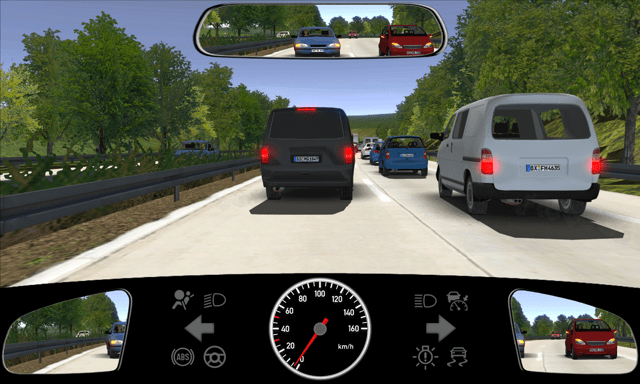
Explicación
Any car driver must cooperate in forming an alley in the middle of the road for the passage of police and support vehicles in case of congestion on freeways and on out-of-town roads with more than one lane. Do not drive on the side strip, this is prohibited.
-
Pregunta 9 de 21
¿Cómo actúa usted correctamente?
2.2.18-0164 puntosExplicación
You meet a wrong-way driver on the freeway exit. By driving as far to the right as possible, you can best counteract a collision with the wrong-way driver. Now other road users must be warned of this acute danger. For this reason, you must inform the police.
-
Pregunta 10 de 21
¿Cómo debe comportarse ahora?
2.2.18-0173 puntosExplicación
They have already passed the truck on the acceleration lane on the right-hand side of the freeway. If you continue to accelerate, you can drive onto the main lane before the end of the lane. You should do that.
-
Pregunta 11 de 21
Usted desea salir de la autopista. ¿Cómo actúa correctamente en esta situación?
2.2.18-0183 puntos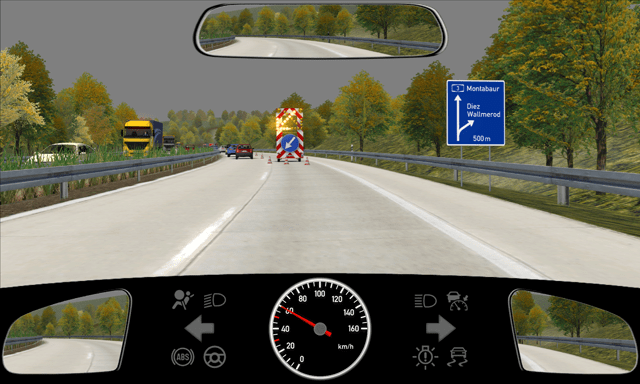
Explicación
You flash and leave the freeway at the exit. The route to the turn of the exit is used to decelerate. Drive quickly off the highway, then reduce your pace. Drive into the corner at a moderately reduced speed.
-
Pregunta 12 de 21
¿Cómo se debe comportar en un atasco en autopistas y carreteras con dos carriles en una dirección?
2.2.18-0194 puntosExplicación
If vehicles stand or drive at walking speed on freeways or on roads outside of built-up areas with at least two lanes for one direction, the following applies: You, as a car driver, must participate in forming a free lane between the leftmost and rightmost lane for the passage of police and support vehicles.
-
Pregunta 13 de 21
¿Qué es correcto hacer en este momento?
2.2.18-0214 puntosExplicación
You must stay in the middle lane because there are vehicles in the left and right lanes that you would obstruct. In the right lane, a motorbike is coming onto the motorway from the slip road. In the left lane is the car that just overtook you.
-
Pregunta 14 de 21
Va circulando por autovía y quiere abandonarla en la siguiente salida. ¿Qué es correcto hacer en esta situación?
2.2.18-0224 puntosExplicación
When leaving the motorway, you should set the indicator at least 300 m before the exit. Always keep a close eye on the traffic behind you when driving on the motorway. Especially when exiting the motorway, make sure that nobody tries to overtake you on the right.
-
Pregunta 15 de 21
¿Qué debería hacer en este momento?
2.2.18-0234 puntosExplicación
Reduce your speed and allow the blue car to join the motorway while keeping a safe distance.
-
Pregunta 16 de 21
¿Con qué debe contar ahora?
2.2.18-0244 puntosExplicación
You should expect the truck in front of you to slow down because the other truck in the right lane is already slowing down and has its hazard lights on. You also have to expect that the truck will stay in the middle lane because it doesn't have enough space to get into the right lane. If a dangerous situation is identified on the motorway, the hazard warning lights may be switched on in order to warn all following vehicles in good time. Dangerous situations usually include accidents, traffic jams or slow traffic.
-
Pregunta 17 de 21
Su vehículo ha quedado inmovilizado en la autopista. ¿Qué hay que tener en cuenta al remolcarlo?
2.2.18-1013 puntosExplicación
When towing on the freeway, the towing vehicle and the towed vehicle must have their hazard lights switched on. It's only allowed to tow on the freeway until the next exit. Then, the freeway must be left.
-
Pregunta 18 de 21
Va circulando por la autopista y se ha pasado de la salida que quería tomar. ¿Qué es lo correcto?
2.2.18-1034 puntosExplicación
Continue until the next exit and leave the freeway there. Now you can drive back to the missed exit on the other side of the freeway. You must not stop or drive backwards.
-
Pregunta 19 de 21
En esta situación, ¿en qué puede ayudarle el asistente de cambio de carril sin corrección de la dirección?
2.2.18-1044 puntos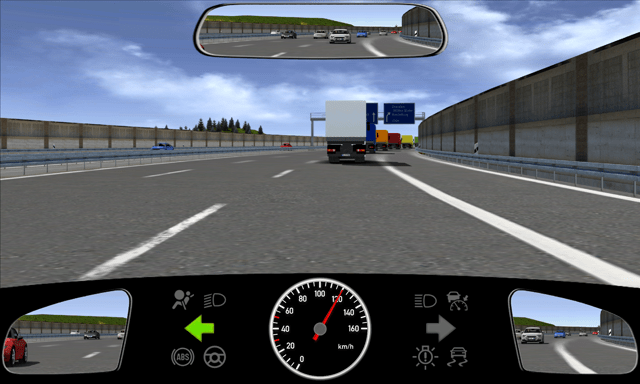
Explicación
Lane Change Assist recognises the vehicle in the middle lane as a hazard and warns you not to change to that lane. To change lanes on your own would require steering intervention. Lane Change Assist does not interfere with your speed.
-
Pregunta 20 de 21
¿Qué está prohibido al circular por autovía?
2.2.18-1053 puntosExplicación
According to the StVO § 18 motorways and motor drivers: (7) Turning and reversing are prohibited. (8) hold, also on the side stripes, is forbidden.
-
Pregunta 21 de 21
Al circular por autopista, ¿por qué se recomienda llevar activada la recepción automática de información sobre el tráfico?
2.2.18-2153 puntosExplicación
Drivers are not required to listen to traffic news, but traffic news are indispensable for a smooth journey. Traffic news inform about traffic jams, traffic accidents and construction sites. Warnings about wrong-way drivers have already prevented a lot of serious accidents.