
2.1.07 Situaciones de tráfico especiales
Situaciones de tráfico especiales, Capítulo 2.1.07: aprenda qué hacer en situaciones de tráfico peligrosas, poco claras o inusuales.
⭐ Regla principal del examen
Cuando la situación no está clara, es peligrosa o otro usuario de la vía puede cometer un error: reduzca la velocidad, aumente la distancia, conduzca con cuidado y esté preparado para frenar.
🚜 Vehículos lentos / tractores
Cuando veas:
Un tractor, un camión o un ciclomotor quiere volver desde el arcén o girar a la izquierda.
Debería:
Reduzca la velocidad y permita que se incorpore de forma segura.
🚗 Final de carril / Regla de la cremallera
Cuando veas:
Un carril termina u otro conductor no puede continuar en su carril.
Debería:
Reduzca la velocidad y deje que el vehículo se incorpore mediante el procedimiento de cremallera.
⚠ Vehículos averiados
Cuando veas:
Un automóvil detenido, una persona en la vía o un carril bloqueado.
Debería:
Reduzca la velocidad, conduzca por el extremo derecho y espere que las personas o los vehículos se muevan repentinamente.
🦌 Animales
Cuando veas:
Animales cerca o en la carretera.
Debería:
Reduzca la velocidad, observe con atención y prepárese para frenar. No te desvíes peligrosamente.
🚴 Ciclistas
Cuando veas:
Un ciclista bloqueado por un obstáculo o subiendo una cuesta.
Debería:
Espere desviarse, mantenga una distancia adicional y solo adelante cuando sea seguro.
🏍 Motocicletas
Cuando veas:
Un motociclista adelantando, tomando curvas o inclinándose hacia su carril.
Debería:
Conduce hacia la derecha, reduce la velocidad y crea más espacio.
🧠 Patrón de examen: cuando vea X → haga Y
| Situación | Reacción correcta | ¿Por qué? |
|---|---|---|
| Conductor en sentido contrario en la autopista | Mover a la derecha, freno, luces de emergencia | Advertir a otros y evitar colisiones. |
| El que sigue detrás de ti | Mantenga la velocidad legal | No aceleres ni frenes bruscamente |
| El taxi se detuvo adelante | Deténgase detrás de él si el carril izquierdo está bloqueado. | No conduzcas por la acera |
| Visibilidad limitada cerca de árboles/curvas | Reduzca la velocidad y conduzca por el extremo derecho | Los peligros ocultos pueden aparecer tarde |
| Neumático reventado o viento cruzado fuerte | Soltar el acelerador, contravirar, frenar suavemente | Mantenga el vehículo estable |
| Colisión de animales inevitable | Frene fuerte, sostenga el volante y permanezca en el carril. | Desviarse puede ser más peligroso |
📏 Distancia de seguridad
Fuera de las zonas urbanizadas conservar al menos:
La mitad de tu velocidad en metros
Ejemplo: 100 km/h → 50 m de distancia
🛑 Distancia de frenado
Si su velocidad se duplica, la distancia de frenado se vuelve mucho más larga.
Doble velocidad → 4× distancia de frenado
40 km/h = 16 m, 80 km/h = 64 m
🎴 Tarjetas didácticas rápidas
Pregunta
¿Qué haces si un tractor quiere incorporarse?
Respuesta
Reduce la velocidad y deja que se fusione.
Pregunta
¿Qué haces si hay animales en el camino?
Respuesta
Reduzca la velocidad y prepárese para frenar.
Pregunta
¿Se puede conducir por la acera para pasar un taxi?
Respuesta
No. Deténgase y espere si no puede adelantar con seguridad.
Pregunta
¿Qué pasa si un motociclista puede adelantar peligrosamente?
Respuesta
Conduzca hacia la derecha y reduzca la velocidad.
Pregunta
¿Qué haces después de encontrar caza salvaje?
Respuesta
Deténgase, asegure el lugar e informe a la policía o a la oficina forestal.
Pregunta
¿Qué pasa si puede entrar un vehículo desde un camino forestal?
Respuesta
Prepárate para frenar, incluso si tienes prioridad.
✅ Lista de verificación de revisión final
Preguntas de práctica (31)
-
Pregunta 1 de 31
¿Por qué tiene que frenar en este momento?
2.1.07-0094 puntosExplicación
You should brake because of the green vehicle, as it appears to be driving onto the road behind the tractor.
-
Pregunta 2 de 31
¿Con qué ha de contar en este aparcamiento?
2.1.07-0103 puntos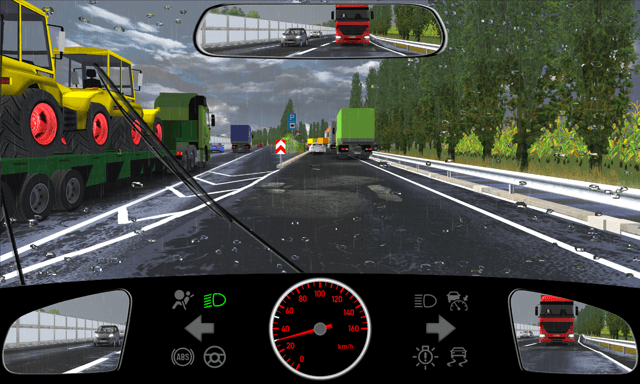
Explicación
Vehicles can leave the parking space, watch out for vehicles leaving the parking space. People can walk on the roadway because you are taking a break. Truck drivers often park in car parking spaces.
-
Pregunta 3 de 31
¿Con qué debería contar en esta situación?
2.1.07-0144 puntosExplicación
Because of the turning truck, the van could miss you. Be ready to brake.
-
Pregunta 4 de 31
En esta situación, ¿por qué se recomienda continuar reduciendo la velocidad?
2.1.07-0155 puntosExplicación
It's unlikely that the car in the left lane will continue as it appears to have broken down. Even if it did, it wouldn't affect you. However, since there is a person in the lane, extra caution is required here. It's also possible that other people get out of the vehicle and run onto the road. The stationary car may be hidden by the bush or no warning triangle was set up. The following car could therefore recognize too late that the vehicle has stopped in front of it. You should therefore drive with foresight and expect the car behind to swerve into your lane.
-
Pregunta 5 de 31
¿Qué debería hacer en este momento?
2.1.07-0204 puntosExplicación
The yellow car comes towards you as a wrong-way driver on the highway. Drive to the right as far as possible and brake. To warn other road users, turn on the hazard warning lights.
-
Pregunta 6 de 31
¿Qué es correcto hacer en esta situación?
2.1.07-0223 puntosExplicación
Animals on the road are unpredictable. You should continue to reduce your speed and monitor the situation carefully, and be ready to brake in case the animals run across the road. Hazard braking could lead to a rear-end collision if the vehicle behind you cannot react quickly enough.
-
Pregunta 7 de 31
¿Por qué se recomienda reducir la velocidad en este momento?
2.1.07-0234 puntosExplicación
Even if you keep to the speed limit of 60 km/h, an animal will run onto the road right in front of you. To avoid an accident, you have to reduce your speed. The oncoming car does not affect your driving style.
-
Pregunta 8 de 31
¿Qué es correcto hacer en esta situación?
2.1.07-0254 puntosExplicación
As the blue car will probably be travelling on the road without observing the right of way rules, you must slow down sharply and give up your right of way.
-
Pregunta 9 de 31
¿Qué es correcto hacer en esta situación?
2.1.07-0263 puntosExplicación
The tractor is signalling by flashing its lights that it wants to move back into the lane. You should therefore reduce your speed and allow the tractor to merge into the lane.
-
Pregunta 10 de 31
¿Qué es correcto hacer en esta situación?
2.1.07-0284 puntosExplicación
The yellow car has an unusual driving style. It may be distracted or drunk. The abrupt braking and steering manoeuvres of the car in front are dangerous. Pay attention to how he continues to drive, increase the distance and be ready to brake.
-
Pregunta 11 de 31
¿Qué ha de tener en cuenta al circular por vías estrechas con árboles a los lados?
2.1.07-0294 puntosExplicación
Visibility in avenues is more restricted than in open fields and therefore requires an adapted driving style. On bends, your view of the carriageway may be restricted after the bend. You may therefore only see obstacles very late.
-
Pregunta 12 de 31
¿Cuándo puede salirse lateralmente un turismo que circula por una vía seca y recta?
2.1.07-1013 puntosExplicación
A vehicle on a straight, dry road can swing off sideways in the event of a strong crosswind or a burst tire. In this case, immediately lay off the gas pedal, countersteer and brake gently.
-
Pregunta 13 de 31
¿Qué facilita la circulación en fila?
2.1.07-1023 puntosExplicación
Slightly offset driving allows you to observe the vehicles in front. This allows you to see the traffic situation in front of you or through the windows of the driver in front and react faster to sudden events. Driving with hazard lights in a convoy is generally prohibited.
-
Pregunta 14 de 31
A alta velocidad en la autopista revienta un neumático de su turismo. ¿Cuál debe ser su comportamiento?
2.1.07-1064 puntosExplicación
Avoid emergency braking on the freeway and instead steer and brake gently to stabilize your vehicle. If possible, bring your vehicle to a stop on the hard shoulder. Turn on your hazard lights and set up your warning triangle to warn subsequent vehicles.
-
Pregunta 15 de 31
Aumenta su velocidad de 50 a 100 km/h. ¿Cómo varía la distancia de frenado según la regla práctica?
2.1.07-1093 puntosExplicación
According to the rule of thumb, the braking distance quadruples when the speed doubles. At 40 km/h, for example, it is 16 meters and at 80 km/h 64 meters.
-
Pregunta 16 de 31
¿Por qué debe estar dispuesto a frenar en esta situación?
2.1.07-1115 puntosExplicación
You see that a vehicle wants to drive onto the road from the right. Since it comes from a field or forest path, you have right of way. Due to the forest cover the visibility for the vehicle driver may be limited. It is possible that he/she will continue despite having to wait. For this reason, you must be ready to brake until you clearly recognize that he/she is stopping.
-
Pregunta 17 de 31
¿Por qué ahora debe reducir su velocidad?
2.1.07-1125 puntosExplicación
Basically, you have the right of way, because you are on a priority road. However, to avoid a dangerous situation, you should still reduce your speed and be ready to brake, as the car driver of the car coming from the right-hand side might recognize you too late or miss you altogether. Due to the trees on the roadside his/her view is clearly limited.
-
Pregunta 18 de 31
¿Cómo reacciona correctamente en esta situación?
2.1.07-1135 puntosExplicación
In this situation, you need to reduce the speed and allow the car driver to go back into lane on the left. If a lane ends on a multi-lane road or if it is not possible for the drivers driving on the other lane to drive through the lane continuously, they must be able to change lanes using the zipper procedure.
-
Pregunta 19 de 31
¿Qué se puede esperar en esta situación?
2.1.07-1145 puntosExplicación
Although you are on the priority road, you must always expect dangerous situations to arise. For example, the tractor driver approaching your street at a junction could not fulfill his duty of waiting and force the vehicle in front of you to brake. By driving anticipatory you can help defuse potentially dangerous situations.
-
Pregunta 20 de 31
¿Cómo se comporta correctamente en esta situación?
2.1.07-1155 puntosExplicación
The maximum speed limit on this road is 80 km/h. You drive 80 km/h. The driver driving behind you harasses you to drive quicker; he/she comes dangerously close and falls below the required safety distance. Keep your speed. If you try to increase the safety margin by accelerating, the driver behind you will probably also accelerate. Braking, even briefly, endangers you and the car behind.
-
Pregunta 21 de 31
¿A qué debe prestarle atención al girar a la derecha?
2.1.07-1173 puntosExplicación
All drivers driving on the priority road must be given priority. The motorcycle is on the lane where you want to turn right. Before you turn right into the priority road, you have to wait and let the motorcycle pass.
-
Pregunta 22 de 31
¿Qué debe hacer si es inevitable una colisión con venado?
2.1.07-1193 puntosExplicación
If a collision with an animal is no longer avoidable, the direction of travel is to be maintained. Then brake hard and hold the steering wheel firmly. An evasive maneuver can injure other road users or increase the risk of greater damage than a controlled collision with the animal.
-
Pregunta 23 de 31
¿Qué tiene que hacer en esta situación?
2.1.07-1215 puntosExplicación
In this situation, you should immediately brake hard but also not swerve.
-
Pregunta 24 de 31
Va circulando por una ruta con muchas curvas que es popular entre los motoristas. ¿Con qué tiene que contar?
2.1.07-1224 puntosExplicación
On curvy roads, motorcyclists can cut their curves or protrude on your roadway in curves because of their strong inclinations. Even motorcyclists who drive in the same direction of travel can also take advantage of the curves and could tend to carry out risky overtaking maneuvers.
-
Pregunta 25 de 31
¿Qué debería hacer en este momento?
2.1.07-1234 puntosExplicación
The driver of the red vehicle cuts the bend. Brake and stay behind the vehicle until you are sure that it will stay in its lane after the bend.
-
Pregunta 26 de 31
¿Cómo debe comportarse en este caso?
2.1.07-1243 puntosExplicación
On confusing roadways or when there is oncoming traffic on a narrow street, you should always pay close attention to other road users and adjust your speed. In this way, dangerous situations can be reduced in advance. You should also drive as far to the right as possible to avoid a collision with the oncoming truck. You can't see through the tree how far in the middle the oncoming truck is driving. You also create more space on the road if the motorcycle behind you tries to overtake and hasn't seen the truck yet.
-
Pregunta 27 de 31
¿Qué haría?
2.1.07-2024 puntosExplicación
A car driving in front of you parks. You must reduce your speed and then change the lane to avoid the parked car when the motorcycle has passed you.
-
Pregunta 28 de 31
¿Qué tiene que saber con respecto a la utilización de los retrovisores?
2.1.07-2034 puntosExplicación
Using the rear-view mirrors requires you to know the following: 1. Rear-view mirrors must be adjusted to the driver before starting to drive. 2. There are blind spots on all types of rear-view mirrors. These indicate areas hidden from view in which pedestrians, small vehicles or obstacles can be overlooked. By optimally adjusting the outer rearview mirror and the inner mirror, you keep the blind spot as low as possible.
-
Pregunta 29 de 31
Va circulando por una carretera secundaria. Delante de Ud. hay una cola de unos 15 vehículos que circulan lentamente. ¿Qué hace?
2.1.07-2063 puntosExplicación
In such a convoy, it is important to stay calm and to maintain the necessary safety distance. So-called queue, that is the overtaking of individual vehicles, brings no time gain and leads to a high accident risk.
-
Pregunta 30 de 31
Detiene su vehículo para dejar bajar a otras personas que van en él por la derecha, por donde hay un carril bici. ¿Qué se recomienda que haga?
2.1.07-2073 puntosExplicación
You as a car driver have a special duty of care. So, if you're stopping at a bike path with a co-driver, you should warn him/her about the cyclist before he/she gets off.
-
Pregunta 31 de 31
Aumenta su velocidad de 50 a 100 km/h. ¿Cómo varía la distancia de reacción según la regla práctica?
2.1.07-2083 puntosExplicación
If the car driver doubles the speed of the vehicle, the braking distance doubles from 15 to 30 meters.