
2.2.07 Uso de carriles por vehículos de motor
Sea predecible, manténgase a la derecha cuando sea necesario y nunca adelante por la derecha. En situaciones de carril difíciles, reduzca la velocidad temprano y haga espacio en lugar de forzar su prioridad.
Manténgase a la derecha
Fuera de las zonas urbanizadas, utilizar el carril derecho cuando esté libre. Muévase hacia la izquierda sólo para adelantar a vehículos más lentos.
No pases colas
Espere detrás del último vehículo en su carril. No intentes pasar la cola por ningún lado.
Primero baja la velocidad
Cuando alguien pueda incorporarse, un carril finalice o no esté permitido adelantar, reduzca la velocidad y cree espacio.
Las reglas centrales
1. Regla de conducción por la derecha
En Alemania se conduce normalmente por la derecha. Si no hay ningún vehículo más lento delante de usted, regrese al carril derecho.
2. Excepción de zonas urbanizadas
Dentro de las zonas urbanizadas, los vehículos de hasta 3,5 toneladas podrán elegir libremente su carril. Allí no se les aplica la estricta obligación de circular por la derecha.
3. Adelantar sólo por la izquierda
Si un vehículo en el carril izquierdo es más lento que usted, no lo rebase por el derecho. Quédese atrás y reduzca la velocidad.
4. No fuerces tu derecho de paso
Si otro conductor está entrando o incorporándose y no puede cambiar de carril de manera segura, reduzca la velocidad y deje espacio.
Situaciones de examen simplificadas
Estás en el carril central o izquierdo, pero el carril derecho está libre.
Acción correcta: Vuelva al carril derecho. Puede volver a utilizar el carril central o el carril izquierdo sólo al adelantar a tráfico más lento.
Un camión rápido puede salir para adelantar
Acción correcta: Espere que el camión cambie de carril y esté listo para frenar. No se mueva hacia la izquierda si ya hay un coche detrás de usted.
Un coche acelera en el carril de aceleración.
Acción correcta: Ayude al conductor a incorporarse reduciendo la velocidad, especialmente cuando cambiar al carril izquierdo no es seguro.
Un carril esta terminando
Acción correcta: Utilice el principio de combinación de cremallera. Deje que los vehículos del carril final pasen al carril adyacente uno por uno.
Estás en el carril central y ambos cambios de lado son inseguros.
Acción correcta: Manténgase en su carril y reduzca la velocidad. No realice cambios de carril riesgosos hacia la izquierda o hacia la derecha.
Un coche más lento está en el carril izquierdo.
Acción correcta: No adelantar por la derecha. Reduzca la velocidad y espere hasta que sea posible adelantar por la izquierda.
arcén
El arcén no es un carril normal. Por lo general, sólo podrá utilizarlo en caso de emergencia, como una avería.
Excepción: si una señal de tráfico abre el arcén, éste deberá utilizarse como el carril de la derecha.
Señales de dirección
Algunas señales indican que debes elegir tu dirección pronto. Utilice los carriles de la izquierda sólo si tiene intención de girar a la izquierda.
Mire hacia adelante con anticipación para no necesitar cambios de carril repentinos o peligrosos.
Lista de verificación de memoria
Preguntas de práctica (11)
-
Pregunta 1 de 11
¿Para qué vehículos es válido dentro de poblaciones la libre selección de carril?
2.2.07-0023 puntosCorrecto: 3
Explicación
In Germany, the legal driving requirement applies. Vehicles up to 3.5 tons are excluded from the right-hand drive requirement within built-up areas and can freely choose their lane.
-
Pregunta 2 de 11
¿Qué es correcto hacer en esta situación?
2.2.07-0043 puntosExplicación
In Germany, you must drive on the right. As there is no vehicle in front of you that is travelling slower than you, you must move into the right lane. As soon as slower vehicles appear, you may move back into the centre or left lane to overtake them.
-
Pregunta 3 de 11
¿Qué podría dar lugar a una situación peligrosa?
2.2.07-0055 puntosExplicación
The fast driving style of the yellow truck suggests that he will overtake the blue truck in front of him as well. Their speed is faster than that of the trucks. You cannot dodge to the left as a car on the left lane is directly behind you. If the yellow truck swings out, you have to brake hard.
-
Pregunta 4 de 11
¿Qué debería hacer?
2.2.07-0072 puntosExplicación
Stay on the middle lane and delay. The leading car will also delay soon to let the car on the left lane merge into traffic, because this lane ends. You cannot go to the left, changing to the right lane would be too dangerous as well.
-
Pregunta 5 de 11
¿Qué es lo correcto?
2.2.07-0085 puntosExplicación
You drive on the middle lane and in this situation you have to stay on the lane and reduce the speed. The driver on the left lane drives more slowly. You must not overtake him from the right. You cannot change to the right lane, there is a vehicle.
-
Pregunta 6 de 11
¿Con qué tiene que contar en esta situación?
2.2.07-0095 puntosExplicación
Since the vehicle drives very fast from the right onto the freeway, you have to expect that it will change to the middle lane. This impression is reinforced by the fact that trucks maintain their speed and distance.
-
Pregunta 7 de 11
¿Qué es lo correcto?
2.2.07-0105 puntosExplicación
A car drives in front of you and from the right a car drives onto the main carriageway of the freeway. It is clear that the car driving on the left lane has a slower pace than you. Since it's only allowed to overtake on the left, you must delay and reduce your speed.
-
Pregunta 8 de 11
Va circulando por una vía con varios carriles marcados para el mismo sentido. ¿Cuándo ha de aplicarse la técnica de la cremallera?
2.2.07-0113 puntosExplicación
The zipper merge is to be used when a lane cannot be used any further. The exception is on the motorway.
-
Pregunta 9 de 11
En esta situación, ¿qué es correcto con respecto al uso del arcén?
2.2.07-0124 puntos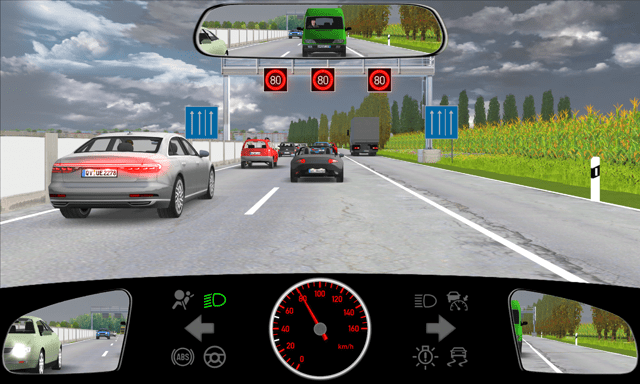
Explicación
The traffic sign indicates that the hard shoulder is to be used like the right-hand lane.
-
Pregunta 10 de 11
En esta situación, ¿qué es correcto con respecto al uso del arcén?
2.2.07-0134 puntos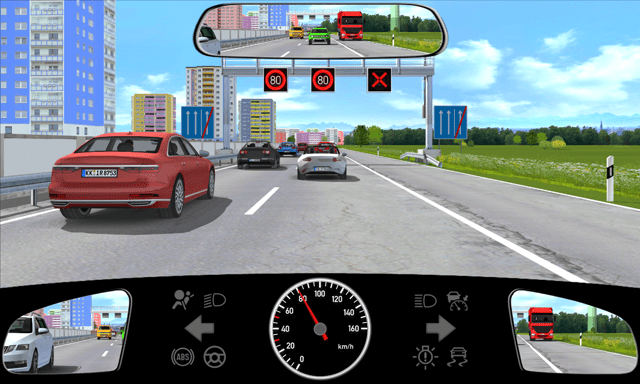
Explicación
The hard shoulder may not be used regularly. You can only use it in case of a breakdown.
-
Pregunta 11 de 11
¿Cómo debe comportarse en este caso?
2.2.07-0144 puntosExplicación
If one of the lanes ends on a multi-lane road, vehicles must be allowed to move to the adjacent lane. Here it is important to drive with foresight in order to be able to react to lane changes in a timely manner and to adjust your own speed if necessary.