
2.2.07 Uso de faixas por veículos a motor
Mantenha-se previsível, mantenha-se à direita quando necessário e nunca ultrapasse pela direita. Em situações de pista difícil, reduza a velocidade antecipadamente e abra espaço em vez de forçar a sua prioridade.
Mantenha certo
Fora das áreas urbanas, utilize a faixa da direita quando esta estiver livre. Mova-se para a esquerda apenas para ultrapassar veículos mais lentos.
Não passe nas filas
Espere atrás do último veículo na sua faixa. Não tente passar a fila por nenhum dos lados.
Desacelere primeiro
Quando alguém puder fazer uma fusão, uma faixa terminar ou uma ultrapassagem não for permitida, reduza a velocidade e crie espaço.
As regras básicas
1. Regra de condução pela direita
Na Alemanha, normalmente conduzimos pela direita. Se não houver nenhum veículo mais lento à sua frente, volte para a faixa da direita.
2. Exceção de áreas construídas
Dentro das áreas urbanas, veículos de até 3,5 toneladas poderão escolher livremente sua faixa. A exigência estrita da faixa da direita não se aplica a eles lá.
3. Ultrapassar apenas pela esquerda
Se um veículo na faixa da esquerda for mais lento que você, não o ultrapasse pela direita. Fique para trás e reduza sua velocidade.
4. Não force seu direito de passagem
Se outro motorista estiver entrando ou fazendo fusão e você não puder mudar de faixa com segurança, diminua a velocidade e deixe espaço.
Situações de exame simplificadas
Você está na faixa do meio ou da esquerda, mas a faixa da direita está livre
Ação correta: Volte para a faixa da direita. Você poderá usar novamente a faixa do meio ou da esquerda somente ao ultrapassar um trânsito mais lento.
Um caminhão rápido pode sair para ultrapassar
Ação correta: Espere que o caminhão mude de faixa e esteja pronto para frear. Não vá para a esquerda se um carro já estiver logo atrás de você.
Um carro acelera na pista de aceleração
Ação correta: Ajude o motorista a fazer a fusão reduzindo sua velocidade, especialmente quando mudar para a faixa da esquerda não for seguro.
Uma pista está terminando
Ação correta: Use o princípio de mesclagem de zíper. Deixe os veículos da faixa final passarem para a faixa adjacente, um por um.
Você está na faixa do meio e ambas as mudanças laterais não são seguras
Ação correta: Permaneça na sua pista e reduza a velocidade. Não faça uma mudança de faixa arriscada para a esquerda ou para a direita.
Um carro mais lento está na faixa da esquerda
Ação correta: Não ultrapasse pela direita. Reduza a velocidade e espere até que seja possível ultrapassar pela esquerda.
Ombro duro
O acostamento não é uma pista normal. Normalmente, você pode usá-lo apenas em caso de emergência, como uma avaria.
Exceção: se um sinal de trânsito abre o acostamento, ele deve ser utilizado como faixa da direita.
Sinais de direção
Alguns sinais mostram que você deve escolher logo sua direção. Utilize as faixas da esquerda apenas se pretender virar à esquerda.
Antecipe-se com antecedência para não precisar de mudanças repentinas ou perigosas de faixa.
Lista de verificação de memória
Perguntas de Prática (11)
-
Pergunta 1 de 11
Which motor vehicles may freely choose their lane inside built-up areas?
2.2.07-0023 PontosCorreto: 3
Explicação
In Germany, the legal driving requirement applies. Vehicles up to 3.5 tons are excluded from the right-hand drive requirement within built-up areas and can freely choose their lane.
-
Pergunta 2 de 11
What is the right course of action now?
2.2.07-0043 PontosExplicação
In Germany, you must drive on the right. As there is no vehicle in front of you that is travelling slower than you, you must move into the right lane. As soon as slower vehicles appear, you may move back into the centre or left lane to overtake them.
-
Pergunta 3 de 11
How could a dangerous situation arise?
2.2.07-0055 PontosExplicação
The fast driving style of the yellow truck suggests that he will overtake the blue truck in front of him as well. Their speed is faster than that of the trucks. You cannot dodge to the left as a car on the left lane is directly behind you. If the yellow truck swings out, you have to brake hard.
-
Pergunta 4 de 11
What should you do?
2.2.07-0072 PontosExplicação
Stay on the middle lane and delay. The leading car will also delay soon to let the car on the left lane merge into traffic, because this lane ends. You cannot go to the left, changing to the right lane would be too dangerous as well.
-
Pergunta 5 de 11
What is the right course of action?
2.2.07-0085 PontosExplicação
You drive on the middle lane and in this situation you have to stay on the lane and reduce the speed. The driver on the left lane drives more slowly. You must not overtake him from the right. You cannot change to the right lane, there is a vehicle.
-
Pergunta 6 de 11
What must you anticipate in this situation?
2.2.07-0095 PontosExplicação
Since the vehicle drives very fast from the right onto the freeway, you have to expect that it will change to the middle lane. This impression is reinforced by the fact that trucks maintain their speed and distance.
-
Pergunta 7 de 11
What is the right course of action?
2.2.07-0105 PontosExplicação
A car drives in front of you and from the right a car drives onto the main carriageway of the freeway. It is clear that the car driving on the left lane has a slower pace than you. Since it's only allowed to overtake on the left, you must delay and reduce your speed.
-
Pergunta 8 de 11
You are driving on a road that has several marked lanes going in one direction. When should the alternate merging procedure be employed?
2.2.07-0113 PontosExplicação
The zipper merge is to be used when a lane cannot be used any further. The exception is on the motorway.
-
Pergunta 9 de 11
What is true about using the hard shoulder in this situation?
2.2.07-0124 Pontos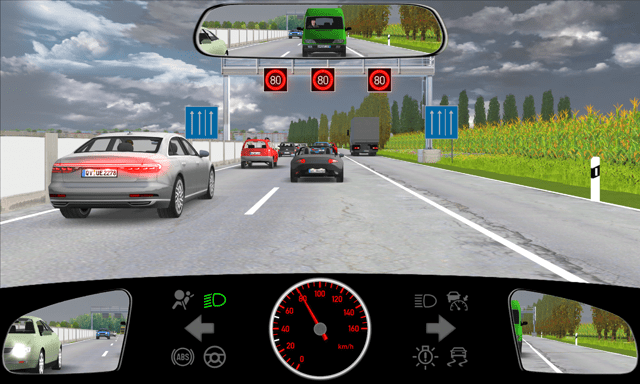
Explicação
The traffic sign indicates that the hard shoulder is to be used like the right-hand lane.
-
Pergunta 10 de 11
What is true in this situation about using the hard shoulder?
2.2.07-0134 Pontos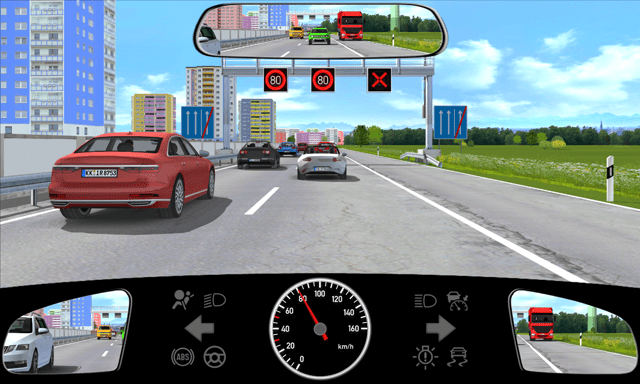
Explicação
The hard shoulder may not be used regularly. You can only use it in case of a breakdown.
-
Pergunta 11 de 11
What is the right behaviour now?
2.2.07-0144 PontosExplicação
If one of the lanes ends on a multi-lane road, vehicles must be allowed to move to the adjacent lane. Here it is important to drive with foresight in order to be able to react to lane changes in a timely manner and to adjust your own speed if necessary.