
1.2.02 Uso da estrada
1. Usando o ombro direito

O acostamento (Standstreifen) é estritamente reservado para emergências. Não é uma faixa extra para dirigir, parar ou estacionar, a menos que seja explicitamente sinalizada.
Ações Corretas
Use somente se o seu veículo quebrar.
Use quando os sinais de trânsito permitirem explicitamente (por exemplo, durante congestionamentos intensos).
Ações Proibidas
Não o utilize para ultrapassar veículos mais lentos.
Não pare para fazer uma pausa ou para fazer uma ligação.
2. Pista errada – o que fazer?

Perceber que você está em uma faixa de conversão quando pretendia seguir em frente pode ser estressante. No entanto, a segurança tem prioridade sobre o seu percurso.
thumb_up Fazer
Continue na direção das setas da pista.
Encontre um lugar seguro para voltar mais tarde.
thumb_down Não
Não pare abruptamente no trânsito.
Não tente mudar de faixa em linhas sólidas.
Nunca dê ré em uma pista ativa.
3. Situações Complexas
directions_car Ruas estreitas com carros estacionados
Ao passar por veículos estacionados, você deve manter uma distância segura para compensar a abertura de portas.
- Mantenha pelo menos 1,0 metro distância lateral.
- O tráfego em sentido contrário tem prioridade se a obstrução estiver do seu lado.
- Espere em uma brecha se a rua for estreita demais para dois carros.
agriculture Encontrando carruagens puxadas por cavalos
Os cavalos podem ser imprevisíveis. O ruído e a proximidade podem assustá-los.
- Ultrapassar com um amplo espaço e baixo ruído do motor.
- Não acelere o motor nem buzine.
4. Direito de passagem e velocidade
Regras fundamentais para cruzamentos e estradas de alta velocidade.
Direito antes da esquerda
Aplica-se em todos os cruzamentos sem semáforos ou sinais de prioridade.
Renda-se aos veículos vindos da sua direita.
Requisitos da autoestrada
Seu veículo deve ser mecanicamente capaz de atingir determinadas velocidades.
Velocidade de projeto > 60 km/h necessária.
A velocidade recomendada (Richtgeschwindigkeit) é de 130 km/h.
Resumo ultracurto do exame
Ombro duro é para apenas emergências.
Pista errada? Siga-o, então vire-se com segurança.
Passe cavalos lenta e silenciosamente.
Direito antes da esquerda aplica-se se não existirem sinais.
A entrada na Autobahn exige capacidade do veículo de > 60 km/h.
Perguntas de Prática (8)
-
Pergunta 1 de 8
When may you use the right-hand hard shoulder?
1.2.02-1013 Pontos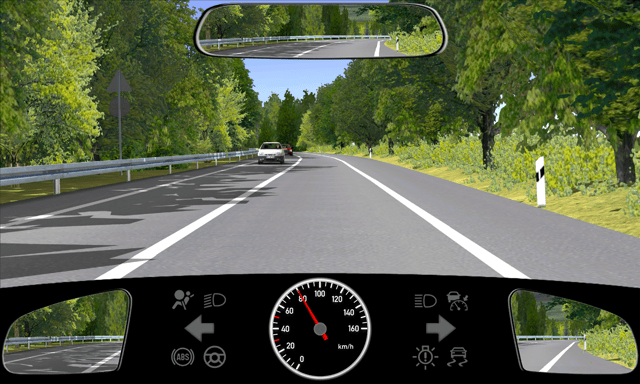
Explicação
The right side strip may be used in the following cases: 1. for holding and parking, 2. for slow moving vehicles such as mopeds or agricultural tractors and machinery. These should use the right side strip to avoid traffic obstructions and traffic jams. The side strip must be attached and have a sufficient width. It is forbidden in any case to use the side strip for overtaking.
-
Pergunta 2 de 8
You have manoeuvred into the left lane by mistake, but would like to take a right turn. What is the right course of action?
1.2.02-1044 Pontos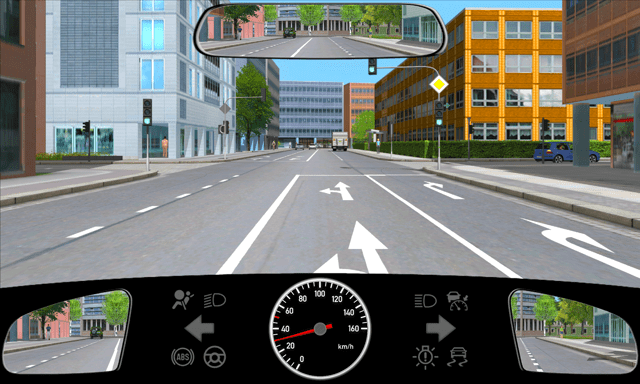
Explicação
With a solid line as a road edge marking, you must under no circumstances turn right. Rather, you must stay in your lane and continue straight or turn left.
-
Pergunta 3 de 8
When driving on main roads, which vehicles must use the hard shoulders where possible?
1.2.02-1063 PontosExplicação
Slow-moving vehicles such as tractors, mopeds must use the hard shoulder. Other vehicles that go faster than 45km/h need to remain on the road
-
Pergunta 4 de 8
What should you do in this situation?
1.2.02-1073 PontosExplicação
In a street where vehicles park on both sides, the range of movement is limited. With only one lane, vehicles are equally important in both directions. Nevertheless, you should drive into a gap here to let an oncoming vehicle pass.
-
Pergunta 5 de 8
A horse-drawn carriage is coming towards you. What should you do?
1.2.02-1083 PontosExplicação
Drive as far to the right as possible when you encounter a horse-drawn carriage. Do not honk and do not drive at high motor speed. The animals could be sensitive to noise and be frightened. It might happen that they break out and run on your side of the road.
-
Pergunta 6 de 8
What is correct in this situation?
1.2.02-1092 Pontos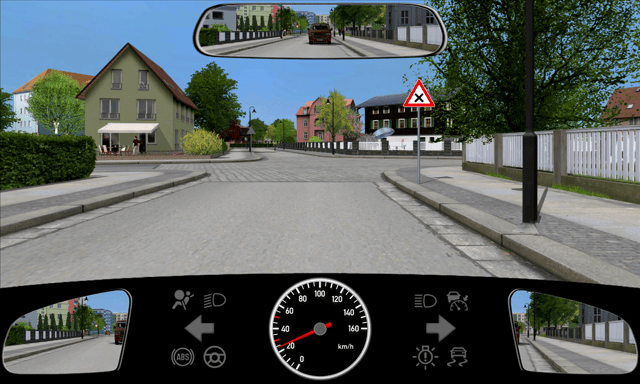
Explicação
At the traffic sign "Intersection or junction with right-of-way", you must follow the right-of-way rule "right before left". This applies to the nearest intersection.
-
Pergunta 7 de 8
What do you have to watch out for, when crossing a priority road?
1.2.02-1102 PontosExplicação
When crossing a priority road, you must keep in mind: 1. the width of the priority road, 2. the distance and speed of oncoming traffic, 3. the weather conditions. These are all the influences that are important for crossing the priority road. The weather influences the condition of the road and the visibility. Along with the road width, it determines how long you need to cross the priority road. By estimating the distance and the speed of oncoming traffic you can assess how much time you have available.
-
Pergunta 8 de 8
You want to use an autobahn. To allow you to do so, what type-specific maximum speed must be entered in Part I of the registration certificate or in the operating licence?
1.2.02-1113 PontosCorreto: 60
Explicação
According to the German Road Traffic Regulations (Straßenverkehrsordnung - StVO), motorways may only be used by vehicles with a maximum design speed of more than 60 km / h.