
2.2.17 Iluminação
Aprenda as regras de iluminação mais importantes para o exame de direção alemão de forma simples e visual. Concentre-se na visibilidade, segurança e uso correto das luzes durante diferentes situações climáticas e rodoviárias.
🔵 Farol Alto (Fernlicht)
Fatos importantes
- Luz azul do painel = farol alto ligado
- Use farol alto apenas em estradas escuras
- Desligue-o para trânsito em sentido contrário
- Não cegue outros motoristas
- Não use em estradas bem iluminadas
Quando desligar
- Veículos se aproximando
- Nos cruzamentos ferroviários
- Ao dirigir atrás de outro veículo
- Quando a assistência do farol alto falha
💡 Farol baixo (Abblendlicht)
Usar farol baixo:
- Ao entardecer
- À noite
- Em túneis
- Na chuva
- Na neve
- No nevoeiro
Por que é importante
- Você pode ver melhor
- Outros podem ver você melhor
- Melhora a segurança rodoviária
Lembrar
- Luzes de estacionamento NÃO são suficientes
- Luzes automáticas podem falhar no nevoeiro
- Ative manualmente, se necessário
🌫️ Faróis de neblina e faróis de neblina traseiros
Faróis de neblina
- Pode ser usado sob chuva forte, neblina ou neve
- Permitido durante o dia com pouca visibilidade
- Ajuda outras pessoas a ver seu veículo
Faróis de neblina traseiros
- Somente quando a visibilidade for inferior a 50 metros
- Use apenas em neblina intensa
- A luz amarela de advertência do painel mostra ativação
- Pode cegar os motoristas atrás de você
🚗 Regras de estacionamento e iluminação de veículos
- Os carros podem estacionar com luzes de estacionamento apenas dentro de áreas urbanas
- Fora de áreas construídas isso não é permitido
- Caminhões/reboques com mais de 3,5 t podem precisar de placas ou luzes de advertência de estacionamento
- Anexos que se estendem para fora do veículo precisam de iluminação e refletores extras
- Acessórios agrícolas longos precisam de refletores amarelos
⚙️ Ajuste correto do farol
Muito alto
O tráfego que se aproxima ficará ofuscado e inseguro.
Muito baixo
A estrada está mal iluminada e a visibilidade torna-se perigosa.
🧠 Dicas rápidas de memória para exames
Luz azul = Farol alto ligado
Luz amarela = Luz de neblina traseira acesa
Nunca dirija apenas com luzes de estacionamento
Use farol baixo em neblina, neve, chuva, túneis, crepúsculo e escuridão
Perguntas de Prática (18)
-
Pergunta 1 de 18
How can you tell whether the rear fog lamp is switched on?
2.2.17-0012 PontosExplicação
A look at the dashboard is enough and the car driver immediately recognizes from the yellow warning light that the rear fog-lamp is in operation. According to the highway traffic act, the warning light must be in direct field of vision.
-
Pergunta 2 de 18
Visibility is considerably reduced. When are you allowed to switch on fog headlamps?
2.2.17-0053 PontosExplicação
If the visibility during the day is badly affected by fog, snowfall or rain, then you, as a car driver, have to switch on to low beam. Only in weather conditions with strong visual impairment you may also turn on the fog lights.
-
Pergunta 3 de 18
You are driving at night on an unlit road. There is a motor vehicle travelling a short distance in front of you. Which lights must you have on?
2.2.17-0084 PontosExplicação
The car driver must turn on the low beam on his own vehicle in order not to blind vehicles driving in front of you nor oncoming traffic. Using high beam is out of the question, as it would dazzle the other driver.
-
Pergunta 4 de 18
The rear lighting systems of your car are covered. What has to be done?
2.2.17-0102 PontosExplicação
You must always attach a light carrier with all the rear lights to your vehicle. Keep in mind that you as a car driver are responsible for the effectiveness of the lighting equipment. A kilometer limit does not exist in this situation.
-
Pergunta 5 de 18
As a basic rule, what lights of a motor vehicle must be turned on when driving in darkness?
2.2.17-0123 PontosExplicação
In Germany it is compulsory to switch on the dipped headlights in the dark. When the low beam is switched on, you see more and you are also seen better.
-
Pergunta 6 de 18
When are you allowed to use fog headlamps also during the day?
2.2.17-1013 PontosExplicação
In the event of heavy weather-related visibility restriction due to fog, snow or rain, fog lights may be switched on during the day. These strong weather-related restrictions of visibility usually only occur in autumn and winter months. You are generally not allowed to drive with ice on the windscreen. You need to remove it before starting your journey.
-
Pergunta 7 de 18
When are you allowed to switch on rear fog lamps?
2.2.17-1023 PontosExplicação
The rear fog-lamps of your vehicle may only be used if the visibility is less than 50 m in heavy fog. Due to the high risk of glare, the lights can otherwise become a security risk for subsequent traffic.
-
Pergunta 8 de 18
Where is it sufficient to use your parking lights while your car is parked on an unlit roadway?
2.2.17-1033 PontosExplicação
Cars may only be parked on unlit roads with parking lights switched on within built-up areas. Because within built-up areas, people drive at lower speeds, so that the parked car can be detected in time. Outside built-up areas this is not permitted.
-
Pergunta 9 de 18
When must you use dipped headlights also during the day?
2.2.17-1094 PontosExplicação
If visibility is severely limited due to weather conditions - rain, fog, snowfall - you must use the prescribed lighting equipment, usually low beam, even during the daytime driving. This is necessary to be seen better by other road users and to help you see the others better.
-
Pergunta 10 de 18
During twilight or the hours of darkness, when must you have your side lights switched on as a minimum requirement?
2.2.17-1113 PontosExplicação
At dusk and in the dark always drive with low beam. So, you are clearly visible and you can see well yourself. Vehicles are not allowed to only drive with parking light, because the luminosity of these lights, which are also known as the sidelights, is not sufficient.
-
Pergunta 11 de 18
When do you have to switch on your dipped headlights?
2.2.17-1144 PontosExplicação
In poor visibility you must always turn on the low beam. This is always the case during dusk, in darkness or in weather-related poor visibility conditions such as rain, fog or snow. Even if you drive through a tunnel, you must always turn on the low beam.
-
Pergunta 12 de 18
What can be the consequence of wrongly setting the headlamp levelling control?
2.2.17-1153 PontosExplicação
If the headlights are set too high, you will dazzle oncoming traffic. If the headlights are set too low, they will barely illuminate the road and you will not have sufficient visibility ahead. If the headlights are set incorrectly, the lights may not turn off completely.
-
Pergunta 13 de 18
What is the function of your vehicle’s high-beam assist during hours of darkness?
2.2.17-1163 PontosExplicação
The assistant switches the high beam on and off automatically so that other road users are not dazzled. The high beam is only switched on automatically if the road is not sufficiently lit.
-
Pergunta 14 de 18
In what situation might your high-beam assist be unable to dim your vehicle’s high beam in good time when encountering oncoming traffic?
2.2.17-1173 PontosExplicação
When crossing a crest and driving through a bend, the high beam assist camera may not be able to recognise oncoming traffic in time. Switch off the high beam manually when you notice it so as not to dazzle oncoming traffic and endanger yourself.
-
Pergunta 15 de 18
The automatic lighting system is activated on your car. What should you anticipate when driving in the lighting conditions shown?
2.2.17-1183 Pontos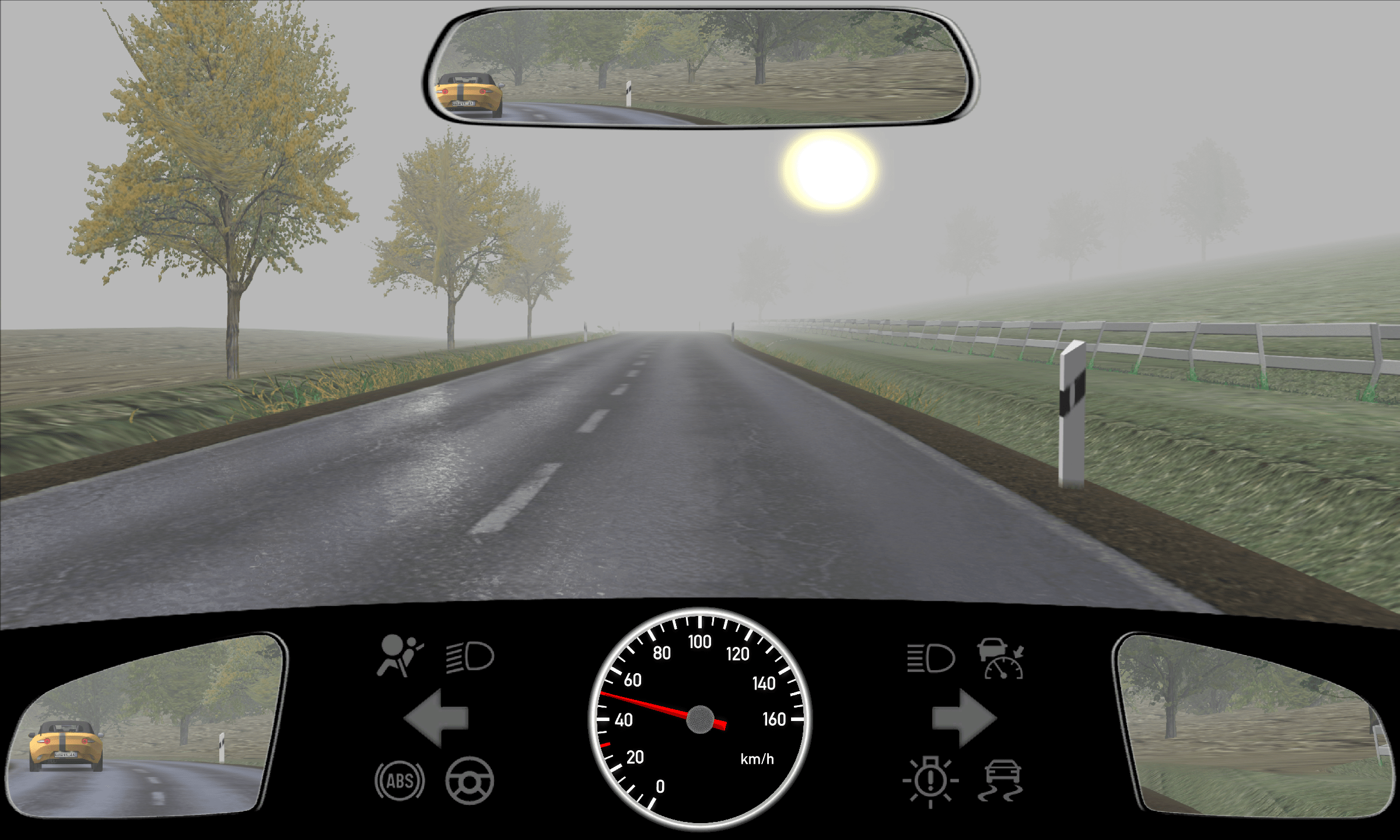
Explicação
The light and visibility conditions are poor due to the low sun and foggy air. However, the automatic light system does not recognise poor light conditions. Switch on the low beam manually so that following road users can see you better.
-
Pergunta 16 de 18
You are driving with main beam lights on in darkness. When do you have to dip your headlights?
2.2.17-4024 PontosExplicação
You must not dazzle the oncoming traffic with high beam. So, turn it off immediately if you realize that other vehicles are driving towards you. Pedestrians will not be dazzled by your high beam if they travel in the same direction as you.
-
Pergunta 17 de 18
You are driving with main beam lights on in darkness. When do you have to dip your headlights?
2.2.17-4033 PontosExplicação
When driving in the dark with high beam, you need to turn it off when approaching oncoming traffic. You are not allowed to drive with high beam on roads that have sufficient lighting throughout. The head lamps of waiting vehicles should not blind others. That's why you have to dip your lights at railroad crossings. If pedestrians precede in the same direction, they are not dazzled by the high beam.
-
Pergunta 18 de 18
Why must you also drive with dipped headlight during the day when visibility is impaired by fog, rain or falling snow?
2.2.17-4044 PontosExplicação
If visibility is poor during the day, due to weather conditions such as rain, fog or snow, you as the driver must switch on the low beam. The primary concern here is that your vehicle is better seen by other road users. The traffic signs are not better seen from a greater distance.