
2.2.17 Beleuchtung
Hier lernen Sie die wichtigsten Regeln zur Beleuchtung für die Theorieprüfung. Es geht darum, gut zu sehen, gut gesehen zu werden und bei jedem Wetter das richtige Licht einzuschalten.
🔵 Fernlicht
Das Wichtigste
- Blaue Kontrollleuchte = Fernlicht ist an
- Fernlicht nur auf dunklen Straßen benutzen
- Bei Gegenverkehr abblenden
- Niemanden blenden
- Auf Straßen mit durchgehender, ausreichender Beleuchtung nicht benutzen
Wann Sie abblenden müssen
- Wenn Ihnen ein Fahrzeug entgegenkommt
- Wenn Sie vor einem Bahnübergang warten und andere blenden würden
- Wenn ein Fahrzeug mit geringem Abstand vor Ihnen fährt
- Wenn der Fernlichtassistent nicht rechtzeitig reagiert – etwa an Kuppen oder in Kurven
💡 Abblendlicht
Abblendlicht einschalten:
- In der Dämmerung
- Bei Dunkelheit
- Im Tunnel
- Bei Regen
- Bei Schneefall
- Bei Nebel
Warum das wichtig ist
- Sie sehen besser
- Andere sehen Sie besser
- Das macht den Verkehr sicherer
Denken Sie daran
- Standlicht allein reicht NICHT
- Bei Nebel schaltet die Lichtautomatik das Abblendlicht oft nicht ein – dann sieht man Sie von hinten erst spät
- Schalten Sie das Licht dann selbst ein
🌫️ Nebelscheinwerfer und Nebelschlussleuchte
Nebelscheinwerfer
- Erlaubt, wenn Nebel, Schneefall oder Regen die Sicht erheblich behindern
- Das gilt auch am Tag
- Andere sehen Ihr Fahrzeug dann besser
Nebelschlussleuchte
- Nur bei Sichtweite unter 50 m
- Nur bei Nebel – nicht bei Regen
- Eine gelbe Kontrollleuchte zeigt, dass sie an ist
- Sie kann den Hintermann blenden
🚗 Licht beim Parken und an besonderen Fahrzeugen
- Parken Sie einen Pkw nachts auf einer unbeleuchteten Straße, genügt innerorts die Parkleuchte
- Außerorts reicht sie nicht. Parken Sie dort zum Beispiel auf dem Seitenstreifen, müssen die Begrenzungsleuchten (Standlicht) an sein
- Lkws und Wohnmobile über 3,5 t sowie Anhänger, die innerorts im Dunkeln auf der Fahrbahn stehen, müssen immer beleuchtet oder mit Parkwarntafeln gekennzeichnet sein
- Anbaugeräte, die die Beleuchtung verdecken oder weit hinausragen (seitlich mehr als 40 cm, nach hinten mehr als 1 m), brauchen eigene Leuchten und Rückstrahler
- Zugmaschinen mit Anbaugerät über 6 m Länge, Anhänger und angehängte Arbeitsgeräte brauchen seitlich gelbe Rückstrahler
⚙️ Leuchtweitenregelung richtig einstellen
Zu hoch
Ihr Abblendlicht blendet den Gegenverkehr. Das ist gefährlich.
Zu niedrig
Die Leuchtweite ist zu gering. Sie sehen die Straße vor sich zu schlecht.
🧠 Kurz gemerkt
Blaue Kontrollleuchte = Fernlicht an
Gelbe Kontrollleuchte = Nebelschlussleuchte an
Nie nur mit Standlicht fahren
Abblendlicht bei Nebel, Schneefall, Regen, im Tunnel, in der Dämmerung und bei Dunkelheit
Übungsfragen (18)
-
Frage 1 von 18
Woran können Sie erkennen, ob die Nebelschlussleuchte eingeschaltet ist?
2.2.17-0012 PunkteErklärung
A look at the dashboard is enough and the car driver immediately recognizes from the yellow warning light that the rear fog-lamp is in operation. According to the highway traffic act, the warning light must be in direct field of vision.
-
Frage 2 von 18
Die Sicht ist erheblich behindert. Wann dürfen Sie Nebelscheinwerfer einschalten?
2.2.17-0053 PunkteErklärung
If the visibility during the day is badly affected by fog, snowfall or rain, then you, as a car driver, have to switch on to low beam. Only in weather conditions with strong visual impairment you may also turn on the fog lights.
-
Frage 3 von 18
Sie fahren nachts auf unbeleuchteter Straße. Ein Fahrzeug fährt in geringem Abstand voraus. Welches Licht müssen Sie dabei eingeschaltet haben?
2.2.17-0084 PunkteErklärung
The car driver must turn on the low beam on his own vehicle in order not to blind vehicles driving in front of you nor oncoming traffic. Using high beam is out of the question, as it would dazzle the other driver.
-
Frage 4 von 18
Die hinteren Beleuchtungseinrichtungen Ihres Kraftfahrzeugs sind verdeckt. Was ist zu tun?
2.2.17-0102 PunkteErklärung
You must always attach a light carrier with all the rear lights to your vehicle. Keep in mind that you as a car driver are responsible for the effectiveness of the lighting equipment. A kilometer limit does not exist in this situation.
-
Frage 5 von 18
Welche Beleuchtungseinrichtung müssen Sie bei einer Fahrt in Dunkelheit an Ihrem Kraftfahrzeug grundsätzlich einschalten?
2.2.17-0123 PunkteErklärung
In Germany it is compulsory to switch on the dipped headlights in the dark. When the low beam is switched on, you see more and you are also seen better.
-
Frage 6 von 18
Wann dürfen Sie auch am Tage Nebelscheinwerfer einschalten?
2.2.17-1013 PunkteErklärung
In the event of heavy weather-related visibility restriction due to fog, snow or rain, fog lights may be switched on during the day. These strong weather-related restrictions of visibility usually only occur in autumn and winter months. You are generally not allowed to drive with ice on the windscreen. You need to remove it before starting your journey.
-
Frage 7 von 18
Wann dürfen Sie Nebelschlussleuchten einschalten?
2.2.17-1023 PunkteErklärung
The rear fog-lamps of your vehicle may only be used if the visibility is less than 50 m in heavy fog. Due to the high risk of glare, the lights can otherwise become a security risk for subsequent traffic.
-
Frage 8 von 18
Wo genügen beim Parken eines Pkws auf unbeleuchteten Straßen Parkleuchten?
2.2.17-1033 PunkteErklärung
Cars may only be parked on unlit roads with parking lights switched on within built-up areas. Because within built-up areas, people drive at lower speeds, so that the parked car can be detected in time. Outside built-up areas this is not permitted.
-
Frage 9 von 18
Wann müssen Sie auch am Tage mit Abblendlicht fahren?
2.2.17-1094 PunkteErklärung
If visibility is severely limited due to weather conditions - rain, fog, snowfall - you must use the prescribed lighting equipment, usually low beam, even during the daytime driving. This is necessary to be seen better by other road users and to help you see the others better.
-
Frage 10 von 18
In welchen Fällen müssen Sie bei Dämmerung oder Dunkelheit nur die Begrenzungsleuchten (Standlicht) einschalten?
2.2.17-1113 PunkteErklärung
At dusk and in the dark always drive with low beam. So, you are clearly visible and you can see well yourself. Vehicles are not allowed to only drive with parking light, because the luminosity of these lights, which are also known as the sidelights, is not sufficient.
-
Frage 11 von 18
Wann müssen Sie Abblendlicht einschalten?
2.2.17-1144 PunkteErklärung
In poor visibility you must always turn on the low beam. This is always the case during dusk, in darkness or in weather-related poor visibility conditions such as rain, fog or snow. Even if you drive through a tunnel, you must always turn on the low beam.
-
Frage 12 von 18
Was kann eine falsche Einstellung der manuellen Leuchtweitenregelung zur Folge haben?
2.2.17-1153 PunkteErklärung
If the headlights are set too high, you will dazzle oncoming traffic. If the headlights are set too low, they will barely illuminate the road and you will not have sufficient visibility ahead. If the headlights are set incorrectly, the lights may not turn off completely.
-
Frage 13 von 18
Welche Funktion soll der Fernlichtassistent bei Dunkelheit erfüllen?
2.2.17-1163 PunkteErklärung
The assistant switches the high beam on and off automatically so that other road users are not dazzled. The high beam is only switched on automatically if the road is not sufficiently lit.
-
Frage 14 von 18
In welcher Situation kann der Fernlichtassistent Ihres Kraftfahrzeugs bei Gegenverkehr möglicherweise nicht rechtzeitig abblenden?
2.2.17-1173 PunkteErklärung
When crossing a crest and driving through a bend, the high beam assist camera may not be able to recognise oncoming traffic in time. Switch off the high beam manually when you notice it so as not to dazzle oncoming traffic and endanger yourself.
-
Frage 15 von 18
An Ihrem Pkw ist das automatische Lichtsystem aktiviert. Womit müssen Sie bei den dargestellten Lichtverhältnissen rechnen?
2.2.17-1183 Punkte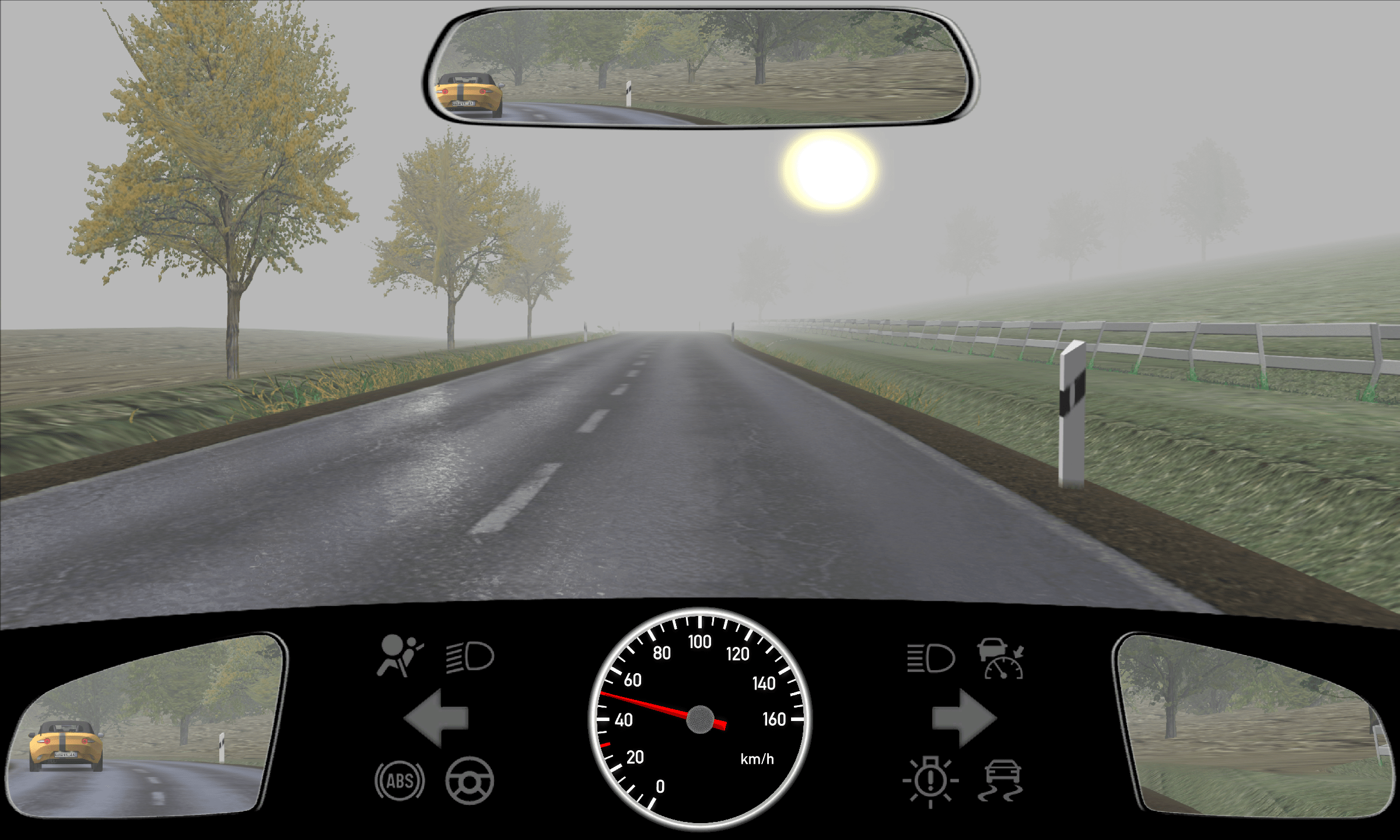
Erklärung
The light and visibility conditions are poor due to the low sun and foggy air. However, the automatic light system does not recognise poor light conditions. Switch on the low beam manually so that following road users can see you better.
-
Frage 16 von 18
Sie fahren bei Dunkelheit mit Fernlicht. Wann müssen Sie abblenden?
2.2.17-4024 PunkteErklärung
You must not dazzle the oncoming traffic with high beam. So, turn it off immediately if you realize that other vehicles are driving towards you. Pedestrians will not be dazzled by your high beam if they travel in the same direction as you.
-
Frage 17 von 18
Sie fahren bei Dunkelheit mit Fernlicht. Wann müssen Sie abblenden?
2.2.17-4033 PunkteErklärung
When driving in the dark with high beam, you need to turn it off when approaching oncoming traffic. You are not allowed to drive with high beam on roads that have sufficient lighting throughout. The head lamps of waiting vehicles should not blind others. That's why you have to dip your lights at railroad crossings. If pedestrians precede in the same direction, they are not dazzled by the high beam.
-
Frage 18 von 18
Warum müssen Sie auch am Tage mit Abblendlicht fahren, wenn die Sicht durch Nebel, Regen oder Schneefall erheblich behindert ist?
2.2.17-4044 PunkteErklärung
If visibility is poor during the day, due to weather conditions such as rain, fog or snow, you as the driver must switch on the low beam. The primary concern here is that your vehicle is better seen by other road users. The traffic signs are not better seen from a greater distance.