
2.2.17 Éclairage
Apprenez les règles d'éclairage les plus importantes pour l'examen de conduite allemand de manière simple et visuelle. Concentrez-vous sur la visibilité, la sécurité et l'utilisation correcte des lumières dans différentes situations météorologiques et routières.
🔵 Feux de route (Fernlicht)
Faits importants
- Voyant bleu du tableau de bord = les feux de route sont allumés
- Utilisez les feux de route uniquement sur les routes sombres
- Désactivez-le pour le trafic venant en sens inverse
- N'aveuglez pas les autres conducteurs
- Ne pas utiliser sur des routes bien éclairées
Quand éteindre
- Véhicules en approche
- Aux passages à niveau
- Lorsque vous conduisez derrière un autre véhicule
- Lorsque l'assistance aux feux de route échoue
💡 Feux de croisement (Abblendlicht)
Utiliser les feux de croisement :
- Au crépuscule
- La nuit
- Dans les tunnels
- Sous la pluie
- Dans la neige
- Dans le brouillard
Pourquoi c'est important
- Tu peux mieux voir
- Les autres peuvent mieux vous voir
- Améliore la sécurité routière
Souviens-toi
- Les feux de stationnement ne suffisent PAS
- Les feux automatiques peuvent tomber en panne dans le brouillard
- Allumez manuellement si nécessaire
🌫️ Feux antibrouillard et feux antibrouillard arrière
Feux antibrouillard
- Peut être utilisé en cas de forte pluie, de brouillard ou de neige
- Autorisé de jour en cas de mauvaise visibilité
- Aide les autres à voir votre véhicule
Feux antibrouillard arrière
- Uniquement lorsque la visibilité est inférieure à 50 mètres
- Utiliser uniquement en cas de brouillard épais
- Le voyant jaune du tableau de bord indique l'activation
- Peut aveugler les conducteurs derrière vous
🚗 Règles de stationnement et d'éclairage des véhicules
- Les voitures peuvent stationner avec des feux de stationnement uniquement à l'intérieur des zones bâties.
- En dehors des agglomérations, cela n'est pas autorisé
- Les camions/remorques de plus de 3,5 t peuvent avoir besoin de panneaux d'avertissement ou de feux de stationnement.
- Les accessoires s'étendant loin à l'extérieur du véhicule nécessitent un éclairage et des réflecteurs supplémentaires
- Les longs accessoires agricoles nécessitent des réflecteurs jaunes
⚙️ Réglage correct des phares
Trop haut
Le trafic venant en sens inverse sera ébloui et dangereux.
Trop bas
La route est mal éclairée et la visibilité devient dangereuse.
🧠 Conseils pour la mémoire des examens rapides
Lumière bleue = Feux de route allumés
Lumière jaune = Feu antibrouillard arrière allumé
Ne conduisez jamais uniquement avec des feux de stationnement
Utilisez les feux de croisement dans le brouillard, la neige, la pluie, les tunnels, le crépuscule et l'obscurité
Questions d’entraînement (18)
-
Question 1 sur 18
A quoi reconnaissez-vous que les feux antibrouillards arrières sont allumés?
2.2.17-0012 pointsExplication
A look at the dashboard is enough and the car driver immediately recognizes from the yellow warning light that the rear fog-lamp is in operation. According to the highway traffic act, the warning light must be in direct field of vision.
-
Question 2 sur 18
La visibilité est très mauvaise. Quand pouvez-vous allumer les phares antibrouillards?
2.2.17-0053 pointsExplication
If the visibility during the day is badly affected by fog, snowfall or rain, then you, as a car driver, have to switch on to low beam. Only in weather conditions with strong visual impairment you may also turn on the fog lights.
-
Question 3 sur 18
Vous roulez de nuit sur une route non éclairée. Un véhicule vous précède à faible distance. Quel éclairage devez-vous adopter?
2.2.17-0084 pointsExplication
The car driver must turn on the low beam on his own vehicle in order not to blind vehicles driving in front of you nor oncoming traffic. Using high beam is out of the question, as it would dazzle the other driver.
-
Question 4 sur 18
Les phares arrière de votre véhicule sont masqués. Que faire?
2.2.17-0102 pointsExplication
You must always attach a light carrier with all the rear lights to your vehicle. Keep in mind that you as a car driver are responsible for the effectiveness of the lighting equipment. A kilometer limit does not exist in this situation.
-
Question 5 sur 18
Quel dispositif d'éclairage devez-vous en principe allumer sur votre véhicule lorsque vous conduisez dans l'obscurité?
2.2.17-0123 pointsExplication
In Germany it is compulsory to switch on the dipped headlights in the dark. When the low beam is switched on, you see more and you are also seen better.
-
Question 6 sur 18
Quand pouvez-vous allumer les phares antibrouillards également le jour?
2.2.17-1013 pointsExplication
In the event of heavy weather-related visibility restriction due to fog, snow or rain, fog lights may be switched on during the day. These strong weather-related restrictions of visibility usually only occur in autumn and winter months. You are generally not allowed to drive with ice on the windscreen. You need to remove it before starting your journey.
-
Question 7 sur 18
Quand pouvez-vous allumer les feux antibrouillards arrières?
2.2.17-1023 pointsExplication
The rear fog-lamps of your vehicle may only be used if the visibility is less than 50 m in heavy fog. Due to the high risk of glare, the lights can otherwise become a security risk for subsequent traffic.
-
Question 8 sur 18
Où, lors du stationnement d'une voiture dans une rue non éclairée, les feux de stationnement suffisent-ils?
2.2.17-1033 pointsExplication
Cars may only be parked on unlit roads with parking lights switched on within built-up areas. Because within built-up areas, people drive at lower speeds, so that the parked car can be detected in time. Outside built-up areas this is not permitted.
-
Question 9 sur 18
Quand devez-vous également rouler le jour en feux de croisement?
2.2.17-1094 pointsExplication
If visibility is severely limited due to weather conditions - rain, fog, snowfall - you must use the prescribed lighting equipment, usually low beam, even during the daytime driving. This is necessary to be seen better by other road users and to help you see the others better.
-
Question 10 sur 18
Au crépuscule ou dans l'obscurité, dans quels cas ne devez-vous allumer que les feux de position?
2.2.17-1113 pointsExplication
At dusk and in the dark always drive with low beam. So, you are clearly visible and you can see well yourself. Vehicles are not allowed to only drive with parking light, because the luminosity of these lights, which are also known as the sidelights, is not sufficient.
-
Question 11 sur 18
Quand devez-vous allumer les feux de croisement?
2.2.17-1144 pointsExplication
In poor visibility you must always turn on the low beam. This is always the case during dusk, in darkness or in weather-related poor visibility conditions such as rain, fog or snow. Even if you drive through a tunnel, you must always turn on the low beam.
-
Question 12 sur 18
Quel est l'impact d'un réglage manuel incorrect de la portée des phares?
2.2.17-1153 pointsExplication
If the headlights are set too high, you will dazzle oncoming traffic. If the headlights are set too low, they will barely illuminate the road and you will not have sufficient visibility ahead. If the headlights are set incorrectly, the lights may not turn off completely.
-
Question 13 sur 18
Quelle fonction doit remplir l'assistant de feux de route dans l'obscurité?
2.2.17-1163 pointsExplication
The assistant switches the high beam on and off automatically so that other road users are not dazzled. The high beam is only switched on automatically if the road is not sufficiently lit.
-
Question 14 sur 18
Dans quelle situation l'assistant de feux de route de votre voiture peut-il ne pas passer en feux de croisement à temps en cas de circulation en sens inverse?
2.2.17-1173 pointsExplication
When crossing a crest and driving through a bend, the high beam assist camera may not be able to recognise oncoming traffic in time. Switch off the high beam manually when you notice it so as not to dazzle oncoming traffic and endanger yourself.
-
Question 15 sur 18
Le système d'éclairage automatique est activé sur votre voiture. À quoi devez-vous vous attendre avec les conditions de luminosité exposées?
2.2.17-1183 points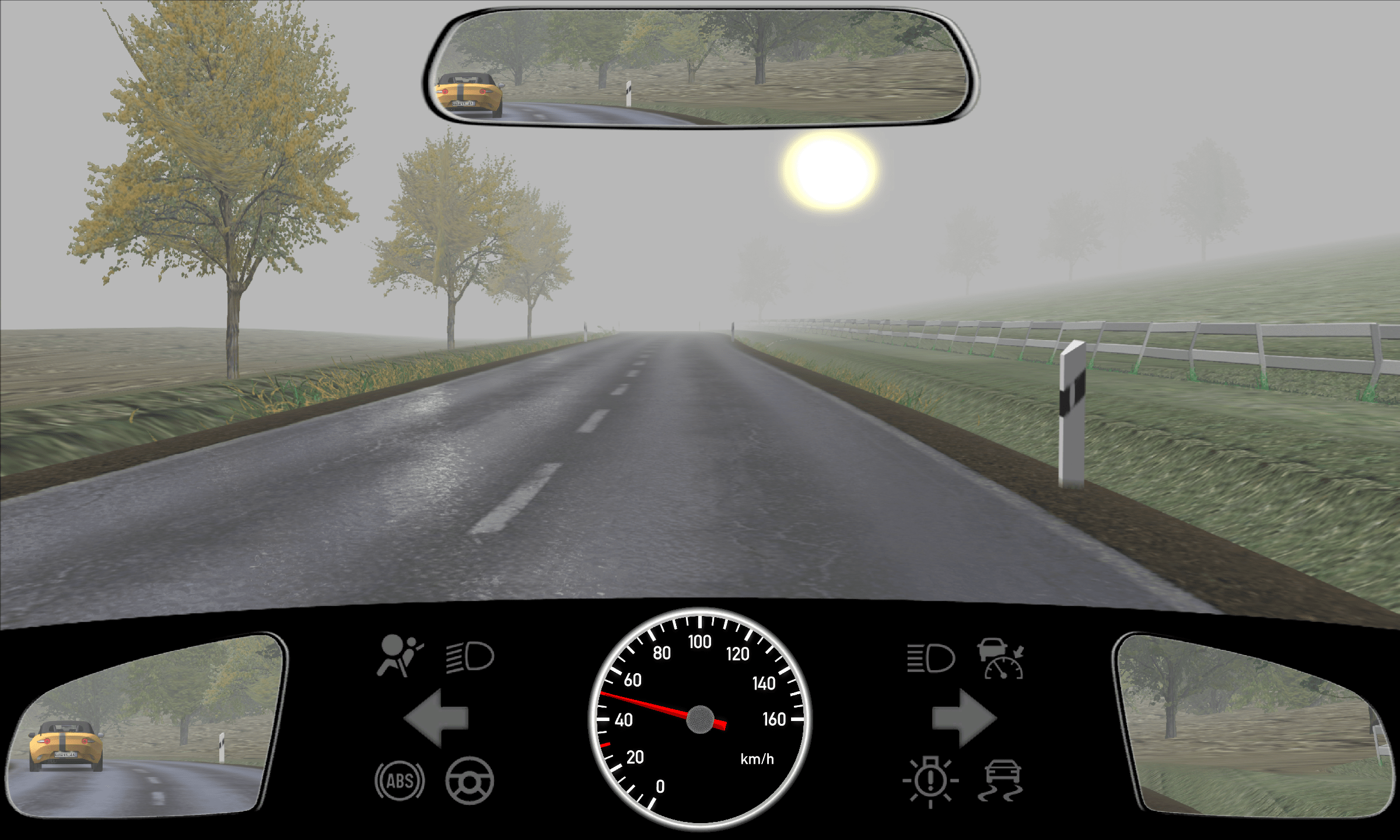
Explication
The light and visibility conditions are poor due to the low sun and foggy air. However, the automatic light system does not recognise poor light conditions. Switch on the low beam manually so that following road users can see you better.
-
Question 16 sur 18
Vous roulez dans l'obscurité avec vos feux de route allumés. Quand devez-vous les masquer?
2.2.17-4024 pointsExplication
You must not dazzle the oncoming traffic with high beam. So, turn it off immediately if you realize that other vehicles are driving towards you. Pedestrians will not be dazzled by your high beam if they travel in the same direction as you.
-
Question 17 sur 18
Vous roulez, la nuit, avec vos feux de route allumés. Quand devez-vous les éteindre?
2.2.17-4033 pointsExplication
When driving in the dark with high beam, you need to turn it off when approaching oncoming traffic. You are not allowed to drive with high beam on roads that have sufficient lighting throughout. The head lamps of waiting vehicles should not blind others. That's why you have to dip your lights at railroad crossings. If pedestrians precede in the same direction, they are not dazzled by the high beam.
-
Question 18 sur 18
Pourquoi devez-vous rouler avec vos feux de croisement allumés, même en journée, lorsque la visibilité est considérablement entravée par le brouillard, la pluie ou les chutes de neige?
2.2.17-4044 pointsExplication
If visibility is poor during the day, due to weather conditions such as rain, fog or snow, you as the driver must switch on the low beam. The primary concern here is that your vehicle is better seen by other road users. The traffic signs are not better seen from a greater distance.