
1.2.19 Passages à niveau
Voici les règles les plus importantes concernant les passages à niveau, les barrières ferroviaires, les feux clignotants, les croix de Saint-André et la priorité des trains, d'une manière simple et mémorable.
🧠 Règles de mémoire rapide
🚦 Lumière clignotante rouge
Arrêtez-vous immédiatement avant le Croix de Saint-André.
🚧 Abaisser la barrière
Ne traversez jamais lorsque les barrières commencent à s’abaisser.
🚂 Priorité aux trains
Véhicules ferroviaires toujours avoir la priorité.
⚠ Danger d'embouteillage
N'entrez jamais dans le passage à niveau si vous risquez de vous arrêter sur les rails.
🛑 Quand vous DEVEZ arrêter
🚫 Arrêtez immédiatement
- Des feux rouges clignotants apparaissent
- Les barrières commencent à baisser
- Les barrières sont fermées
- Un employé des chemins de fer agite un drapeau
- Un employé des chemins de fer montre un feu rouge
⚠ Pourquoi c'est important
- Les trains voyagent très vite
- Les trains ont besoin de longues distances de freinage
- Les barrières se ferment rapidement
- Les véhicules peuvent rester coincés
✖ Règles de la Croix de Saint-André
| Signe / Situation | Signification | Ce que vous devez faire |
|---|---|---|
| Croix de Saint-André | Le train est prioritaire | Attendez si le train approche |
| Feu rouge clignotant | Passage bloqué | Arrêtez immédiatement |
| Flèche clignotante | S'applique aux virages | Les véhicules qui tournent doivent s'arrêter |
| Symbole de foudre | Ligne aérienne électrique | Important pour les véhicules de grande taille |
✅ Comment traverser en toute sécurité
🚗 Comportement de conduite sécuritaire
- Réduire la vitesse avant de traverser
- Regardez attentivement dans les deux sens
- Écoutez les trains qui approchent
- Traversez rapidement et en toute sécurité
- Restez vigilant même avec des barrières ouvertes
❌ Comportement dangereux
- Contourner les barrières
- S'arrêter sur les rails
- Suivre aveuglément les autres voitures
- Ignorer les feux clignotants
- Traversée pendant les embouteillages
⭐ Situations particulières
🚛 Camions de plus de 7,5 t
En dehors des agglomérations, les poids lourds et les véhicules avec remorques doivent souvent attendre derrière la borne des 80 mètres.
🏭 Zones industrielles et forestières
Attendez-vous à des passages à niveau non protégés, sans barrières ni feux clignotants.
🚨 Système de barrière brisée
Ne traversez jamais si le système de barrière semble défectueux. Informez immédiatement la police.
🚩 Signaux du personnel ferroviaire
🚩 Drapeau Blanc-Rouge-Blanc
Le passage à niveau est bloqué. Vous devez vous arrêter et attendre à une distance sécuritaire.
🔴 Feu rouge du personnel ferroviaire
Les voies sont inaccessibles et les trains sont prioritaires. Ne traversez pas.
🎯 Conseils d'examen faciles
- Le train a toujours la priorité
- Arrêtez-vous aux feux rouges clignotants
- Ne vous arrêtez jamais sur les rails
- Une barrière ouverte ne signifie PAS une sécurité automatique
- Traversée pendant les embouteillages
- Contourner les barrières
- Ignorer le personnel ferroviaire
- Suivre d'autres véhicules trop tôt
Questions d’entraînement (19)
-
Question 1 sur 19
Quand devez-vous attendre devant un passage à niveau?
1.2.19-0023 pointsExplication
All road users are required to stop and wait immediately before a level crossing in the following situations: when the signal system's red flashing light comes on, when the barriers start to lower, when the barriers are closed, when a staff member waves a white-red-white flag , You must wait until the blockage is released again.
-
Question 2 sur 19
Un employé des chemins de fer agite une lampe rouge à un passage à niveau. Comment devez-vous vous comporter?
1.2.19-0043 pointsExplication
All car drivers and other road users must wait at a safe distance before the crossing if a member of the railway staff secures a low-traffic level crossing with a red light. Waving the red light means that the tracks are inaccessible and trains have priority.
-
Question 3 sur 19
A l'entrée d'une zone industrielle se trouve une croix de Saint-André avec le panonceau supplémentaire "Zone industrielle, céder le passage aux véhicules sur rails". A quoi devez-vous veiller dans ce secteur?
1.2.19-0083 pointsExplication
Even if there are no barriers and no diagonal crosses at the level crossings in the entire industrial area, motor vehicle drivers must give priority to all rail vehicles. Always expect a train to come, observe the railway lines accurately and approach the tracks only with moderate speed.
-
Question 4 sur 19
La position de la barrière du passage à niveau reste inchangée depuis un bout de temps. Comment devez-vous vous comporter?
1.2.19-0094 points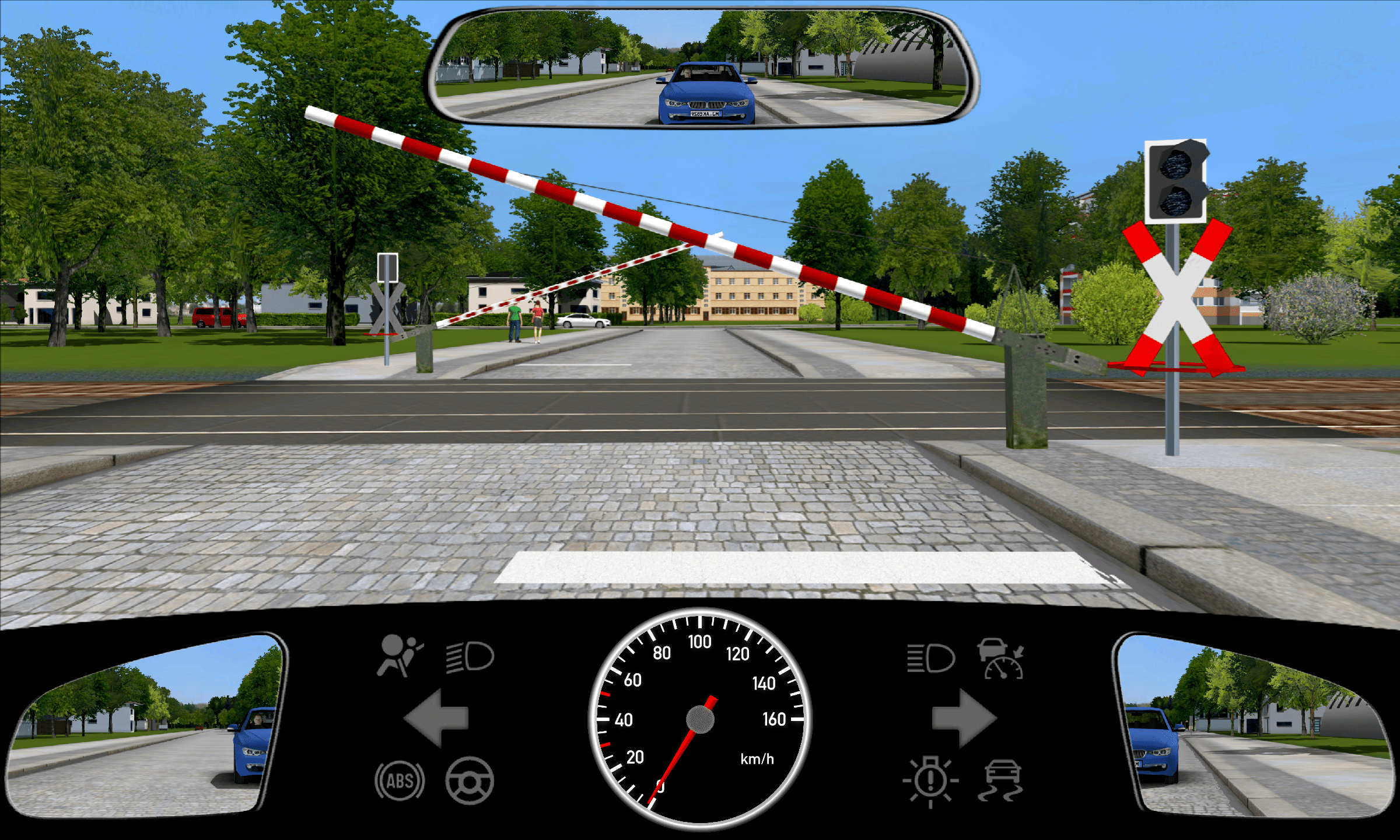
Explication
Apparently there is a fault with the railway barrier. It is therefore not safe to use the railway crossing. Do not cross the railway crossing under any circumstances; if a train is approaching, there is an acute danger to your life and there is also a risk that you will not be able to get through under the barriers and get stuck. Inform the police about the fault at the railway crossing so that the problem can be fixed.
-
Question 5 sur 19
Vous circulez sur un chemin forestier et vous approchez d'un passage à niveau sans croix de Saint-André. Comment devez-vous vous comporter?
1.2.19-1013 pointsExplication
Even without the diagonal cross, a car driver must always give priority to a rail vehicle on field and forest paths. Approach the railroad crossing at moderate speed and listen for a train approaching. Observe the track and stop, if necessary, to let the rail vehicle pass.
-
Question 6 sur 19
Comment devez-vous vous comporter devant un passage à niveau aux barrières baissées?
1.2.19-1023 pointsExplication
At a level crossing with closed gates, all car drivers have to wait in front of the diagonal cross. If there is no traffic sign, a safe distance to the rails must be observed. Be careful not to block intersections or T-junctions when waiting. In the dark, lighting must be switched on, parking light is sufficient.
-
Question 7 sur 19
Un train vient juste de passer. A quel moment pouvez-vous traverser un passage à niveau sans barrières mais équipé d'un système de feux clignotants?
1.2.19-1043 pointsExplication
You may only cross the level crossing after the red flashing light turns off, as another train could follow. Do not be fooled by oncoming traffic to drive on if the car driver waiting on the opposite site already starts driving too early after the train has passed through.
-
Question 8 sur 19
Vous vous approchez d'un passage à niveau à barrières. Où devez-vous attendre si vous voyez qu'à cause d'un encombrement de la circulation, vous resteriez à l'arrêt sur le passage à niveau?
1.2.19-1053 pointsExplication
If you are unable to pass the railroad crossing quickly due to slow traffic, then stop in front of the diagonal cross. Waiting directly in front of the rails or at the level of the barriers is prohibited, because at these positions you may be hit by the dynamic pressure of the train, by the train itself or trapped by the barriers.
-
Question 9 sur 19
A un passage à niveau - en agglomération -, les barrières sont baissées. Où devez-vous attendre?
1.2.19-1073 pointsExplication
Trucks and vehicles with trailers (vehicles over 7.5 t permissible total mass) are only required to wait outside of built-up areas behind the level crossing (80 m) ahead marker. Inside a built-up area they have to wait in front of the diagonal crosses.
-
Question 10 sur 19
Qu'annonce ce panneau?
1.2.19-1093 points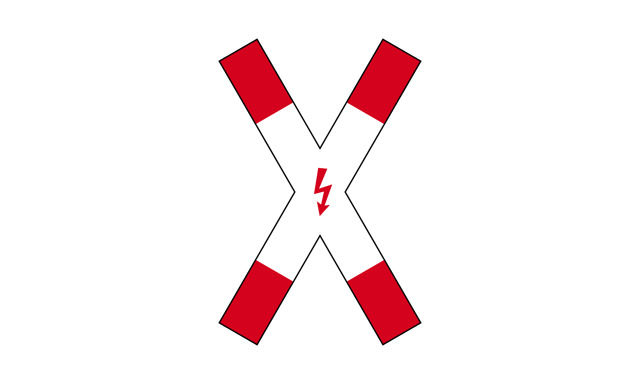
Explication
The diagonal crosses indicate that rail transport has priority here. As a car driver you need to wait when a rail vehicle is approaching. A lightning bolt in the diagonal cross is an indication of an electrical overhead line, which is important for special transports with a big height.
-
Question 11 sur 19
Avant un passage à niveau, un signal lumineux rouge sans croix de Saint-André se trouve devant une rue qui s'embouche par la droite. Où devez-vous vous arrêter?
1.2.19-1103 points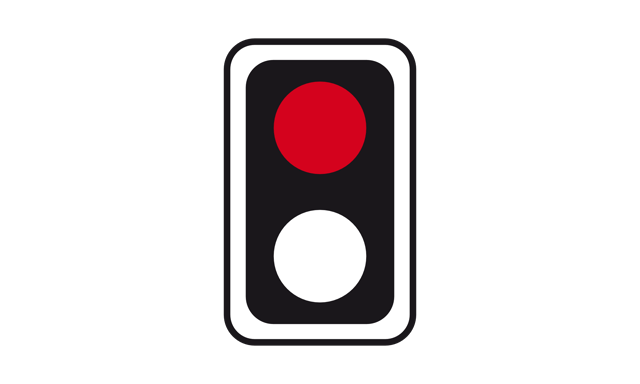
Explication
In the event of a red light, the car driver must stop in any case. In order not to block the traffic from the road going to the right, the red light is located several meters from the actual railroad crossing. Wait at the stop line or at the light sign if no line is available.
-
Question 12 sur 19
Quelle attitude adopter face à cette situation?
1.2.19-1113 points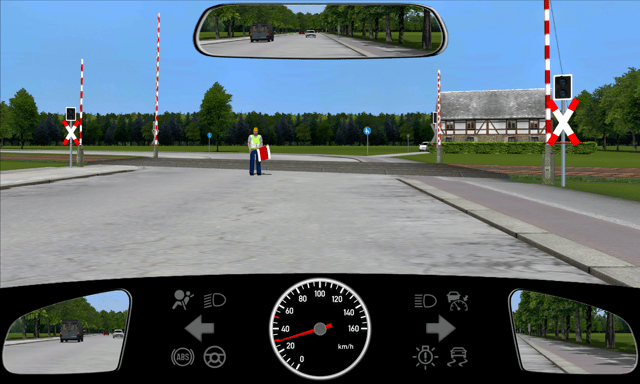
Explication
The railway employee secures the level crossing and therefore you should stop before the St. Andrew's cross.
-
Question 13 sur 19
Qui doit attendre en présence d'une croix de Saint-André avec flèche rouge clignotante vers la droite?
1.2.19-1123 pointsExplication
A diagonal cross with a red flashing light in the form of an arrow to the right can be found behind an intersection or T-junction after a railroad crossing. The right arrow indicates that the car drivers who turn right must wait.
-
Question 14 sur 19
Que signifie la présente association de ces deux panneaux de circulation?
1.2.19-1134 points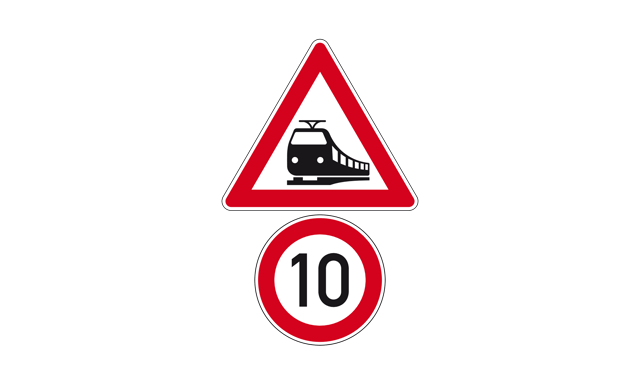
Explication
The traffic sign combination shows you a level crossing. The car driver may approach the level crossing only at 10 km/h and cross it at that speed.
-
Question 15 sur 19
Quel doit être maintenant le comportement correct?
1.2.19-1144 pointsExplication
If there is a risk that you might come to a stop on the rails due to a traffic jam situation or stagnant traffic, stop in front of the diagonal cross and wait until you can safely and quickly cross the level crossing. Fatal accidents occur when a car standing on the rails cannot avoid the approaching train.
-
Question 16 sur 19
Vous approchez d'un passage à niveau. La barrière se baisse. Comment devez-vous vous comporter?
1.2.19-1153 pointsExplication
When a driver approaches a gate that lowers, he/she must wait in front of the level crossing. This also applies if no rail vehicle is yet to be seen. Switching on the hazard light is not required.
-
Question 17 sur 19
À quel(s) endroit(s) faut-il s'attendre à des passages à niveau non techniquement sécurisés?
1.2.19-1163 pointsExplication
In industrial and port areas, on field and forest paths, as well as on roads with little traffic, you should expect a railway crossing without a barrier or traffic light (technically unprotected).
-
Question 18 sur 19
Vous souhaitez traverser un passage à niveau dont les barrières sont ouvertes. Que faut-il faire?
1.2.19-1173 pointsExplication
Even when the barriers are open, you must always approach level crossings with caution and at a moderate speed. This gives you enough time to react to possible bumps and dangerous situations. Moderate speed in this context does not mean walking speed, because you can also drive faster than walking speed. In this way you can prevent possible dangerous situations with approaching trains or lowering barriers.
-
Question 19 sur 19
Que dois-je faire maintenant?
1.2.19-1183 pointsExplication
Level crossings may not be crossed when the flashing lights above the St. Andrew's Cross are on or the barriers are lowered.