
1.1.02 Comportement envers les piétons
Les piétons sont les acteurs les plus vulnérables du trafic routier. En tant que conducteur, vous devez toujours anticiper leur comportement, en particulier les enfants et les personnes âgées qui peuvent ne pas respecter strictement les règles. Une conduite défensive et un comportement de type partenaire sont essentiels.
verified Principes de base de l'examen
Conduite défensive
Conduisez toujours en pensant que les piétons pourraient commettre des erreurs. Réduisez votre vitesse dans les zones à forte circulation piétonnière ou à visibilité limitée.
Comportement de type partenaire
N'insistez pas sur votre priorité si un piéton est déjà sur la route ou clairement confus. Donnez la priorité à la sécurité plutôt qu’au strict respect des règles.
child_care Enfants dans la circulation
Risque élevéComportement correct
- check Réduisez considérablement votre vitesse lorsque vous voyez des enfants jouer près de la route.
- check Soyez prêt à freiner immédiatement ; la distance de réaction compte.
- check Maintenez une distance latérale de sécurité lors des dépassements.
Mauvaises idées
- close En supposant que les enfants s’arrêteront sur le trottoir et regarderont des deux côtés.
- close Klaxonner pour avertir les enfants (cela pourrait les inciter à courir sur la route).
- close Accélérer pour les dépasser rapidement.
Note d'examen
Lors des questions d’examen, si vous voyez une balle rouler dans la rue, supposez TOUJOURS qu’un enfant courra après elle immédiatement sans regarder. La bonne réponse est toujours de freiner.
horizontal_rule Passages piétons (passages piétons)

Approche d'un passage piéton
Règle clé : Vitesse modérée et volonté de freiner.
Approchant
Approchez-vous à vitesse modérée. Si un piéton attend ou s’engage sur le passage à niveau, vous devez vous arrêter.
Interdiction de dépasser
Le dépassement sur un passage piéton est strictement interdit pour assurer la visibilité des piétons.
Arrêt
Ne vous arrêtez pas et ne vous garez pas directement sur le passage à niveau ou jusqu'à 5 mètres avant celui-ci.
Embouteillages
Gardez le passage à niveau dégagé si la circulation est bloquée. Ne bloquez pas le chemin pour les piétons.
directions_bus Bus, tramways et arrêts
1
Autobus s'approchant d'un arrêt avec les feux de détresse allumés
expand_more
Vous ne devez PAS dépasser le bus lorsqu'il est en mouvement. Restez derrière jusqu'à ce que ça s'arrête. Cela indique une situation dangereuse où des enfants pourraient traverser.
2
Bus à l'arrêt à l'arrêt avec les feux de détresse allumés
expand_more
Vous pouvez passer le bus à rythme de marche (4-7 km/h). Ceci s'applique au trafic dans LES DEUX directions (sauf s'il y a une barrière physique comme un terre-plein). Vous devez pouvoir vous arrêter immédiatement si un passager entre sur la route.
3
Passage des tramways
expand_more
Normalement, dépassez les tramways par la droite. Si des passagers montent ou descendent et qu’il n’y a pas d’îlot de sécurité, vous devez vous arrêter et attendre que la voie soit libre. Conduisez prudemment devant les tramways arrêtés.
warning Pièges typiques des examens
Le piège du « agitement »
Scénario: Un piéton attend de traverser mais hésite. Vous arrêtez.
Réponse piège : "J'agite la main pour faire signe au piéton de traverser."
Incorrect! Ne faites pas signe. Vous pourriez leur signaler un danger (par exemple, une voiture qui vous dépasse). Attendez patiemment.
Véhicules stationnés et visibilité limitée
Scénario: Nous roulons dans une rue étroite avec des voitures garées des deux côtés.
Objectif de l'examen : Vous devez vous attendre à ce que des piétons sortent de derrière les véhicules. Le comportement correct est toujours de réduire la vitesse et garder un grande distance latérale si possible.
Questions d’entraînement (33)
-
Question 1 sur 33
A quel comportement de la part des enfants devez-vous vous attendre aux passages pour piétons?
1.1.02-0055 pointsExplication
Children generally do not have the necessary training to always behave according to the rules in road traffic. Therefore, it is quite conceivable that they do not know the meaning of a zebra crossing and enter the road despite approaching vehicles or suddenly run back after crossing.
-
Question 2 sur 33
Que doit-on prévoir lorsque des enfants attendent à un feu de signalisation?
1.1.02-0224 pointsExplication
Due to a lack of life experience as well as insufficient education, children do not always behave according to the rules in road traffic and, for example, get into the lane during a scuffle. Furthermore, you must expect children to suddenly run across the road, even if the traffic lights are still red or the lights of the cross-traffic are just changing.
-
Question 3 sur 33
A quoi devez-vous vous attendre lorsque des personnes âgées traversent la chaussée avec un appareil orthopédique aidant à la marche?
1.1.02-0274 pointsExplication
When elderly people with walking aids cross the road, you have a higher duty of care. The principle of trust is suspended. You must expect these people to stop suddenly or turn around unexpectedly. Older people also take a comparatively long time to cross the road.
-
Question 4 sur 33
Malgré la présence d’un trottoir sur le côté droit de la chaussée, une personne en fauteuil roulant se déplace sur la chaussée. Quel est votre comportement?
1.1.02-0284 pointsExplication
Disabled and elderly people sometimes do not behave in a roadworthy manner due to physical limitations. Therefore, please be especially careful and be sure to show consideration. Expect the wheelchair user to suddenly and unexpectedly swerve and drive even further into the lane. In such situations, it is not permitted to use the horn or drive around the person at high speed.
-
Question 5 sur 33
Après avoir traversé la rue, une personne en fauteuil roulant ne parvient pas à franchir la bordure de trottoir avec son fauteuil roulant pour atteindre le trottoir. Quel est votre comportement?
1.1.02-0294 pointsExplication
You should help the person. To do this, you may stop and switch on the hazard warning lights to warn other road users of possible dangers. It is not permitted to honk your horn and drive around the person in this situation. This would frighten and unsettle the wheelchair user.
-
Question 6 sur 33
Avec quelle personne devez-vous vous attendre à une déficience visuelle?
1.1.02-0324 points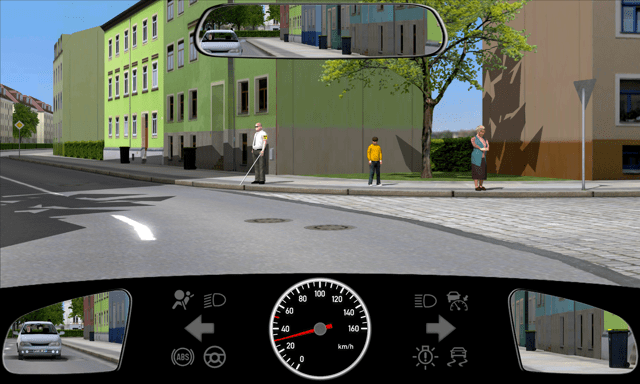
Explication
You must expect a severe visual impairment in the case of persons with the following markings: If a person is wearing a yellow armband with three black dots and/or a white blind person's cane extended diagonally.
-
Question 7 sur 33
Quel doit être votre comportement?
1.1.02-0394 points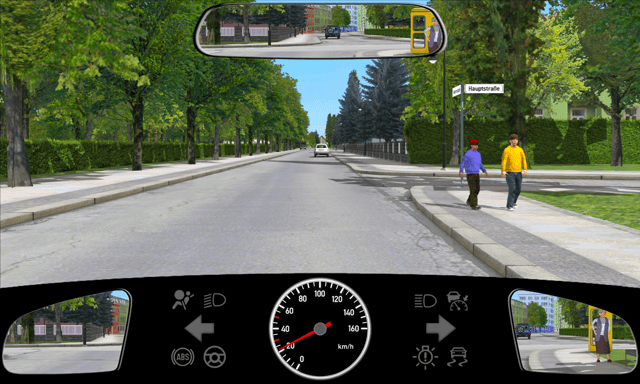
Explication
Reduce speed and watch the two children very closely. Be careful and ready to brake. Stop if the children's behaviour makes this necessary.
-
Question 8 sur 33
A quels dangers devez-vous faire face?
1.1.02-0415 points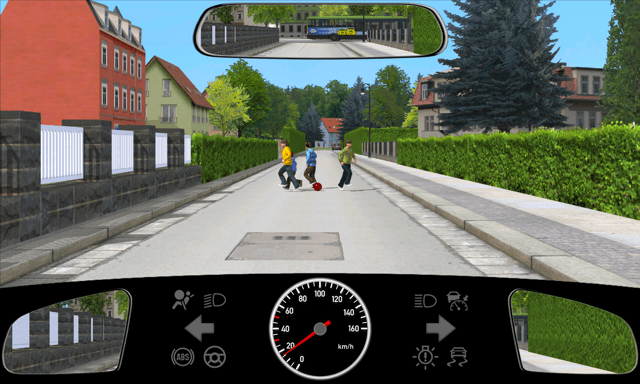
Explication
If a ball is lying on the road, it can be assumed that a child will come and fetch it. For you as a driver, this means: stop immediately so that the child can fetch the ball safely. With children, you have to expect that they will behave in a way that is contrary to traffic regulations and that they will not be able to assess dangers correctly.
-
Question 9 sur 33
Comment devriez-vous vous comporter?
1.1.02-0425 points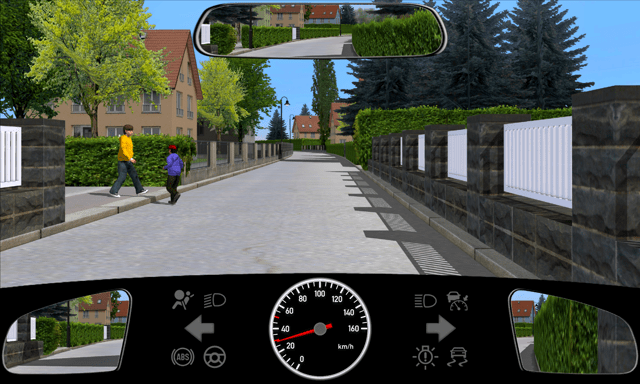
Explication
The rule here is: reduce speed immediately, be ready to brake and drive slowly past the situation. It can be assumed that children who are playing are not paying attention to the traffic and are not behaving in a way that is appropriate for the traffic.
-
Question 10 sur 33
Comment devez-vous vous comporter?
1.1.02-0435 points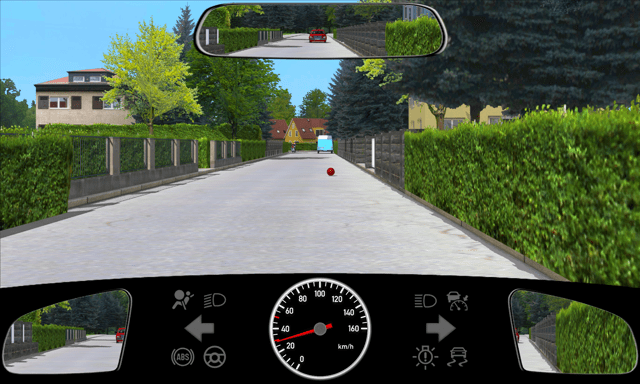
Explication
Most likely, a child will come running into the road after the ball without paying attention to the traffic. Immediately slow your vehicle down to walking speed. Be especially alert and ready to brake!
-
Question 11 sur 33
Quelle conduite devez-vous adopter maintenant?
1.1.02-0485 points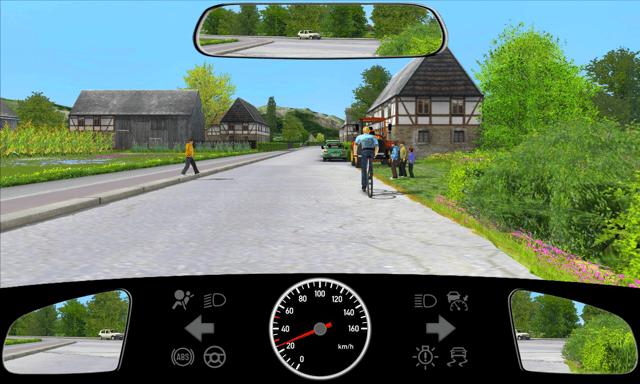
Explication
Since there are children both on the left and right on the street, you should brake to walking pace and remain ready to brake.
-
Question 12 sur 33
Pourquoi devez-vous ralentir ici et être prêt à freiner?
1.1.02-0505 pointsExplication
The child behind the van on the left runs towards the roadway. You cannot see whether it will stop. Therefore, be especially attentive and careful in this unclear traffic situation. Drive slowly and be ready to brake.
-
Question 13 sur 33
Quel comportement correct adoptez-vous dans cette situation?
1.1.02-0514 points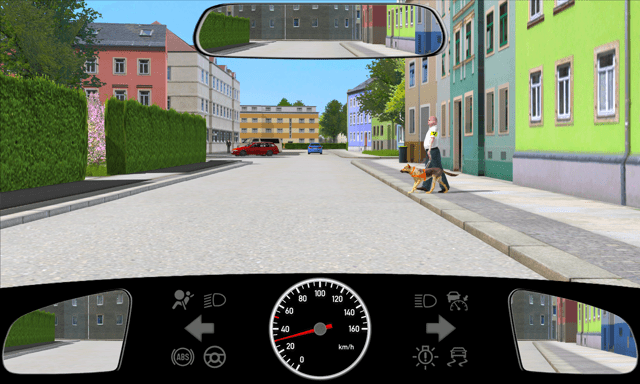
Explication
The man is wearing a yellow armband and has a guide dog with him. He is blind or visually impaired and cannot see the traffic situation. Special care must be taken for blind people. Therefore, you must let him cross the road in front of you.
-
Question 14 sur 33
Pourquoi devez-vous vous attendre à une réaction imprévue des enfants dans le trafic?
1.1.02-0524 pointsExplication
Children often behave unpredictably, which is why other road users always have to count on the unexpected. Due to external stimuli in the environment, small children are constantly distracted from the road and traffic. They continuously let their eyes hike in the area and get stuck with interesting events or objects. The noise perception also only develops in the course of life and is only available to a limited extent in children. That is why children can usually not assign the many noises in road traffic to a certain direction and it is more difficult for them to assess them purely acoustically from which direction a vehicle approaches. In addition to the perception of the direction, the perception of distances, speeds and braking distance in childhood is not yet fully pronounced. Therefore, children can often only overlook the traffic situation incompletely.
-
Question 15 sur 33
A quoi devez-vous faire attention dans cette situation?
1.1.02-1084 points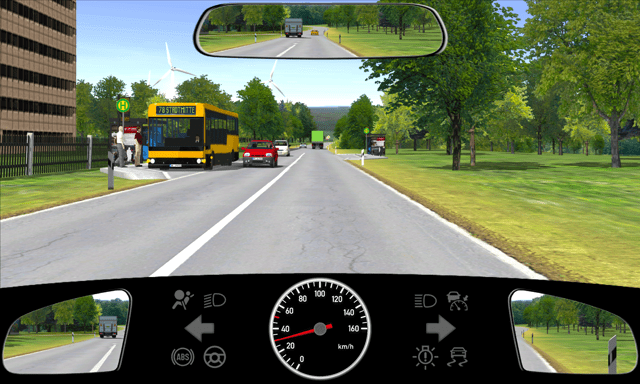
Explication
When public transport and school buses are at a stop and their hazard warning lights are switched on, the following applies: Vehicles may only pass them at walking speed and at a sufficient distance. This applies to oncoming traffic as well as to vehicles travelling in the same direction as the bus. Any danger to passengers must be ruled out by you as the driver of the vehicle.
-
Question 16 sur 33
Le tram vient de s'arrêter à sa station. Quel est le comportement adapté?
1.1.02-1164 points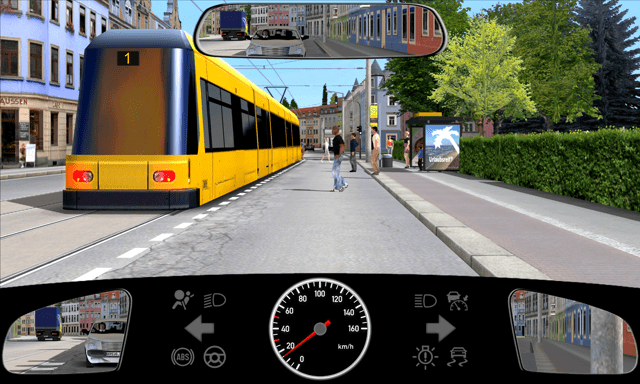
Explication
You may carefully pass a stopping tram at walking speed - but only if this does not endanger or obstruct any passengers.
-
Question 17 sur 33
Comment devriez-vous vous comporter?
1.1.02-1195 points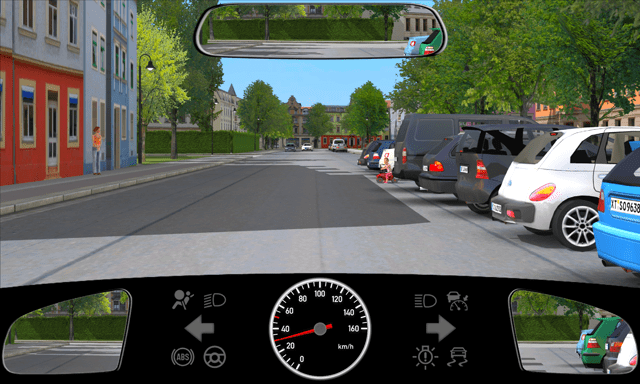
Explication
Special caution is always required towards children in road traffic. In this situation, you must expect that the small child will continue to drive onto the road behind the van. Slow down to walking speed and remain alert and ready to brake at all times. Stop if necessary if you are not sure how the child will behave. It would be grossly negligent to just honk your horn and drive on.
-
Question 18 sur 33
Comment devez-vous vous comporter?
1.1.02-1214 points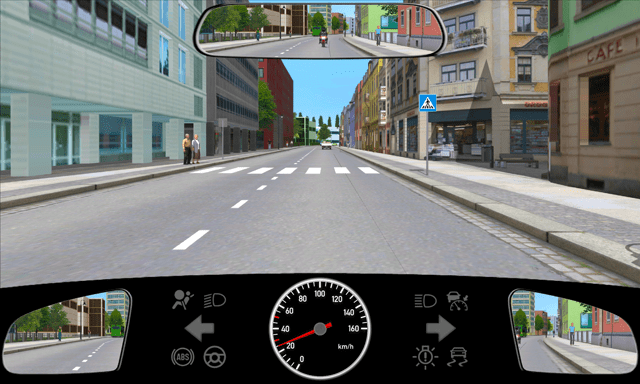
Explication
When pedestrians wait at a zebra crossing to cross the road, they have priority. This also applies if they are on the left-hand side of the road. You should therefore brake in good time. Pedestrians must be able to see that you are complying with your obligation to stop. Even if the pedestrians stop first and wait, you must give them the right of way in a clearly visible manner.
-
Question 19 sur 33
À quel comportement devez-vous vous attendre à de tels arrêts?
1.1.02-1224 points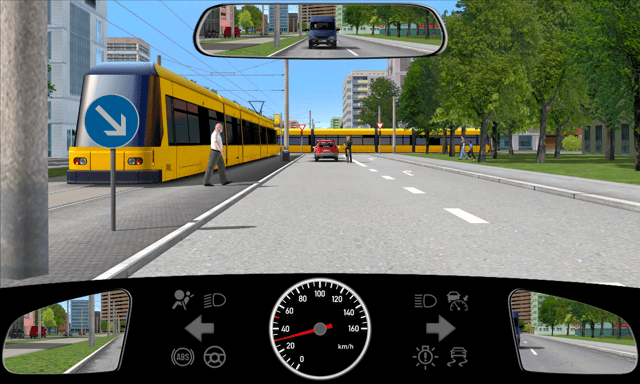
Explication
Pedestrians are required to wait at such traffic islands. You are therefore allowed to pass the tram even if the tram doors are still open. But because people often behave carelessly when getting on and off the tram, dangerous situations arise time and again. For example, without paying attention to the traffic, passengers simply run across the carriageway to reach the tram.
-
Question 20 sur 33
Vous voulez tourner à droite. À quoi devez-vous vous attendre?
1.1.02-1234 points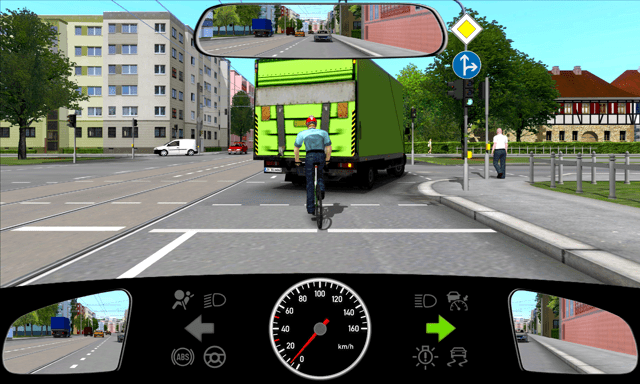
Explication
If you want to turn right, road users travelling in a straight line here have priority. These may be pedestrians or cyclists who want to cross the road. If a truck turns right in front of you, it is also possible that a pedestrian will let it pass. In that case, the lorry would block your view of the other side of the road and thus of the road users travelling from there.
-
Question 21 sur 33
À quoi devez-vous vous attendre?
1.1.02-1244 points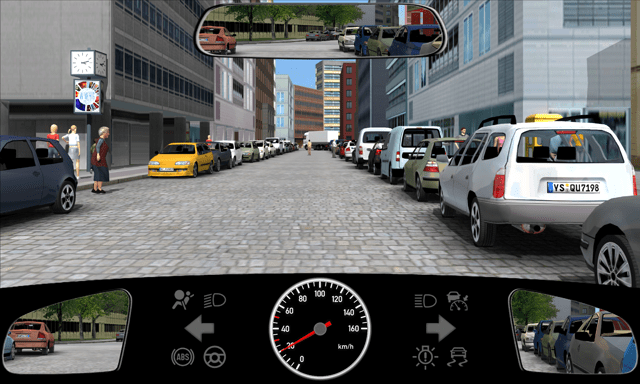
Explication
Where there are many parked cars, you should always drive carefully and considerately. On the one hand, your view is obstructed by the parked vehicles. Secondly, you must always be aware that car doors may be carelessly opened. Other road users may also want to cross the lane between the parked cars.
-
Question 22 sur 33
À quoi devriez-vous vous attendre?
1.1.02-1254 points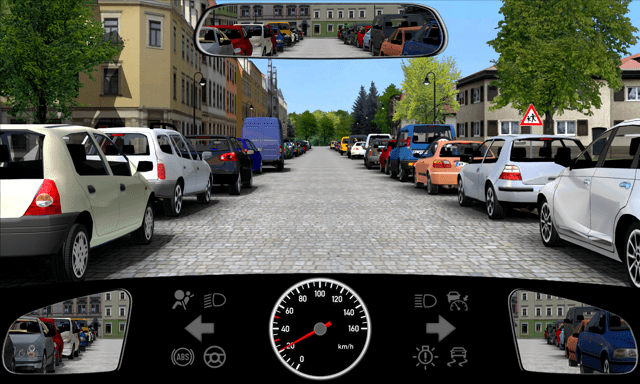
Explication
The "Children" danger sign on the right makes it clear that increased attention and a special degree of caution are necessary at this point. In addition to children, adults can of course also suddenly step onto the roadway between parked vehicles here, requiring heavy braking.
-
Question 23 sur 33
Pourquoi est-ce que les piétons plus âgés sont davantage en danger, dans la circulation, que les plus jeunes?
1.1.02-1264 pointsExplication
Older road users see less well, hear less well, react more slowly and misjudge the speed of vehicles. Be prepared for these people to recognise dangers too late and react too late or not at all.
-
Question 24 sur 33
À quel comportement devez-vous vous attendre de la part des personnes à un passage piéton?
1.1.02-1284 pointsExplication
Zebra crossings have a protective function for pedestrians. They give them priority over other road users. Some pedestrians thoughtlessly trust this protection and cross the roadway without paying attention to the traffic. At zebra crossings, be aware that pedestrians and especially elderly or vulnerable people may enter the roadway without looking left and right. It is also possible that pedestrians will turn halfway around when the traffic lights turn red.
-
Question 25 sur 33
Un piéton avec une canne blanche souhaite traverser la chaussée devant vous. Comment devez-vous vous comporter?
1.1.02-1294 pointsExplication
The white cane shows you that this road user is blind or at least severely visually impaired. The stick is also the sign that the person is allowed to participate in road traffic without an escort. You must always treat blind and visually impaired people with increased consideration. Reduce your speed and stop if necessary. Do not honk: you would frighten and unsettle the person.
-
Question 26 sur 33
À quoi devez-vous vous attendre?
1.1.02-1304 points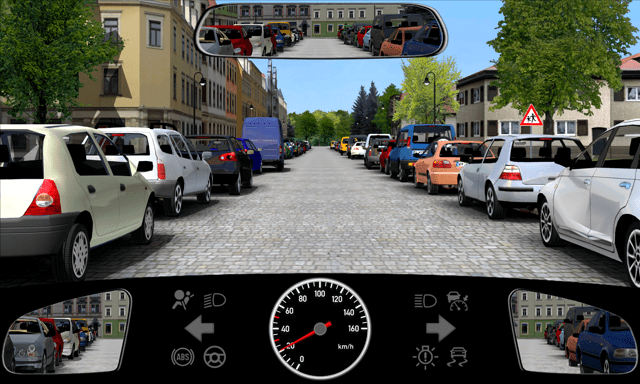
Explication
The "Children" danger sign on the right warns you to take extra care. With many parked vehicles, however, you must always assume that people will step onto the carriageway unexpectedly. Of course, in addition to children, adults can also fail to behave in a roadworthy manner and suddenly appear between the vehicles.
-
Question 27 sur 33
À quoi devez-vous vous attendre?
1.1.02-1313 points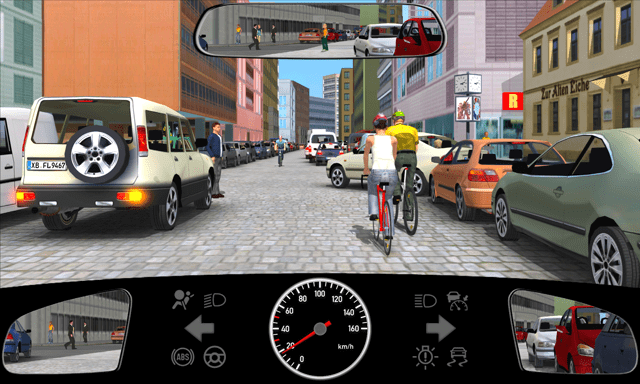
Explication
In a traffic situation with several parked vehicles and different road users, the parked vehicles impair your visibility. Pedestrians can be expected to emerge between cars to cross the road. It is also possible for people to get out of vehicles or for vehicles to drive off without paying attention to the current traffic situation.
-
Question 28 sur 33
Comment évaluez-vous la situation?
1.1.02-1324 points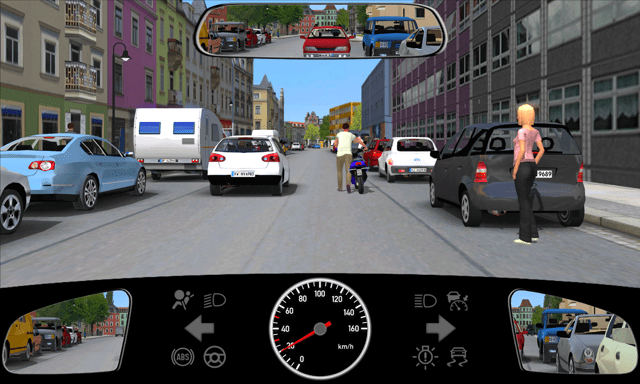
Explication
You should only pass the waiting pedestrian at the side of the road with an appropriate safe distance and very carefully. The same applies to a moped rider who is properly pushing his moped on the right-hand side of the road. If necessary, you can also change to the left lane.
-
Question 29 sur 33
Une personne, sur le bord de la chaussée, porte un brassard jaune avec trois points noirs. Que signale ce brassard?
1.1.02-1334 pointsExplication
If you see a person at the side of the road wearing a yellow armband with three black dots, this means for you: the principle of trust has been suspended. You now have an increased duty of care. This is because the armband indicates a physical limitation in the form of a severe visual impairment. If visually impaired persons wear this armband and/or a white stick, they are allowed to move in traffic without an escort.
-
Question 30 sur 33
À quoi devez-vous vous attendre lorsque des piétons traversent la chaussée?
1.1.02-1354 pointsExplication
When a pedestrian crosses the roadway, it is not certain that he will continue this action to the opposite side of the road. It is also quite possible that he will stop, turn around or continue with a delay.
-
Question 31 sur 33
Pourquoi devez-vous rouler maintenant lentement et être prêt(e) à freiner?
1.1.02-1365 pointsExplication
You must drive slowly and be ready to brake because passengers can cross the road in front of the bus.
-
Question 32 sur 33
Pourquoi devez vous freiner dans cette situation?
1.1.02-1375 pointsExplication
A child is behind the parked vehicle and will probably cross the road in the next moment.
-
Question 33 sur 33
Quel est le bon comportement à adopter maintenant?
1.1.02-1384 pointsExplication
Since the dog, most likely, will run onto the street from the left, you have to reduce your speed and prepare for a braking for danger.