
1.1.02 Zachowanie wobec pieszych
Piesi są najbardziej bezbronnymi uczestnikami ruchu drogowego. Jako kierowca musisz zawsze przewidywać ich zachowanie, zwłaszcza dzieci i osób starszych, które mogą nie przestrzegać ściśle przepisów. Kluczowa jest defensywna jazda i partnerskie zachowanie.
verified Podstawowe zasady egzaminu
Jazda Defensywna
Zawsze jedź ze świadomością, że pieszy może popełnić błąd. W obszarach o dużym natężeniu ruchu pieszego lub ograniczonej widoczności należy zmniejszyć prędkość.
Zachowanie partnerskie
Nie nalegaj na pierwszeństwo przejazdu, jeśli pieszy jest już na drodze lub jest wyraźnie zdezorientowany. Przedstaw bezpieczeństwo ponad ścisłe przestrzeganie zasad.
child_care Dzieci w ruchu drogowym
Wysokie ryzykoPrawidłowe zachowanie
- check Widząc dzieci bawiące się w pobliżu drogi, znacznie zmniejsz prędkość.
- check Bądź gotowy do natychmiastowego hamowania; Odległość reakcji ma znaczenie.
- check Podczas wyprzedzania należy zachować bezpieczną odległość boczną.
Błędne pomysły
- close Zakładając, że dzieci zatrzymają się przy krawężniku i rozejrzą się w obie strony.
- close Trąbienie, aby ostrzec dzieci (może to spłoszyć je i wybiec na drogę).
- close Przyspieszenie, aby szybko je wyprzedzić.
Notatka egzaminacyjna
W przypadku pytań egzaminacyjnych, jeśli widzisz piłkę toczącą się po ulicy, ZAWSZE zakładaj, że dziecko natychmiast za nią pobiegnie, nie patrząc. Prawidłowa odpowiedź brzmi zawsze: hamować.
horizontal_rule Przejścia dla pieszych (zebra)

Zbliżamy się do przejścia dla pieszych
Kluczowa zasada: Umiarkowana prędkość i gotowość do hamowania.
Zbliżający się
Podejdź z umiarkowaną prędkością. Jeżeli pieszy czeka lub wchodzi na przejście, należy się zatrzymać.
Żadnego wyprzedzania
Wyprzedzanie na przejściu dla pieszych jest surowo zabronione aby zapewnić widoczność pieszym.
Zatrzymanie
Nie zatrzymuj się i nie parkuj bezpośrednio na przejściu lub w odległości do 5 metrów przed nim.
Korki
Utrzymuj przejazd w czystości, jeśli ruch jest wstrzymany. Nie blokuj przejścia dla pieszych.
directions_bus Autobusy, tramwaje i przystanki
1
Autobus zbliża się do przystanku z włączonymi światłami awaryjnymi
expand_more
NIE wolno wyprzedzać autobusu w trakcie jazdy. Pozostań z tyłu, aż się zatrzyma. Oznacza niebezpieczną sytuację, w której mogą przechodzić dzieci.
2
Autobus stoi na przystanku z włączonymi światłami awaryjnymi
expand_more
Możesz przejechać autobus o godz tempo chodu (4-7 km/h). Dotyczy to ruchu w OBU kierunkach (chyba że istnieje fizyczna bariera taka jak mediana). Jeżeli pasażer wejdzie na jezdnię, musisz mieć możliwość natychmiastowego zatrzymania się.
3
Przejeżdżające tramwaje
expand_more
Zwykle mijaj tramwaje po prawej stronie. Jeśli pasażerowie wsiadają lub wysiadają, a nie ma wyspy bezpieczeństwa, należy się zatrzymać i poczekać, aż droga będzie wolna. Jedź ostrożnie obok zatrzymanych tramwajów.
warning Typowe pułapki egzaminacyjne
Pułapka „falująca”.
Scenariusz: Pieszy czeka na przejście, ale się waha. Zatrzymaj się.
Odpowiedź na pułapkę: „Macham ręką, aby dać znak pieszym, aby przeszedł na drugą stronę”.
Błędny! Nie machaj. Możesz zasygnalizować im niebezpieczeństwo (np. wyprzedzanie samochodu). Po prostu poczekaj cierpliwie.
Zaparkowane pojazdy i ograniczona widoczność
Scenariusz: Jadę wąską ulicą z samochodami zaparkowanymi po obu stronach.
Cel egzaminu: Należy przewidzieć pieszych wychodzących zza pojazdów. Prawidłowe zachowanie jest zawsze takie zmniejszyć prędkość i zachowaj duża odległość boczna możliwie.
Practice Questions (33)
-
Question 1 of 33
Z jakim zachowaniem się dzieci należy się liczyć na przejściu dla pieszych?
1.1.02-0055 PunktówWyjaśnienie
Children generally do not have the necessary training to always behave according to the rules in road traffic. Therefore, it is quite conceivable that they do not know the meaning of a zebra crossing and enter the road despite approaching vehicles or suddenly run back after crossing.
-
Question 2 of 33
Z czym należy się liczyć, jeżeli dzieci czekają na światłach?
1.1.02-0224 PunktówWyjaśnienie
Due to a lack of life experience as well as insufficient education, children do not always behave according to the rules in road traffic and, for example, get into the lane during a scuffle. Furthermore, you must expect children to suddenly run across the road, even if the traffic lights are still red or the lights of the cross-traffic are just changing.
-
Question 3 of 33
Z czym należy się liczyć, gdy przez jezdnię przechodzą starsze osoby, korzystające z chodzika?
1.1.02-0274 PunktówWyjaśnienie
When elderly people with walking aids cross the road, you have a higher duty of care. The principle of trust is suspended. You must expect these people to stop suddenly or turn around unexpectedly. Older people also take a comparatively long time to cross the road.
-
Question 4 of 33
Mimo występującego chodnika po prawej stronie jezdni porusza się osoba na wózku inwalidzkim. Jak należy się zachowywać?
1.1.02-0284 PunktówWyjaśnienie
Disabled and elderly people sometimes do not behave in a roadworthy manner due to physical limitations. Therefore, please be especially careful and be sure to show consideration. Expect the wheelchair user to suddenly and unexpectedly swerve and drive even further into the lane. In such situations, it is not permitted to use the horn or drive around the person at high speed.
-
Question 5 of 33
Po przejechaniu jezdni osoba na wózku inwalidzkim nie jest w stanie wjechać nim przez krawężnik na chodnik. Jak należy się zachowywać?
1.1.02-0294 PunktówWyjaśnienie
You should help the person. To do this, you may stop and switch on the hazard warning lights to warn other road users of possible dangers. It is not permitted to honk your horn and drive around the person in this situation. This would frighten and unsettle the wheelchair user.
-
Question 6 of 33
W przypadku której z osób na ilustracji należy liczyć się z poważnym osłabieniem wzroku?
1.1.02-0324 Punktów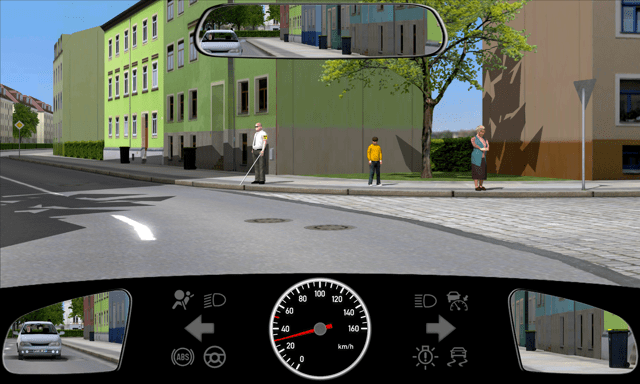
Wyjaśnienie
You must expect a severe visual impairment in the case of persons with the following markings: If a person is wearing a yellow armband with three black dots and/or a white blind person's cane extended diagonally.
-
Question 7 of 33
Jak się Państwo zachowają?
1.1.02-0394 Punktów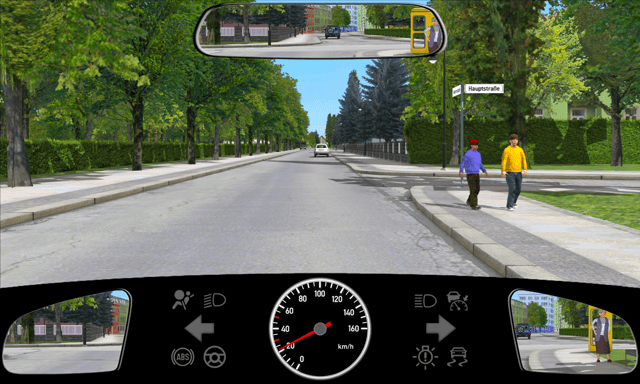
Wyjaśnienie
Reduce speed and watch the two children very closely. Be careful and ready to brake. Stop if the children's behaviour makes this necessary.
-
Question 8 of 33
Z jakimi zagrożeniami muszą się Państwo liczyć?
1.1.02-0415 Punktów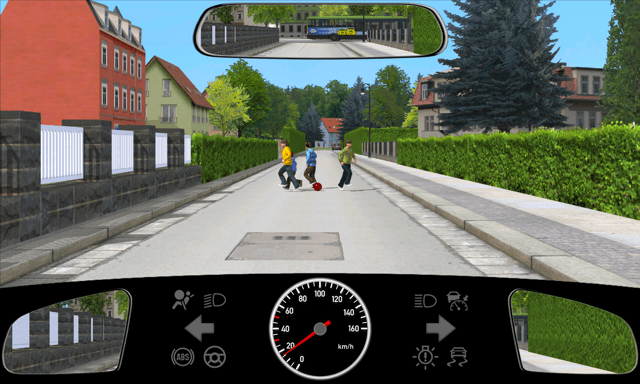
Wyjaśnienie
If a ball is lying on the road, it can be assumed that a child will come and fetch it. For you as a driver, this means: stop immediately so that the child can fetch the ball safely. With children, you have to expect that they will behave in a way that is contrary to traffic regulations and that they will not be able to assess dangers correctly.
-
Question 9 of 33
Jak powinni się Państwo zachować?
1.1.02-0425 Punktów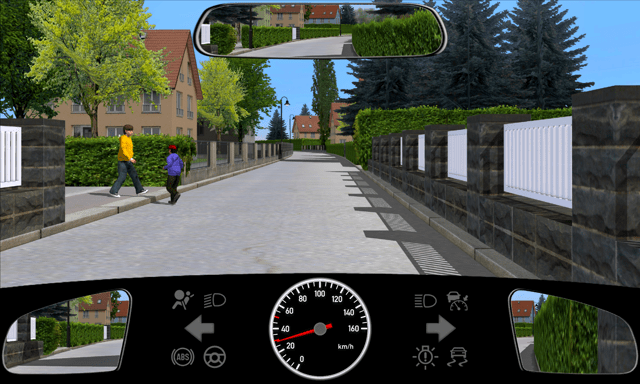
Wyjaśnienie
The rule here is: reduce speed immediately, be ready to brake and drive slowly past the situation. It can be assumed that children who are playing are not paying attention to the traffic and are not behaving in a way that is appropriate for the traffic.
-
Question 10 of 33
Jak muszą się Państwo zachować?
1.1.02-0435 Punktów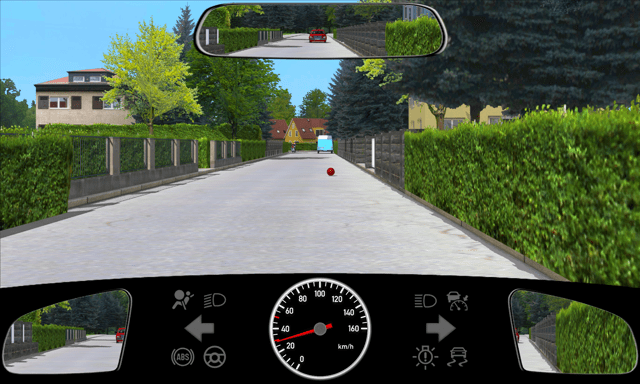
Wyjaśnienie
Most likely, a child will come running into the road after the ball without paying attention to the traffic. Immediately slow your vehicle down to walking speed. Be especially alert and ready to brake!
-
Question 11 of 33
Jak powinni się teraz Państwo zachować?
1.1.02-0485 Punktów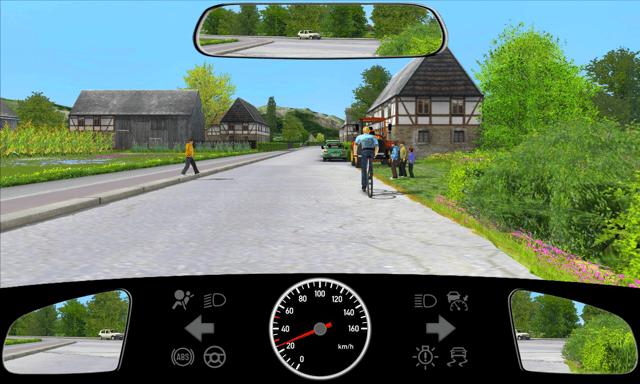
Wyjaśnienie
Since there are children both on the left and right on the street, you should brake to walking pace and remain ready to brake.
-
Question 12 of 33
Dlaczego muszą Państwo jechać tutaj wolno i być przygotowanym na hamowanie?
1.1.02-0505 PunktówWyjaśnienie
The child behind the van on the left runs towards the roadway. You cannot see whether it will stop. Therefore, be especially attentive and careful in this unclear traffic situation. Drive slowly and be ready to brake.
-
Question 13 of 33
Jak właściwie zachować się w tej sytuacji?
1.1.02-0514 Punktów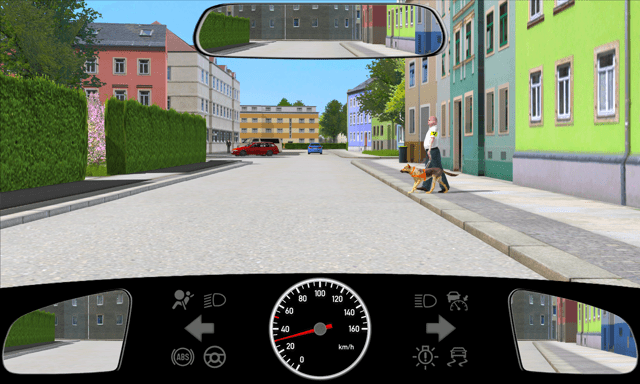
Wyjaśnienie
The man is wearing a yellow armband and has a guide dog with him. He is blind or visually impaired and cannot see the traffic situation. Special care must be taken for blind people. Therefore, you must let him cross the road in front of you.
-
Question 14 of 33
Dlaczego muszą się Państwo liczyć z tym, że dzieci zachowują się w ruchu drogowym w sposób nieprzewidywalny?
1.1.02-0524 PunktówWyjaśnienie
Children often behave unpredictably, which is why other road users always have to count on the unexpected. Due to external stimuli in the environment, small children are constantly distracted from the road and traffic. They continuously let their eyes hike in the area and get stuck with interesting events or objects. The noise perception also only develops in the course of life and is only available to a limited extent in children. That is why children can usually not assign the many noises in road traffic to a certain direction and it is more difficult for them to assess them purely acoustically from which direction a vehicle approaches. In addition to the perception of the direction, the perception of distances, speeds and braking distance in childhood is not yet fully pronounced. Therefore, children can often only overlook the traffic situation incompletely.
-
Question 15 of 33
Na co należy zwrócić uwagę w tej sytuacji?
1.1.02-1084 Punktów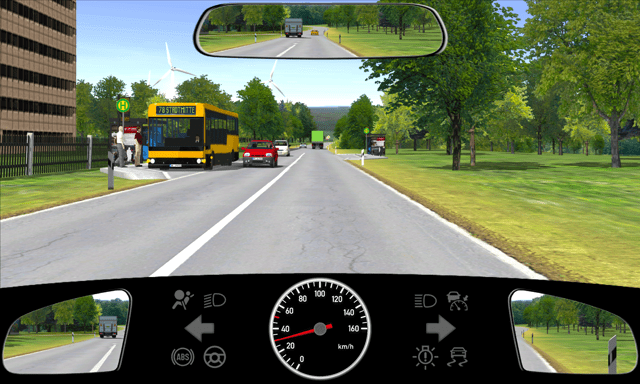
Wyjaśnienie
When public transport and school buses are at a stop and their hazard warning lights are switched on, the following applies: Vehicles may only pass them at walking speed and at a sufficient distance. This applies to oncoming traffic as well as to vehicles travelling in the same direction as the bus. Any danger to passengers must be ruled out by you as the driver of the vehicle.
-
Question 16 of 33
Tramwaj właśnie zatrzymał się na przystanku. Które zachowanie jest prawidłowe?
1.1.02-1164 Punktów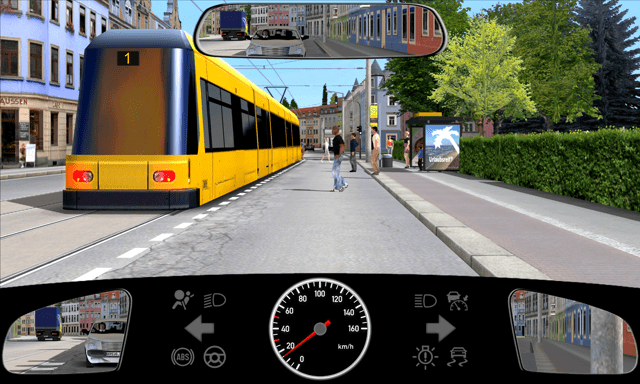
Wyjaśnienie
You may carefully pass a stopping tram at walking speed - but only if this does not endanger or obstruct any passengers.
-
Question 17 of 33
Jak powinieneś się zachować?
1.1.02-1195 Punktów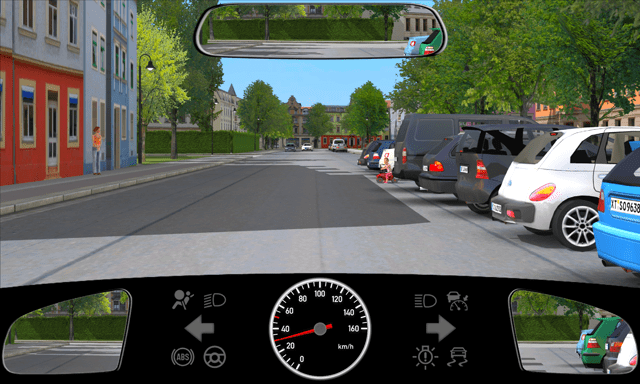
Wyjaśnienie
Special caution is always required towards children in road traffic. In this situation, you must expect that the small child will continue to drive onto the road behind the van. Slow down to walking speed and remain alert and ready to brake at all times. Stop if necessary if you are not sure how the child will behave. It would be grossly negligent to just honk your horn and drive on.
-
Question 18 of 33
Jak musisz się zachować?
1.1.02-1214 Punktów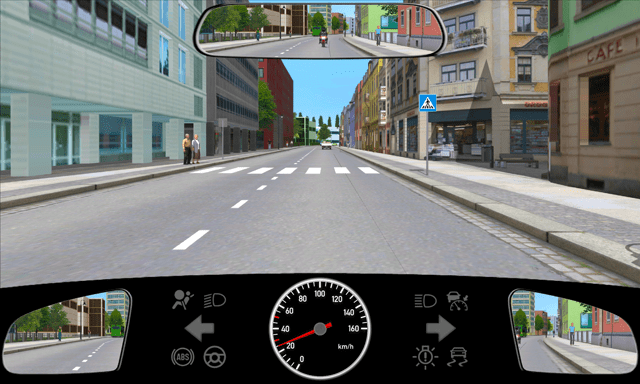
Wyjaśnienie
When pedestrians wait at a zebra crossing to cross the road, they have priority. This also applies if they are on the left-hand side of the road. You should therefore brake in good time. Pedestrians must be able to see that you are complying with your obligation to stop. Even if the pedestrians stop first and wait, you must give them the right of way in a clearly visible manner.
-
Question 19 of 33
Z jakimi zachowaniami musisz się liczyć na przystankach?
1.1.02-1224 Punktów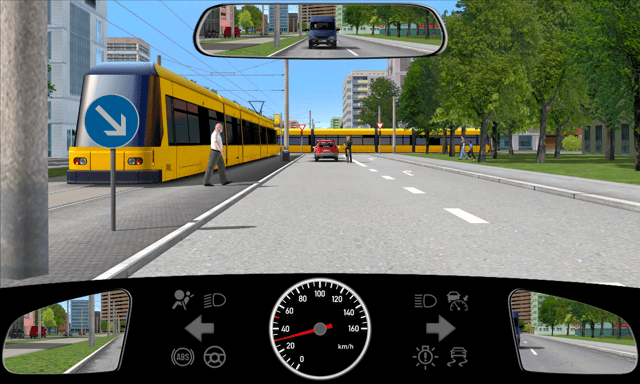
Wyjaśnienie
Pedestrians are required to wait at such traffic islands. You are therefore allowed to pass the tram even if the tram doors are still open. But because people often behave carelessly when getting on and off the tram, dangerous situations arise time and again. For example, without paying attention to the traffic, passengers simply run across the carriageway to reach the tram.
-
Question 20 of 33
Chcesz skręcić w prawo. Na co musisz się przygotować?
1.1.02-1234 Punktów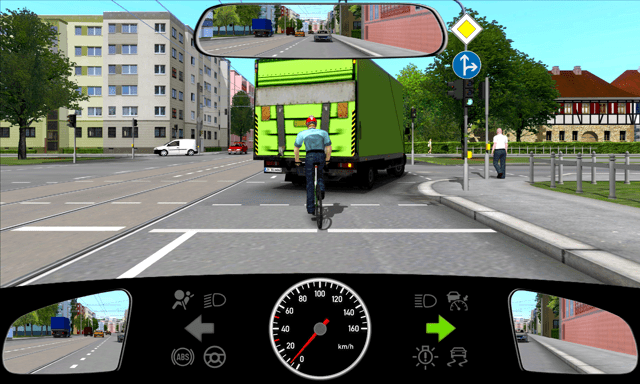
Wyjaśnienie
If you want to turn right, road users travelling in a straight line here have priority. These may be pedestrians or cyclists who want to cross the road. If a truck turns right in front of you, it is also possible that a pedestrian will let it pass. In that case, the lorry would block your view of the other side of the road and thus of the road users travelling from there.
-
Question 21 of 33
Na co musisz się przygotować?
1.1.02-1244 Punktów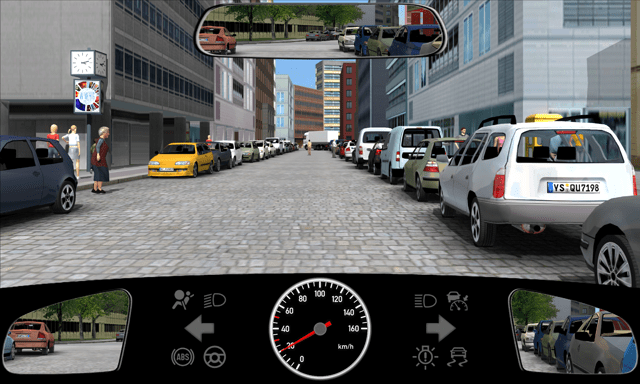
Wyjaśnienie
Where there are many parked cars, you should always drive carefully and considerately. On the one hand, your view is obstructed by the parked vehicles. Secondly, you must always be aware that car doors may be carelessly opened. Other road users may also want to cross the lane between the parked cars.
-
Question 22 of 33
Z czym musisz się liczyć?
1.1.02-1254 Punktów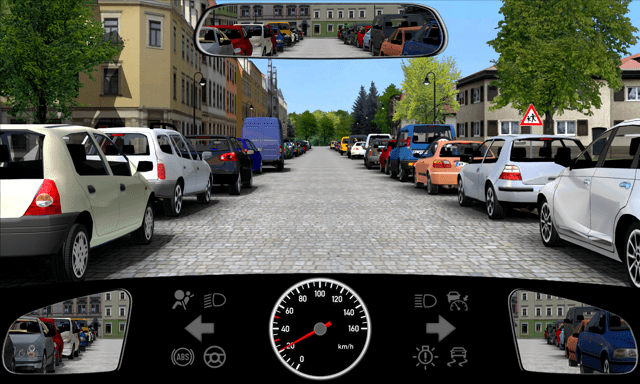
Wyjaśnienie
The "Children" danger sign on the right makes it clear that increased attention and a special degree of caution are necessary at this point. In addition to children, adults can of course also suddenly step onto the roadway between parked vehicles here, requiring heavy braking.
-
Question 23 of 33
Dlaczego starsi przechodnie są bardziej zagrożeni w ruchu drogowym niż młodzi?
1.1.02-1264 PunktówWyjaśnienie
Older road users see less well, hear less well, react more slowly and misjudge the speed of vehicles. Be prepared for these people to recognise dangers too late and react too late or not at all.
-
Question 24 of 33
Z jakim zachowanie trzeba się liczyć u osób na przejściu dla pieszych?
1.1.02-1284 PunktówWyjaśnienie
Zebra crossings have a protective function for pedestrians. They give them priority over other road users. Some pedestrians thoughtlessly trust this protection and cross the roadway without paying attention to the traffic. At zebra crossings, be aware that pedestrians and especially elderly or vulnerable people may enter the roadway without looking left and right. It is also possible that pedestrians will turn halfway around when the traffic lights turn red.
-
Question 25 of 33
Pieszy z białą laską chce przed Tobą przekroczyć jezdnię. Jak musisz się zachować?
1.1.02-1294 PunktówWyjaśnienie
The white cane shows you that this road user is blind or at least severely visually impaired. The stick is also the sign that the person is allowed to participate in road traffic without an escort. You must always treat blind and visually impaired people with increased consideration. Reduce your speed and stop if necessary. Do not honk: you would frighten and unsettle the person.
-
Question 26 of 33
Z czym musisz się liczyć?
1.1.02-1304 Punktów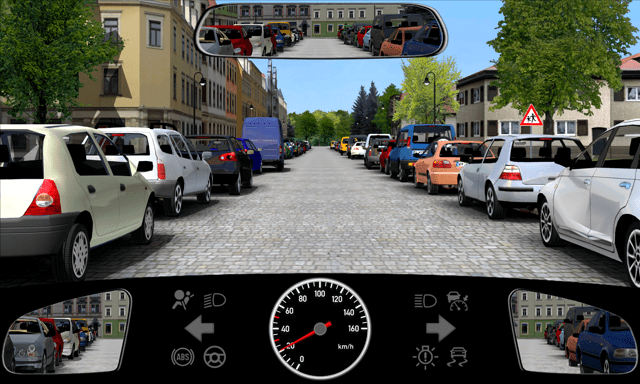
Wyjaśnienie
The "Children" danger sign on the right warns you to take extra care. With many parked vehicles, however, you must always assume that people will step onto the carriageway unexpectedly. Of course, in addition to children, adults can also fail to behave in a roadworthy manner and suddenly appear between the vehicles.
-
Question 27 of 33
Z czym musisz się liczyć?
1.1.02-1313 Punktów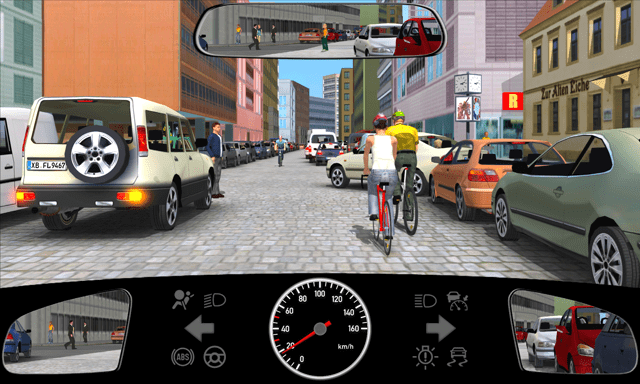
Wyjaśnienie
In a traffic situation with several parked vehicles and different road users, the parked vehicles impair your visibility. Pedestrians can be expected to emerge between cars to cross the road. It is also possible for people to get out of vehicles or for vehicles to drive off without paying attention to the current traffic situation.
-
Question 28 of 33
Jak oceniasz tą sytuację?
1.1.02-1324 Punktów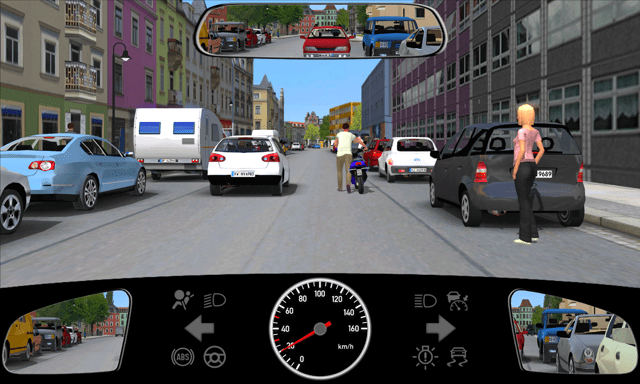
Wyjaśnienie
You should only pass the waiting pedestrian at the side of the road with an appropriate safe distance and very carefully. The same applies to a moped rider who is properly pushing his moped on the right-hand side of the road. If necessary, you can also change to the left lane.
-
Question 29 of 33
Osoba na skraju jezdni nosi żółtą opaskę z czarnymi punktami. O czym świadczy taka opaska?
1.1.02-1334 PunktówWyjaśnienie
If you see a person at the side of the road wearing a yellow armband with three black dots, this means for you: the principle of trust has been suspended. You now have an increased duty of care. This is because the armband indicates a physical limitation in the form of a severe visual impairment. If visually impaired persons wear this armband and/or a white stick, they are allowed to move in traffic without an escort.
-
Question 30 of 33
Z czym należy się liczyć, kiedy piesi przechodzą przez pas jezdni?
1.1.02-1354 PunktówWyjaśnienie
When a pedestrian crosses the roadway, it is not certain that he will continue this action to the opposite side of the road. It is also quite possible that he will stop, turn around or continue with a delay.
-
Question 31 of 33
Dlaczego muszą Państwo teraz jechać powoli i hamować?
1.1.02-1365 PunktówWyjaśnienie
You must drive slowly and be ready to brake because passengers can cross the road in front of the bus.
-
Question 32 of 33
Dlaczego muszą Państwo tu hamować?
1.1.02-1375 PunktówWyjaśnienie
A child is behind the parked vehicle and will probably cross the road in the next moment.
-
Question 33 of 33
Jak zachowają się Państwo teraz w sposób właściwy?
1.1.02-1384 PunktówWyjaśnienie
Since the dog, most likely, will run onto the street from the left, you have to reduce your speed and prepare for a braking for danger.