
1.2.11 Specjalne sytuacje ruchu
🚦 Złote zasady, o których warto pamiętać
Zachowaj Crossroads za darmo
Nigdy nie blokuj skrzyżowań, przejść dla pieszych lub przejazdów kolejowych w czasie korków.
Najpierw pojazdy ratunkowe
Zostaw wystarczająco dużo miejsca dla policji, karetki pogotowia i wozów strażackich.
Rowerzyści potrzebują przestrzeni
Zachowaj bezpieczną odległość 1,5–2 metrów. Nie wyprzedzaj na wąskich drogach.
Zielone światło ≠ Zawsze jedź
Nawet przy zielonym świetle zaczekaj, jeśli droga przed tobą jest zablokowana.
Policja zastępuje sygnały
Instrukcje policji są silniejsze niż sygnalizacja świetlna i znaki.
Poczekaj na duże pojazdy
Ciężarówki i tramwaje mogą potrzebować dodatkowej przestrzeni podczas skręcania.
🚧 Zachowaj wolne obszary ważne
- NIE blokuj skrzyżowań.
- NIE blokuj przejazdów kolejowych.
- NIE blokuj przejść dla pieszych.
- Wjeżdżaj na skrzyżowanie tylko wtedy, gdy możesz szybko z niego wyjść.
- Wyjątkiem są przystanki autobusowe.
„Jeśli nie możesz wyjść, nie wchodź”.
⛔ Pierwszeństwo dla pojazdów nadjeżdżających z naprzeciwka
Znak czerwonej strzałki oznacza, że nadjeżdżający pojazd ma pierwszeństwo.
❌ Nigdy
Wjedź na chodnik.
✅ Zawsze
Poczekaj, aż droga będzie wolna.
🚶 Przejścia dla pieszych muszą pozostać bezpłatne
Przejścia dla pieszych służą bezpiecznemu przejściu. Nigdy się na nich nie zatrzymuj.
🚴 Stowarzyszenia zamknięte
Grupy rowerzystów, pieszych lub pojazdów podróżujących razem nazywane są stowarzyszeniami zamkniętymi.
- Nie przerywaj grupie.
- Poczekaj, aż wszyscy członkowie przejdą.
- W razie potrzeby pozostań za linią zatrzymania.
🚲 Nigdy nie wyprzedzaj w sposób niebezpieczny
- Zwężenie drogi = rowerzysta może zjechać w lewo.
- Nadjeżdżające pojazdy = poczekaj za rowerzystą.
- Zachowaj odległość 1,5–2 metrów.
⚠ Obserwuj uważnie rowerzystów
Rowerzyści mogą nagle zmienić kierunek bez sygnałów ręcznych.
🚋 Tory tramwajowe
Skręcając w lewo przez szyny tramwajowe:
- Zatrzymaj się przed torami.
- Zachowaj odpowiednią odległość.
- Poczekaj, aż przejedzie tramwaj.
- Następnie bezpiecznie skręć w lewo.
🟢 Zielony NIE oznacza „Zawsze idź”
Jeśli ruch jest zablokowany, poczekaj przed wjazdem na skrzyżowanie.
👮 Instrukcje policji są najważniejsze
Policjanci ignorują sygnalizację świetlną i znaki drogowe.
🚑 Pojazdy ratunkowe
Pozostawić skrzyżowania wolne dla karetek, policji i wozów strażackich.
🚛 Ciężarówki potrzebują więcej miejsca
Duże pojazdy mogą się szeroko rozchylać podczas skręcania.
✋ Sygnał ręczny a migające światła
- Sygnał ręczny = ważna rezygnacja z pierwszeństwa.
- Same migające światła NIE wystarczą.
↪ Ciężarówka skręcająca w prawo
Przed kontynuowaniem poczekaj, aż ciężarówka całkowicie zakończy skręcanie.
🧠 Szybka powtórka egzaminu
| Sytuacja | Co robić |
|---|---|
| Korek drogowy | Utrzymuj przejścia i skrzyżowania wolne |
| Rowerzysta naprzód | Zachowaj dystans i poczekaj, jeśli jest to niebezpieczne |
| Zielone światło drogowe | Jedź tylko wtedy, gdy zjazd jest wolny |
| Wskazówki Policji | Zawsze najpierw podążaj za policją |
| Obracająca się ciężarówka | Poczekaj, aż tura się zakończy |
| Przejazd Tramwajowy | Poczekaj przed utworami |
✅ Wskazówka dotycząca egzaminu końcowego
W niemieckiej teorii jazdy wiele pytań sprawdza jedną główną ideę: Nie blokuj ani nie zagrażaj innym. Zawsze myśl o:
Practice Questions (11)
-
Question 1 of 11
Przy blokującym się ruchu należy utrzymywać wolne pewne obszary. Co to są za obszary?
1.2.11-0034 PunktówWyjaśnienie
In the case of stagnant traffic, the following areas must be kept free for example for emergency vehicles: intersections, level crossings and cross-walks. For residential exits, this rule does not apply. If you notice that someone wants to drive off his property onto the road, you should give the driver the opportunity to enter the road.
-
Question 2 of 11
Jakie obszary muszą pozostać niezablokowane w przestrzeni drogowej przy powolnym ruchu pojazdów?
1.2.11-0064 PunktówWyjaśnienie
The pedestrian crossing (“zebra crossing”) is intended to enable pedestrians to cross the road safely and without danger. For this reason, you must leave pedestrian crossings free under all circumstances. If you drive into a junction (or crossing) in slow-moving traffic, there is a risk that you will block oncoming cross traffic or that oncoming traffic turning left will have to wait unnecessarily long. The junction or crossing would thus become even more clogged and traffic would be obstructed more than necessary.
-
Question 3 of 11
Chcą Państwo jechać dalej prosto. Co jest w tej sytuacji prawidłowe?
1.2.11-0074 Punktów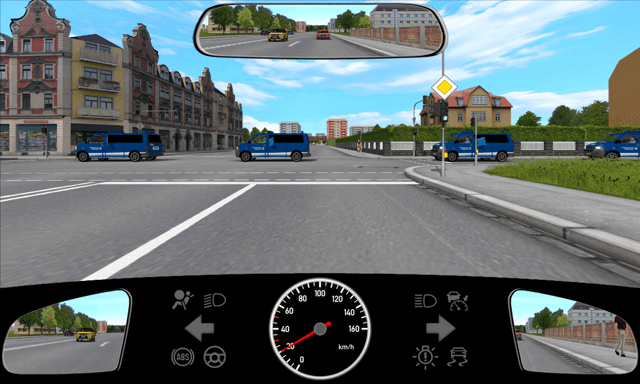
Wyjaśnienie
A group of pedestrians, cyclists or motor vehicles, which is traveling together in road traffic, is called a closed association. Closed associations must be clearly marked and must not be interrupted. So you have to wait until all vehicles drove past you and as long as you have to wait at the stop line.
-
Question 4 of 11
Chcą Państwo jechać na wprost. Jak zachować się poprawnie?
1.2.11-1034 Punktów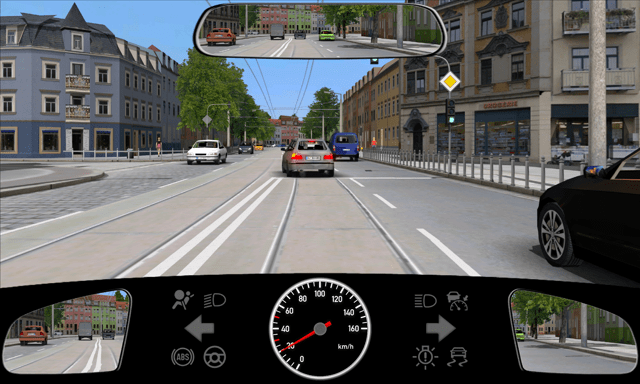
Wyjaśnienie
The car ahead blocks you in your lane. Nevertheless, you should not overtake on the right before the intersection, as this would be too dangerous. Keep your distance, reduce the speed and stop if necessary. Continue straight ahead when the free lane is free and the traffic light turns green. You can only change on the right lane if there is a sufficiently large traffic gap.
-
Question 5 of 11
Jak się zachowasz?
1.2.11-1045 PunktówWyjaśnienie
If tram rails lead through the left turn lane and you want to turn left when the tram approaches, it is important to wait with sufficient distance in front of the tram rails. When the tram passed, you can turn left.
-
Question 6 of 11
Które zachowanie jest prawidłowe?
1.2.11-1055 PunktówWyjaśnienie
If a cyclist who moves to the left drives in front of you, you must not overtake him if the road is narrowed at this point and there is oncoming traffic. A safety distance of 1.5 to 2 meters could not be maintained here.
-
Question 7 of 11
W jakim przypadku nie możesz wjechać na skrzyżowanie, mimo że świeci się "zielone" światło na sygnalizatorze?
1.2.11-1084 PunktówWyjaśnienie
In the following cases, you must not enter a crossroad, even though the traffic light shows "green": with slow-moving traffic, as crossings, for example, must remain free for emergency vehicles. Secondly, when police officers regulate traffic and give instructions that deviate from the meanings of the colors of the traffic lights. In general, a green traffic light tells you that you are allowed to drive and overrules other traffic signs that regulate the right of way. Policeman orders have the highest rank and override traffic lights.
-
Question 8 of 11
Dlaczego muszą Państwo tutaj zwolnić i przygotowaćsię na hamowanie?
1.2.11-1105 PunktówWyjaśnienie
You don't have to slow down because of pedestrians. He is far enough away from the constriction. The red vehicle is standing and is therefore no reason to slow down as well. However, reduce the speed because of the cyclist. He could change lanes without a hand signal and bring about a dangerous situation.
-
Question 9 of 11
Dlaczego muszą Państwo dalej hamować?
1.2.11-1114 PunktówWyjaśnienie
A garbage truck comes towards the blue truck and forces him to stop. Since the garbage truck could swing out and get on your lane as it turns, you'll need to wait for the vehicle to be properly merged. The cyclist is no reason for braking.
-
Question 10 of 11
Chcą Państwo jechać prosto. Jak powinni się Państwo zachować?
1.2.11-1124 PunktówWyjaśnienie
In case of halting traffic, you are not allowed to block any intersection or T-junction despite the green traffic light or right of way. You may need to wait at the stop line and cannot close up until the front vehicles are far enough away.
-
Question 11 of 11
Kiedy mogą Państwo skręcać?
1.2.11-1143 PunktówWyjaśnienie
As you want to turn left, oncoming traffic has priority. Only when the lorry driver gives up his right of way with a clear hand signal can you pass with due regard for oncoming traffic. Flashing your lights is not sufficient here.