
1.1.07 Specjalne sytuacje ruchu
Ruch specjalny Sytuacje
Ruch nie zawsze przebiega gładko. Musisz opanować tunele, przejazdy kolejowe, pojazdy uprzywilejowane i niechronionych użytkowników dróg. Podstawowa zasada: Jazda defensywna i przewidywanie.
Wymagające środowiska
W tych strefach obowiązują szczególne zasady mające na celu zapewnienie bezpieczeństwa.
Tunele
Oczy powoli przyzwyczajają się do ciemności.
- ● Włączone światła mijania
- ● Zdejmij okulary przeciwsłoneczne
- ● NIGDY nie zawracaj ani nie cofaj
Przejścia poziome
Pociągi mają absolutny priorytet.
- ● Poczekaj pod Krzyżem Świętego Andrzeja
- ● Brak strefy wyprzedzania
- ● Nie zatrzymuj się na torach
Obszary leśne (dzika przyroda)
Wysokie ryzyko przekraczania zwierząt („Wildwechsel”).
- ● Diody świateł, jeśli pojawi się zwierzę
- ● Zahamuj mocno, trzymaj kierownicę prosto
- ● NIE skręcaj niebezpiecznie
Place budowy
Złożone wyznaczanie pasów ruchu i zagrożenia.
- ● Żółte linie zastępują białe
- ● Obowiązują rygorystyczne ograniczenia prędkości
- ● Unikaj jazdy naprzemiennej
Wyprzedzanie rowerzystów
Rowerzyści często kołyszą się lub skręcają, aby ominąć dziury. Daj im przestrzeń.
Oceń i sprawdź
Czy nadjeżdżający ruch jest wolny? Sprawdź lusterka i ramię (martwy punkt).
Odległość boczna
Zachowaj chociaż 1,5 m odległość na boki. Jeśli nie możesz, NIE wyprzedzaj.
Połącz ponownie bezpiecznie
Nie tnij zbyt wcześnie. Upewnij się, że widzisz rowerzystę w całości w lusterku wstecznym.
Nagłe wypadki i wypadki: prawidłowe
Utworzenie korytarza awaryjnego
Na autostradach/autostradach: lewy pas porusza się W LEWO, wszystkie pozostałe pasy poruszają się w PRAWO.
Dojazd do wypadku
1. Światła awaryjne WŁĄCZONE. 2. WŁĄCZONA kamizelka odblaskowa. 3. Zabezpieczona scena (trójkąt). 4. Pierwsza pomoc.
Sytuacja awaryjna: niebezpieczne błędy
„Gaffing” (gumka)
Zwalnianie, aby popatrzeć na wypadek lub robienie zdjęć, jest nielegalne i niemoralne.
Podążanie za karetką
Nigdy nie korzystaj z korytarza ratunkowego, aby ominąć ruch uliczny. Blokuje to pojazdy ratownicze.
Niechronieni użytkownicy dróg
„Zasada zaufania” (Vertrauensgrundsatz) mówi, że możesz założyć, że inni przestrzegają zasad. Wyjątek: Dzieci, osoby starsze i niepełnosprawne. Trzeba przewidywać ich błędy.
- check Osoby starsze: Może Cię nie słyszeć/widzieć lub nieprawidłowo ocenić prędkość.
- check Dzieci: Impulsywny. Jeśli piłka toczy się po ulicy, dziecko podąża za nią.
- check Wózki inwalidzkie: Zachowaj bezpieczną odległość boczną. Bądź cierpliwy.
Kontakt wzrokowy jest kluczowy
Jeśli pieszy lub rowerzysta na Ciebie nie patrzy, załóż, że Cię nie widział. Zahamuj i bądź gotowy do zatrzymania.
Typowe pułapki egzaminacyjne
Pułapka nr 1: TYLKO niebieskie światło kontra niebieskie światło + syrena expand_more
Tylko niebieskie światło: Ostrzeżenie o wypadku lub konwoju. Jedź ostrożnie, zrób miejsce.
Niebieskie światło + syrena: Natychmiastowe pierwszeństwo przejazdu! Natychmiast oczyść drogę. Zatrzymaj się, jeśli to konieczne.
Pułapka nr 2: pierwszeństwo przejazdu a zapobieganie wypadkom expand_more
Nawet jeśli masz pierwszeństwo (np. na zielonym świetle lub na drodze z priorytetem), jeśli inny kierowca wtargnie do środka, będziesz MUSI HAMOWAĆ. Naleganie na swoją prawą stronę powoduje wypadek, a ty będziesz częściowo winien.
Pułapka nr 3: Wyprzedzanie autobusu zbliżającego się do przystanku. expand_more
Jeśli autobus zbliża się do przystanku z migającymi światłami awaryjnymi, to Ty tak robisz ZABRONIONY od wyprzedzenia go. Musisz poczekać za nim, aż się zatrzyma. Tylko wtedy możesz przejść z prędkością pieszego.
Practice Questions (63)
-
Question 1 of 63
Z czym należy się liczyć, jeżeli samochód ciężarowy z przyczepą (naczepą) przed Panią/Panem chce skręcić w prawo w wąską ulicę?
1.1.07-0013 PunktówWyjaśnienie
Keep a large distance from the lorry and under no circumstances overtake on the right-hand side, even if you would have the opportunity to do so as a two-wheeler driver. The road train must first reduce its speed considerably to turn. For reasons of space, the truck driver may then have to steer the towing vehicle far to the left so that the trailer or semi-trailer does not roll over the kerb when turning.
-
Question 2 of 63
Na co należy zwracać szczególną uwagę na skrzyżowaniach i połączeniach ulic w terenie zabudowanym?
1.1.07-0023 PunktówWyjaśnienie
By driving on a wide and well-developed road, you don't automatically have the right of way. The rule "right before left" does not apply always and everywhere. Instead, signs or traffic lights regulate who has priority. Therefore, pay attention to the signposted right-of-way regulation or the traffic lights at each individual intersection and junction.
-
Question 3 of 63
Dlaczego należy zachować tutaj szczególną ostrożność?
1.1.07-0063 Punktów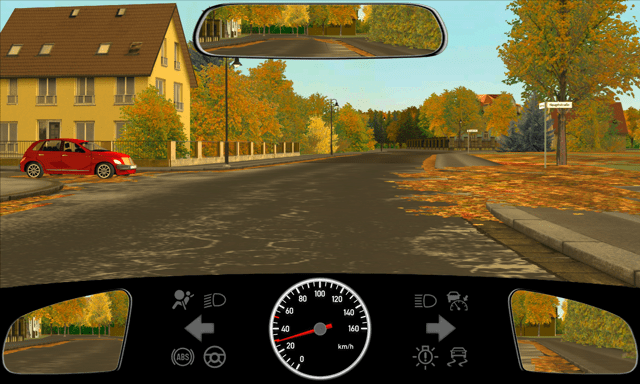
Wyjaśnienie
The wet leaves on the road result in a longer braking distance and a high risk of slipping. Therefore, reduce your speed and drive carefully before reaching the intersection. A vehicle could be coming from the right and you should give it the right of way. Since there are no signs at the intersection that give you the right of way, the rule here is "right before left".
-
Question 4 of 63
Zbliża się Pani/Pan do szkoły. Dzieci wychodzą z podwórka szkoły. Z czym należy się liczyć?
1.1.07-0095 PunktówWyjaśnienie
In the vicinity of schools, you must always be prepared for children crossing the road abruptly. Children are not yet able to assess themselves and other road users very well and often react impulsively and in a way that is not appropriate for traffic. As a car driver, you must adapt your driving style accordingly in order to exclude any danger to children. In addition to driving at a low speed, you must be particularly attentive and ready to brake at all times.
-
Question 5 of 63
O czym mogą informować załączone światła awaryjne?
1.1.07-0104 PunktówWyjaśnienie
The use of the hazard warning lights is subject to strict rules. You may only switch on the hazard warning lights to secure your broken-down vehicle or to indicate a traffic jam or a school bus. A school bus with its hazard warning lights on may only be overtaken at walking speed.
-
Question 6 of 63
Duży kombajn rolniczy przed Panią/Panem chce skręcić w prawo. Co jest poprawne?
1.1.07-0114 PunktówWyjaśnienie
The combine harvester needs to gain amplitude to turn because the turn is very narrow. To do this, it will greatly reduce his speed. Keep your distance and also drive slowly and be prepared to brake. Especially for cyclists: Never overtake on the right!
-
Question 7 of 63
Jedzie Pani/Pan za pojazdem rolniczym z wysoko załadowaną przyczepą. Z czym należy się liczyć?
1.1.07-0134 PunktówWyjaśnienie
If you are riding behind an agricultural vehicle with a heavily loaded trailer, you must expect the following: Part of the load could fall onto the roadway when turning or braking. The indicator could be dirty or covered by the load. The braking distance of the vehicle is increased by the weight of the load.
-
Question 8 of 63
Z czym należy się liczyć?
1.1.07-0143 Punktów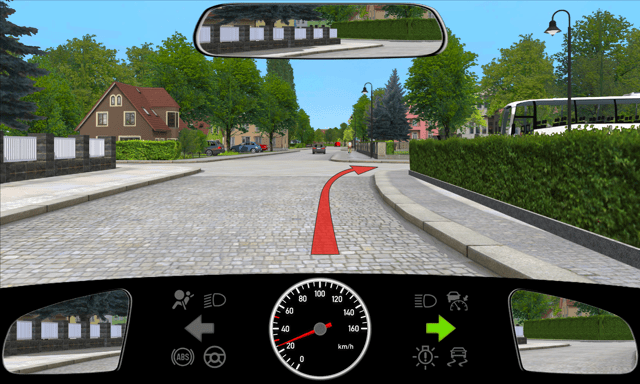
Wyjaśnienie
You must expect to have to stop before the intersection when turning. For one thing, the view of the bus coming from the right is obstructed. In addition, other vehicles could pass it. In addition, pedestrians may also want to cross the road. You must always show special consideration for them.
-
Question 9 of 63
Jak zachowasz się w takiej sytuacji?
1.1.07-0154 Punktów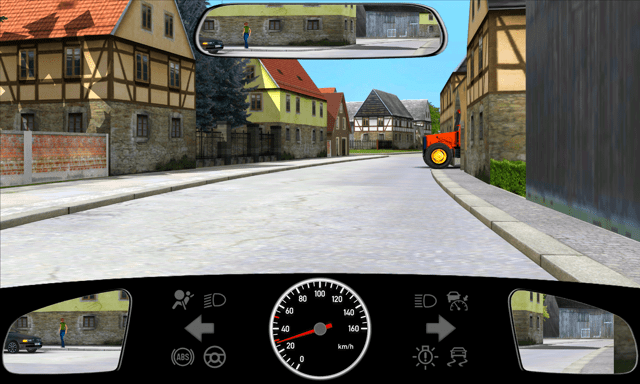
Wyjaśnienie
The driver of the vehicle coming out of the exit cannot see the cross traffic. He would have to be directed into the traffic. He could drive further ahead and prevent you from continuing your journey. You should reduce your speed, be ready to brake, even stop if necessary.
-
Question 10 of 63
Na co musisz przygotować się w takiej sytuacji?
1.1.07-0175 PunktówWyjaśnienie
Because the oncoming vehicle is being slowed down by a bicycle, you should expect the vehicle to overtake the bicycle. If this happens, the vehicle could cross into your lane. In the event that the driver does not brake, you should keep as far to the right on the road as possible. Also, be prepared to brake so that you can react to any situation as quickly as possible.
-
Question 11 of 63
Na skrzyżowaniu chcą Państwo skręcić w prawo. Co jest właściwe?
1.1.07-0194 Punktów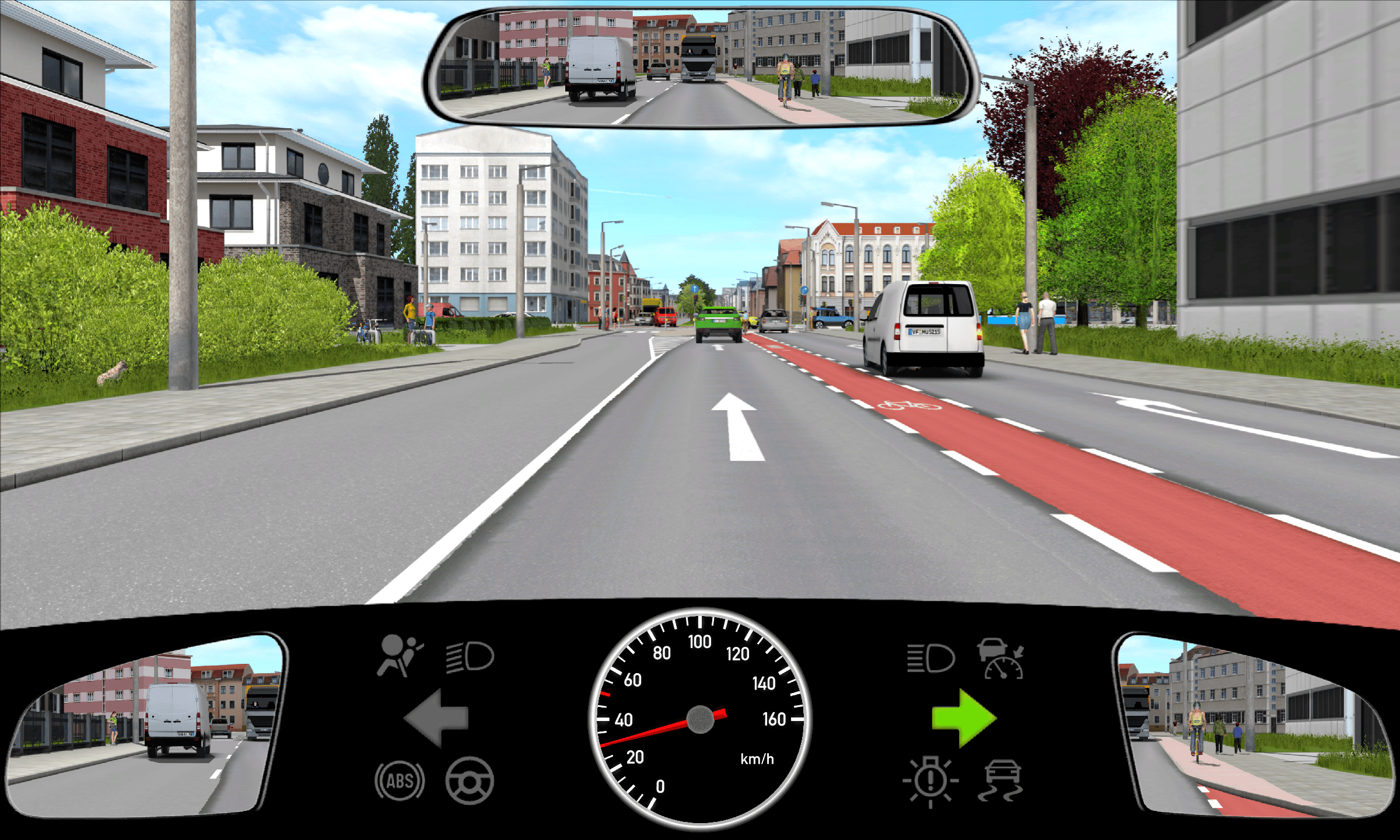
Wyjaśnienie
There is a protective lane for cyclists between your lane and the turning lane. It is part of the carriageway and is separated by a broken line. You may only use the protective lane to change lanes, swerve or turn. If you use it, you are not allowed to obstruct cyclists or come to a standstill in the protective lane. You should therefore change lanes as early as possible.
-
Question 12 of 63
Jak może dojść tutaj do niebezpiecznej sytuacji?
1.1.07-0204 Punktów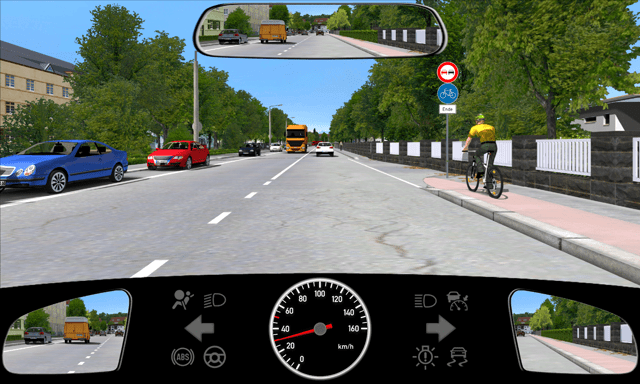
Wyjaśnienie
You can see that the cycle path ends immediately in front of you. The cyclist would have to stop and wait until she can safely merge into the flowing traffic. However, rather than stopping, expect her to swing into the lane in front of you.
-
Question 13 of 63
Na co należy zwrócić uwagę podczas korzystania z rowerów elektrycznych (e-rowerów) na drodze?
1.1.07-0233 PunktówWyjaśnienie
E-bikes are just as quiet as classic bikes and are therefore often perceived late. However, they often achieve significantly higher speeds than bicycles without an engine. This is underestimated by many road users, so dangerous situations can occur surprisingly. In general, expect cyclists to gain speed and perform speedy maneuvers.
-
Question 14 of 63
Jak zachować się teraz właściwie?
1.1.07-0254 Punktów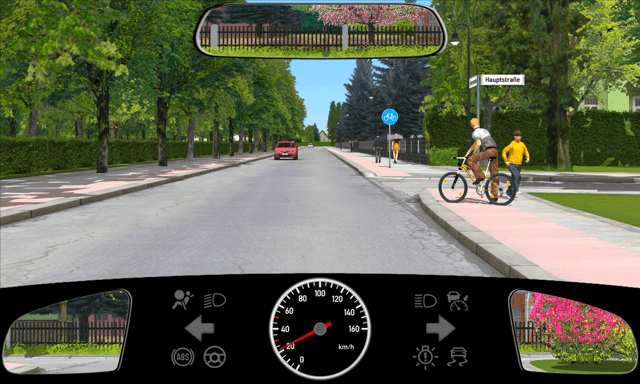
Wyjaśnienie
You should be ready to brake and watch the cyclist carefully, because the cyclist can suddenly ride onto the road.
-
Question 15 of 63
Chce Pani/Pan wyprzedzić ciągnik rolniczy z dobudowanym osprzętem, wystającym do tyłu. Na co należy zwrócić uwagę?
1.1.07-1014 PunktówWyjaśnienie
You should always refrain from an overtaking maneuver when the tractor wants to turn. The reason for this is that the tractor has a large turning circle and is likely to veer, blocking the road. Also keep in mind that the turn signals of such a vehicle are not always visible and that they could be covered by dirt due to the agricultural use.
-
Question 16 of 63
Z czym muszę się liczyć za tym wzniesieniem drogowym?
1.1.07-1033 Punktów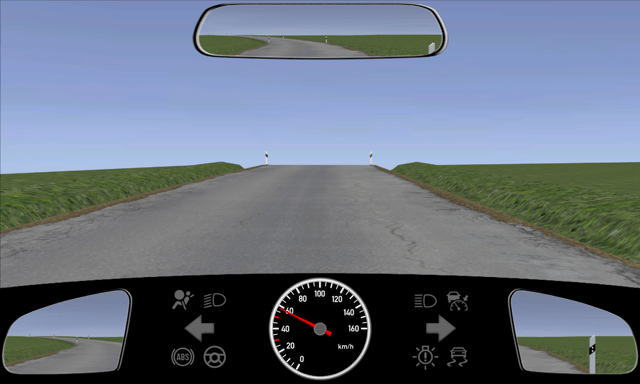
Wyjaśnienie
Due to the height of the crest, it is not possible to see what is behind it. Expect to encounter obstacles there, such as broken-down or slow-moving motor vehicles. Also be prepared for oncoming trucks sharing your lane. To be able to react to such dangers in time, you should reduce your speed accordingly.
-
Question 17 of 63
Na co należy się nastawić?
1.1.07-1073 Punktów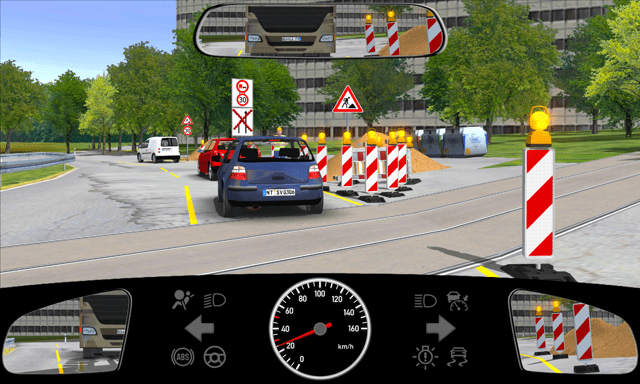
Wyjaśnienie
In the area of a construction site you have to drive carefully and reduce the speed. For one, the road can be dirty. But it there can also be workers, construction equipment or construction vehicles on the road and obstruct the traffic.
-
Question 18 of 63
Jedzie Pani/Pan nowo wybudowaną drogą przez teren leśny. Z czym musi się Pani/Pan liczyć?
1.1.07-1133 PunktówWyjaśnienie
When roads are newly constructed in forested areas, they often pass through the natural habitat of various wild animals. Therefore, it is possible that their habitual paths cross your roadway. For this reason, you must expect wildlife crossings and obstacles due to frequent wildlife accidents on forest roads.
-
Question 19 of 63
W jakich porach dnia należy się szczególnie liczyć z wędrówkami dzikich zwierząt?
1.1.07-1173 PunktówWyjaśnienie
Expect more deer crossings during the morning and evening twilight. This transitional period between day and night is characterized by diffuse light conditions.
-
Question 20 of 63
Z jakimi niebezpieczeństwami musi się Pani/Pan liczyć przede wszystkim w terenach wiejskich?
1.1.07-1184 PunktówWyjaśnienie
Where farming is practised, tractors and other agricultural vehicles travel at slow speeds and/or over width. Often the roadway is also dirty with soil or manure.
-
Question 21 of 63
O zmierzchu z przeciwka nadjeżdża ciągnik rolniczy z załączonym oświetleniem. Z czym musi Pani/Pan się liczyć?
1.1.07-1194 PunktówWyjaśnienie
In agricultural vehicles, the lights are sometimes broken. They can also be covered up by dirt or tarpaulins. The width of the vehicles is not easy to assess. In addition, these vehicles can have up to two trailers.
-
Question 22 of 63
O czym należy pamiętać przed wjechaniem do tunelu?
1.1.07-1204 PunktówWyjaśnienie
Before entering a tunnel, you must note the following: there is a light obligation in a tunnel. Therefore, turn on the dipped beam to see and be seen better. If you have sunglasses, take them off. You must not switch on the fog lamp in the tunnel.
-
Question 23 of 63
Jak należy zachowywać się w przypadku wystąpienia korka w tunelu?
1.1.07-1214 PunktówWyjaśnienie
If there is a traffic jam in a tunnel, stop and turn off the engine. By keeping a safe distance of about five metres, you reduce the risk of poisoning, preserve a manoeuvring option and allow rescue vehicles to pass. Switch on the hazard warning lights to warn following drivers. Only leave your vehicle after an appropriate loudspeaker announcement.
-
Question 24 of 63
Co może pogarszać uwagę podczas przejazdu przez tunel?
1.1.07-1224 PunktówWyjaśnienie
When passing through a tunnel, the following factors may interfere with your attention: the lack of visual stimulus and the monotony of speed, as well as the lights of oncoming traffic. In this case, an orientation on the right side of the road is helpful; avoid looking directly into the light of oncoming traffic.
-
Question 25 of 63
Jakich podstawowych zasad postępowania należy przestrzegać w tunelu?
1.1.07-1254 PunktówWyjaśnienie
The following rules of conduct are mandatory in all tunnels: on the entire route no U-turns are allowed. Regardless of the lighting situation, the dim light must always be switched on. The instructions of the tunnel staff must always be followed. Personal protection antecedes the protection of vehicles and their security.
-
Question 26 of 63
Jak się teraz zachowasz?
1.1.07-1365 PunktówWyjaśnienie
The white reversing lights of the vehicle that turned in front of you indicate that it would probably turn back to its original lane in reverse. Since you cannot tell if you have been noticed by the driver, you should reduce your driving speed and be ready to brake. Refrain from an evasive maneuver due to oncoming traffic.
-
Question 27 of 63
Chcesz skręcić w prawo. Jak powinieneś się zachować?
1.1.07-1374 Punktów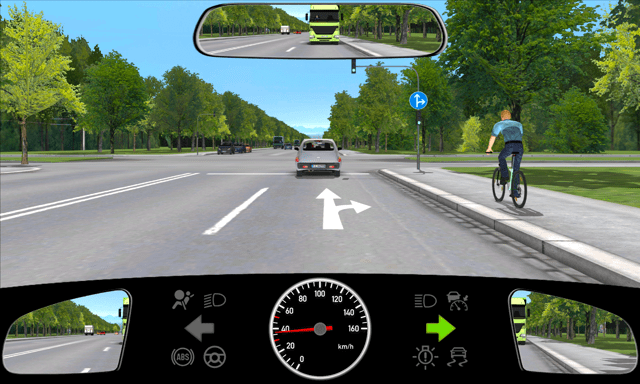
Wyjaśnienie
Before you can turn, you have to check in the rear-view mirror if the road is clear. It is also advisable to look over your shoulder: this is the only way to be aware of dangerous situations located in the blind spot of the mirror. Keep in mind that other road users - cyclists or pedestrians - whose way you cross, always have priority.
-
Question 28 of 63
Z czym musisz się liczyć?
1.1.07-1384 Punktów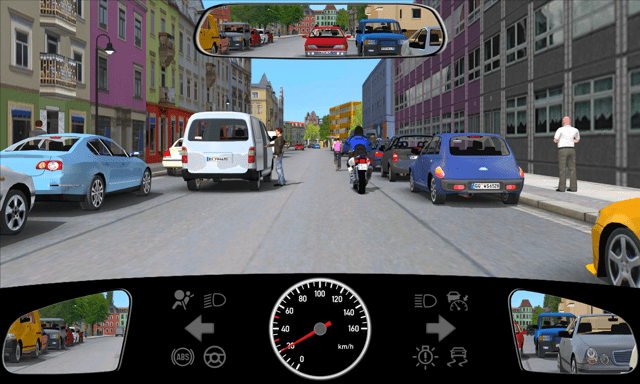
Wyjaśnienie
The other road users can react to this situation with all the different scenarios described. All are equally dangerous. Therefore, extreme caution and slow driving is required.
-
Question 29 of 63
Przed motorem na jednię chce wrócić samochód osobowy. Z czym musisz się liczyć?
1.1.07-1393 Punktów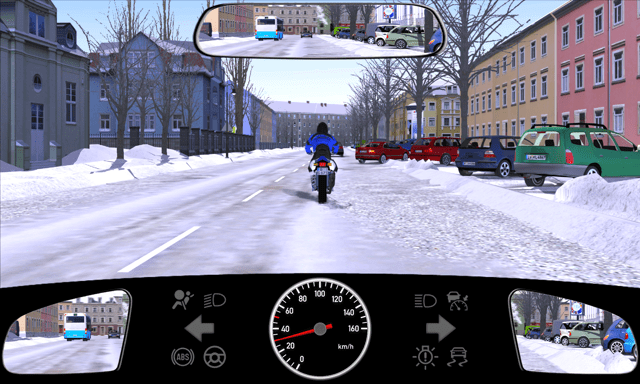
Wyjaśnienie
Car drivers often underestimate the speed of approaching motorcyclists; the same happens to the driver here while he's pulling out of a parking space. The action alternatives of the motorcyclist - braking or dodging - are both dangerous for him on a snow-slicked road surface. He could fall. Also consider the longer braking distance in this weather.
-
Question 30 of 63
Dlaczego jesteś szczególnie zagrożony, gdy poruszasz się dwukołowcem?
1.1.07-1414 PunktówWyjaśnienie
Especially in restrictive visibility conditions such as fog and darkness, the small silhouette of the two-wheeled driver leads to the fact that he is recognized late or not at all. In addition, the small design makes it difficult to estimate its speed. In the event of a collision, two-wheelers generally offer less protection than most other motor vehicles.
-
Question 31 of 63
Na mocno uczęszczanej drodze z kilkoma pasami do jazdy ustawiłeś się do skrętu w lewo. Chciałbyś jednak zamiast tego skręcić w prawo. Jak się zachowasz?
1.1.07-1423 PunktówWyjaśnienie
A lane change or turning right could endanger other road users due to the heavy traffic. You must therefore turn left and take a small detour. Watch out for lane markings that prohibit you from changing lanes.
-
Question 32 of 63
Na moim pasie ruchu znajduje się tunel. O czym powinienem wiedzieć?
1.1.07-1434 PunktówWyjaśnienie
If there is a tunnel on your route, you should know the appropriate traffic signs and behavioral measures in the event of a breakdown or an accident: in this case, alert the tunnel monitoring center and follow the next escape route. First, turn off the engine of your vehicle and leave the ignition key in the lock for rescue operations.
-
Question 33 of 63
Podczas jazdy w tunelu musiałeś odstawić swoje auto z powodu pożaru w tunelu. Jak się teraz zachowasz?
1.1.07-1454 PunktówWyjaśnienie
If you have to park your vehicle in a tunnel due to a fire, you should: stop the engine, leave the key in the ignition switch and quickly trigger the fire alarm at the emergency call station. Leave the tunnel as fast as possible on the next escape route.
-
Question 34 of 63
Z czym należy się liczyć?
1.1.07-1465 PunktówWyjaśnienie
You see that the truck wants to turn in front of you. The vehicle obscures the view of the traffic, so you need to adjust your speed. The truck probably swings out to take the curve. He might stop abruptly to let pedestrians or other road users pass.
-
Question 35 of 63
Na co należy teraz zwrócić uwagę?
1.1.07-1474 PunktówWyjaśnienie
You want to turn right, so does the car driver in front of you. The pedestrian traffic light of the cross street into which you want to turn shows green, and the pedestrian has priority. It is possible that your car in front will pull up and stop soon after to let the pedestrian pass. On the right you can also see a cyclist. The cyclist could drive past your vehicle on the right and circle your turning vehicle on the left. Avoid this danger.
-
Question 36 of 63
Dlaczego muszą Państwo tutaj zaczekać?
1.1.07-1485 PunktówWyjaśnienie
The cyclist must be given priority because she is on the right-of-way. Wait until the cyclist has passed the vehicles and driven through.
-
Question 37 of 63
Dlaczego muszą Państwo tutaj zaczekać?
1.1.07-1495 PunktówWyjaśnienie
The traffic on the main road is jammed. The red car drives around the parked vehicles to turn left. You have to wait and let this car pass as it has priority.
-
Question 38 of 63
Na co trzeba zwrócić uwagę przy przełączeniu świateł na "zielony"?
1.1.07-1525 PunktówWyjaśnienie
While you wait at the red light, a motorcyclist pushes past the waiting vehicles. When the traffic light switches to green you should pay attention to the motorcyclist and let him pass before he initiates a risky overtaking maneuver. But you should also let the pedestrian cross the road, which is still on the road despite it being green.
-
Question 39 of 63
Na co muszą się Państwo nastawić w tej sytuacji?
1.1.07-1533 Punktów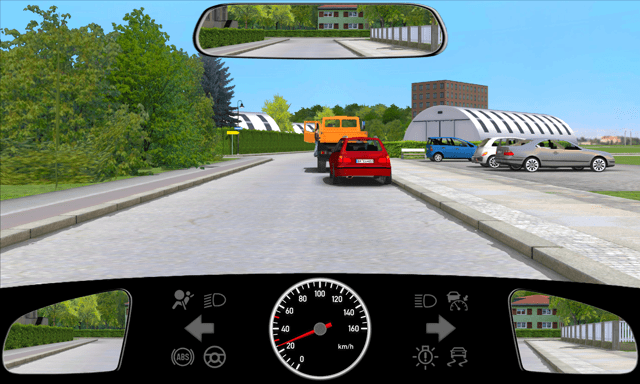
Wyjaśnienie
The truck blocks your view. You can therefore recognize neither the oncoming traffic nor traffic signs behind the truck. Approach the vehicle at low speed. Look for oncoming traffic (they have priority) and keep your distance to the open driver's door when driving around. The driver of the truck could suddenly get out and jump onto the road.
-
Question 40 of 63
Jak właściwie zachowają się Państwo podczas przejeżdżania przez tunel?
1.1.07-1544 PunktówWyjaśnienie
When driving through a tunnel, proceed as follows: Make sure to pay attention to the safety distance and orient yourself on the right-hand side of the road in order to avoid glare from oncoming traffic. Get an overview of safety devices so you know where the nearest emergency exit and emergency telephone are located.
-
Question 41 of 63
Na co muszą Państwo teraz uważać?
1.1.07-1554 PunktówWyjaśnienie
You intend to turn left. Two cyclists move in the same direction. You must pay particular attention to these, as they could also turn into the street without notice.
-
Question 42 of 63
Jak powinni się teraz Państwo zachować?
1.1.07-1563 PunktówWyjaśnienie
Since the dog (from the right) seems to be walking into the street, please perform emergency braking and keep the steering wheel straight and steady.
-
Question 43 of 63
Na co powinni się Państwo nastawić w tej sytuacji?
1.1.07-1574 PunktówWyjaśnienie
Please be prepared for people behind the bus to enter the lane and for the bus to swerve and briefly enter your lane.
-
Question 44 of 63
Z jakim zachowaniem rowerzystów muszą się Państwo liczyć?
1.1.07-1584 PunktówWyjaśnienie
All 3 answers are correct. Cyclists use one-way streets in both directions, they may not have lights in the dark or they may ride on the wrong side of cycle paths.
-
Question 45 of 63
Na co muszą się Państwo tutaj nastawić?
1.1.07-1594 Punktów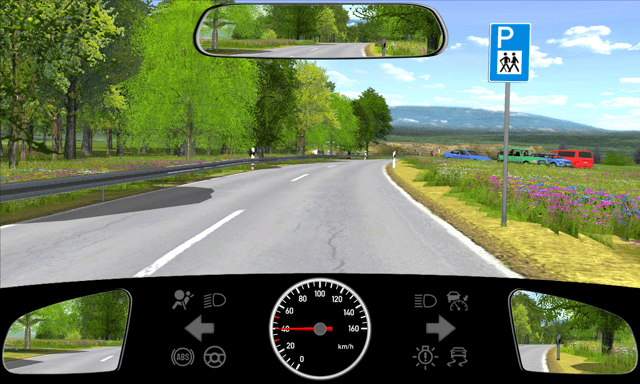
Wyjaśnienie
The traffic sign indicates a rambler parking area, which means that people can walk across the roadway and vehicles can drive off or onto the parking area at any time.
-
Question 46 of 63
Dlaczego muszą się Państwo teraz zatrzymać?
1.1.07-1605 PunktówWyjaśnienie
As you do not have a full view of the traffic situation and must give the cyclist the right of way, you must stop and carefully feel your way in.
-
Question 47 of 63
Chcieliby Państwo jechać dalej prosto. Jakie zachowanie będzie właściwe w tej sytuacji?
1.1.07-1615 PunktówWyjaśnienie
You are coming from a priority road first. As there are no other traffic signs, right is before left. The red car is driving on your right and therefore has the right of way. The electric scooter does not have right of way, so to avoid an accident you should let it cross anyway.
-
Question 48 of 63
Chcieliby Państwo wyjechać z parkingu. Jak prawidłowo ocenią Państwo sytuację?
1.1.07-1623 Punktów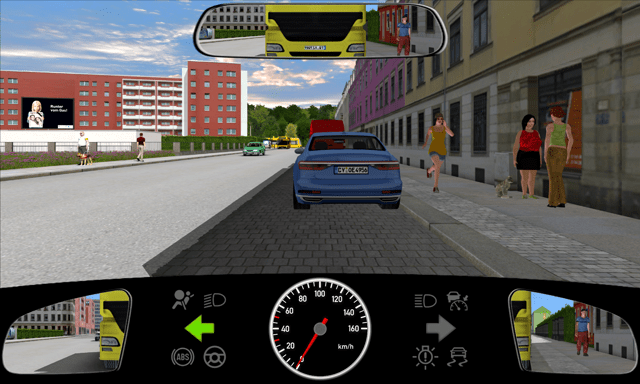
Wyjaśnienie
As the vehicle parked behind you is very large, you will only see vehicles coming from behind at a late stage and you yourself will only be recognised by other drivers at a late stage.
-
Question 49 of 63
Dlaczego przejazd obok w tej sytuacji związanej z wypadkiem jest niebezpieczny?
1.1.07-1633 Punktów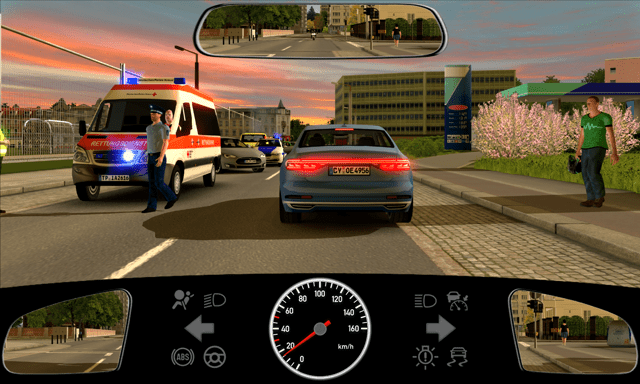
Wyjaśnienie
The traffic situation is unclear, sudden braking manoeuvres by gawpers and pedestrians crossing the road must be expected.
-
Question 50 of 63
Na co muszą Państwo tutaj zwrócić uwagę przy skręcie w prawo?
1.1.07-1645 PunktówWyjaśnienie
The cyclist has the right of way. When turning right, you must always pay attention to whether pedestrians or cyclists are approaching. They are allowed to cross the street in front of you. Use the rearview mirror and also look over your shoulder to be able to see the blind spot.
-
Question 51 of 63
Jakie zachowanie będzie teraz właściwe?
1.1.07-1655 PunktówWyjaśnienie
The scooter does not seem to see you coming and takes the right of way. To avoid an accident, you must immediately perform emergency braking.
-
Question 52 of 63
Z czym muszą się Państwo liczyć w tej sytuacji?
1.1.07-1664 Punktów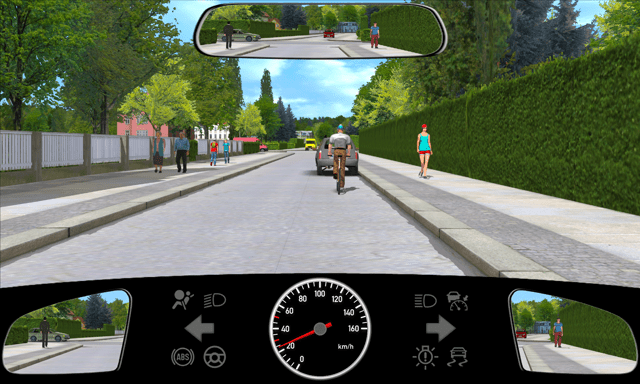
Wyjaśnienie
Since the obstacle is on your side, you must wait in this case. In addition, the cyclist will overtake the parked car and therefore swerve to the left.
-
Question 53 of 63
Jadą Państwo przez tunel. Co jest w tym szczególnego?
1.1.07-1674 PunktówWyjaśnienie
In a tunnel, the emergency exits and SOS emergency telephones are clearly signposted and illuminated. In an emergency, you should use the facilities. You can easily be distracted by the different lighting, the lights of other road users and the much louder noises in the tunnel.
-
Question 54 of 63
Jak zachowają się Państwo teraz właściwie?
1.1.07-1684 PunktówWyjaśnienie
The vehicle that is still parked wants to enter the road and has obviously overlooked you. You should slow down to avoid an accident.
-
Question 55 of 63
Z czym należy się teraz liczyć?
1.1.07-1694 PunktówWyjaśnienie
The [yellow] vehicle will stop, so you must be ready for the driver to open the door. The cyclist will probably move to the left to overtake the yellow vehicle. You must also expect the truck to drive off.
-
Question 56 of 63
Jadą Państwo na odcinku drogi, dla którego zgłoszono korek. Jak zachować się teraz właściwie?
1.1.07-1704 PunktówWyjaśnienie
You should be extra attentive on curves and before hilltops, because the traffic situation is difficult to see. You should also continue to follow the traffic reports.
-
Question 57 of 63
Dlaczego muszą się Państwo teraz zatrzymać?
1.1.07-1714 PunktówWyjaśnienie
The "Give way" sign in combination with the additional bicycle sign shows you that you must pay attention to possible cyclists and give them the right of way. Therefore, you must now stop and let the cyclist pass.
-
Question 58 of 63
Jak właściwie zachować się w tej sytuacji?
1.1.07-1724 PunktówWyjaśnienie
If a cyclist suddenly comes from the left, you must do an emergency stop.
-
Question 59 of 63
Podczas jazdy przed Państwa pojazdem sarna przebiega przez jezdnię. O czym powinni Państwo pamiętać?
1.1.07-1733 PunktówWyjaśnienie
A deer is very unpredictable, maybe it runs back into the forest, maybe it will stop in the middle of the street. You should therefore reduce your speed and follow what is happening, as other animals can also step on the road.
-
Question 60 of 63
Jakie zachowanie jest właściwe?
1.1.07-1743 PunktówWyjaśnienie
As the lorry in front of you is parking in reverse, you must continue to slow down. You can only change lanes when the lane to your left is free. Stay in your lane for the time being and continue braking.
-
Question 61 of 63
Na co nastawiają się Państwo w tej sytuacji?
1.1.07-1754 PunktówWyjaśnienie
You are driving on a turning priority road. Anyone leaving a priority road must give way to vehicles following the priority road. The yellow car flashes and turns left. Although it does not have right of way, at its high speed it will not be able to stop without coming into your lane. You should therefore brake and give up your right of way to avoid a collision. The obligation to avoid accidents takes precedence over all right of way rules.
-
Question 62 of 63
Co należy teraz zrobić?
1.1.07-1764 PunktówWyjaśnienie
In the left side mirror you can see that a car behind you is about to overtake. At the same time, the person on the bike on the right in front of you could move onto the road. A truck is also coming towards you on the opposite lane. All three factors lead to a narrow roadway and thus increase the risk of accidents. In this situation you have to brake to avoid a collision with the overtaking car and the cyclist.
-
Question 63 of 63
Dlaczego teraz musisz być szczególnie uważny?
2.2.11-0014 Punktów